
Level Measuring Equipment Market Size, Growth & Trends by 2034
Coverage: by Type (Level Gauge, Float Type, Ultrasonic Type, Hydrostatic Pressure Measurement, Displacement Type, Echo Type, Others); Measuring Technique (Continuous Level, Point Level, Interface level, Solids Measurement); End-user (Construction, Oil and Gas, Manufacturing and Fabrication, Water and Wastewater Treatment Plants, Power Plants, Others) , and Geography (North America, Europe, Asia Pacific, and South and Central America)
- Status : Data Released
- Report Code : TIPRE00010623
- Category : Manufacturing and Construction
- No. of Pages : 150
- Available Report Formats :


- Last update date : July 13, 2026


2025 Market Size
US$ 5. Bn
Base year value
2034 Forecast
US$ 6.59 Bn
Projected by 2034
CAGR 2026-2034
3.11 %
Growth rate
Addressable Market
US$ 52.61 Bn
(2026-2034)
The level measuring equipment market size is projected to grow from US$ 5.0 Billion in 2025 to US$ 6.59 Billion by 2034, registering a CAGR of 3.11% during 2026–2034. The market has witnessed strong demand for sensors to measure the levels of liquid, bulk solid, slurry, and interface in process industries where accurate stock-taking, safety compliance, and process control automation are key concerns.
In North America, the market will experience a 2.8–3.2% CAGR during the forecast period from 2026 to 2034. The reason behind the growth will be improvements in water utility systems, shale infrastructure maintenance, and automation within process plants. This demand for replacements will be more prominent in custody tanks, wastewater basins, and power plants.
Level Measuring Equipment Market Assessment and Insights
- North America: Share in 2025 is estimated at 30–34%, growing at a CAGR between 2.8–3.2% during 2026–2034, led by brownfield automation, wastewater upgrades, and refinery tank-farm reliability programs.
- US: Share in 2025 is estimated at 72–76% of the North America level measuring equipment market, growing at a CAGR between 2.7–3.1%, supported by municipal infrastructure renewal and process safety modernization.
- Europe: Share in 2025 is estimated at 24–28%, growing at a CAGR between 2.5–2.9%, led by Germany, the UK, France, Italy, and Spain through industrial efficiency and water compliance spending.
- Asia Pacific: Share in 2025 is estimated at 27–31%, growing at a CAGR between 3.6–4.1%, led by China, India, Japan, South Korea, and Australia through manufacturing expansion and utility digitization.
- Largest Segment: Continuous Level is estimated to hold 54–58% level measuring equipment market share in 2025, growing at a CAGR between 3.0–3.4% as operators prioritize real-time tank and silo visibility.
- High Growth Segment: Ultrasonic Type is estimated to hold 16–20% market share in 2025, growing at a CAGR between 3.8–4.4% due to non-contact use in water and solids applications.
- Key companies analyzed in detail: ABB Ltd, AMETEK, Inc., Baumer Holding AG, Emerson Electric Co., Endress+Hauser Group Services AG, Flowline, Inc., Klay Instruments B.V., NIVUS GmbH, Siemens AG, VEGA Grieshaber KG, Honeywell International Inc., and Schneider Electric SE.
Source: The Insight Partners' analysis based on proprietary research, government publications, company annual reports, investor presentations, industry databases, and expert interviews.
Level Measuring Equipment market has transitioned from the use of mechanical instruments to radar, ultrasonic, hydrostatic, and intelligent transmitters in conjunction with the plant control system. Current production trends lean more towards the incorporation of modular electronics, standardized communication protocol, and robust design able to resist pressure, vapor, foam, dust, and corrosive environment. The manufacturers are focusing on safety integrity, predictive maintenance, and commissioning time reduction as essential criteria to align product ranges with, instead of measurement accuracy as a separate parameter.
The demand ahead would be driven by emerging industrial belts, decentralized sewerage infrastructure, and energy resources that need visibility into distributed tanks/basins. Regulatory compliance in relation to discharge quality, dangerous substances storage, and safety of personnel will drive the growth of the level measuring equipment market forecast for connected devices. Investments will be made primarily in APAC and select ME projects, while in developed countries focus will be made on replacement, diagnostics, cybersecurity enabled connectivity, and life cycle cost reduction.
Level Measuring Equipment Market Report Scope
| Report Attribute | Details |
|---|---|
| Market size in 2025 | US$ 5. Billion |
| Market Size by 2034 | US$ 6.59 Billion |
| Global CAGR (2026 - 2034) | 3.11% |
| Historical Data | 2021-2024 |
| Forecast period | 2026-2034 |
Level Measuring Equipment Market Analysis
The demand for the product is fueled by continuity in the processes, better inventory management, regulatory compliance, and improved safety in risky environments. Level measurement is essential for oil and gas, power plants, manufacturing units, construction material, and wastewater treatment plants to avoid overflow, dry runs, inadequate storage, and unexpected shutdowns. As per the International Energy Agency, energy investments were to reach $ 3.3 trillion in 2025, maintaining demand for instrumentation in conventional and clean energy plants.
The value chain comprises sensing element suppliers, transmitter providers, system integrators, distributors, engineering companies, and maintenance companies. Supply factors include electronics availability, certification needs, and after-sales services in the location of operations. Buyers now consider factors like installed costs, diagnostics, and interoperability, among others, besides initial procurement costs while purchasing, making the level measuring equipment market report more lifecycle-oriented.
The consolidation of the competitive environment is moderate in the case of premium process instrumentation, but fragmented in relation to basic gauges and point-level switches. Competitors in radar, guided wave, diagnostics, and global services include ABB Ltd, Emerson Electric Co., Endress+Hauser Group Services AG, Siemens AG, and VEGA Grieshaber KG, whereas AMETEK, Inc., Baumer Holding AG, Flowline, Inc., Klay Instruments B.V., and NIVUS GmbH provide solutions for niche measurements.
Trends in current investments relate to non-contact measurement, wireless calibration, edge diagnostics, and instruments suitable for a digital twin. Market positioning is becoming more demanding for application engineering, certification, and software support services. Honeywell International Inc. and Schneider Electric SE contribute to the ecosystem through automation platforms, while sensor manufacturers secure the Level Measuring Equipment share through accuracy and reliability.
● REPORT CUSTOMIZATION
Tailor This Report To Align With Your Specific Business Requirements
This report can be customized to align precisely with your business objectives, scope, and target markets. Customization options include tailored segmentation, geography, competitive analysis, and strategic insights to support informed decision-making.
Customize This Report →WHAT YOU CAN ADJUST
- ● Segmentations
- ● Geography
- ● Competitive Analysis
- ● Language Preferences
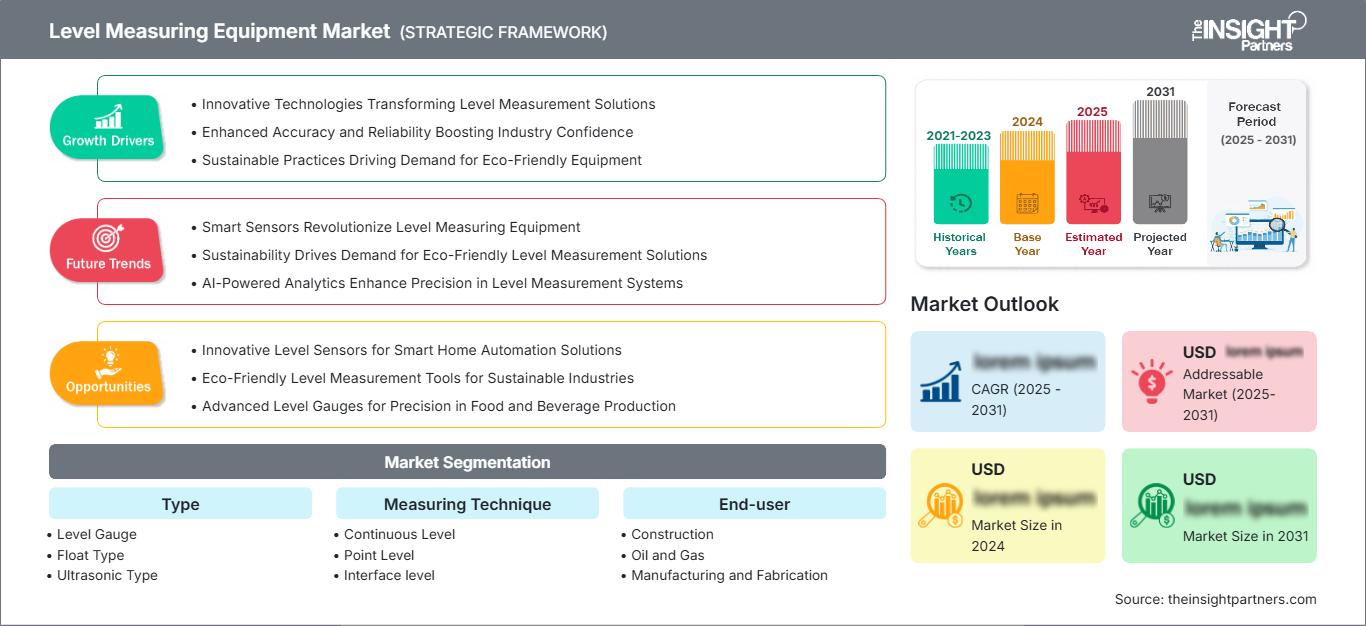
Level Measuring Equipment Market: Strategic Insights
Regional Insights
North America Level Measuring Equipment
The share of North America was 30–34% in 2025, and it will continue growing at a rate of 2.8–3.2% CAGR from 2026 to 2034. Its drivers include refinery maintenance, midstream in shale plays, power plants, and water utility upgrade. There are many devices installed there, and that is why growth is concentrated on replacement and installation of remote devices and hazardous area certified sensors.
Requirements involve high reliability, certification, and integration with distributed control systems. Public funds allocated by the US government and its states for upgrading water infrastructure promote their use in basins and reservoirs. In Canada, the demand is driven by energy, mining, and municipal projects, and in Mexico – manufacturing and industrial water applications.
U.S. Level Measuring Equipment Market
The U.S. represented 72–76% of North America in 2025 and is expected to grow at a 2.7–3.1% CAGR from 2026 to 2034. Adoption is concentrated in oil and gas storage, wastewater treatment, chemical production, food processing, and power plants where level failures can trigger safety, quality, or environmental incidents.
The company’s coverage is extensive with Emerson Electric Co., ABB Ltd, AMETEK, Inc., Honeywell International Inc., Schneider Electric SE, Endress+Hauser Group Services AG, and Siemens AG providing services to operators directly or via channel partners. The applications have seen trends in radar retrofits, Bluetooth commissioning, and ultrasonic sensing in municipal lift stations.
Europe Level Measuring Equipment Market
Europe held 24–28% share in 2025 and is forecast to grow at a 2.5–2.9% CAGR during 2026–2034. Germany leads regional demand through chemicals, machinery, water technology, and manufacturing automation, with strong preference for radar, hydrostatic, and interface measurement solutions that support efficiency and compliance.
UK market features upgrades in water utilities, energy transition equipment, and industrial maintenance. Manufacturers pay attention to sensors which reduce human interference and improve alarm precision. Brownfield assets in the sewage segment guarantee constant application of ultrasonic and hydrostatic transmitters, and process industry uses certified instruments for tanks, reactors, and dosing systems.
France, Italy, and Spain provide inputs via water infrastructure, food and beverages processing, building materials production, and power generation facilities. In France, the focus is on the regulatory water sector; in Italy, fabrication and machinery needs drive the market, and in Spain, the desalination-related instrument requirements come into play.
APAC Level Measuring Equipment Market
APAC holds a 27-31% share in 2025 and is projected to register a 3.6-4.1% CAGR from 2025 to 2034, growing the fastest among all regions. China dominates through investments in chemicals, metals, water treatment, and power industries, whereas India gains impetus due to industrial corridors and municipal wastewater.
Japan and South Korea invest in instrumentation of high precision used in manufacturing, semiconductor and energy sectors. Australia generates demand through mining, water, and LNG segments. Policy considerations related to water recycling, industrial safety and energy security raise the importance of measuring instruments.
Regional buyers combine their preference for premium automation with cost-driven purchasing, which provides business prospects both for multinational companies and for domestic manufacturers with relevant qualifications. In APAC, the Level Measuring Equipment market trends point toward the prevalence of contactless technology and more robust design.
Middle East & Africa Level Measuring Equipment Market
Middle East and Africa is projected to expand at a 3.0–3.5% CAGR during 2026–2034. Saudi Arabia leads demand through oil, gas, petrochemicals, power, and water infrastructure, where tank monitoring and process safety require robust certified instrumentation.
The UAE includes desalination, district cooling, manufacturing, and terminal storage. The contributions by South Africa include mining, water treatment, and power plant servicing. On the other hand, the Rest of MEA includes selective demand based on energy logistics and city infrastructure.
Environmental factors such as severe weather conditions, inaccessible locations, and difficult terrain become a determining factor. Manufacturers who have calibration, project engineering, and documentation facilities in local language will be at an advantage considering that operators are moving away from manual gauging towards automated level visibility.
Segmentation Analysis
Type
The Type segment in the level measuring equipment market is expected to register a 3.1–3.5% CAGR during 2026–2034. Selection depends on medium properties, tank geometry, pressure, temperature, accuracy, and lifecycle cost. Radar, ultrasonic, hydrostatic, float, displacement, and gauge technologies coexist because no single method fits all process conditions, making application engineering central to purchasing decisions.
- Level Gauge remains important for local indication where operators need simple visual confirmation, especially in tanks, boilers, and storage vessels with established maintenance routines.
- Float Type is widely used in point-level switching and basic control because it offers mechanical simplicity, low cost, and dependable performance in clean liquid applications.
- Ultrasonic Type supports non-contact measurement in open channels, tanks, and wastewater basins, with demand rising where operators avoid contact with corrosive or contaminated media.
- Hydrostatic Pressure Measurement is preferred for liquids in tanks, reservoirs, and wells where pressure-to-level conversion offers stable readings and straightforward installation.
- Displacement Type serves specialized process applications requiring robust measurement in high-pressure or high-temperature conditions where buoyancy-based principles remain reliable.
- Echo Type is strategically important in radar and guided-wave applications, supporting accurate measurement despite vapor, foam, turbulence, dust, or changing dielectric properties.
Measuring Technique
The Measuring Technique segment in the level measuring equipment market is projected to grow at a 3.0–3.4% CAGR from 2026 to 2034. Continuous measurement dominates because operators need real-time visibility for inventory, dosing, and process control, while point level remains essential for alarms and interlocks. Interface and solids measurement expand where product quality and material handling efficiency are priorities.
- Continuous Level holds the largest position because process plants rely on uninterrupted tank, vessel, and silo visibility to support control loops, inventory reconciliation, and safety systems.
- Point Level remains critical for overfill prevention, pump protection, dry-run alarms, and high-low switching across utilities, chemical tanks, and bulk material storage.
- Interface level is strategically important where separation between liquids affects product recovery, process efficiency, and wastewater treatment quality in oil, chemicals, and processing units.
- Solids Measurement addresses powders, grains, cement, fly ash, and aggregates, where dust, uneven surfaces, and vessel shape complicate accurate inventory and discharge control.
End-user
The End-user segment in the level measuring equipment market is expected to grow at a 3.2–3.6% CAGR during 2026–2034. Oil and gas, wastewater, manufacturing, construction, and power facilities use level data to manage safety, throughput, and asset reliability. Spending is increasingly linked to automation budgets, regulatory compliance, and the need to reduce manual field inspection.
- Construction uses level instruments in cement, aggregates, admixtures, and storage systems, where bulk solids visibility reduces downtime and improves batching accuracy.
- Oil and Gas remains a high-value user because tank farms, separators, terminals, and refineries require certified measurement for safety, inventory, and process control.
- Manufacturing and Fabrication facilities adopt level measurement for chemicals, coolants, powders, wastewater sumps, and intermediate storage supporting quality control and plant efficiency.
- Water and Wastewater Treatment Plants use ultrasonic, hydrostatic, and radar instruments for basins, lift stations, sludge handling, and chemical dosing reliability.
- Power Plants require dependable measurement in feedwater, condensate, ash handling, chemical tanks, and cooling systems where level deviations can affect uptime and safety.
Opportunity Snapshot
| Segment Name | Revenue Contribution | Trend Tag | Adoption Stage |
| Construction | Medium | Silo Control | Scaling |
| Oil and Gas | High | Tank Safety | Mature |
| Manufacturing and Fabrication | High | Process Visibility | Scaling |
| Water and Wastewater Treatment Plants | High | Remote Monitoring | Scaling |
| Power Plants | Medium | Ash Handling | Mature |
Level Measuring Equipment Market Growth Drivers and Impact Analysis
Automation of Aging Water and Industrial Assets
The aged plants and storages are moving away from manual inspections to the continuous digital monitoring. This trend has created an increased need for ultrasonic, hydrostatic, radar and point level measuring devices which will be able to work inside the wet wells, clarifiers, chemical tanks and sludge processing tanks. The utilities and industries are applying automation to save on their water losses, ensure correct dosing and solve their problem of understaffing. This effect is more pronounced when the renewal budgets are linked to compliance dates.
Safety and Inventory Control in Hazardous Storage
Storage of dangerous liquids and gases must have precise measurements for preventing overfill, dry running, vapor emissions, and the dangers associated with manual gauging. The increasing number of refinery, terminal, chemical, and power plants that require certified and diagnosable measuring instruments with fail-safe outputs is a positive factor for Level Measuring Equipment Market. It is due to the fact that safety cases are becoming data-dependent and that an operator requires a test certificate for proving alarm reliability and control system integration.
Industrial Digitization and Predictive Maintenance
Connected instrumentation is becoming part of plant reliability programs rather than isolated measurement hardware. Devices with echo diagnostics, signal-quality metrics, remote setup, and health logs help maintenance teams identify buildup, coating, turbulence, or impulse-line issues before failure. This improves the business case for replacing older gauges and switches with intelligent transmitters. The commercial impact is higher service attachment, stronger vendor lock-in through installed-base software tools, and wider use of Level Measuring Equipment market trends in digital twin and asset-performance management projects.
Level Measuring Equipment Market Future Trends
Shift Toward Non-Contact Radar and Ultrasonic Platforms
Future procurement will increasingly favor non-contact platforms that reduce exposure to corrosive, abrasive, sticky, or contaminated media. Radar will gain share in closed tanks and difficult process vessels, while ultrasonic systems will remain attractive for water, wastewater, and open-channel applications. The trend is not only about accuracy; it also reflects lower maintenance exposure and safer commissioning. Suppliers that simplify setup, improve false-echo suppression, and offer compact device variants will be better positioned as operators standardize instrumentation across distributed facilities.
Embedded Intelligence at the Instrument Edge
Level instruments are expected to process more diagnostic data locally before transmitting alarms or maintenance recommendations. Edge intelligence can help devices distinguish real level changes from foam, turbulence, dust clouds, buildup, or vessel obstructions. This will increase demand for transmitters with stronger processing capability, secure communication, and compatibility with asset management platforms. Over time, instrument selection will depend less on nominal accuracy alone and more on how effectively the device supports unattended operation and predictive maintenance workflows.
Level Measuring Equipment Market Opportunities
Retrofit Packages for Brownfield Facilities
Brownfield plants often operate mixed fleets of gauges, switches, and aging transmitters that create maintenance complexity and inconsistent data quality. Suppliers can capture opportunity by offering retrofit packages that include device assessment, replacement mapping, wiring adapters, commissioning support, and digital documentation. This action-oriented model reduces risk for operators and improves conversion from single-device sales to site-wide modernization. It is particularly relevant in water utilities, chemical plants, terminals, and power facilities where shutdown windows are limited and compatibility with existing control systems is essential.
Localized Service Networks in High-Growth Regions
APAC and Middle East projects require fast quotation, calibration, installation support, and spare availability. Vendors that expand local service centers, train channel partners, and provide application engineering in regional languages can improve win rates against lower-cost alternatives. This opportunity is strongest in wastewater, petrochemicals, mining, and manufacturing, where measurement errors can stop production or breach compliance limits. Localized support also helps premium suppliers defend pricing by converting technical reliability into measurable uptime and lower lifecycle cost.
Recent Developments
- April 2026: InnovMetric, the independent software development company that empowers manufacturers of every size to digitally transform their 3D measurement processes, announces the launch of PolyWorks 2026. The platform has advanced 5-axis probe head support that includes native go-to-positioning, head-touch measurement, and built-in collision analysis functionalities.
- October 2025: Emerson announced the release of the Rosemount 4051S Pressure Transmitter, a new industrial measurement solution with the flexibility to meet the most demanding pressure measurement challenges by increasing performance and operational insights.
- September 2025: NOVUS Automation Inc. launches WL320: submersible transmitter for level measurement in water and mildly corrosive liquids.
Frequently Asked Questions

- Comprehensive Market Sizing and Forecast Analysis
- Detailed Segmentation Analysis
- In-Depth Market Dynamics Assessment
- Regional and Country-Level Insights
- Competitive Landscape and Company Benchmarking
- Strategic Business Intelligence
Recent Reports
Testimonials

The Insight Partners' SCADA System Market report is comprehensive, with valuable insights on current trends and future forecasts. The team was highly professional, responsive, and supportive throughout. We are very satisfied and highly recommend their services.
RAN KEDEM Partner, Reali Technologies LTDs
I requested a report on a very specific software market and the team produced the report in a few days. The information was very relevant and well presented. I then requested some changes and additions to the report. The team was again very responsive and I got the final report in less than a week.
JEAN-HERVE JENN Chairman, Future Analytica
We worked with The Insight Partners for an important market study and forecast. They gave us clear insights into opportunities and risks, which helped shape our plans. Their research was easy to use and based on solid data. It helped us make smart, confident decisions. We highly recommend them.
PIYUSH NAGPAL Sr. Vice President, High Beam Global
The Insight Partners delivered insightful, well-structured market research with strong domain expertise. Their team was professional and responsive throughout. The user-friendly website made accessing industry reports seamless. We highly recommend them for reliable, high-quality research services
YUKIHIKO ADACHI CEO, Deep Blue, LLC.
This is the first time I have purchased a market report from The Insight Partners.While I was unsure at first, I visited their web site and felt more comfortable to take the risk and purchase a market report.I am completely satisfied with the quality of the report and customer service. I had several questions and comments with the initial report, but after a couple of dialogs over email with their analyst I believe I have a report that I can use as input to our strategic planning process.Thank you so much for taking the extra time and making this a positive experience.I will definitely recommend your service to others and you will be my first call when we need further market data.
JOHN SUZUKI President and Chief Executive Officer, Board Director, BK Technologies
I wish to appreciate your support and the professionalism you displayed in the course of attending to my request for information regarding to infectious disease IVD market in Nigeria. I appreciate your patience, your guidance, and the fact that you were willing to offer a discount, which eventually made it possible for us to close a deal. I look forward to engaging The Insight Partners in the future, all thanks to the impression you have created in me as a result of this first encounter.
DR CHIJIOKE ONYIA MANAGING DIRECTOR, PineCrest Healthcare Ltd.Reason to Buy
- Informed Decision-Making
- Understanding Market Dynamics
- Competitive Analysis
- Identifying Emerging Markets
- Customer Insights
- Market Forecasts
- Risk Mitigation
- Boosting Operational Efficiency
- Strategic Planning
- Investment Justification
- Tracking Industry Innovations
- Aligning with Regulatory Trends





 Get Free Sample for