
Light Pipe Market Demand, Size & Forecast by 2034
Coverage: by Type (Flexible Tube, Rigid Tube); End-Use (Commercial, Residential) , and Geography (North America, Europe, Asia Pacific, and South and Central America)
- Status : Data Released
- Report Code : TIPRE00004821
- Category : Manufacturing and Construction
- No. of Pages : 150
- Available Report Formats :


- Last update date : July 13, 2026


2025 Market Size
US$ 280.82 Mn
Base year value
2034 Forecast
US$ 533. Mn
Projected by 2034
CAGR 2026-2034
7.38 %
Growth rate
Addressable Market
US$ 3,669.46 Mn
(2026-2034)
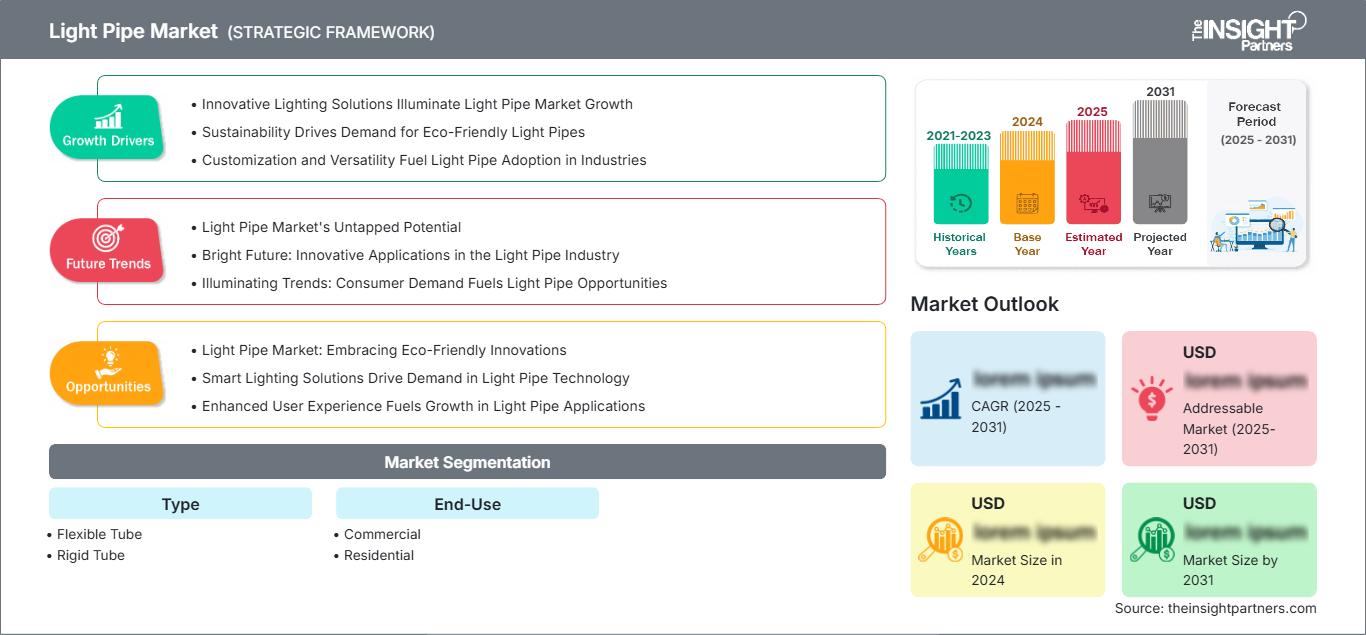
The global Light Pipe market was valued at US$ 280.82 million in 2025 and is expected to reach US$ 533 million by 2034; it is estimated to record a CAGR of 7.38% during 2026-2034.
Light Pipe Market Assessment and Insights
- North America accounted for 34–37% share in 2025 and is projected to grow at a 7.9–8.4% CAGR between 2026–2034, driven by building-energy compliance, commercial retrofit activity, and established suppliers.
- The US represented 78–82% of North America in 2025 and is expected to grow at a 7.8–8.3% CAGR, reflecting strong adoption in commercial daylighting and LED indication.
- Europe held 24–27% share in 2025 and is forecast to grow at a 7.2–7.8% CAGR, with Germany, the UK, France, Italy, and Spain leading sustainable-building specifications.
- Asia Pacific captured 26–30% share in 2025 and is expected to grow at an 8.8–9.5% CAGR, led by China, Japan, South Korea, India, and Australia.
- Largest Segment: Rigid Tube held 58–62% light pipe market share in 2025 and is projected to grow at a 7.7–8.2% CAGR, supported by predictable optical routing.
- High Growth Segment: Commercial held 63–67% market share in 2025 and is expected to grow at an 8.5–9.2% CAGR as facilities prioritize lighting-energy efficiency.
- Key companies analyzed in detail: Bivar, Inc.; Elite Solar Systems, Inc.; Essentra plc; HUVCO, L.L.C.; LEDtronics, Inc.; Lumex, Inc.; Orion Energy Systems, Inc.; Skydome Skylight Systems Pty Ltd.; Solatube International, Inc.; Visual Communications Company, LLC.
Source: The Insight Partners' analysis based on proprietary research, government publications, company annual reports, investor presentations, industry databases, and expert interviews.
The Light Pipe Market Report highlights a shift from basic mechanical light guides toward engineered optical assemblies that combine reflective tubing, molded polymers, diffusers, and LED-compatible housings. Today, the key focus areas in manufacturing are efficient transmission, lower light leakage, thermal insulation, and ease of installation. Also, production dynamics will be impacted due to modular systems becoming mainstream in electronics manufacturing, along with the optimization of the design of dome optics, ceiling attachments, and tubes used in daylighting for retrofitting purposes in buildings.
During the forecast period, new geographies will become relevant due to the convergence of energy-efficient policies, construction in urban areas, and the concept of wellness-led building design. Asia Pacific and certain Middle Eastern countries present upside potential since densely populated buildings need efficient daylight transfer without altering the envelope of the building.
Light Pipe Market Report Scope
| Report Attribute | Details |
|---|---|
| Market size in 2025 | US$ 280.82 Million |
| Market Size by 2034 | US$ 533. Million |
| Global CAGR (2026 - 2034) | 7.38% |
| Historical Data | 2021-2024 |
| Forecast period | 2026-2034 |
Light Pipe Market Analysis
The demand is influenced by two interrelated ecosystems: daylighting systems in buildings and LED light guides in electronic devices. Daylighting systems are employed in buildings to minimize dependency on lighting during daytime in areas such as corridors, warehouses, medical facilities, schools, and small apartments. On the other hand, rigid and flexible light pipes in electronics are used to transfer light emitted by LEDs from circuit boards to panels allowing for easier status indication without having to move any parts.
Factors influencing the supply include the quality of polymer, availability of reflective films, molding accuracy, and access to installation channels. According to the Light Pipe Market forecast, companies providing application engineering, computer-aided design capabilities and distribution channels have an advantage because the end-users need products to be compatible with enclosures, roofs, and local standards.
The competitive landscape is fragmented but highly technical. Bivar, Inc. and Visual Communications Company, LLC are highly competitive in LED indications, while Solatube International, Inc. and Skydome Skylight Systems Pty Ltd. cater to the need for daylighting. Essentra plc increases component availability via extensive industrial distribution channels, while Orion Energy Systems, Inc. supports energy-based commercial lighting programs.
Key investment trends include configurability, better sealing, increased reflectivity, and faster retrofitting. Key strategic trends hinge on finding an optimal balance between performance and ease-of-use. Firms that reduce installation efforts, increase thermal efficiency, and enable digital product selection will be able to retain Light Pipe Market share as architects, facilities managers, and electronics engineers consider total value per lifecycle versus unit price.
● REPORT CUSTOMIZATION
Tailor This Report To Align With Your Specific Business Requirements
This report can be customized to align precisely with your business objectives, scope, and target markets. Customization options include tailored segmentation, geography, competitive analysis, and strategic insights to support informed decision-making.
Customize This Report →WHAT YOU CAN ADJUST
- ● Segmentations
- ● Geography
- ● Competitive Analysis
- ● Language Preferences
Light Pipe Market: Strategic Insights
Regional Insights
North America Light Pipe Market
North America represented 34–37% share in 2025 and is forecast to grow at a 7.9–8.4% CAGR through 2034. Demand is anchored in commercial building upgrades, warehouse daylighting, retail energy management, and electronics manufacturing. Energy codes and utility-efficiency programs continue to encourage daylight contribution in occupied spaces where conventional skylights are difficult to apply. Regional buyers also value proven installation channels and product warranties because roof penetrations and enclosure interfaces require reliability. The Light Pipe Market trends in North America point to higher specification of sealed daylighting products, modular LED light guides, and retrofit kits that reduce installation time while improving visibility, safety, and occupant comfort in commercial and residential interiors.
U.S. Light Pipe Market
The US represents 78-82% of North America in 2025, with growth predicted at a 7.8-8.3% CAGR from 2026 through 2034. It has seen the highest adoption in commercial structures, industrial buildings, and electronic appliances requiring visual signaling and effective illumination. Domestic specifications are favored by distributors and installers along with knowledge of relevant codes. Companies such as Bivar, Inc., LEDtronics, Inc., Lumex, Inc., Solatube International, Inc., and Visual Communications Company, LLC remain pertinent via component engineering, daylighting, or channel distribution. Application trends indicate increasing demand in control panels, office buildings, schools, hospitals, and residential building renovations. US specifications prefer products providing performance details as well as installation and maintenance ease.
Europe Light Pipe Market
In 2025, Europe had 24–27% market share and is estimated to grow at a 7.2–7.8% CAGR. The UK continues to be significant as commercial refurbishment, school buildings, and health care establishments use daylighting to enhance indoor environment and energy efficiency. Building owners require systems that occupy minimal roof space and help achieve net-zero refurbishment targets. Germany has the highest contribution and this is due to its energy-efficient constructions, industrial electronics, and strict product specifications. Producers and distributors of daylighting solutions benefit from demand for durable and engineered light guides in machinery, automation, and control panels. Scope of the Light Pipe Market in Germany includes commercial buildings and premium electronic assemblies. France, Italy, and Spain have contributions through renovation of public buildings, hotel renovations, and residential daylighting demand in cities. Southern European nations benefit from solar availability, whereas France encourages sustainable construction through policy-driven refurbishment. Suppliers who modify their products based on roof type, climatic conditions, and installers' needs could increase their market penetration levels.
APAC Light Pipe Market
Asia Pacific accounted for 26–30% share in 2025 and is expected to grow at an 8.8–9.5% CAGR. China is the leading country because electronics production, commercial construction, and urban infrastructure create broad demand for compact optical transmission and daylighting systems. Both Japan and South Korea focus on precise parts, dense electronics, and interior efficiency. India is now making progress by way of commercial property, industrial space, and green-building rating systems, whereas Australia promotes the use of daylighting in classrooms, office buildings, and residential areas. The policy incentives for energy-efficient buildings are focused on the efficiency of buildings, manufacturing of equipment locally, and sustainable urbanization. Growth in the region is more robust compared to developed countries since construction and electronic production both increase.
Middle East & Africa Light Pipe Market
Middle East and Africa is forecast to grow at a 6.9–7.5% CAGR through 2034. Saudi Arabia is the leading country as large infrastructure, tourism, healthcare, and commercial projects integrate energy-conscious building systems. The UAE encourages the use of advanced daylighting systems in office, retail, hospitality and residential projects where there is a connection between the quality of daylighting and load control. While South Africa and the remaining MEA countries are very selective, the use is primarily in institutions and high-value commercial properties. Context in terms of energy is important since there is a lot of solar gain which means that there are challenges. The best products will have controlled heat gain, good seals and ease of maintenance.
Segmentation Analysis
Type
The Type segment is expected to grow at a 7.9–8.6% CAGR between 2026 and 2034. Product selection depends on routing complexity, light uniformity, installation space, and durability requirements. Rigid products dominate structured layouts, while flexible products gain relevance where space constraints or curved paths make straight optical transfer impractical. Flexible Tube products address complex routing in electronics, retrofits, and confined assemblies where design freedom matters. Demand is strongest when installers or engineers must avoid obstacles without compromising indication clarity. Rigid Tube products hold the strongest market position because they offer consistent optical alignment, lower design uncertainty, and proven performance in panels, daylighting assemblies, and repeatable commercial installations.
End-Use
The End-Use segment is forecast to grow at an 8.1–8.8% CAGR during 2026–2034. Commercial demand leads because facilities quantify energy savings, visibility improvement, and maintenance reduction at scale. Residential adoption is also expanding as homeowners seek natural daylight in interior rooms and efficient visual lighting without extensive structural modification. Commercial applications provide high revenue contribution because offices, warehouses, healthcare, education, retail, and industrial sites deploy light pipes for daylight access, status indication, and lower operating energy. Residential applications are strategically important as remodeling, wellness-oriented interiors, and compact housing layouts increase interest in daylighting bathrooms, kitchens, stairwells, hallways, and home workspaces.
Opportunity Snapshot
| End Use | Revenue Contribution | Trend Tag | Adoption Stage |
| Commercial | High | Daylight Retrofit | Scaling |
| Residential | Medium | Interior Daylight | Scaling |
Light Pipe Market Growth Drivers and Impact Analysis
Energy-Efficient Building Codes Accelerate Daylighting Specification
Property owners face an increasing need to cut lighting energy usage but still provide adequate comfort in visual terms, particularly in commercial buildings that have deeper floor plates. Light pipes aid in transferring natural light to places that cannot get light through windows or skylights. The application of light pipes in practice is most effective in office buildings, warehouses, schools, and healthcare facilities since there is an opportunity for reduction of daytime lighting load without shifting core occupancy.
Electronics Miniaturization Raises Need for Precise LED Indication
LEDs are now increasingly isolated from the operator’s panels in the quest for better circuit board design, sealing of enclosures, and ease of servicing. However, light pipes are an elegant solution to this problem as they enable the transmission of light from the light source to the panel display without any additional powered elements at the panel face. This technology is suitable for use in medical devices, industrial control systems, telecommunications equipment, transport electronics, and consumer home appliances.
Retrofit Demand Expands Addressable Commercial Applications
Retrofit activity is widening the Light Pipe Market scope because many existing buildings lack adequate daylight in interior zones but cannot justify major structural redesign. Tubular systems provide a lower-disruption path for bringing natural light into corridors, restrooms, retail back areas, storage rooms, and production spaces. The impact extends beyond energy savings; daylight can improve wayfinding, perceived space quality, and occupant satisfaction. Suppliers that provide installer training, roof-compatible flashing, and predictable performance documentation gain an advantage in retrofit procurement.
Light Pipe Market Future Trends
Hybrid Daylighting and Electric Lighting Controls
Future systems are likely to integrate light pipes with sensors, dimming controls, and electric lighting strategies rather than operate as standalone products. This shift will help facilities balance daylight availability, glare control, occupancy patterns, and energy targets in real time. Commercial buildings with variable work schedules can use daylight contribution more intelligently, while residential users may benefit from better comfort and reduced heat gain. Suppliers that document compatibility with lighting controls and building-management platforms will be better positioned for specification-led projects.
Higher-Performance Materials for Compact Optical Routing
Material innovation will shape future Light Pipe Market growth as designers demand higher transmission, smaller footprints, and improved durability. Advanced polymers, reflective films, coatings, and diffuser geometries can reduce loss over longer paths and support thinner device enclosures. In building systems, improved seals and thermal interfaces can reduce concerns about heat transfer or condensation. The trend favors companies with optical engineering depth because incremental material gains can translate into better brightness, fewer LEDs, and more flexible installation choices.
Light Pipe Market Opportunities
Commercial Retrofit Partnerships with Installers and ESCOs
Manufacturers can expand revenue by partnering with installers, energy service companies, and facility-management firms that already influence retrofit decisions. These partners understand roof access, payback expectations, maintenance constraints, and procurement cycles. Packaging light pipes with energy audits, installation guidance, and verified performance data can reduce buyer hesitation. The strongest opportunity lies in commercial portfolios such as schools, logistics centers, municipal buildings, and retail chains, where repeatable deployments across multiple sites can lower acquisition cost and improve margin stability.
Application-Specific Kits for Electronics OEMs
Electronics OEMs increasingly need ready-to-integrate optical indication solutions that reduce custom engineering time. Suppliers can capture value by offering application-specific kits for industrial controls, medical equipment, telecom hardware, mobility systems, and smart appliances. Standardized kits with CAD models, multiple lens profiles, low-bleed adapters, and flexible mounting options help engineers validate designs quickly. This opportunity is attractive because it can increase design-in stickiness and recurring component demand once the product enters production.
Recent Developments
- June 2026: Dialight will be exhibiting at Reuters Events: Downstream USA 2026, taking place next month in Houston, Texas. Dialight will be showcasing the latest high-performance LED lighting solutions, with delegates invited to meet the team and learn more about lighting technology designed to support safety, reliability, and efficiency in demanding downstream environments.
- May 2026: ERALUX is pleased to announce a strategic partnership with Wizard Lighting Company, aimed at delivering next-generation lighting technologies and enhanced customer solutions across commercial, residential, and architectural markets.
- October 2025: Eralux is proud to announce a new strategic partnership with Kore Lighting & Controls (Kore-LC), an experience lighting & controls representative covering the Central Coast, Fresno, Los Angeles, San Diego & the Inland Empire, in Southern California. Their deep expertise in lighting controls perfectly complements our innovative fixture solutions.
Frequently Asked Questions

- Comprehensive Market Sizing and Forecast Analysis
- Detailed Segmentation Analysis
- In-Depth Market Dynamics Assessment
- Regional and Country-Level Insights
- Competitive Landscape and Company Benchmarking
- Strategic Business Intelligence
Recent Reports
Testimonials

The Insight Partners' SCADA System Market report is comprehensive, with valuable insights on current trends and future forecasts. The team was highly professional, responsive, and supportive throughout. We are very satisfied and highly recommend their services.
RAN KEDEM Partner, Reali Technologies LTDs
I requested a report on a very specific software market and the team produced the report in a few days. The information was very relevant and well presented. I then requested some changes and additions to the report. The team was again very responsive and I got the final report in less than a week.
JEAN-HERVE JENN Chairman, Future Analytica
We worked with The Insight Partners for an important market study and forecast. They gave us clear insights into opportunities and risks, which helped shape our plans. Their research was easy to use and based on solid data. It helped us make smart, confident decisions. We highly recommend them.
PIYUSH NAGPAL Sr. Vice President, High Beam Global
The Insight Partners delivered insightful, well-structured market research with strong domain expertise. Their team was professional and responsive throughout. The user-friendly website made accessing industry reports seamless. We highly recommend them for reliable, high-quality research services
YUKIHIKO ADACHI CEO, Deep Blue, LLC.
This is the first time I have purchased a market report from The Insight Partners.While I was unsure at first, I visited their web site and felt more comfortable to take the risk and purchase a market report.I am completely satisfied with the quality of the report and customer service. I had several questions and comments with the initial report, but after a couple of dialogs over email with their analyst I believe I have a report that I can use as input to our strategic planning process.Thank you so much for taking the extra time and making this a positive experience.I will definitely recommend your service to others and you will be my first call when we need further market data.
JOHN SUZUKI President and Chief Executive Officer, Board Director, BK Technologies
I wish to appreciate your support and the professionalism you displayed in the course of attending to my request for information regarding to infectious disease IVD market in Nigeria. I appreciate your patience, your guidance, and the fact that you were willing to offer a discount, which eventually made it possible for us to close a deal. I look forward to engaging The Insight Partners in the future, all thanks to the impression you have created in me as a result of this first encounter.
DR CHIJIOKE ONYIA MANAGING DIRECTOR, PineCrest Healthcare Ltd.Reason to Buy
- Informed Decision-Making
- Understanding Market Dynamics
- Competitive Analysis
- Identifying Emerging Markets
- Customer Insights
- Market Forecasts
- Risk Mitigation
- Boosting Operational Efficiency
- Strategic Planning
- Investment Justification
- Tracking Industry Innovations
- Aligning with Regulatory Trends





 Get Free Sample for