
Low NOx Burner Market Share, Size & Demand by 2034
Coverage: By Type (Cylindrical Premix Burner, Flat Premix Burner); Application (Residential, Light Commercial, Industrial) , and Geography (North America, Europe, Asia Pacific, and South and Central America)
- Status : Data Released
- Report Code : TIPRE00021331
- Category : Manufacturing and Construction
- No. of Pages : 150
- Available Report Formats :


- Last update date : July 17, 2026


2025 Market Size
US$ 1.63 Bn
Base year value
2034 Forecast
US$ 2.09 Bn
Projected by 2034
CAGR 2026-2034
2.77 %
Growth rate
Addressable Market
US$ 16.86 Bn
(2026-2034)
The Low Nox Burner Market size was valued at US$ 1.63 Billion in 2025 and is projected to reach US$ 2.09 Billion by 2034; it is expected to register a CAGR of 2.77% from 2026 to 2034. Demand is shaped by stricter combustion-emission requirements, boiler modernization, and industrial heat users seeking reliable NOx reduction without major process redesign.
North America is expected to expand at a 2.6–3.0% CAGR as industrial boiler owners, refinery operators, and institutional heat users upgrade combustion systems for compliance resilience. Replacement demand is supported by EPA boiler standards, state-level air district permitting, and a mature service ecosystem that favors retrofit-ready premix and staged-combustion burner platforms. These factors contribute significantly to the Low NOx Burner Market Share across the region.
Low NOx Burner Market Assessment and Insights
- North America accounted for 26–30% share in 2025 and is expected to grow at a 2.6–3.0% CAGR between 2026–2034, led by retrofit demand in boilers, process heaters, and institutional heating assets.
- The US represented 76–80% of North America in 2025 and is projected to grow at a 2.5–2.9% CAGR between 2026–2034, supported by industrial compliance upgrades.
- Europe held 30–34% share in 2025 and is expected to grow at a 2.3–2.7% CAGR between 2026–2034, with Germany, the UK, France, Italy, and Spain leading demand.
- Asia Pacific captured 24–28% share in 2025 and is projected to grow at a 3.0–3.4% CAGR between 2026–2034, supported by China, India, Japan, South Korea, and Australia.
- Largest Segment: Industrial applications held 54–58% market share in 2025 and are expected to grow at a 2.7–3.1% CAGR between 2026–2034, driven by boilers and process heat.
- High Growth Segment: Flat Premix Burner held 38–42% market share in 2025 and is expected to grow at a 3.1–3.5% CAGR between 2026–2034, reflecting compact retrofit suitability.
- Key companies analyzed in detail: ALZETA Corporation, ANDRITZ AG, Babcock & Wilcox Enterprises, Inc., G.P. Burners (CIB) Ltd., Honeywell International Inc., Parker Boiler Co., POLIDORO S.p.A., R.F. MacDonald Co., Riello S.p.A., Zeeco, Inc.
Source: The Insight Partners' analysis based on proprietary research, government publications, company annual reports, investor presentations, industry databases, and expert interviews.
Combustion equipment has evolved from simple staged-air technology to premix systems with precision engineering, digital burner management, and fuel-flexible burners capable of burning natural gas, refinery gas, biogas, and hydrogen blends. The manufacturers are focusing on stable flame shape, minimal excess air, and burner only retrofits as most sites cannot afford boiler/furnace replacement. Process specifics continue to be relevant with burners engineered based on heat release, combustion chamber shape, emissions and service life considerations.
Future growth in Low NOx Burners will depend increasingly on Asia-Pacific industrial installation, North American replacement cycles, and Europe burner replacements related to decarbonization. Regulatory tailwinds are reinforced by tightening boiler tune-up requirements, localized NOx caps, and corporate air-quality targets. Investment is expected to favor modular premix burners, controls integration, and service contracts that help operators document performance while managing downtime risk, as highlighted in the Low NOx Burner Market Report.
Low NOx Burner Market Report Scope
| Report Attribute | Details |
|---|---|
| Market size in 2025 | US$ 1.63 Billion |
| Market Size by 2034 | US$ 2.09 Billion |
| Global CAGR (2026 - 2034) | 2.77% |
| Historical Data | 2021-2024 |
| Forecast period | 2026-2034 |
Low NOx Burner Market Analysis
Demand is driven by industrial combustion assets that must reduce nitrogen oxide formation while preserving thermal efficiency. Boilers, process heaters, ovens, and kilns require burner solutions tailored to load variability and chamber constraints. EPA rules for industrial, commercial, and institutional boilers require emission controls and periodic tune-ups for covered units, reinforcing replacement and service demand, supporting a positive Low NOx Burner Market Forecast.
Ecosystem players include burner OEMs, boiler integration companies, suppliers of controls for combustion, environmental consultants, installation services, and aftermarket maintenance services. Factors that influence the supply chain include alloy composition, gas trains, sensors, control systems, and capabilities for engineered manufacturing. Today buyers assess total installation costs, stack test quality, turndown abilities, and documentation support, making analysis of Low Nox Burner more technical than a mere comparison of prices.
The competition structure includes global leaders in the combustion industry and regional players specialized in boiler services. The ALZETA Corporation develops technologies related to advanced surface stabilized combustion. Zeeco, Inc. and Babcock & Wilcox Enterprises, Inc. provide products for refining and petrochemical industries and utilities. Honeywell International Inc. provides stronger control systems, while Riello S.p.A. promotes the use of packaged burners. These competitive developments reflect key Low NOx Burner Market Trends shaping technology innovation and market positioning.
Investment trends favor retrofit engineering, hydrogen-ready combustion testing, and burner-management integration. ANDRITZ AG, G.P. Burners (CIB) Ltd., Parker Boiler Co., POLIDORO S.p.A., and R.F. MacDonald Co. compete through application expertise, service proximity, and compliance execution. Strategic positioning increasingly depends on whether suppliers can prove emissions performance without raising maintenance complexity or fuel consumption.
● REPORT CUSTOMIZATION
Tailor This Report To Align With Your Specific Business Requirements
This report can be customized to align precisely with your business objectives, scope, and target markets. Customization options include tailored segmentation, geography, competitive analysis, and strategic insights to support informed decision-making.
Customize This Report →WHAT YOU CAN ADJUST
- ● Segmentations
- ● Geography
- ● Competitive Analysis
- ● Language Preferences
Low NOx Burner Market: Strategic Insights
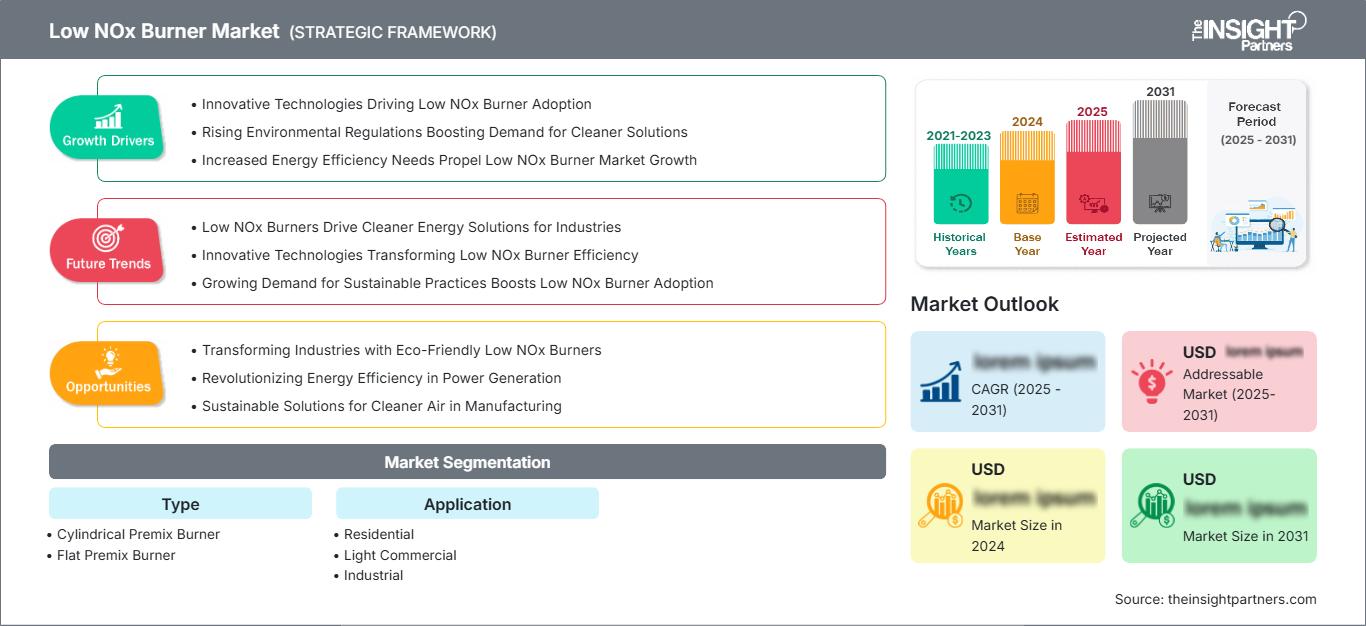
Regional Insights
North America Low Nox Burner
North America accounted for 26–30% share in 2025 and is expected to grow at a 2.6–3.0% CAGR. Demand is strongest where aging boilers, refinery heaters, and institutional plants face localized permitting scrutiny. The Low Nox Burner Market benefits from replacement projects that avoid full boiler changeouts while improving stack-test confidence. Structural growth is tied to EPA boiler systems, California and Texas air districts, and company emissions reporting. Purchasers value well-proven turndown, fuel versatility, and compatibility with control systems. In North America, the share of the Low Nox Burner is driven by the presence of extensive networks of maintenance, which minimize downtime in the heating season.
U.S. Low Nox Burner Market
The US represented 76–80% of North America in 2025 and is projected to grow at a 2.5–2.9% CAGR. Industrial users in refining, food processing, chemicals, universities, and hospitals drive retrofit demand because combustion upgrades can align with maintenance outages and permit renewals, supporting continued growth in the Low NOx Burner Market. Company presence is broad, with ALZETA Corporation, Parker Boiler Co., Babcock & Wilcox Enterprises, Inc., Honeywell International Inc., R.F. MacDonald Co., and Zeeco, Inc. supporting equipment, controls, and field service. Application trends emphasize burner-only retrofits, staged combustion, premix platforms, and verification support for recurring compliance documentation.
Europe Low Nox Burner Market
Europe held 30–34% share in 2025 and is expected to grow at a 2.3–2.7% CAGR. The UK market is shaped by building heat decarbonization, industrial air-quality obligations, and packaged boiler replacements in commercial estates, food manufacturing, and public infrastructure. The Low NOx Burner Market in the region increasingly favors compact designs that support staged fuel pathways. Germany is at the forefront on account of its huge process-heat capacity, district-energy facilities, and its engineering-based manufacturing process. Customers value emission confirmation, efficiency maintenance, and burner control. Replacement cycle in Germany is suited for cylindrical premix burners in high-duty industrial plants where flame stability and accessibility are still important. Demand is boosted by France, Italy, and Spain from their ceramic industry, textile sector, food processing, chemical industry, and hospitality sector. Riello S.p.A., POLIDORO S.p.A., and G.P. Burners (CIB) Ltd. enhance local supply in the region. The Low Nox Burner market scope still relates to EU industrial emission regulations.
APAC Low Nox Burner Market
APAC captured 24–28% share in 2025 and is expected to grow at a 3.0–3.4% CAGR. China leads regional demand through industrial boilers, refinery heaters, and urban air-quality controls, supporting the growth of the Low NOx Burner Market across the Asia-Pacific region. Japan and South Korea prioritize high-efficiency combustion, compact retrofits, and hydrogen-readiness testing. India shows rising adoption in chemicals, food processing, textiles, and captive industrial heat systems. Australia contributes to demand from mining, institutional heating, and process industries. Policy drivers include local air-quality rules, fuel-efficiency expectations, and industrial modernization, making APAC the highest-growth regional platform for Low Nox Burner growth.
Middle East & Africa Low Nox Burner Market
The Middle East & Africa is expected to grow at a 2.4–2.8% CAGR. Saudi Arabia leads demand through refining, petrochemicals, and utility-linked process heat, driving continued expansion of the Low NOx Burner Market across the region. The UAE market is supported by district cooling, industrial parks, and gas-fired infrastructure, where emissions performance is increasingly specified in procurement. South Africa and Rest of MEA show selective demand in mining, food processing, and institutional boilers. Energy reliability concerns favor robust burners that can operate across variable fuel quality and service conditions.
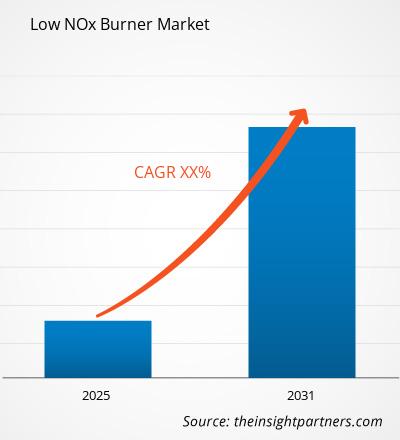
Segmentation Analysis
Type
The Type segment is expected to grow at a 2.8–3.2% CAGR from 2026–2034. Product selection is determined by chamber geometry, heat release, fuel mix, and emissions limits. Cylindrical premix burners remain preferred in higher-duty systems, while flat premix designs gain traction where compact form factor, uniform flame distribution, and retrofit simplicity matter, supporting demand across the Low NOx Burner Market.
- Cylindrical Premix Burner maintains a strong market position in industrial boilers and process heaters where flame stability, higher heat input, and retrofit compatibility support long service life and predictable emissions outcomes.
- Flat Premix Burner is strategically important in compact boilers, commercial heating systems, and modular equipment because it supports uniform combustion, lower acoustic issues, and easier integration with modern controls.
Application
The Application segment is expected to grow at a 2.6–3.0% CAGR from 2026–2034. Industrial users remain the primary revenue base because emissions exposure, operating hours, and stack-test obligations are higher than in smaller installations. Residential and light commercial demand is tied to low-emission packaged systems and replacement heating equipment, contributing to sustained demand in the Low NOx Burner Market.
- The Residential application uses low-emission burners primarily in premium boilers and compliance regions, with demand driven by energy efficiency building renovations, replacement needs, and clean gas-fired heating preference.
- Light Commercial applications include hotel, school, hospital, laundry, and small manufacturing applications, where package boiler replacement and easy maintenance play key roles in choosing a burner.
- Industrial application generates the highest revenues since industrial sectors like refinery, chemical, food processing, power generation, and heavy industry rely on high-duty combustion units that require proven emission reduction and reliable process heating solutions.
Opportunity Snapshot
| Application | Revenue Contribution | Trend Tag | Adoption Stage |
| Residential | Low | Clean Heat | Scaling |
| Light Commercial | Medium | Packaged Boilers | Mature |
| Industrial | High | Process Heat | Mature |
Low NOx Burner Market Growth Drivers and Impact Analysis
Emission Compliance Pressure in Industrial Combustion
The reason behind the use of low-emission burners by industries is the requirement of air permit programs that mandate the reduction of NOx emissions from industrial boilers and process heaters. The EPA rules regarding Boiler MACT and other state-specific programs emphasize tuning, testing, and documentation as key steps for compliance. The result is an increase in the need for replacement of burners that are capable of meeting stricter emission standards without the installation of additional downstream emission reduction systems.
Retrofit Economics Versus Full Boiler Replacement
The preferred solution is the burner retrofit, since it allows for reduction of NOx generation along with prolonging the lifespan of boilers, furnaces and heaters. The replacement of the whole heating system involves the civil construction, shutdowns and permit changes, whereas the burner upgrade can be performed within the existing maintenance cycle. This cost-related factor drives the need for application-specific premix systems, small flame design, and control integration. It is beneficial for the service-oriented companies, which can assess the combustion chamber and calibrate the fuel train.
Fuel Flexibility and Hydrogen-Blend Readiness
Fuel policy is emerging as a purchase factor as businesses consider natural gas, refinery gas, biogas, and hydrogen blends as options. Hydrogen increases the temperature of the flame and NOx production probability, and hence burners should account for stability, flashback and emissions at the same time. This driver increases the Low NOx Burner applications to include energy transition considerations as well as regulatory compliance. Companies with laboratory testing, simulation and commissioning capability have an advantage in securing more high-margin projects as customers seek reassurance on future fuels' compatibility.
Low NOx Burner Market Future Trends
Digital Combustion Optimization
Burner platforms of tomorrow will incorporate the use of hardware along with sensors, flame viewing, oxygen trimming, and analytics that enable operations personnel to control emissions regardless of changes in load levels. Such developments are not restricted to large facilities alone, but light commercial boiler systems, too are increasingly opting for smart controls to prevent manual adjustments. Digital optimization will enable consistency during audits, as well as minimize the risk of going out of compliance limits. For vendors, this is another way to earn recurring income from monitoring and calibrations.
Ultra-Low Emission Designs for Mixed Fuels
In terms of technology advancement, the direction will involve the creation of burners capable of keeping the NOx emissions at low levels even during the use of mixed fuels, which include hydrogen and changing refinery gases. This will entail the need for better mixing, flame attachment, and materials able to cope with the changes in the combustion process. This kind of development may initially find application in the oil refineries, petrochemical plants, and industrial parks pursuing decarbonization.
Low NOx Burner Market Opportunities
Aftermarket Retrofit Programs for Aging Boiler Fleets
The existing fleet of boilers and process heaters provides a platform to develop systematic retrofit packages covering site audit, burner selection, controls retrofit, installation, and emission confirmation. This type of arrangement is appealing to operators of multiple sites due to the standardization of procurement and the minimization of compliance risks. Manufacturers can leverage their advantage through developing repeatable engineering recipes for particular boiler families and training regional partners. The best fit is where permitting schedules, company sustainability goals, and maintenance schedules coincide in a multiyear pipeline of upgrades.
Localized Manufacturing and Service in APAC
APAC offers investment potential for localized burner fabrication, test facilities, and service networks because industrial growth is geographically dispersed and downtime tolerance is low. China, India, Japan, South Korea, and Australia each require different compliance documentation, fuel specifications, and installation practices. Companies that localize engineering support can shorten lead times, adapt designs to regional boilers, and build trust with EPC contractors. This opportunity also supports value-added services such as commissioning, operator training, and periodic emissions performance checks.
Recent Developments
- March 2026: ClearSign Technologies Corporation (Nasdaq: CLIR) (“ClearSign” or the “Company”), a leader in advanced combustion and sensing technologies that help industrial operators dramatically reduce emissions, increase efficiency and safety, and support the use of cleaner fuels including hydrogen, announces today that, in conjunction with the U.S. Department of Energy’s (“DOE”) National Energy Technology Laboratory (“NETL”), under its Small Business Innovation Research (“SBIR”) program, it has successfully completed the testing of its ClearSign Core Flexible Fuel, 100% Hydrogen Capable process burner branded as ClearSign Core 2.
- November 2025: ClearSign Technologies Corporation (Nasdaq: CLIR) (“ClearSign” or the “Company”), a leader in advanced combustion and sensing technologies that help industrial operators dramatically reduce emissions, increase efficiency and safety, and support the use of cleaner fuels including hydrogen, today provides an update on operations for the quarter ended September 30, 2025.
- September 2025: At Gastech 2025, Fives, a worldwide leader in industrial combustion, unveiled ITAS Invistableflame — a breakthrough flameless burner designed for ultra-low NOx emissions. Hydrogen proven, Fives’ innovation sets a new benchmark in emissions control, safety, and flexible combustion.
Frequently Asked Questions

- Comprehensive Market Sizing and Forecast Analysis
- Detailed Segmentation Analysis
- In-Depth Market Dynamics Assessment
- Regional and Country-Level Insights
- Competitive Landscape and Company Benchmarking
- Strategic Business Intelligence
Recent Reports
Testimonials

The Insight Partners' SCADA System Market report is comprehensive, with valuable insights on current trends and future forecasts. The team was highly professional, responsive, and supportive throughout. We are very satisfied and highly recommend their services.
RAN KEDEM Partner, Reali Technologies LTDs
I requested a report on a very specific software market and the team produced the report in a few days. The information was very relevant and well presented. I then requested some changes and additions to the report. The team was again very responsive and I got the final report in less than a week.
JEAN-HERVE JENN Chairman, Future Analytica
We worked with The Insight Partners for an important market study and forecast. They gave us clear insights into opportunities and risks, which helped shape our plans. Their research was easy to use and based on solid data. It helped us make smart, confident decisions. We highly recommend them.
PIYUSH NAGPAL Sr. Vice President, High Beam Global
The Insight Partners delivered insightful, well-structured market research with strong domain expertise. Their team was professional and responsive throughout. The user-friendly website made accessing industry reports seamless. We highly recommend them for reliable, high-quality research services
YUKIHIKO ADACHI CEO, Deep Blue, LLC.
This is the first time I have purchased a market report from The Insight Partners.While I was unsure at first, I visited their web site and felt more comfortable to take the risk and purchase a market report.I am completely satisfied with the quality of the report and customer service. I had several questions and comments with the initial report, but after a couple of dialogs over email with their analyst I believe I have a report that I can use as input to our strategic planning process.Thank you so much for taking the extra time and making this a positive experience.I will definitely recommend your service to others and you will be my first call when we need further market data.
JOHN SUZUKI President and Chief Executive Officer, Board Director, BK Technologies
I wish to appreciate your support and the professionalism you displayed in the course of attending to my request for information regarding to infectious disease IVD market in Nigeria. I appreciate your patience, your guidance, and the fact that you were willing to offer a discount, which eventually made it possible for us to close a deal. I look forward to engaging The Insight Partners in the future, all thanks to the impression you have created in me as a result of this first encounter.
DR CHIJIOKE ONYIA MANAGING DIRECTOR, PineCrest Healthcare Ltd.Reason to Buy
- Informed Decision-Making
- Understanding Market Dynamics
- Competitive Analysis
- Identifying Emerging Markets
- Customer Insights
- Market Forecasts
- Risk Mitigation
- Boosting Operational Efficiency
- Strategic Planning
- Investment Justification
- Tracking Industry Innovations
- Aligning with Regulatory Trends





 Get Free Sample for