
Lyocell Fiber Market Growth, Trends & Forecast by 2034
Coverage: By Type (Staple Fiber, Filament Fiber); Application (Medical, Textiles, Hygiene, Automotive, Aerospace, Others) , and Geography (North America, Europe, Asia Pacific, and South and Central America)
- Status : Data Released
- Report Code : TIPRE00020590
- Category : Chemicals and Materials
- No. of Pages : 150
- Available Report Formats :


- Last update date : July 15, 2026


2025 Market Size
US$ 978.12 Mn
Base year value
2034 Forecast
US$ 2,029.15 Mn
Projected by 2034
CAGR 2026-2034
8.45 %
Growth rate
Addressable Market
US$ 13,497.89 Mn
(2026-2034)
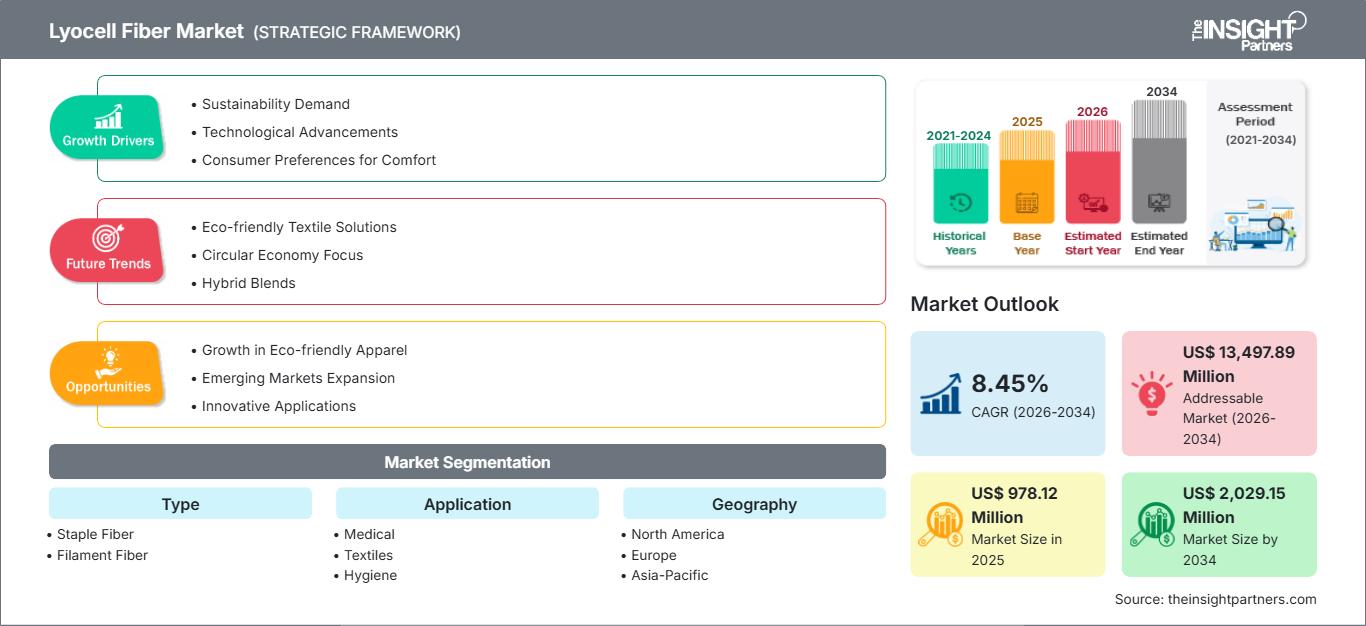
The lyocell fiber market size was US$ 978.12 million in 2025 and is projected to reach US$ 2,029.15 million by 2034, registering a CAGR of 8.45% during 2026–2034. Rising demand for sustainable cellulosic fibers, expanding applications across textile and technical industries, and continuous investments in closed-loop fiber manufacturing technologies are strengthening the market outlook. Increasing preference for biodegradable materials among manufacturers and consumers is further supporting long-term industry expansion.
Across North America, the industry is benefiting from rising demand for environmentally responsible textile materials, increasing investments in sustainable apparel production, and broader adoption of bio-based fibers by medical and hygiene product manufacturers. The lyocell fiber market size continues to expand as regional brands emphasize circular material sourcing and compliance with evolving environmental regulations. The regional market is anticipated to grow at a CAGR ranging between 7.2% and 8.0% through 2034.
Lyocell Fiber Market Assessment and Insights
- North America: The region accounted for 24–27% of the lyocell fiber market share in 2025 and is projected to expand at a CAGR of 7.2–8.0% during 2026–2034. Strong sustainability initiatives, premium textile manufacturing, and increasing medical textile demand continue to support regional growth.
- US: The country represented 76–80% of the North American market in 2025 and is anticipated to register a CAGR of 7.4–8.1% during 2026–2034, supported by sustainable apparel manufacturing and growing demand for biodegradable hygiene products.
- Europe: Europe held 28–31% share in 2025 and is expected to grow at a CAGR of 7.8–8.5% during 2026–2034. Austria, Germany, Italy, France, and the UK remain leading production and consumption centers owing to strong environmental regulations and advanced textile manufacturing.
- Asia Pacific: Asia Pacific accounted for 35–39% share in 2025 and is projected to register the fastest regional expansion at a CAGR of 9.0–9.8% during 2026–2034. China, India, Japan, and South Korea continue to attract investments in sustainable fiber manufacturing and downstream textile production.
- Largest Segment: Textiles represented 57–61% market share in 2025 and is expected to expand at a CAGR of 8.4–9.1% during 2026–2034, supported by increasing adoption of eco-friendly fibers across apparel, home textiles, and fashion brands.
- High Growth Segment: Medical applications accounted for 10–13% market share in 2025 while expanding at a CAGR of 9.8–10.6% during 2026–2034, driven by increasing utilization of biodegradable wound-care products and advanced healthcare textiles.
- Key companies analyzed in detail: Lenzing AG, Aditya Birla Management Corporation Pvt. Ltd. (Birla Cellulose), Sappi Limited, Grasim Industries Limited, Eastman Chemical Company, Kelheim Fibres GmbH, The Lyocell Company Limited, Suzano S.A., Acree Technologies Inc., LENZING (Lenze reference standardized to Lenzing AG), China Hi-Tech Group Corporation, Sico Fibres, Fujian Xinlong Fiber Co., Ltd., Kraton Corporation, and Shandong Helon Textile Sci. & Tech. Co., Ltd.
Source: The Insight Partners' analysis based on proprietary research, government publications, company annual reports, investor presentations, industry databases, and expert interviews.
The increasing need for eco-friendliness in the global fiber industry has changed focus to sustainable manufacturing processes and renewable resources. Lyocell has become popular owing to its closed solvent recovery cycle system, its efficiency, and the compatibility of the raw material that can be made from certified wood pulp. The increasing strength, moisture resistance, dye absorption, and blending capabilities of lyocell fibers have made its use more widespread in clothing, home furnishings, technical textiles, and specialty industrial uses.
The future holds more changes in competitive positioning due to the increased investment in lyocell capacity expansions in the Asia Pacific, the investment in sustainability throughout the entire textile supply chain, and the promotion of circular manufacturing processes through government policies. Consumer interest in biodegradable fibers and manufacturers' commitments to green products make long-term purchasing agreements probable. Innovations of specialty fiber grades in applications such as the medical, hygiene, and automotive industries will lead to greater diversification of lyocell demand.
Lyocell Fiber Market Report Scope
| Report Attribute | Details |
|---|---|
| Market size in 2025 | US$ 978.12 Million |
| Market Size by 2034 | US$ 2,029.15 Million |
| Global CAGR (2026 - 2034) | 8.45% |
| Historical Data | 2021-2024 |
| Forecast period | 2026-2034 |
Lyocell Fiber Market Analysis
Increasing consumer demand for renewable textile materials, strict government policies on environmental sustainability, and the green commitment of apparel makers towards sustainable sourcing keep driving growth in the lyocell fiber market worldwide. The European Environment Agency and Textile Exchange have identified increased use of preferred man-made cellulosic fibers in fashion because of their smaller environmental impacts. The industry continues to benefit from the availability of certified forest-based resources, better dissolving pulp, improved spinning techniques, and efficient textile processing facilities.
Availability of stable supplies of certified wood pulp from well-managed forests and technological improvements in solvent recovery systems have been driving down costs in major manufacturing centers. More emphasis is being put on vertical integration in order to secure wood pulp supplies, mitigate risks arising from fluctuations in prices of raw materials, and strengthen the supply chain. Partnership between manufacturers of fiber and leading apparel makers around the globe keeps accelerating innovation in sustainable textiles.
The competitive positioning within the market keeps changing with regard to capacity expansion, licensing, and development of specialty fibers. Lenzing AG and Grasim Industries Limited are still two of the largest producers globally, while Sappi Limited is constantly expanding dissolving pulp capacity to produce more fibers. Suzano S.A. has been making efforts towards developing sustainable wood-based raw materials as its sources to ensure supply security for its regenerated cellulosic fibers.
Certified sustainable sourcing, lower carbon footprint in manufacturing, and development of specialty fibers aimed at apparel, hygiene, and medical uses become the strategies used by industry players to gain competitive advantage. Kelheim Fibres GmbH, Eastman Chemical Company, Fujian Xinlong Fiber Co., Ltd., China Hi-Tech Group Corporation, and Shandong Helon Textile Sci. & Tech. Co., Ltd. keep developing new products and entering into strategic partnership with other companies. More collaboration with fashion brands and textile converters will intensify competition but also offer more opportunities.
● REPORT CUSTOMIZATION
Tailor This Report To Align With Your Specific Business Requirements
This report can be customized to align precisely with your business objectives, scope, and target markets. Customization options include tailored segmentation, geography, competitive analysis, and strategic insights to support informed decision-making.
Customize This Report →WHAT YOU CAN ADJUST
- ● Segmentations
- ● Geography
- ● Competitive Analysis
- ● Language Preferences
Lyocell Fiber Market: Strategic Insights
Regional Insights
North America Lyocell Fiber Market
North America accounted for 24–27% of the global lyocell fiber market share in 2025 and is projected to register a CAGR of 7.2–8.0% during 2026–2034. On the demand side, the growth drivers include leading apparel manufacturers, producers of textiles for health care sector, and increased usage of sustainable raw materials among consumer goods industries. The sustainability initiatives of corporations, increased investments into circular textiles manufacturing, as well as focus on cutting down pollution from synthetic fibers are boosting the demand in the region. The use of technical textiles and increased consumer awareness about biodegradable fibers are motivating manufacturers to expand their product portfolio.
Apart from that, the presence of excellent research and development facilities, textile innovation centers in the region, as well as close cooperation between manufacturers of fibers and fashion companies are contributing to the market growth. The increased application of lyocell in nonwoven hygiene textiles, in automobiles, and other industries is also opening new growth avenues.
U.S. Lyocell Fiber Market
The U.S. represented 76–80% of the North American market in 2025 and is anticipated to grow at a CAGR of 7.4–8.1% during 2026–2034. The nation profits greatly from high demand for eco-friendly clothing, luxury furniture, and high-quality medical textiles. Leading fashion brands are persisting in their use of sustainable materials in their offerings, while medical manufacturers are using more regenerated cellulose fibers for medical uses and hygiene products. All of this helps increase consumption within the country in many sectors.
Investments in production of sustainable textiles, research on materials, and circular economy projects contribute to future growth prospects. The national brands emphasize traceable sources of raw materials and certified wood pulp as well. The growing cooperation between the suppliers of fibers, clothing manufacturers, and research organizations is likely to help in the commercial application of new types of fibers.
Europe Lyocell Fiber Market
Europe held 28–31% of the global market in 2025 and is projected to expand at a CAGR of 7.8–8.5% during 2026–2034, supported by stringent environmental policies, strong technical expertise, and widespread adoption of sustainable textile materials. Austria remains the regional leader because of its established regenerated fiber manufacturing ecosystem, while Germany represents one of the largest downstream textile markets. Continuous investments in circular economy practices and certified forestry resources further reinforce regional competitiveness.
The UK continues witnessing steady demand from premium apparel brands and technical textile manufacturers emphasizing sustainable sourcing strategies. Germany benefits from advanced textile engineering capabilities, industrial innovation, and increasing adoption of eco-friendly fibers across automotive and industrial applications. France, Italy, and Spain collectively support regional expansion through luxury fashion manufacturing, home textile production, and increasing investments in sustainable textile supply chains. Growing regulatory focus on reducing environmental impacts across textile production is expected to sustain long-term market development.
APAC Lyocell Fiber Market
Asia Pacific accounted for 35–39% of the global market in 2025 and is forecast to record the highest regional CAGR of 9.0–9.8% during 2026–2034. China leads regional production owing to its integrated textile manufacturing ecosystem, while India continues expanding investments in sustainable fiber production and downstream apparel manufacturing.
Japan and South Korea emphasize high-performance specialty textiles, whereas Australia contributes through certified forestry resources and sustainable pulp production. Government initiatives supporting green manufacturing, export-oriented textile industries, and increasing consumer demand for environmentally responsible apparel continue positioning Asia Pacific as the fastest-growing regional market.
Middle East & Africa Lyocell Fiber Market
The Middle East & Africa is projected to register a CAGR of 7.0–7.8% during 2026–2034, supported by growing textile manufacturing investments, industrial diversification strategies, and increasing demand for sustainable materials. Saudi Arabia and the UAE continue investing in downstream manufacturing capabilities, while South Africa remains an important regional textile production hub.
Expansion of industrial infrastructure, rising apparel manufacturing activities, and government initiatives encouraging sustainable industrial development are expected to support future demand. Increasing partnerships with international textile manufacturers and broader adoption of environmentally responsible materials across regional consumer goods industries are likely to create long-term opportunities for lyocell fiber suppliers.
Segmentation Analysis
Type
The Type segment is anticipated to register a CAGR of 8.4–9.1% during 2026–2034. Product innovation, improvements in fiber performance, and increasing adoption across apparel, industrial textiles, and hygiene products continue driving segment growth. Manufacturers are expanding production capacities while developing differentiated fiber grades to meet evolving performance and sustainability requirements. The lyocell fiber market scope continues to widen as both staple and filament fibers address diverse end-use applications requiring durability, softness, moisture management, and environmental compatibility.
- Staple Fiber – Widely utilized across apparel, home textiles, hygiene products, and nonwoven materials because of excellent softness, moisture absorption, blending capability with cotton and polyester, and cost-effective processing for high-volume textile manufacturing.
- Filament Fiber – Preferred for premium apparel, luxury fabrics, industrial textiles, and specialty technical products requiring superior tensile strength, smooth surface characteristics, consistent appearance, and enhanced dimensional stability during processing.
Application
The Application segment is projected to expand at a CAGR of 8.6–9.4% during 2026–2034 owing to increasing diversification of regenerated cellulose fibers across consumer and industrial sectors. Expanding environmental regulations, continuous product innovation, and growing investments in sustainable manufacturing are encouraging wider commercial adoption. Textile applications continue dominating global demand, while healthcare and technical industries increasingly utilize specialized lyocell fiber grades for performance-driven products.
- Medical – Demand is increasing because of growing utilization in wound dressings, surgical textiles, healthcare disposables, and advanced medical fabrics requiring biocompatibility, high absorbency, softness, and biodegradable material characteristics.
- Textiles – The largest application, supported by rising adoption across fashion apparel, sportswear, denim, home furnishings, and luxury clothing due to excellent comfort, moisture management, durability, and sustainable manufacturing credentials.
- Hygiene – Increasing demand for biodegradable wipes, personal hygiene products, baby care items, and feminine hygiene applications continues supporting long-term consumption of regenerated cellulose fibers.
- Automotive – Manufacturers increasingly incorporate lyocell fibers into vehicle interiors, seating fabrics, insulation materials, and composite reinforcements to improve sustainability while maintaining lightweight performance characteristics.
- Aerospace – Specialty technical textiles utilizing lyocell fibers are gaining attention for lightweight composite materials, insulation products, and advanced engineering applications requiring dimensional stability and environmentally responsible raw materials.
Opportunity Snapshot
| Segment Name | Revenue Contribution | Trend Tag | Adoption Stage |
| Medical | Medium | Wound Care | Scaling |
| Textiles | High | Sustainable Fashion | Mature |
| Hygiene | Medium | Biodegradable Wipes | Scaling |
| Automotive | Medium | Lightweight Interiors | Emerging |
| Aerospace | Low | Advanced Composites | Emerging |
Lyocell Fiber Market Growth Drivers and Impact Analysis
Expansion of Sustainable Apparel Manufacturing Worldwide
The global textile industry is undergoing a structural transformation as fashion brands commit to reducing greenhouse gas emissions, water consumption, and dependence on petroleum-based fibers. Lyocell has emerged as a preferred material because it is manufactured from renewable wood pulp through a closed-loop solvent recovery process that significantly minimizes chemical waste. Organizations such as Textile Exchange and the Programme for the Endorsement of Forest Certification (PEFC) continue encouraging responsible sourcing of cellulosic raw materials, supporting wider commercial adoption. Growing investments by international apparel companies in circular supply chains, certified forestry resources, and sustainable product portfolios are expected to accelerate fiber demand across fashion, sportswear, home furnishing, and premium textile applications throughout the forecast period.
Increasing Adoption in Medical and Hygiene Applications
Demand for biodegradable and highly absorbent fibers is expanding across healthcare and personal hygiene industries as manufacturers seek safer and environmentally responsible alternatives to conventional synthetic materials. Lyocell fibers offer excellent moisture management, softness, tensile strength, and biocompatibility, making them suitable for wound dressings, surgical products, medical wipes, feminine hygiene products, and baby care applications. Healthcare providers are increasingly emphasizing patient comfort while governments continue strengthening regulations regarding single-use medical products and waste management. These factors are encouraging manufacturers to invest in specialty lyocell grades capable of meeting stringent quality standards, creating long-term commercial opportunities across both developed and emerging healthcare markets.
Technological Advancements in Closed-Loop Fiber Production
Continuous innovation in solvent recovery systems, fiber spinning technologies, and dissolving pulp production is improving manufacturing efficiency while reducing environmental impacts. Producers are investing in digital process monitoring, energy-efficient production equipment, and advanced purification technologies to improve fiber consistency and operational productivity. Integration across the value chain, from certified forestry resources to finished fiber production, is further strengthening supply security and reducing raw material volatility. These technological developments enable manufacturers to produce differentiated fiber grades for premium apparel, industrial textiles, automotive components, and specialty applications while supporting profitability and compliance with increasingly stringent environmental standards.
Lyocell Fiber Market Future Trends
Growing Integration into Circular Textile Value Chains
The leading lyocell fiber market trends indicate that manufacturers are increasingly integrating recycled textile feedstocks, certified wood pulp, and advanced solvent recovery technologies into commercial production. Global apparel brands are strengthening partnerships with fiber producers to improve material traceability, reduce lifecycle emissions, and comply with evolving sustainability commitments. Digital product passports, recycled cellulose technologies, and transparent sourcing practices are expected to become increasingly important as governments introduce stricter environmental reporting requirements. These developments are likely to enhance consumer confidence while supporting broader commercialization of circular textile manufacturing systems over the coming decade.
Development of High-Performance Specialty Fiber Grades
Manufacturers are expected to focus on developing differentiated lyocell products tailored for technical textiles, healthcare, filtration, automotive, and industrial applications. Advanced surface treatments, engineered fiber structures, and innovative blending technologies are improving durability, thermal stability, and functional performance. As industrial customers increasingly require customized material solutions, producers are investing in research and development to expand application-specific product portfolios. These innovations are anticipated to strengthen competitive differentiation while reducing dependence on traditional apparel demand and creating additional revenue opportunities across high-value end-use industries.
Lyocell Fiber Market Opportunities
Expansion Across Emerging Textile Manufacturing Economies
According to long-term lyocell fiber market Forecasts, emerging economies across South and Southeast Asia, Latin America, and parts of Eastern Europe present attractive investment opportunities due to expanding textile manufacturing capacity and rising exports. Increasing government support for sustainable industrialization, improving manufacturing infrastructure, and favorable labor availability continue attracting foreign investments into textile production. Fiber manufacturers can establish strategic partnerships with regional spinning mills and apparel exporters to strengthen market penetration while reducing logistics costs. Investments in localized production capabilities and certified sustainable supply chains are expected to generate significant long-term competitive advantages as global demand for environmentally responsible textile materials continues expanding.
Investment in Value-Added Technical Textile Applications
Growing demand for sustainable industrial materials is creating attractive opportunities beyond conventional apparel manufacturing. Producers can expand into automotive interiors, filtration media, medical textiles, aerospace composites, and advanced nonwoven applications where performance characteristics justify premium pricing. Continued collaboration with research institutions and downstream manufacturers will support commercialization of innovative fiber technologies meeting industry-specific requirements. Strategic investments in specialty manufacturing facilities, application development centers, and customer-focused product innovation are expected to improve profit margins while diversifying revenue sources across rapidly evolving industrial sectors.
Recent Developments
- June 2026: Grasim Industries Limited, the flagship company of the Aditya Birla Group and a global leader in cellulosic fibres, announced an investment of ₹3,094 crore, for Phase II Lyocell capacity of 110K TPA at Harihar, Karnataka. This expansion will consist of 2 lines of 55K TPA (150 Tons per day) each. The first line is expected to be commissioned by 2028, and the second line is expected to be commissioned by 2030.
- April 2026: Circulose announced an agreement with China Textile Academy Green Fibre (CTA) to offer lyocell fibers produced using CIRCULOSE pulp. Producing lyocell from recycled pulp at commercial scale is an important step in making textile-to-textile recycled materials available across a wider range of textile applications.
- March 2026: Birla Cellulose, a part of the Aditya Birla Group and one of the world’s leading producers of man-made cellulosic fibres (MMCF), announced the launch of Livaeco Lyocell, its next-generation sustainable fibre, at Confluence 2026, the company’s flagship industry platform held in Coimbatore.
Frequently Asked Questions

- Comprehensive Market Sizing and Forecast Analysis
- Detailed Segmentation Analysis
- In-Depth Market Dynamics Assessment
- Regional and Country-Level Insights
- Competitive Landscape and Company Benchmarking
- Strategic Business Intelligence
Recent Reports
Testimonials

The Insight Partners provided valuable market intelligence that supported our global go-to-market strategy. Their team was professional, responsive, and attentive to our feedback, providing thoughtful analysis and helpful methodological clarifications throughout the project.
Junmo Kim Chief Financial Officer (CFO), Enertech Co., Ltd.
The Insight Partners' SCADA System Market report is comprehensive, with valuable insights on current trends and future forecasts. The team was highly professional, responsive, and supportive throughout. We are very satisfied and highly recommend their services.
RAN KEDEM Partner, Reali Technologies LTDs
I requested a report on a very specific software market and the team produced the report in a few days. The information was very relevant and well presented. I then requested some changes and additions to the report. The team was again very responsive and I got the final report in less than a week.
JEAN-HERVE JENN Chairman, Future Analytica
We worked with The Insight Partners for an important market study and forecast. They gave us clear insights into opportunities and risks, which helped shape our plans. Their research was easy to use and based on solid data. It helped us make smart, confident decisions. We highly recommend them.
PIYUSH NAGPAL Sr. Vice President, High Beam Global
The Insight Partners delivered insightful, well-structured market research with strong domain expertise. Their team was professional and responsive throughout. The user-friendly website made accessing industry reports seamless. We highly recommend them for reliable, high-quality research services
YUKIHIKO ADACHI CEO, Deep Blue, LLC.
This is the first time I have purchased a market report from The Insight Partners.While I was unsure at first, I visited their web site and felt more comfortable to take the risk and purchase a market report.I am completely satisfied with the quality of the report and customer service. I had several questions and comments with the initial report, but after a couple of dialogs over email with their analyst I believe I have a report that I can use as input to our strategic planning process.Thank you so much for taking the extra time and making this a positive experience.I will definitely recommend your service to others and you will be my first call when we need further market data.
JOHN SUZUKI President and Chief Executive Officer, Board Director, BK Technologies
I wish to appreciate your support and the professionalism you displayed in the course of attending to my request for information regarding to infectious disease IVD market in Nigeria. I appreciate your patience, your guidance, and the fact that you were willing to offer a discount, which eventually made it possible for us to close a deal. I look forward to engaging The Insight Partners in the future, all thanks to the impression you have created in me as a result of this first encounter.
DR CHIJIOKE ONYIA MANAGING DIRECTOR, PineCrest Healthcare Ltd.Reason to Buy
- Informed Decision-Making
- Understanding Market Dynamics
- Competitive Analysis
- Identifying Emerging Markets
- Customer Insights
- Market Forecasts
- Risk Mitigation
- Boosting Operational Efficiency
- Strategic Planning
- Investment Justification
- Tracking Industry Innovations
- Aligning with Regulatory Trends





 Get Free Sample for