
Maritime Cybersecurity Market Share, Demand & Forecast by 2031
Maritime Cybersecurity Market Size and Forecast (2021 - 2031), Global and Regional Share, Trend, and Growth Opportunity Analysis Report Report Coverage : by Component (Solutions, Services), Security Type (Network Security, Endpoint Security, Application Security, Cloud Security, Operational Technology (OT) Security), Deployment (On-Premise, Cloud), Organization Size (Large Enterprises, Small and Medium-sized Enterprises (SMEs), End-user (Commercial Shipping, Naval and Defense, Port Operators, Offshore Operations, Others) and Geography
- Status : Data Released
- Report Code : TIPRE00042068
- Category : Technology, Media and Telecommunications
- No. of Pages : 150
- Available Report Formats :


- Last update date : December 05, 2025


2024 Market Size
US$ 3.56 Bn
Base year value
2031 Forecast
US$ 7.92 Bn
Projected by 2031
CAGR 2025-2031
12.1 %
Growth rate
Addressable Market
US$ 40.39 Bn
(2025-2031)
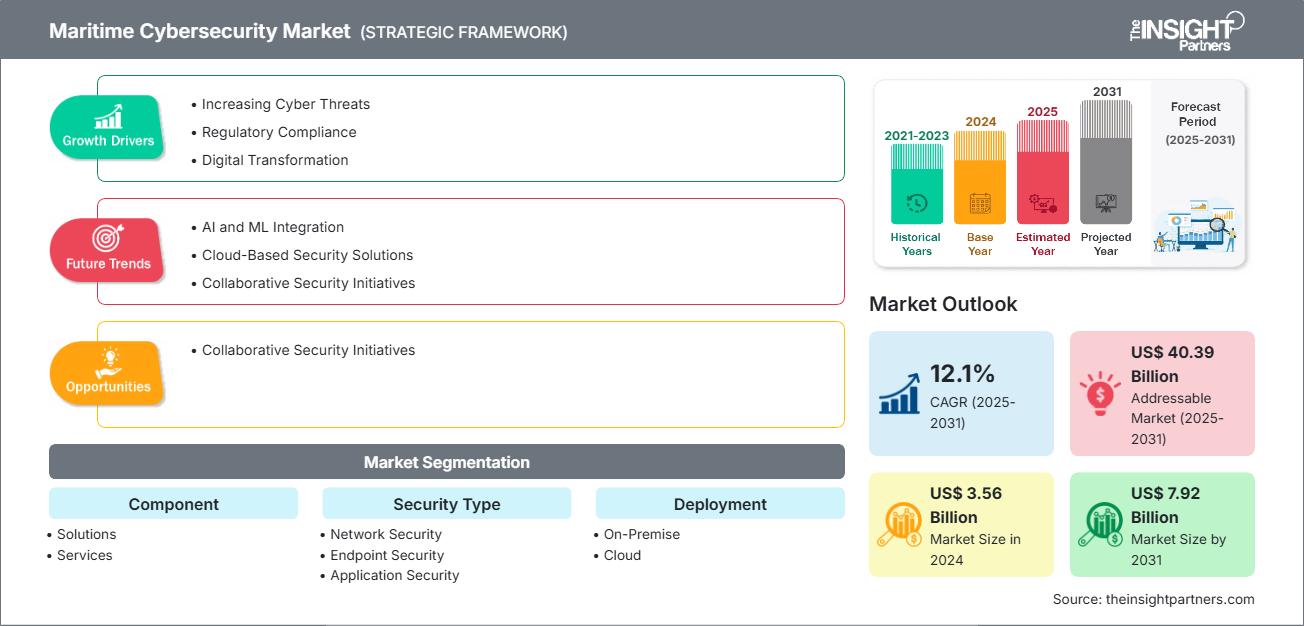
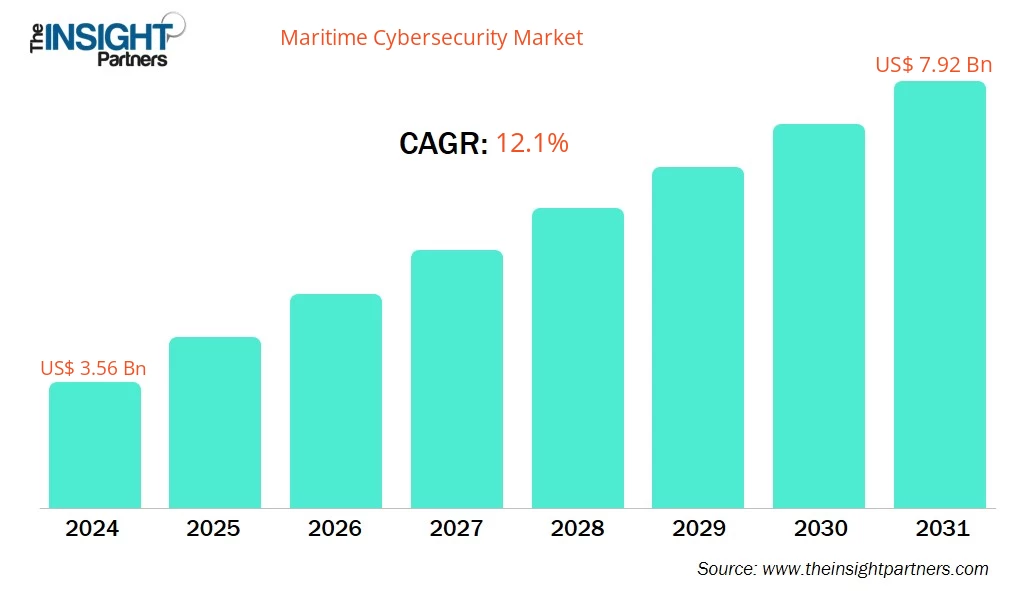
The Maritime Cybersecurity Market size is projected to reach US$ 7.92 billion by 2031 from US$ 3.56 billion in 2024. The market is expected to register a CAGR of 12.1% during 2025–2031.
Maritime Cybersecurity Market Analysis
The maritime cybersecurity market is poised for significant growth due to the increasing frequency and sophistication of cyber threats targeting the maritime industry. Factors such as the rising adoption of Internet of Things (IoT) devices in maritime operations, the need for compliance with international cybersecurity regulations, and the growing awareness about the importance of securing critical maritime infrastructure are driving the market's expansion. Additionally, the integration of advanced technologies like Artificial Intelligence (AI) and Machine Learning (ML) for threat detection and response is further propelling market growth.
Maritime Cybersecurity Market Overview
Maritime cybersecurity encompasses the protection of ships, ports, offshore platforms, and other maritime assets from cyber threats. It involves implementing measures to safeguard digital systems, networks, and data from unauthorized access, cyberattacks, and other malicious activities. With the increasing digitization of maritime operations, ensuring robust cybersecurity has become paramount to maintain the integrity, safety, and efficiency of maritime activities.
Market Research Highlights
- Global market for Maritime Cybersecurity was valued at US$ 3.56 Billion in 2024
- Annual market size is expected to reach US$ 7.92 Billion by 2031
- Total addressable market (TAM) during 2025-2031 is projected to reach approximately US$ 40.39 Billion
- Market is anticipated to register a CAGR of 12.1% during the forecast period
- The United States represents a key market, supported by Increasing Cyber Threats, Regulatory Compliance, Digital Transformation, as well as evolving industry dynamics
- Market analysis covers North America, Europe, Asia-Pacific, South and Central America, Middle East and Africa, with growth evaluated across the forecast period
- Market opportunities such as Collaborative Security Initiatives are expected to influence market dynamics and addressable market
- Report profiles industry participants, including Darktrace Plc, CrowdStrike Holdings, Inc., SentinelOne, Inc., Acalvio Technologies Inc., Smokescreen Technologies, Proofpoint, Inc., Microsoft Corp., Apate.ai, Cyabra, while analyzing competitive strategies and innovation developments
-
Source: The Insight Partners' analysis based on proprietary research, government publications, company annual reports, investor presentations, industry databases, and expert interviews.
● REPORT CUSTOMIZATION
Tailor This Report To Align With Your Specific Business Requirements
This report can be customized to align precisely with your business objectives, scope, and target markets. Customization options include tailored segmentation, geography, competitive analysis, and strategic insights to support informed decision-making.
Customize This Report →WHAT YOU CAN ADJUST
- ● Segmentations
- ● Geography
- ● Competitive Analysis
- ● Language Preferences
Maritime Cybersecurity Market: Strategic Insights
-
Get Top Key Market Trends of this report.This FREE sample will include data analysis, ranging from market trends to estimates and forecasts.
Maritime Cybersecurity Market Drivers and Opportunities
Market Drivers:
- Increasing Cyber Threats: The maritime industry is witnessing a surge in cyberattacks, including ransomware, phishing, and malware, targeting critical systems and data.
- Regulatory Compliance: International regulations and standards, such as the International Maritime Organization's (IMO) guidelines, mandate the implementation of cybersecurity measures within the maritime sector.
- Digital Transformation: The adoption of digital technologies, including IoT, cloud computing, and automation, in maritime operations is expanding the attack surface, necessitating enhanced cybersecurity protocols.
Market Opportunities:
- AI and ML Integration: Leveraging AI and ML for predictive analytics and real-time threat detection presents significant opportunities for enhancing cybersecurity measures.
- Cloud-Based Security Solutions: The growing trend towards cloud adoption in maritime operations opens avenues for scalable and flexible cybersecurity solutions.
- Collaborative Security Initiatives: Partnerships between maritime stakeholders, cybersecurity firms, and governmental bodies can foster information sharing and collective defense strategies.
Maritime Cybersecurity Market Report Segmentation Analysis
By Component:
- Solutions
- Services
By Deployment Mode:
- On-Premises
- Cloud-Based
By End-User Industry:
- Shipping Companies
- Port Authorities
- Offshore Oil & Gas
- Others
By Geography:
- North America
- Europe
- Asia Pacific
- Middle East & Africa
- South America
Maritime Cybersecurity Market Report Scope
| Report Attribute | Details |
|---|---|
| Market size in 2024 | US$ 3.56 Billion |
| Market Size by 2031 | US$ 7.92 Billion |
| Global CAGR (2025 - 2031) | 12.1% |
| Historical Data | 2021-2023 |
| Forecast period | 2025-2031 |
| Segments Covered |
By Component
|
| Regions and Countries Covered |
North America
|
| Market leaders and key company profiles |
|
Maritime Cybersecurity Market Players Density: Understanding Its Impact on Business Dynamics
The Maritime Cybersecurity Market is growing rapidly, driven by increasing end-user demand due to factors such as evolving consumer preferences, technological advancements, and greater awareness of the product's benefits. As demand rises, businesses are expanding their offerings, innovating to meet consumer needs, and capitalizing on emerging trends, which further fuels market growth.
Maritime Cybersecurity Market Share Analysis by Geography
1. North America:
- Market Share: Holds the largest market share due to advanced maritime infrastructure and stringent cybersecurity regulations.
- Key Drivers: Implementation of the Maritime Transportation Security Act (MTSA), adoption of advanced cybersecurity technologies, and collaboration between public and private sectors.
2. Europe:
- Market Share: Second-largest market share, influenced by the European Union's cybersecurity directives and a robust maritime industry.
- Key Drivers: Compliance with the EU Network and Information Security Directive (NIS Directive), emphasis on port security, and investment in cybersecurity research.
3. Asia Pacific:
- Market Share: Fastest-growing region due to rapid industrialization and increasing maritime trade activities.
- Key Drivers: Government initiatives to enhance cybersecurity capabilities, expansion of port facilities, and rising cyber threat awareness.
4. Middle East & Africa:
- Market Share: Emerging market with significant growth potential.
- Key Drivers: Strategic importance of maritime routes, investments in port modernization, and focus on securing critical infrastructure.
5. South America:
- Market Share: Developing market with increasing adoption of cybersecurity measures.
- Key Drivers: Growth in maritime trade, need for port security enhancements, and international collaborations.
Maritime Cybersecurity Market Players Density: Understanding Its Impact on Business Dynamics
High Market Density and Competition:
The maritime cybersecurity market is characterized by a high level of competition, with numerous players offering a range of solutions and services. Key players include:
- Cybersecurity Firms: Specialized companies providing tailored cybersecurity solutions for the maritime industry.
- Technology Providers: Companies offering networking, IoT, and cloud solutions integrated with cybersecurity features for maritime applications.
- Consulting & Service Providers: Organizations delivering advisory, managed services, training, and incident response to enhance cybersecurity posture.
Impact of High Market Density:
A dense competitive landscape encourages continuous innovation, drives solution differentiation, and fosters strategic partnerships. However, it also creates pricing pressures, necessitating investment in R&D and marketing to maintain market position.
Certainly! Below are the requested sections for the AI Deception Tools Market report, formatted in line with industry standards and incorporating the latest available data.
Major Companies Operating in the AI Deception Tools Market
The AI Deception Tools market is characterized by a diverse array of companies specializing in cybersecurity, AI-driven threat detection, and deception technologies. Key players include:
- Darktrace Plc
- CrowdStrike Holdings, Inc.
- SentinelOne, Inc.
- Acalvio Technologies Inc.
- Smokescreen Technologies
- Proofpoint, Inc.
- Microsoft Corp.
- Apate.ai
- Cyabra
These companies are at the forefront of integrating AI into cybersecurity, offering innovative solutions to address the evolving landscape of cyber threats.
Other Companies Analyzed During the Course of Research
In addition to the major players, several other companies contribute to the AI Deception Tools market:
- Fortinet Inc.
- IBM
- Cisco Systems Inc.
- McAfee Corp.
- Trend Micro
- Check Point Software
- BlackBerry
- Splunk
These companies are integral to the market, providing a range of AI-driven cybersecurity solutions to meet diverse organizational needs.
News and Recent Developments
- Bumble Inc. Launches Deception Detector: In February 2024, Bumble Inc. introduced "Deception Detector," an AI-powered tool designed to identify and block spam, scams, and fake profiles across its platforms. The tool applies advanced machine learning to verify account authenticity and eliminate suspicious profiles before users interact with them, achieving a 45% reduction in member reports of deceptive accounts within two months.
- Proofpoint Acquires Illusive Networks: In December 2023, Proofpoint, Inc. acquired Illusive Networks Inc., enhancing its threat protection portfolio by incorporating Illusive Networks' advanced identity threat detection and response solutions. This acquisition strengthens Proofpoint's capabilities in addressing privileged identity risks and lateral movement within hybrid environments.
- Microsoft Introduces AI Agents in Security Copilot: In March 2025, Microsoft announced the rollout of 11 new AI agents for its Security Copilot platform, aimed at automating repetitive cybersecurity tasks and alleviating analyst burnout. These agents are integrated into Microsoft's existing security tools, streamlining operations and improving accuracy in threat detection.
- Apate.ai Develops AI Voice Chatbots to Combat Scams: Apate.ai, a Sydney-based AI start-up, developed sophisticated AI voice chatbots designed to combat scams by engaging and misleading scammers. The bots convincingly mimic real people, holding scammers in lengthy conversations and gathering intelligence on scam methods. This initiative has diverted over 280,000 scam attempts and is employed by institutions like the Commonwealth Bank and TPG.
- Cyabra Enhances Disinformation Detection: Cyabra, an AI-powered platform specializing in combating disinformation, provides solutions to governments and organizations worldwide. The company helps detect and mitigate threats posed by fake profiles, harmful narratives, and Generative AI content, aiming to restore trust in digital platforms.
Report Coverage and Deliverables
This comprehensive report provides an in-depth analysis of the AI Deception Tools market, covering the following:
- Market size and forecast across global, regional, and country levels with detailed segmentation.
- Comprehensive analysis of market drivers, restraints, and growth opportunities.
- Detailed competitive landscape and company profiling.
- Industry trends, regulatory overview, and technological advancements.
- Strategic recommendations for stakeholders and potential entrants
Frequently Asked Questions

- Comprehensive Market Sizing and Forecast Analysis
- Detailed Segmentation Analysis
- In-Depth Market Dynamics Assessment
- Regional and Country-Level Insights
- Competitive Landscape and Company Benchmarking
- Strategic Business Intelligence
Recent Reports
Testimonials

The Insight Partners' SCADA System Market report is comprehensive, with valuable insights on current trends and future forecasts. The team was highly professional, responsive, and supportive throughout. We are very satisfied and highly recommend their services.
RAN KEDEM Partner, Reali Technologies LTDs
I requested a report on a very specific software market and the team produced the report in a few days. The information was very relevant and well presented. I then requested some changes and additions to the report. The team was again very responsive and I got the final report in less than a week.
JEAN-HERVE JENN Chairman, Future Analytica
We worked with The Insight Partners for an important market study and forecast. They gave us clear insights into opportunities and risks, which helped shape our plans. Their research was easy to use and based on solid data. It helped us make smart, confident decisions. We highly recommend them.
PIYUSH NAGPAL Sr. Vice President, High Beam Global
The Insight Partners delivered insightful, well-structured market research with strong domain expertise. Their team was professional and responsive throughout. The user-friendly website made accessing industry reports seamless. We highly recommend them for reliable, high-quality research services
YUKIHIKO ADACHI CEO, Deep Blue, LLC.
This is the first time I have purchased a market report from The Insight Partners.While I was unsure at first, I visited their web site and felt more comfortable to take the risk and purchase a market report.I am completely satisfied with the quality of the report and customer service. I had several questions and comments with the initial report, but after a couple of dialogs over email with their analyst I believe I have a report that I can use as input to our strategic planning process.Thank you so much for taking the extra time and making this a positive experience.I will definitely recommend your service to others and you will be my first call when we need further market data.
JOHN SUZUKI President and Chief Executive Officer, Board Director, BK Technologies
I wish to appreciate your support and the professionalism you displayed in the course of attending to my request for information regarding to infectious disease IVD market in Nigeria. I appreciate your patience, your guidance, and the fact that you were willing to offer a discount, which eventually made it possible for us to close a deal. I look forward to engaging The Insight Partners in the future, all thanks to the impression you have created in me as a result of this first encounter.
DR CHIJIOKE ONYIA MANAGING DIRECTOR, PineCrest Healthcare Ltd.Reason to Buy
- Informed Decision-Making
- Understanding Market Dynamics
- Competitive Analysis
- Identifying Emerging Markets
- Customer Insights
- Market Forecasts
- Risk Mitigation
- Boosting Operational Efficiency
- Strategic Planning
- Investment Justification
- Tracking Industry Innovations
- Aligning with Regulatory Trends





 Get Free Sample for