
Metal Folding Machine Market Size, Trends & Growth by 2034
Coverage: By Product (Mechanical Metal Folding Machine, Hydraulic Metal Folding Machine, Electric Metal Folding Machine, Pneumatic Metal Folding Machine); Type (Conventional Metal Folding Machine, Computer Numerical Control (CNC) Metal Folding Machine); End-user (Manufacturing and Processing, Automotive, Building and Construction, Power Generation, Oil and Gas, Others) , and Geography (North America, Europe, Asia Pacific, and South and Central America)
- Status : Data Released
- Report Code : TIPRE00019038
- Category : Manufacturing and Construction
- No. of Pages : 150
- Available Report Formats :


- Last update date : July 20, 2026


2025 Market Size
US$ 3.9 Bn
Base year value
2034 Forecast
US$ 5.77 Bn
Projected by 2034
CAGR 2026-2034
4.45 %
Growth rate
Addressable Market
US$ 43.91 Bn
(2026-2034)
The global Metal Folding Machine market was valued at US$ 3.9 billion in 2025 and is expected to reach US$ 5.77 billion by 2034; it is estimated to record a CAGR of 4.45% during 2026-2034.
Metal Folding Machine Market Assessment and Insights
- North America accounted for 22–25% share in 2025 and is projected to grow at a CAGR between 4.6–5.2% during 2026–2034, supported by automated fabrication upgrades and construction products demand.
- US represented 76–80% of North America in 2025 and is expected to grow at a CAGR between 4.7–5.3% during 2026–2034, led by HVAC, roofing, and contract fabrication.
- Europe held 27–30% share in 2025 and is forecast to grow at a CAGR between 4.3–4.9% during 2026–2034, with Germany, Italy, France, and the UK leading precision machinery adoption.
- Asia Pacific captured 36–40% share in 2025 and is projected to grow at a CAGR between 5.5–6.2% during 2026–2034, driven by China, India, Japan, and South Korea.
- Largest Segment Hydraulic Metal Folding Machine held 38–42% market share in 2025 and is expected to grow at a CAGR between 4.6–5.1% during 2026–2034.
- High Growth Segment Computer Numerical Control held 30–34% market share in 2025 and is projected to grow at a CAGR between 6.0–6.7% during 2026–2034.
- Key companies analyzed in detail: Alpha Manufacturing Ltd, AMS Controls Inc., ASCO Biegetechnik GmbH, CIDAN Machinery Group AB, EBR Metal Makina Sanayi ve Ticaret Ltd. Sti., Mac-Tech Inc., Prod-Masz company, RAS Reinhardt Maschinenbau GmbH, Roper Whitney, and Schröder Group.
Source: The Insight Partners' analysis based on proprietary research, government publications, company annual reports, investor presentations, industry databases, and expert interviews.
Production economics have evolved from mere bending ability to programmable bending cells that cut down on setup times, increase repeat performance, and provide complicated profiles. Fabricators no longer consider only tonnage when assessing machines but also bend quality, software integration, tool change, and energy requirements. Such evolution has resulted in a preference for electric, hydraulic, and computer numerical controlled machines, in particular in small lot manufacturing of enclosures, ducting, roofing, and automotive components.
Future trends will include the growth of new fabrication centers, increased pipeline development for infrastructure needs, and regulations promoting efficient production. Metal fabrication capacity is being built up near consumption markets in countries like India, Southeast Asia, Mexico, and Eastern Europe. At the same time, energy conservation, labor shortages, and digital factory initiatives drive buyers to purchase equipment with safe and efficient operations and less waste.
Metal Folding Machine Market Report Scope
| Report Attribute | Details |
|---|---|
| Market size in 2025 | US$ 3.9 Billion |
| Market Size by 2034 | US$ 5.77 Billion |
| Global CAGR (2026 - 2034) | 4.45% |
| Historical Data | 2021-2024 |
| Forecast period | 2026-2034 |
Metal Folding Machine Market Analysis
The Metal Folding Machine Market growth is being driven by precision requirements in automotive parts, architectural panels, electrical cabinets, industrial enclosures, and renewable energy structures. Increasingly, consumers demand precise angles, good surface finish, and minimum reworking, making folding machines more favorable to use on visible panels and coated surfaces. Furthermore, automation can assist companies that face limitations in labor by reducing their reliance on skilled operators.
The value chain involves machinery frames, drives, hydraulics, CNC control systems, sensors, tooling, software, and post-market services. The supply chain is still impacted by the cost of steel, the availability of servo components, and the time taken by electronics. Consumers are increasingly favoring suppliers who offer local services and training due to the critical importance of machine availability to production schedules and customer deliveries.
The Metal Folding Machine Market analysis indicates a competitive field split between full-system machinery specialists and control-focused suppliers. The CIDAN Machinery Group AB, RAS Reinhardt Maschinenbau GmbH, Schröder Group, and Roper Whitney are competing in terms of machine design, whereas the AMS Controls Inc. is enhancing digital control functions. The Alpha Manufacturing Ltd illustrates end-user integration using automatic folding features.
Capital is being allocated towards modular automation, maintenance connectivity, and application-specific folders for roofing, HVAC, and panel manufacturing. ASCO Biegetechnik GmbH, EBR Metal Makina Sanayi ve Ticaret Ltd. Sti., Mac-Tech Inc., and Prod-Masz company cater to specialized and local requirements. Increasingly, differentiation will rely on software interface, service reach, and the capability to accommodate different gauges without extended preparation.
● REPORT CUSTOMIZATION
Tailor This Report To Align With Your Specific Business Requirements
This report can be customized to align precisely with your business objectives, scope, and target markets. Customization options include tailored segmentation, geography, competitive analysis, and strategic insights to support informed decision-making.
Customize This Report →WHAT YOU CAN ADJUST
- ● Segmentations
- ● Geography
- ● Competitive Analysis
- ● Language Preferences
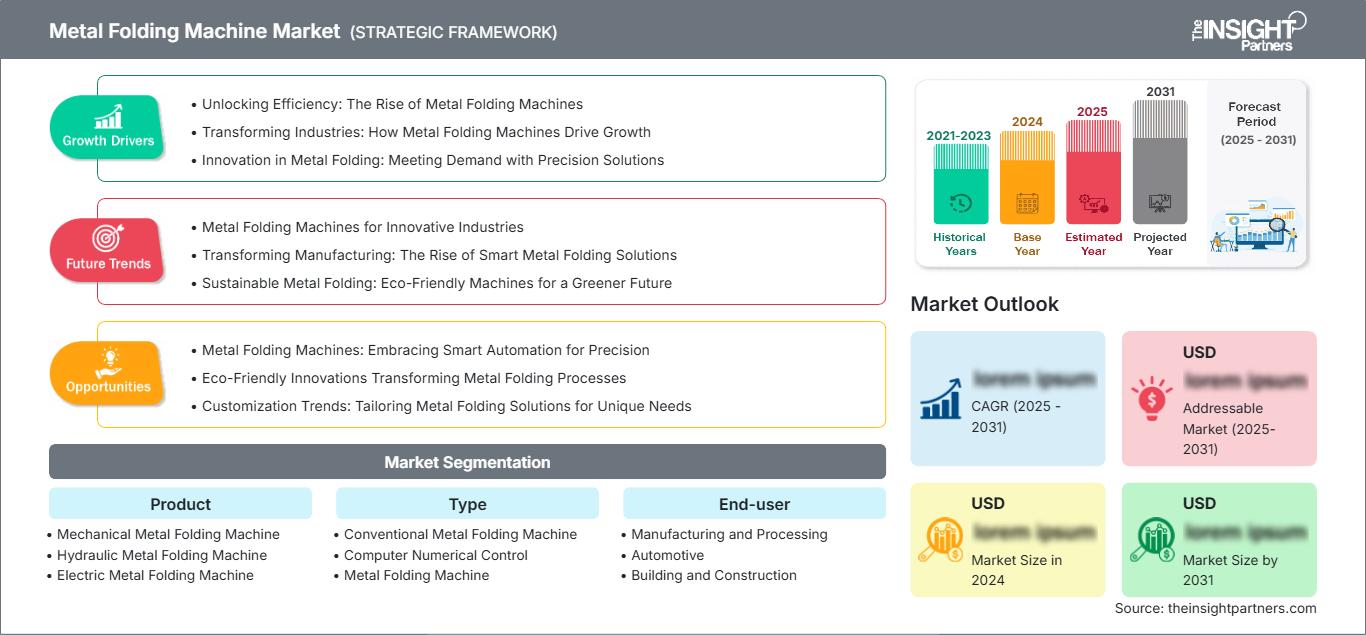
Metal Folding Machine Market: Strategic Insights
Regional Insights
North America Metal Folding Machine Market
North America accounted for 22–25% of global revenue in 2025 and is expected to expand at a 4.6–5.2% CAGR through 2034. The Metal Folding Machine Market share in the region is supported by reshored production, equipment replacement in metal buildings, and growing use of automated folding in HVAC ducts, roofing panels, electrical cabinets, and custom fabrication. Demand is strongest where buyers need shorter lead times and lower dependence on skilled manual bending. U.S. and Canadian fabricators are adding CNC folders to protect coated material surfaces and improve batch flexibility. Government infrastructure spending and private warehouse construction provide recurring demand for formed panels, trims, and enclosures.
U.S. Metal Folding Machine Market
The U.S. represented 76–80% of North American demand in 2025 and is projected to grow at a 4.7–5.3% CAGR during 2026–2034. Market pull comes from metal roofing, HVAC fabrication, appliance components, transportation equipment, and defense-adjacent suppliers seeking reliable production of repeatable folded parts. Company presence is broad, with AMS Controls Inc., Roper Whitney, RAS Reinhardt Maschinenbau GmbH, and CIDAN Machinery Group AB serving fabricators through machinery, controls, and service networks. Application trends favor automated backgauges, touch-screen programming, offline design transfer, and safety systems that let small and mid-size shops increase output without adding proportional labor.
Europe Metal Folding Machine Market
Europe held 27–30% share in 2025 and is forecast to grow at a 4.3–4.9% CAGR through 2034, led by Germany. The region benefits from advanced machine building, high labor costs, and demand for precision architectural metalwork. The UK supports modernization in contract fabrication and building products, while Germany leads in automated machinery integration. Italy remains important for machinery supply chains and sheet metal equipment design, while France, Spain, and Nordic markets contribute demand from transport, energy, and construction applications. European buyers emphasize energy efficiency, CE-compliant safety, compact footprints, and digital documentation. This favors suppliers with strong engineering support and standardized service processes across multiple countries.
APAC Metal Folding Machine Market
APAC captured 36–40% share in 2025 and is projected to grow at a 5.5–6.2% CAGR during 2026–2034, with China as the leading country. Japan and South Korea sustain high-end demand, while India and Australia add growth through infrastructure, commercial buildings, and localized fabrication capacity. Policy support for manufacturing, electric mobility, renewable energy, and industrial corridors is expanding equipment purchases. APAC buyers often balance cost with automation benefits, creating opportunities for electric and hydraulic folders that provide measurable reductions in scrap, setup time, and operator variability.
Middle East & Africa Metal Folding Machine Market
The Middle East and Africa are expected to grow at a 4.8–5.4% CAGR during 2026–2034, led by the UAE and Saudi Arabia. Energy projects, airports, data centers, and commercial construction sustain demand for formed panels, ducts, frames, and electrical enclosures. South Africa anchors industrial demand in the region, while the rest of MEA relies on fabrication linked to oil and gas, utilities, and urban development. Buyers typically prefer durable hydraulic systems, accessible service, and machines capable of handling varied materials in harsh operating environments.
Segmentation Analysis
Product
Product is expected to grow at a 4.8–5.4% CAGR during 2026–2034 as buyers select machines by force delivery, energy profile, maintenance needs, and application fit. The Metal Folding Machine Market scope across product types is broadening as fabricators combine hydraulic robustness with electric precision and pneumatic simplicity for lighter-duty workflows.
- Mechanical Metal Folding Machine remains relevant for cost-sensitive workshops handling standard bends, light gauges, and repetitive profiles where operators prioritize simplicity, low maintenance, and predictable manual control.
- The Hydraulic Metal Folding Machine leads heavy-duty adoption because it delivers stable forming force, handles thicker material, and supports industrial users requiring reliable output across construction, energy, and fabrication jobs.
- Electric Metal Folding Machine gains attention where precision, energy efficiency, cleaner operation, and lower noise are important, particularly in modern factories with digital workflows and environmental performance targets.
- Pneumatic Metal Folding Machine serves lighter sheet applications and compact production cells, offering quick actuation, simple operation, and suitability for shops with existing compressed-air infrastructure.
Type
Type is forecast to advance at a 5.2–5.8% CAGR during 2026–2034 as the market shifts from conventional equipment toward programmable systems. Buyers increasingly compare productivity per operator, repeatability, and software-assisted job setup, making CNC capability a key differentiator in high-mix production environments.
- Conventional Metal Folding Machine remains important for small workshops and maintenance operations that need affordability, straightforward training, and reliable forming of common parts without complex programming.
- Computer Numerical Control, Metal Folding Machine is gaining share as fabricators seek repeatable bends, stored programs, reduced setup time, and integration with digital design and production planning systems.
End-user
The demand from end-users is expected to rise at a CAGR of 4.9% to 5.5% through 2026-2034 on the back of industrial consumers who seek uniform tolerances in sheet metal that is formed. Manufacturing and processing are the largest applications, whereas automotive, construction, power generation, and oil and gas have distinct needs.
- Manufacturing and Processing is an industry where there is consistent demand for enclosures, cabinets, trays, ducts, and fabricated assemblies, thereby giving flexibility in folding capability, high strategic value to contract manufacturers and captive manufacturing facilities.
- The Automotive industry needs precision folding for various components such as brackets, panels, housings, and other EV components.
- In Building and Construction, the folding machines used for roofing, cladding, flashing, gutters, and façade elements result in requirements for long folders, on-site operation, and quick profile changes.
- In Power Generation, the use of folded metal components for cabinets, protective casings, and renewable energy components requires tough equipment able to process varying thicknesses and coatings.
- The Oil and Gas industry needs durable folded components for enclosures, skids, ducts, and protective structures, which can justify procurement through the capability to process heavy materials.
Opportunity Snapshot
| End-user | Revenue Contribution | Trend Tag | Adoption Stage |
| Manufacturing and Processing | High | Flexible Cells | Mature |
| Automotive | High | EV Structures | Scaling |
| Building and Construction | High | Metal Roofing | Scaling |
| Power Generation | Medium | Grid Cabinets | Scaling |
| Oil and Gas | Medium | Field Skids | Mature |
Metal Folding Machine Market Growth Drivers and Impact Analysis
Automation Demand in Precision Fabrication
Metal Folding Machine Market forecast indicates growing demand for programmable folding systems as fabricators respond to shorter production runs, greater product customization, and tighter delivery schedules. Manual bending remains useful, but it exposes plants to operator variability and longer setup times. Automated backgauges, stored bending programs, and visual controls reduce trial parts and help maintain consistent geometry across repeat orders. This has a direct financial impact because each avoided scrap sheet preserves material value and protects downstream assembly schedules. The Metal Folding Machine Market benefits most in shops serving HVAC, electrical enclosures, architectural panels, and transportation components, where small errors can create visible defects or installation delays. As customers demand documentation and repeatability, automation becomes a purchasing requirement rather than an optional upgrade.
Construction Metalwork and Infrastructure Pipelines
Commercial structures, logistics facilities, data centers, airports, and infrastructure projects need large quantities of sheet metal that are folded into various shapes for their roofs, facades, flashing, ductwork, draining, and service enclosures. The folding machine would be appropriate in this case since it is capable of producing long, smooth bends without scratching coatings or paint on the sheets. The demand is more stable when the projects need custom work on-site since the contractors need fast changes of profiles and quick deliveries. The effect of the market is the gradual replacement of long folders and hydraulic components in the construction supply chain. The suppliers who assist the roofing and cladding professionals in their needs will benefit from repeat business.
Labor Shortages and Quality Standardization
The availability and retention of competent sheet metal operators are challenging in many industrial environments, thus increasing the importance of equipment that is easy to set up and operate. The use of CNC control systems, guiding sequences, and recognition of tools enables even relatively inexperienced operators to carry out repeated folding operations after proper training. This ensures that there are no delays on the part of senior operators and that production continues without disruptions during shift changes. Standardization of quality levels is important for automotive, energy, and industrial equipment customers since size uniformity affects fit during assembly as well as warranty liability risks.
Metal Folding Machine Market Future Trends
Connected Folding Cells with Predictive Service
Metal Folding Machine Market trends are moving toward connected machines that monitor cycle counts, drive loads, hydraulic performance, tooling use, and operator interventions. Over the forecast period, suppliers will use this data to provide predictive maintenance alerts, remote diagnostics, and performance benchmarking. Fabricators benefit because unplanned downtime can interrupt project schedules and increase overtime costs. Connected service also enables smaller shops to access expert support without maintaining large internal engineering teams. The trend will strengthen vendor lock-in through software ecosystems, but it will also raise expectations for cybersecurity, data ownership, and transparent service agreements across industrial customers.
Servo-Electric and Low-Energy Forming Platforms
Electric and hybrid foldable systems will become more common as vendors aim to cut down energy consumption, reduce contamination inside the workshop, and enhance their motion control. The importance of hydraulic systems in heavy applications is obvious; however, for customers who prioritize energy savings, low maintenance of fluids, and noise level, servo-electric systems may seem preferable. The future development of such machines will involve electric motion together with automatic tools, electronic program importing, and assistance in loading. Such systems will be demanded in places with expensive electricity control, requirements for sustainability reports, and up-to-date manufacturing plants.
Metal Folding Machine Market Opportunities
Retrofit Controls for Installed Machine Bases
There are many systems out there in which the number of conventional and semi-automatic folders in use gives way to an upgrade potential related to controls, safety systems, backgauge systems, and software installations. Fabricating companies may not be able to afford new machines right away, but they certainly have enough funds to invest in specific upgrades that increase the precision of the process, save time on setups, and prolong the lifespan of their equipment. Service providers, such as control experts and machine manufacturers, are able to design upgrade packages based on applications, training of operators, and increased productivity goals.
Localized Fabrication Hubs in Emerging Economies
Localized manufacturing capability in developing countries is being developed to reduce dependency on imports, optimize supply chain distances, and implement favorable policies for domestic manufacturers. This results in the need for rugged but cost-effective machines that offer dependable mechanisms along with effective CNC functionality. Manufacturers can gain the upper hand by providing financing, operator training, spare parts, and solutions that cover roofing, ducts, enclosures, and infrastructural elements. Collaborations with distribution and technical partners can make entry easier in regions where skilled operators are scarce. This business is not limited to selling machines alone but also extends to consumables and other aspects of manufacturing processes.
Recent Developments
- February 2026: Schröder Group upgrades the MAKU folding machine. with a new safety laser system directly on the bending line, which clamps the sheet metal much faster before folding. A new clamping beam option also enables the use of goat foot tools and thus the production of boxes.
- October 2025: CIDAN Machinery Group launches its next-generation CNC control system for the F-series folders, built to take the complexity out of bending and put precision at fingertips. CIDAN’s new nuLINK control system is now rolling out in the U.S. (mid-October 2025), bringing a modern, connected user experience to sheet-metal folding.
- June 2025: Schröder Group has redesigned its popular PowerBend Industrial and made it even more robust and faster with a new bending beam and a more efficient drive system. The opening height of the clamping beam has been increased to 850 mm, and tools up to 400 mm high can now be used. The PowerBend Industrial is available in two versions: with a working length of 4000 mm for up to 5 mm thick sheet steel and the 3200 mm version, which bends 6 mm sheet steel. The Schröder Group originally closed the gap between its high-end folding machines and thin sheet metal machines with the introduction of the PowerBend Industrial in 2016.
Frequently Asked Questions

- Comprehensive Market Sizing and Forecast Analysis
- Detailed Segmentation Analysis
- In-Depth Market Dynamics Assessment
- Regional and Country-Level Insights
- Competitive Landscape and Company Benchmarking
- Strategic Business Intelligence
Recent Reports
Testimonials

The Insight Partners' SCADA System Market report is comprehensive, with valuable insights on current trends and future forecasts. The team was highly professional, responsive, and supportive throughout. We are very satisfied and highly recommend their services.
RAN KEDEM Partner, Reali Technologies LTDs
I requested a report on a very specific software market and the team produced the report in a few days. The information was very relevant and well presented. I then requested some changes and additions to the report. The team was again very responsive and I got the final report in less than a week.
JEAN-HERVE JENN Chairman, Future Analytica
We worked with The Insight Partners for an important market study and forecast. They gave us clear insights into opportunities and risks, which helped shape our plans. Their research was easy to use and based on solid data. It helped us make smart, confident decisions. We highly recommend them.
PIYUSH NAGPAL Sr. Vice President, High Beam Global
The Insight Partners delivered insightful, well-structured market research with strong domain expertise. Their team was professional and responsive throughout. The user-friendly website made accessing industry reports seamless. We highly recommend them for reliable, high-quality research services
YUKIHIKO ADACHI CEO, Deep Blue, LLC.
This is the first time I have purchased a market report from The Insight Partners.While I was unsure at first, I visited their web site and felt more comfortable to take the risk and purchase a market report.I am completely satisfied with the quality of the report and customer service. I had several questions and comments with the initial report, but after a couple of dialogs over email with their analyst I believe I have a report that I can use as input to our strategic planning process.Thank you so much for taking the extra time and making this a positive experience.I will definitely recommend your service to others and you will be my first call when we need further market data.
JOHN SUZUKI President and Chief Executive Officer, Board Director, BK Technologies
I wish to appreciate your support and the professionalism you displayed in the course of attending to my request for information regarding to infectious disease IVD market in Nigeria. I appreciate your patience, your guidance, and the fact that you were willing to offer a discount, which eventually made it possible for us to close a deal. I look forward to engaging The Insight Partners in the future, all thanks to the impression you have created in me as a result of this first encounter.
DR CHIJIOKE ONYIA MANAGING DIRECTOR, PineCrest Healthcare Ltd.Reason to Buy
- Informed Decision-Making
- Understanding Market Dynamics
- Competitive Analysis
- Identifying Emerging Markets
- Customer Insights
- Market Forecasts
- Risk Mitigation
- Boosting Operational Efficiency
- Strategic Planning
- Investment Justification
- Tracking Industry Innovations
- Aligning with Regulatory Trends





 Get Free Sample for