
Metering Pumps Market Growth, Size & Forecast by 2034
Coverage: By Type (Diaphragm, Piston/Plunger, Others ); End-Use Industry (Water and Wastewater Treatment , Petrochemicals, Oil and Gas , Chemical Processing , Pharmaceuticals , Food and Beverage , Pulp and Paper , Others) , and Geography (North America, Europe, Asia Pacific, and South and Central America)
- Status : Data Released
- Report Code : TIPRE00006098
- Category : Manufacturing and Construction
- No. of Pages : 150
- Available Report Formats :


- Last update date : July 20, 2026


2025 Market Size
US$ 6.7 Bn
Base year value
2034 Forecast
US$ 9.15 Bn
Projected by 2034
CAGR 2026-2034
3.98 %
Growth rate
Addressable Market
US$ 73.67 Bn
(2026-2034)
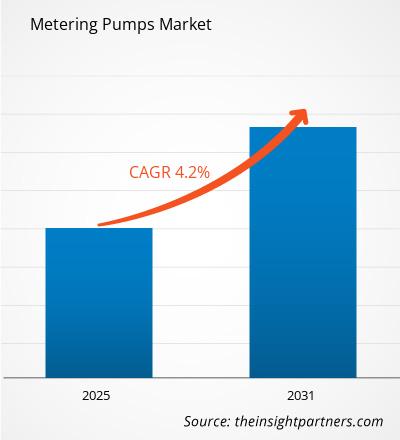
The Metering Pumps Market was valued at US$ 6.7 Billion in 2025 and is projected to reach US$ 9.15 Billion by 2034, registering a CAGR of 3.98% during 2026–2034. The market reflects steady demand for precise chemical dosing across water treatment, petrochemicals, oil and gas, chemical processing, pharmaceuticals, food and beverage, and pulp and paper applications, where flow accuracy and compliance remain essential.
Across North America, replacement of aging water infrastructure, tighter discharge norms, and reshoring of specialty chemical capacity are expected to support a 3.6–4.2% CAGR through 2034. Metering Pumps Market size in the region is influenced by municipal treatment upgrades, chemical feed automation, and demand from refinery, food processing, and pharmaceutical facilities seeking repeatable dosing under variable pressure and corrosive-fluid conditions.
Metering Pumps Market Assessment and Insights
- North America accounted for 27–30% share in 2025 and is projected to grow at a 3.6–4.2% CAGR between 2026–2034, led by municipal water renewal, chemical dosing automation, and U.S. industrial resilience.
- US represented 78–82% of North America in 2025 and is expected to expand at a 3.7–4.3% CAGR between 2026–2034, supported by treatment plants and refining corridors.
- Europe held 22–25% share in 2025 and is forecast to grow at a 3.2–3.8% CAGR between 2026–2034, with Germany, the UK, France, Italy, and Spain leading regulated dosing demand.
- Asia Pacific captured 34–38% share in 2025 and is projected to grow at a 4.4–5.0% CAGR between 2026–2034, driven by China, India, Japan, South Korea, and Australia.
- Largest Segment Diaphragm pumps held 44–48% market share in 2025 and are expected to grow at a 3.8–4.4% CAGR between 2026–2034 due to chemical resistance and lower maintenance.
- High Growth Segment Water and Wastewater Treatment held 32–36% market share in 2025 and is projected to grow at a 4.5–5.1% CAGR between 2026–2034.
- Key companies analyzed in detail: Dover Corporation, Grundfos Holding A/S, IDEX Corporation, LEWA GmbH, Milton Roy, ProMinent GmbH, SEKO S.p.A., SPX FLOW, Inc., Verder Group, and Watson-Marlow Fluid Technology Solutions.
Source: The Insight Partners' analysis based on proprietary research, government publications, company annual reports, investor presentations, industry databases, and expert interviews.
Adoption of technology is transitioning from mechanically regulated dosing to digitized metering systems, which incorporate sensors, thereby improving the repeatability and efficient use of chemicals. Manufacturers continue to fine-tune the diaphragm integrity sensing systems, corrosion protection of liquid ends, and API 675-compatible design for continuous operations. Changes in manufacturing dynamics include the move to a modular platform to cut down on engineering lead time but still customize based on viscosity, discharge pressure, and hazardous fluid handling.
Demand trends are driven by the growth of industrial zones, more stringent effluent regulations, and investments in potable water, desalination, and specialty chemicals. Asia Pacific continues to emerge as the largest market by volume, whereas North America and Europe are more concerned with replacement, automation, and regulation-driven upgrades. The industry will enjoy the advantages of customers focusing on life cycle costs, chemical efficiencies, and dosing performances, rather than pump prices.
Metering Pumps Market Report Scope
| Report Attribute | Details |
|---|---|
| Market size in 2025 | US$ 6.7 Billion |
| Market Size by 2034 | US$ 9.15 Billion |
| Global CAGR (2026 - 2034) | 3.98% |
| Historical Data | 2021-2024 |
| Forecast period | 2026-2034 |
Metering Pumps Market Analysis
Metering Pumps Market growth is anchored in the need to inject acids, alkalis, coagulants, polymers, disinfectants, inhibitors, and process additives with repeatable accuracy. Water utilities, refineries, chemical plants, and pharmaceutical lines increasingly require dosing systems that reduce chemical losses, protect downstream assets, and meet audit-ready operating limits.
The industry includes pump makers, suppliers of motors and actuators, instrumentation companies, systems integrators, EPC contractors, and after-market players. The supply is influenced by precision-machined parts, elastomeric products, stainless steel, fluoropolymers, and electronics. Buyers tend to purchase pumps along with controllers, tanks, mixers, and calibration towers in one go.
Based on the market analysis, there is competition among diversified flow control firms and dosing experts. Companies like Dover Corporation, IDEX Corporation, SPX FLOW, and Verder Group have an edge due to wide distribution channels, whereas Grundfos Holding A/S, LEWA GmbH, Milton Roy, ProMinent GmbH, SEKO S.p.A., and Watson-Marlow Fluid Technology Solutions win due to application knowledge.
Areas of focus for investment include digital dosing, regional assembly, chemical compatibility tests, and service infrastructure, which minimizes equipment downtime for critical facilities. Positioning involves companies that can validate accuracy, work in corrosive conditions, and provide monitoring software. As a result, differentiation has moved away from pump technology itself to performance, life cycle, and engineering solutions.
● REPORT CUSTOMIZATION
Tailor This Report To Align With Your Specific Business Requirements
This report can be customized to align precisely with your business objectives, scope, and target markets. Customization options include tailored segmentation, geography, competitive analysis, and strategic insights to support informed decision-making.
Customize This Report →WHAT YOU CAN ADJUST
- ● Segmentations
- ● Geography
- ● Competitive Analysis
- ● Language Preferences
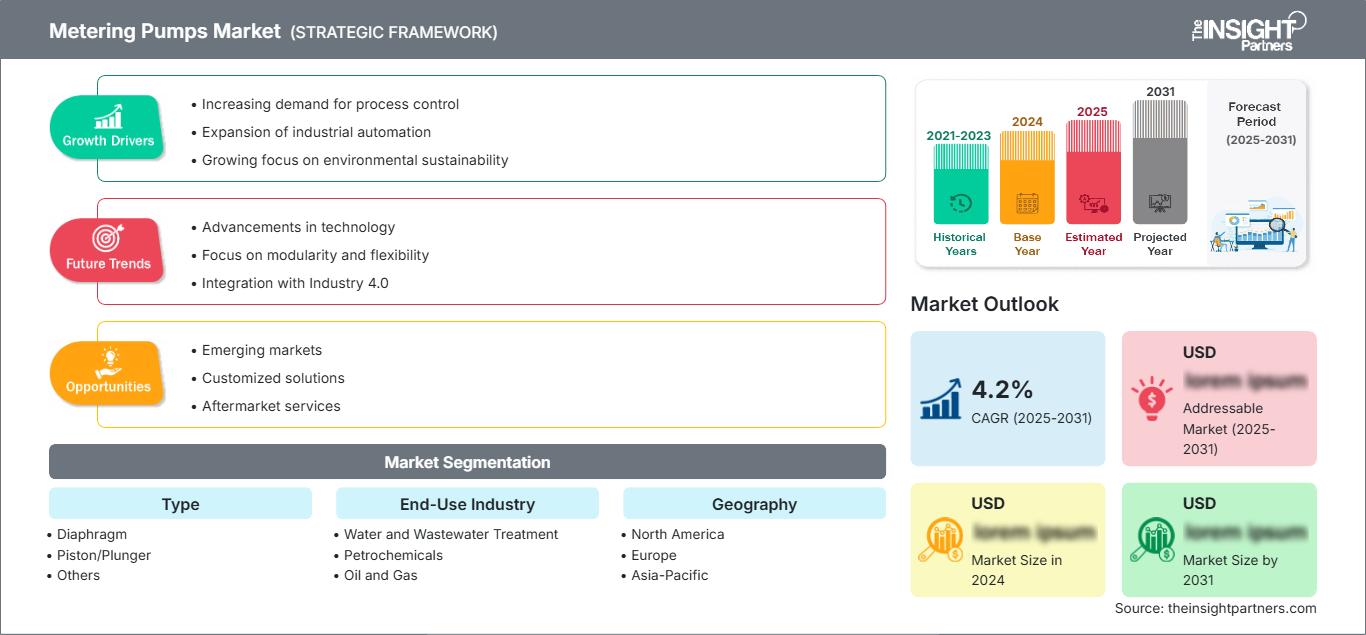
Metering Pumps Market: Strategic Insights
Regional Insights
North America Metering Pumps Market
North America held 27–30% share in 2025 and is projected to register a 3.6–4.2% CAGR through 2034. The Metering Pumps Market share is supported by the U.S. Water Infrastructure Finance and Innovation Act pipeline, state-level wastewater consent decrees, and upgrades in chemical, refinery, and food processing facilities. Regional buyers emphasize reliability, serviceability, and compatibility with treatment chemicals such as chlorine, sodium hypochlorite, ferric chloride, and polymers. Demand is also tied to automation retrofits at aging plants, where operators seek remote calibration, leak detection, and lower maintenance exposure. Supplier presence across the U.S. and Canada strengthens after market responsiveness.
U.S. Metering Pumps Market
The U.S. represented 78–82% of North America in 2025 and is expected to grow at a 3.7–4.3% CAGR through 2034. Municipal treatment modernization, chemical manufacturing capacity, oil refining, and shale-linked water handling create consistent demand for diaphragm and plunger dosing systems. Company presence is broad, with IDEX Corporation, Milton Roy, Dover Corporation, and SPX FLOW maintaining strong industrial channels. At the same time, Grundfos Holding A/S, ProMinent GmbH, and Watson-Marlow Fluid Technology Solutions serve water, hygienic, and process customers. Application trends favor packaged chemical feed skids, remote diagnostics, and redundant dosing trains.
Europe Metering Pumps Market
Europe accounted for 22–25% share in 2025 and is forecast to grow at a 3.2–3.8% CAGR through 2034, with Germany the leading country. Wastewater management regulations, safety requirements on chemicals, and validation of pharmaceutical production processes drive the need for precise dosing systems in controlled production processes. Water utility asset management schemes and upgrades to food processing plants in the UK help, whereas Germany enjoys the benefit of chemical clusters, export of engineered equipment, and a high level of automation in dosing. The French, Italian, and Spanish markets help through municipal wastewater treatments, specialty chemicals, pulp and paper production, and beverage production.
APAC Metering Pumps Market
Asia Pacific captured 34–38% share in 2025 and is expected to grow at a 4.4–5.0% CAGR through 2034, making it the fastest regional contributor. China leads on chemical processing, municipal wastewater, and refining demand, while India adds momentum through industrial corridors and water infrastructure. Japan and South Korea emphasize high-specification dosing for electronics, pharmaceuticals, and advanced materials, whereas Australia supports mining, desalination, and water reuse applications. Policy pressure on effluent discharge and industrial water efficiency is expanding the installed base of automated systems across the market.
Middle East & Africa Metering Pumps Market
The Middle East & Africa is projected to expand at a 3.9–4.5% CAGR through 2034, led by Saudi Arabia. Desalination, oil and gas processing, petrochemicals, and wastewater reuse create demand for pumps able to handle brine, anti-scalants, acids, corrosion inhibitors, and biocides. The UAE supports growth through district cooling, water reuse, and industrial zones, while South Africa contributes through mining, municipal treatment, and pulp applications. The rest of MEA demand remains project-led, with procurement tied to EPC specifications, harsh operating conditions, and availability of certified service partners.
Segmentation Analysis
Type
Type is expected to register a 3.7–4.3% CAGR during 2026–2034 as buyers balance accuracy, pressure capability, chemical compatibility, and maintenance intensity. The Metering Pumps Market scope across types is shaped by diaphragm adoption in corrosive liquids, piston and plunger systems in high-pressure service, and niche designs for specialized flow profiles.
- Diaphragm pumps remain the preferred option for corrosive, hazardous, and treatment chemicals because the diaphragm isolates liquid from drive components and reduces leakage risk in continuous dosing duty.
- Piston/Plunger pumps serve high-pressure, high-accuracy applications in petrochemicals, oil and gas, and specialty chemicals where robust liquid ends and repeatable stroke control are strategically important.
End-Use Industry
End-Use Industry is projected to grow at a 4.0–4.6% CAGR during 2026–2034, supported by compliance requirements, automation, and efficiency targets. Water-intensive industries are prioritizing controlled chemical injection to reduce overdosing, stabilize quality, and protect equipment, while process industries demand pumps that operate reliably under pressure, temperature, and compatibility constraints.
- Water and Wastewater Treatment leads adoption as utilities and industrial operators dose disinfectants, coagulants, pH adjusters, and polymers to meet quality standards and lower chemical wastage.
- Petrochemicals use metering systems for catalyst injection, corrosion control, additive dosing, and process stabilization in plants requiring precise flow under aggressive and continuous operating conditions.
- Oil and Gas demand is tied to scale inhibitors, demulsifiers, biocides, and corrosion inhibitors used in upstream production, midstream pipelines, refining, and produced-water treatment.
- Chemical Processing requires controlled dosing for acids, alkalis, solvents, polymers, and additives, making pump accuracy and material compatibility central to process quality and safety.
- Pharmaceuticals rely on clean, repeatable dosing for formulation, cleaning validation, and purified-water treatment, where documentation, accuracy, and hygienic compatibility guide equipment selection.
- Food and Beverage applications include ingredient dosing, sanitation chemicals, pH control, and water treatment, with demand shaped by hygiene, repeatability, and reduced product loss.
- Pulp and Paper uses metering pumps for bleaching chemicals, retention aids, dyes, biocides, and wastewater treatment, supporting process consistency and environmental compliance.
Opportunity Snapshot
| End-Use Industry | Revenue Contribution | Trend Tag | Adoption Stage |
| Water and Wastewater Treatment | High | Chemical Dosing | Mature |
| Petrochemicals | High | Process Safety | Mature |
| Oil and Gas | Medium | Corrosion Control | Scaling |
| Chemical Processing | High | Precision Feed | Mature |
| Pharmaceuticals | Medium | Validated Dosing | Scaling |
| Food and Beverage | Medium | Hygienic Flow | Scaling |
| Pulp and Paper | Low | Bleach Control | Mature |
| Others | Low | Specialty Fluids | Emerging |
Metering Pumps Market Growth Drivers and Impact Analysis
Water quality compliance and chemical dosing precision
Water treatment operators serving municipalities and industries are under increasing demands to meet stricter discharge standards, goals for reuse, and potable water quality requirements while at the same time minimizing operating expenses and chemical usage. Metering pumps are essential in meeting these challenges, as they allow precision dosage of chlorine, coagulants, chemicals for pH adjustment, disinfectants, and polymers during the entire process of water purification. Precision dosage allows for minimization of chemical waste, prevention of overdose and underdosage, efficient treatment, and stability of process parameters, resulting in improved water quality and lower costs. The need is especially high in plants with outdated equipment, whose operators want to install new dosing systems ready for retrofits, which would allow them to boost performance without extensive modernization of the facility. Suppliers find increasing demand from utilities and industrial plants adopting automation in their work in combination with metering pumps, including fully assembled dosing skids, monitoring and control systems, leakage detection systems, remote diagnostics and preventive maintenance services.
Industrial automation in process manufacturing
Automation is increasingly taking the place of manual and semi-manual approaches to chemical dosing in process industries. This not only enhances the accuracy of dosing but also helps achieve batch consistency and greater reliability in the process. Automation also eliminates the need for human operators to perform certain tasks and reduces any chances of exposure to harmful chemicals. Through automation, it is easier to control the dosing of valuable chemicals so as to help the process industry cut down on wastage, reduce costs, and achieve optimal production quality. In this regard, the Metering Pumps Market stands to gain from the changing nature of chemical processing. The increasing need for precise chemical dosing in industrial operations will see the demand for smart and communicative metering pumps increase in view of their role in process automation. Suppliers that offer calibration and other application engineering services along with metering pumps will benefit more from automation than those who do not.
Expansion of petrochemical and specialty chemical capacity
Petrochemical and specialty chemical companies are looking for pumps that can meter highly aggressive, viscous, or dangerous substances at high pressures and temperatures. Additional capacity in Asia-Pacific, the Middle East, and certain US Gulf Coast locations will help satisfy the demand for sophisticated diaphragm and plunger pumps. This is important not only because of additional units that can be sold, but also because existing facilities will have to maintain their equipment by ordering spares and seal kits.
Metering Pumps Market Future Trends
Connected dosing platforms with predictive service models
Metering Pumps Market trends will increasingly center on connected pumps that monitor stroke behavior, flow deviation, diaphragm condition, suction pressure, and chemical inventory. Predictive alerts can reduce unplanned shutdowns in water plants, refineries, and pharmaceutical lines where dosing failure has regulatory or production consequences. Over the forecast period, suppliers are expected to embed diagnostics into standard platforms rather than premium models only. This will shift value from hardware sales toward uptime assurance, remote troubleshooting, and data-supported maintenance contracts.
Material innovation for aggressive and sustainable chemistries
New chemicals used in treatment, higher concentrations of reagents, and environmentally friendly process additives would need liquid ends, diaphragms, valves, and seals that offer better material compatibility. Longer service life, as well as reduced leaks when dealing with oxidizers, acids, solvents, and brine streams, would be desired by consumers. As a result, material innovation could be the distinguishing factor, especially in desalination, lithium extraction, battery production, and advanced chemical manufacturing. Manufacturers that can demonstrate their products’ performance through test results would have an advantage in these applications.
Metering Pumps Market Opportunities
Packaged chemical feed systems for infrastructure upgrades
Utilities and industrial plants often prefer packaged systems that combine metering pumps, tanks, mixers, control panels, safety containment, and instrumentation. Metering Pumps Market Forecasts indicate a stronger opportunity for suppliers that can reduce installation complexity and support standardized skid designs for chlorine, caustic, alum, polymer, and anti-scalant dosing. This opportunity is actionable through partnerships with EPC firms, local fabricators, and automation vendors. Vendors can also improve margins by attaching commissioning, calibration, spare parts, and long-term service agreements to infrastructure renewal projects.
Localized service hubs in high-growth industrial corridors
The accessibility of service has become the determining factor in areas where failure to manufacture or failure to treat water incurs costly consequences. Setting up service centers in regions for spare parts, diaphragm changing, calibration, and troubleshooting will enable manufacturers to generate continuous income and foster customer retention. This situation is especially applicable to India, Southeast Asia, the Gulf region, and the mining region of Africa, where there is growing project activity but inconsistent service coverage.
Recent Developments
- January 2026: CIRCOR International, Inc. announces its participation in MD&M West 2026, February 3–5, 2026, at the Anaheim Convention Center, Anaheim, CA, in booth #724. CIRCOR will showcase its industry-leading Zenith Precision Metering Pumps and other advanced solutions that drive precision, efficiency, and innovation in medical device manufacturing.
- September 2025: OTEC Präzisionsfinish develops and manufactures machines for surface finishing. The company relies on high quality and on the new metering pump beta/X from ProMinent. It ensures precisely controlled lubricant supply in the vibratory finishing process and impresses with its reliable performance, easy integration and high user-friendliness.
- January 2025: Ingersoll Rand’s business launches an innovative TD Series Chemical Metering pump with FLUXDRIVE Technology that revolutionizes process control applications across industries. The TD Series emerges as the most adaptable chemical metering pump, standing out with its extraordinary range of control features. From optional manual speed adjustment to its compatibility with SCADA systems for full remote control, the TD Series offers an unparalleled level of flexibility.
Frequently Asked Questions

- Comprehensive Market Sizing and Forecast Analysis
- Detailed Segmentation Analysis
- In-Depth Market Dynamics Assessment
- Regional and Country-Level Insights
- Competitive Landscape and Company Benchmarking
- Strategic Business Intelligence
Recent Reports
Testimonials

The Insight Partners' SCADA System Market report is comprehensive, with valuable insights on current trends and future forecasts. The team was highly professional, responsive, and supportive throughout. We are very satisfied and highly recommend their services.
RAN KEDEM Partner, Reali Technologies LTDs
I requested a report on a very specific software market and the team produced the report in a few days. The information was very relevant and well presented. I then requested some changes and additions to the report. The team was again very responsive and I got the final report in less than a week.
JEAN-HERVE JENN Chairman, Future Analytica
We worked with The Insight Partners for an important market study and forecast. They gave us clear insights into opportunities and risks, which helped shape our plans. Their research was easy to use and based on solid data. It helped us make smart, confident decisions. We highly recommend them.
PIYUSH NAGPAL Sr. Vice President, High Beam Global
The Insight Partners delivered insightful, well-structured market research with strong domain expertise. Their team was professional and responsive throughout. The user-friendly website made accessing industry reports seamless. We highly recommend them for reliable, high-quality research services
YUKIHIKO ADACHI CEO, Deep Blue, LLC.
This is the first time I have purchased a market report from The Insight Partners.While I was unsure at first, I visited their web site and felt more comfortable to take the risk and purchase a market report.I am completely satisfied with the quality of the report and customer service. I had several questions and comments with the initial report, but after a couple of dialogs over email with their analyst I believe I have a report that I can use as input to our strategic planning process.Thank you so much for taking the extra time and making this a positive experience.I will definitely recommend your service to others and you will be my first call when we need further market data.
JOHN SUZUKI President and Chief Executive Officer, Board Director, BK Technologies
I wish to appreciate your support and the professionalism you displayed in the course of attending to my request for information regarding to infectious disease IVD market in Nigeria. I appreciate your patience, your guidance, and the fact that you were willing to offer a discount, which eventually made it possible for us to close a deal. I look forward to engaging The Insight Partners in the future, all thanks to the impression you have created in me as a result of this first encounter.
DR CHIJIOKE ONYIA MANAGING DIRECTOR, PineCrest Healthcare Ltd.Reason to Buy
- Informed Decision-Making
- Understanding Market Dynamics
- Competitive Analysis
- Identifying Emerging Markets
- Customer Insights
- Market Forecasts
- Risk Mitigation
- Boosting Operational Efficiency
- Strategic Planning
- Investment Justification
- Tracking Industry Innovations
- Aligning with Regulatory Trends





 Get Free Sample for