Middle East & Africa Cybersecurity Market Analysis and Forecast by Size, Share, Growth, Trends 2031
Middle East & Africa Cybersecurity Market Size and Forecast (2021 - 2031), Regional Share, Trend, and Growth Opportunity Analysis Report Coverage: By Component (Solution and Services), Type (Network Security, Endpoint Security, Application Security, Infrastructure Security, and Others), Organization Size (Large Enterprises and SMEs), and Industry Vertical (BFSI, IT and Telecom, Government, Healthcare, Manufacturing, Retail and Ecommerce, and Others)
Historic Data: 2021-2023 | Base Year: 2024 | Forecast Period: 2025-2031- Status : Published
- Report Code : TIPRE00041869
- Category : Technology, Media and Telecommunications
- No. of Pages : 182
- Available Report Formats :


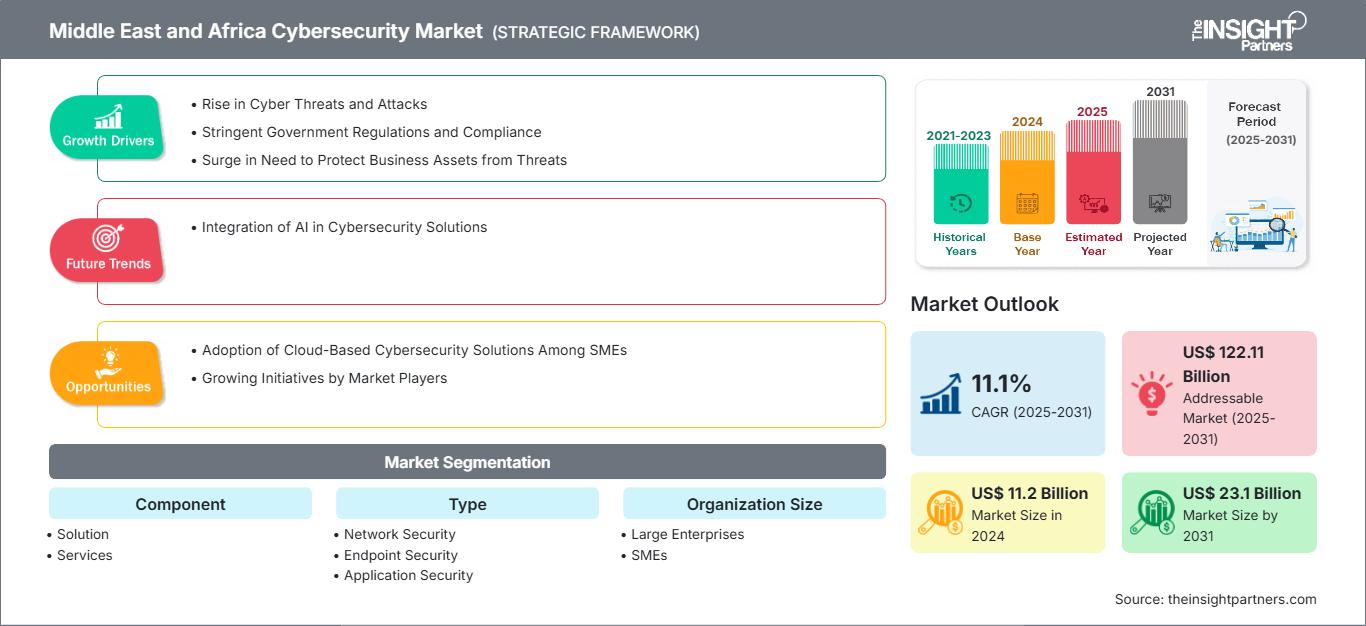
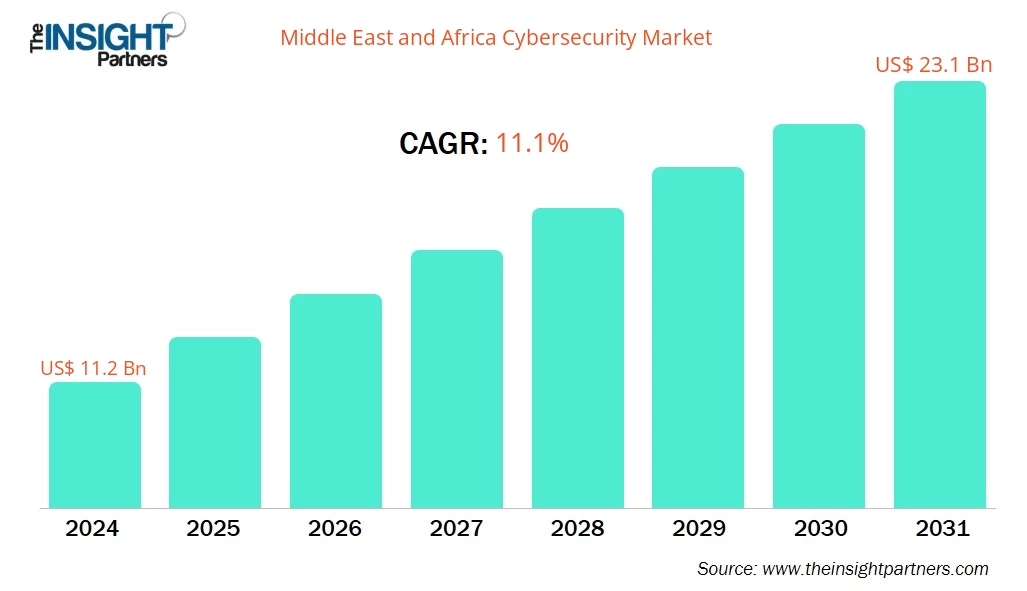
The Middle East and Africa Cybersecurity Market size is expected to reach US$ 23.1 Billion by 2031 from US$ 11.2 Billion in 2024. The market is estimated to record a CAGR of 11.1% from 2025 to 2031.
Executive Summary and Middle East and Africa Cybersecurity Market Analysis:
The Middle East and Africa cybersecurity market is segmented into South Africa, Saudi Arabia, the UAE, and the Rest of Middle East and Africa (MEA). In terms of revenue, in 2024, Saudi Arabia held the largest market share in the Middle East and Africa cybersecurity market. The Middle East and Africa consists of many countries, such as the UAE and Saudi Arabia, witnessing significant growth in adopting security solutions for protecting data due to the increasing number of cyberattacks. The rising frequency of thefts and frauds, and the increasing use cases of data breaches across verticals are a few factors driving the market growth in the region. For instance, according to the Cost of a Data Breach Report 2024 by IBM Corporation, the average cost of cyberattacks on organizations in the Middle East is US$ 8.75 million, nearly double the global average. According to the 2024 Cyber Security Report by Check Point Software Technologies, Nigerian organizations face an average of 3,759 cyberattacks each week. Ransomware has emerged as the most significant threat. Moreover, according to the Trend Micro Annual Cybersecurity Report for 2022, a total of 110 million threats were detected in Saudi Arabia. In addition, the UAE Cyber Security Council (CSC) has disclosed that the country faces over 200,000 cyberattacks daily. According to Liquid C2, the number of cyberattacks on businesses in South Africa has increased. South African businesses recorded a 62% in cyberattacks in 2022. According to AAG, in Q3 of 2022, Nigeria experienced a 1616% increase in data breaches, from 35,472 in Q2 to 608,765 in Q3.
Furthermore, measures taken by governments such as Saudi Vision 2030, We the UAE 2031, Bahrain Vision 2030, Qatar Vision 2030, are likely to present attractive prospects for cybersecurity providers in the coming years. Saudi Arabia launched the CyberIC program as part of its strategy to bolster national security and develop digital infrastructure. The program aims to support more than 60 cybersecurity startups and is being implemented in collaboration with the National Cybersecurity Authority (NCA). Moreover, governments in the Middle East recognize the importance of protecting critical infrastructure and data amid growing cyber threats and are implementing legislative initiatives to bolster cybersecurity. For instance, in September 2023, Saudi Arabia's first-ever data protection law came into effect. Companies operating in the Middle East must assess the impact of the new legislation on their data processing practices and ensure compliance with the new requirements.
Customize This Report To Suit Your Requirement
Get FREE CUSTOMIZATIONMiddle East & Africa Cybersecurity Market: Strategic Insights
-
Get Top Key Market Trends of this report.This FREE sample will include data analysis, ranging from market trends to estimates and forecasts.
Middle East and Africa Cybersecurity Market Segmentation Analysis:
- By Component, the Middle East and Africa Cybersecurity Market is segmented into Solution and Services. Solution held the largest share of the market in 2024.
- By Type, the Middle East and Africa Cybersecurity Market is segmented into Network Security, Endpoint Security, Application Security, Infrastructure Security, and Others. Network Security held the largest share of the market in 2024.
- By Organization Size, the Middle East and Africa Cybersecurity Market is segmented into Large Enterprises and SMEs. Large Enterprises held the largest share of the market in 2024.
- By Industry Vertical, the Middle East and Africa Cybersecurity Market is segmented into BFSI, IT and Telecom, Government, Healthcare, Manufacturing, Retail and Ecommerce, and Others. BFSI held the largest share of the market in 2024.
Middle East & Africa Cybersecurity Market Report Scope
| Report Attribute | Details |
|---|---|
| Market size in 2024 | US$ 11.2 Billion |
| Market Size by 2031 | US$ 23.1 Billion |
| CAGR (2025 - 2031) | 11.1% |
| Historical Data | 2021-2023 |
| Forecast period | 2025-2031 |
| Segments Covered |
By Component
|
| Regions and Countries Covered |
Middle East and Africa
|
| Market leaders and key company profiles |
|
Middle East & Africa Cybersecurity Market Players Density: Understanding Its Impact on Business Dynamics
The Middle East & Africa Cybersecurity Market is growing rapidly, driven by increasing end-user demand due to factors such as evolving consumer preferences, technological advancements, and greater awareness of the product's benefits. As demand rises, businesses are expanding their offerings, innovating to meet consumer needs, and capitalizing on emerging trends, which further fuels market growth.
Middle East and Africa Cybersecurity Market Outlook
Cyberattacks pose a significant risk to businesses, with incidents continuing to rise due to technological advancements. Computer malware, data breaches, and denial of service (DoS) are a few examples of cyber risks. In the first quarter of 2024, the Anti-Phishing Working Group (APWG) recorded 963,994 unique phishing websites, which declined to 877,536 in the second quarter. Despite this decrease, phishing continues to be a widespread problem. According to Interisle Consulting, phishing attacks globally saw a slight year-over-year increase, rising by 50,000 to nearly 1.9 million between May 2023 and April 2024. Similarly, according to the IBM Cost of a Data Breach Report 2024, the average cost of a data breach rose to US$ 4.88 million, up from US$ 4.45 million in 2023. This 10% increase marks the largest year-over-year jump since the onset of the pandemic.
Cyber threats have serious consequences for individuals, corporations, and governments. As a result, many firms are concentrating on data protection as part of their larger cybersecurity initiatives. Organizations can better protect themselves from data breaches and other types of cyberattacks by implementing a robust data protection strategy. Thus, with a continuous surge in cyberattack incidences, cybersecurity solutions have become essential for businesses to safeguard the sensitive information they collect or generate. Cybersecurity solutions offer business continuity through automated backups and disaster recovery solutions, minimizing downtime following an attack. It aids in scalability, allowing companies to modify security measures as they grow; moreover, opting for a service is more cost-effective than having an in-house security infrastructure, particularly for smaller businesses. According to a survey conducted by DigitalOcean in 2023, more than one-third of businesses had plans to raise their cybersecurity spending in the coming years. With continuous monitoring and rapid incident response, cybersecurity solutions help organizations respond quickly to threats, ultimately enabling them to protect their data, avoid financial losses, and maintain customer trust. Thus, an upsurge in the number of cyberattacks has bolstered the importance of cybersecurity to safeguard critical infrastructures and ensure data safety, fueling cybersecurity market growth.
Middle East and Africa Cybersecurity Market Country Insights
By country, the Middle East and Africa Cybersecurity Market is segmented into Saudi Arabia, the United Arab Emirates, South Africa, and the Rest of Middle East and Africa. Saudi Arabia held the largest share in 2024.
Saudi Arabia has emerged as a key target for cyber threats. The country's growing reliance on digital transformation, driven by its Vision 2030 initiatives, has significantly advanced its economic sectors, including oil and gas, finance, healthcare, and technology. However, this rapid digitalization has also exposed critical vulnerabilities, posing significant risks to its infrastructure and national security. Saudi Arabia is one of the countries that considers cybersecurity a matter of concern. According to Cyberlands.io, Saudi Arabia ranks second in the global ranking of the various countries' commitment toward cybersecurity, with 22.5 million cyberattacks per year, which cost US$ 6.5 million in 2021. According to a report from Kaspersky, over 7 million cyberattacks hit Saudi Arabia in the first two months of 2021. To reduce such losses and the occurrence of cyberattacks, Saudi Arabia is increasingly introducing a series of measures. One of these is the government’s decision to double the cybersecurity budget.
Middle East and Africa Cybersecurity Market Company Profiles
Some of the key players operating in the market include International Business Machines Corp, Microsoft Corp, Oracle Corp, SAP SE, Broadcom Inc, Cisco Systems Inc, Palo Alto Networks Inc, Fortinet Inc, CrowdStrike Holdings Inc, and Open Text Corp.
These players are adopting various strategies such as expansion, product innovation, and mergers and acquisitions to provide innovative products to their consumers and increase their market share.
Middle East and Africa Cybersecurity Market Research Methodology
The following methodology has been followed for the collection and analysis of data presented in this report:
Secondary Research
The research process begins with comprehensive secondary research, utilizing internal and external sources to gather qualitative and quantitative data for each market. Commonly referenced secondary research sources include, but are not limited to:
- Company websites, annual reports, financial statements, broker analyses, and investor presentations
- Industry trade journals and other relevant publications
- Government documents, statistical databases, and market reports
- News articles, press releases, and webcasts specific to companies operating in the market
Note:
All financial data included in the Company Profiles section has been standardized to US$. For companies reporting in other currencies, figures have been converted to US$ using the relevant exchange rates for the corresponding year.Primary Research
The Insight Partners conducts a significant number of primary interviews each year with industry stakeholders and experts to validate its data analysis and gain valuable insights. These research interviews are designed to:
- Validate and refine findings from secondary research
- Enhance the expertise and market understanding of the analysis team
- Gain insights into market size, trends, growth patterns, competitive dynamics, and future prospects
Primary research is conducted via email interactions and telephone interviews, encompassing various markets, categories, segments, and sub-segments across different regions. Participants typically include:
- Industry stakeholders: Vice Presidents, Business Development Managers, Market Intelligence Managers, and National Sales Managers
- External experts: Valuation specialists, research analysts, and key opinion leaders with industry-specific expertise

- Historical Analysis (2 Years), Base Year, Forecast (7 Years) with CAGR
- PEST and SWOT Analysis
- Market Size Value / Volume - Regional, Country
- Industry and Competitive Landscape
- Excel Dataset
Recent Reports
Testimonials

The Insight Partners' SCADA System Market report is comprehensive, with valuable insights on current trends and future forecasts. The team was highly professional, responsive, and supportive throughout. We are very satisfied and highly recommend their services.
RAN KEDEM Partner, Reali Technologies LTDs
I requested a report on a very specific software market and the team produced the report in a few days. The information was very relevant and well presented. I then requested some changes and additions to the report. The team was again very responsive and I got the final report in less than a week.
JEAN-HERVE JENN Chairman, Future Analytica
We worked with The Insight Partners for an important market study and forecast. They gave us clear insights into opportunities and risks, which helped shape our plans. Their research was easy to use and based on solid data. It helped us make smart, confident decisions. We highly recommend them.
PIYUSH NAGPAL Sr. Vice President, High Beam Global
The Insight Partners delivered insightful, well-structured market research with strong domain expertise. Their team was professional and responsive throughout. The user-friendly website made accessing industry reports seamless. We highly recommend them for reliable, high-quality research services
YUKIHIKO ADACHI CEO, Deep Blue, LLC.
This is the first time I have purchased a market report from The Insight Partners.While I was unsure at first, I visited their web site and felt more comfortable to take the risk and purchase a market report.I am completely satisfied with the quality of the report and customer service. I had several questions and comments with the initial report, but after a couple of dialogs over email with their analyst I believe I have a report that I can use as input to our strategic planning process.Thank you so much for taking the extra time and making this a positive experience.I will definitely recommend your service to others and you will be my first call when we need further market data.
JOHN SUZUKI President and Chief Executive Officer, Board Director, BK Technologies
I wish to appreciate your support and the professionalism you displayed in the course of attending to my request for information regarding to infectious disease IVD market in Nigeria. I appreciate your patience, your guidance, and the fact that you were willing to offer a discount, which eventually made it possible for us to close a deal. I look forward to engaging The Insight Partners in the future, all thanks to the impression you have created in me as a result of this first encounter.
DR CHIJIOKE ONYIA MANAGING DIRECTOR, PineCrest Healthcare Ltd.Reason to Buy
- Informed Decision-Making
- Understanding Market Dynamics
- Competitive Analysis
- Identifying Emerging Markets
- Customer Insights
- Market Forecasts
- Risk Mitigation
- Boosting Operational Efficiency
- Strategic Planning
- Investment Justification
- Tracking Industry Innovations
- Aligning with Regulatory Trends
Unlock Exclusive Report Discounts
Enquire Now



 Get Free Sample For