
Military Amphibious Vehicles Market Trends, Size & Forecast by 2034
Coverage: By Application (Ground Support Handling, Tactical Warfare, ISR, Military Transportation, and Others), Technology (Autonomous Vehicles and Manual Driven Vehicles), and Geography
- Status : Published
- Report Code : TIPRE00043437
- Category : Aerospace and Defense
- No. of Pages : 225
- Available Report Formats :


- Last update date : May 28, 2026


2025 Market Size
US$ 1.72 Bn
Base year value
2034 Forecast
US$ 3.06 Bn
Projected by 2034
CAGR 2026-2034
6.6 %
Growth rate
Addressable Market
US$ 21.60 Bn
(2026-2034)
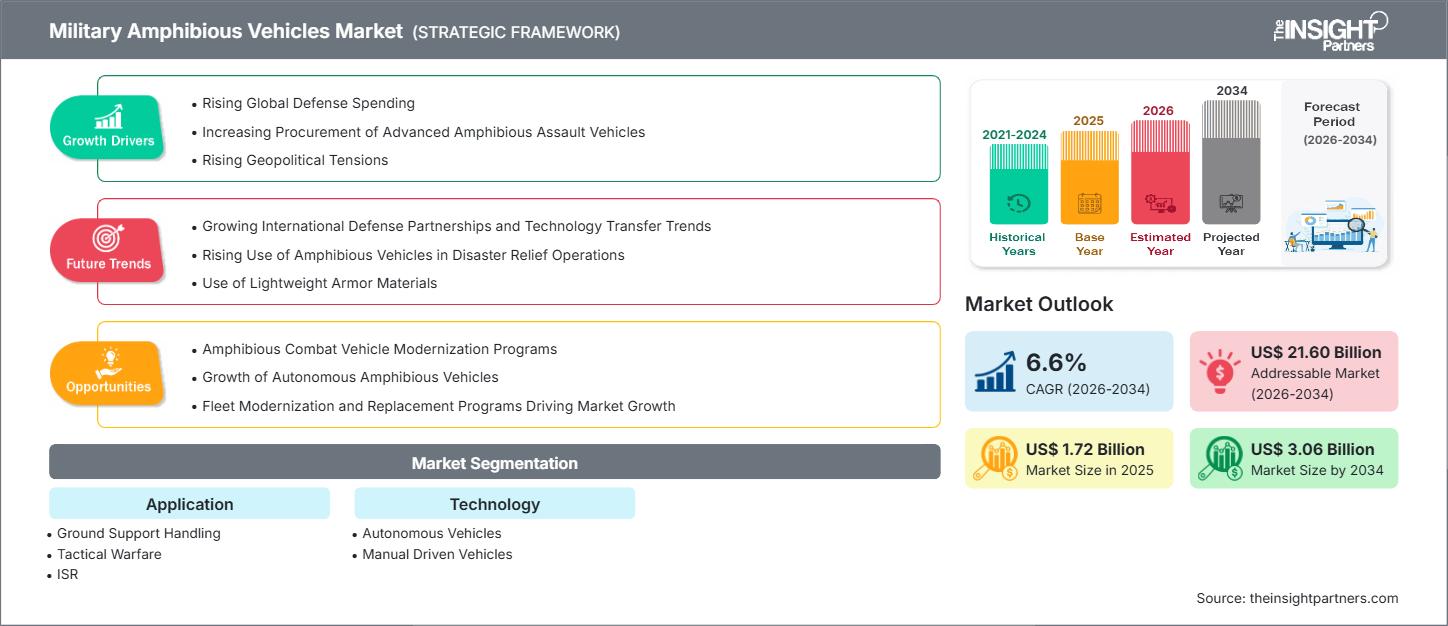
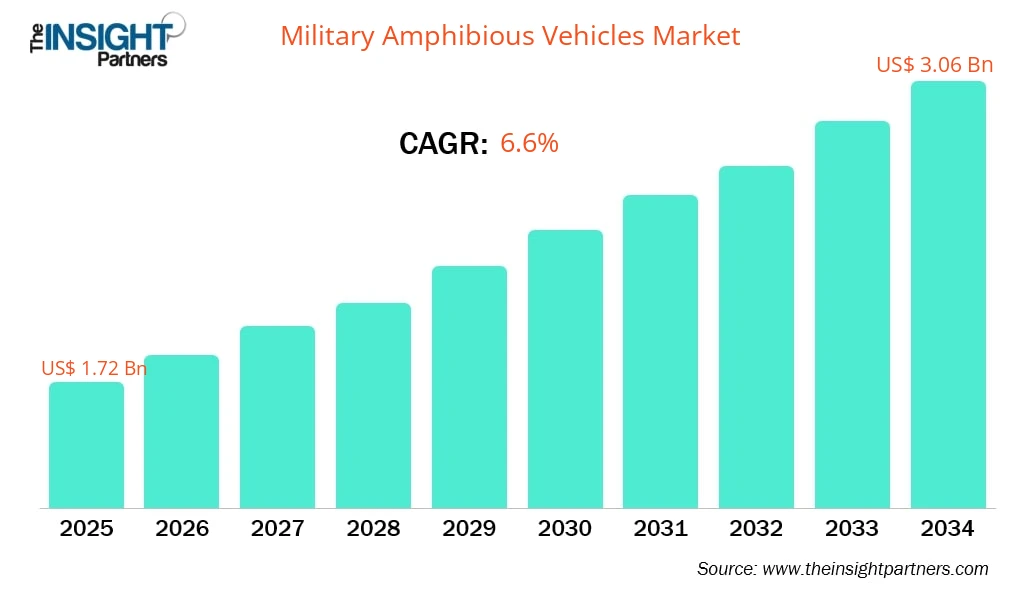
The military amphibious vehicles market size is projected to reach US$ 3.06 billion by 2034, from US$ 1.72 billion in 2025. The market is expected to register a CAGR of 6.6% during 2026–2034.
Military Amphibious Vehicles Market Analysis
Increasing geopolitical tensions, rising defense budgets, the growing modernization of naval and land forces, and a surging emphasis on multi-domain warfare capabilities drive the military amphibious vehicles market. Investments in advanced amphibious mobility solutions to enhance coastal and island defense and improve expeditionary warfare capabilities. The demand for improved water-to-land transition capabilities, better situational awareness technologies, lightweight composite materials, and greater mobility in complex terrain will continue to drive accelerate growth in this space. A growing emphasis on rapid deployment operations, disaster relief missions, humanitarian assistance, and asymmetric warfare will also support the increasing use of amphibious vehicles. However, high procurement and maintenance costs, complex engineering requirements, and long development cycles may hinder growth. Despite these challenges, consistent innovations and increasing investments in next-generation defense technologies are expected to provide opportunities for military amphibious vehicles in the coming years.
Military Amphibious Vehicles Market Overview
The military amphibious vehicle market is a global industry involved in designing, manufacturing & deploying specialized military platforms that can operate in both terrestrial & aquatic environments. These vehicles are utilized during amphibious assaults, for logistics, border security, disaster relief, and several other types of operations. These vehicles possess various capabilities, which include advanced mobility devices, specialized water propulsion methods, armored protection, surveillance systems, and communication systems that allow them to perform within multi-terrain, littoral, and other complex environments. Categories include amphibious armored personnel carriers (AAPCs), amphibious infantry fighting vehicles (AIFVs), amphibious assault vehicles, light amphibious tactical vehicles, and multi-role amphibious support platforms. These various systems are used by military forces, marine infantry units, homeland security agencies, and multi-national peacekeeping organizations to increase their operational flexibility, survivability, and quick deployability within coastal & inland bodies of water. Emerging technologies, such as autonomous navigation systems, hybrid engine technology, unmanned amphibious platforms, and AI-based battlefield management systems, will continue to broaden the military amphibious vehicle market.
Market Assessment and Insights
- North America dominated the market with 41.5% share in 2025.
- Asia Pacific is poised to grow at a CAGR of 7.6% over the forecast period.
- United States market is projected to grow at a CAGR of 7% over the forecast period.
- By Application, the Military Transportation segment accounted for the largest market share of 36.6% in 2025.
- By Technology, the Autonomous Vehicles segment is anticipated to witness the fastest growth, registering a CAGR of 7.7% over the forecast period
- The report profiles key industry players such as BAE Systems Plc, General Dynamics Corp, Thales SA, Lockheed Martin Corp, Rheinmetall AG, Tata Motors Ltd, Ashok Leyland Ltd, Oshkosh Corp, KMW+NEXTER Defense Systems NV, Patria Oyj, while also analyzing key developments in novel ideas, disruptive products, and innovative services that could reshape the future market and reveal emerging themes across the industry.
Source: The Insight Partners' analysis based on proprietary research, government publications, company annual reports, investor presentations, industry databases, and expert interviews.
● REPORT CUSTOMIZATION
Tailor This Report To Align With Your Specific Business Requirements
This report can be customized to align precisely with your business objectives, scope, and target markets. Customization options include tailored segmentation, geography, competitive analysis, and strategic insights to support informed decision-making.
Customize This Report →WHAT YOU CAN ADJUST
- ● Segmentations
- ● Geography
- ● Competitive Analysis
- ● Language Preferences
Military Amphibious Vehicles Market: Strategic Insights
-
Get Top Key Market Trends of this report.This FREE sample will include data analysis, ranging from market trends to estimates and forecasts.
Military Amphibious Vehicles Market Drivers and Opportunities
Market Drivers:
- Rising Military Expenditure Driving Armored Vehicle Demand: A substantial share of defense spending growth has been concentrated in Europe and Asia Pacific, where military budgets increased by 14% and 8.1%, respectively. Governments in these regions are prioritizing the modernization of land forces, armored fleets, and rapid mobility platforms to strengthen combat readiness and territorial defense capabilities.
- Increasing Procurement of Advanced Amphibious Assault Vehicles Driving Market Growth: The growing procurement of next-generation amphibious assault vehicles by defense forces is driving the military amphibious vehicles market.
- Emerging Geopolitical Tensions: Amphibious vehicles are crucial in these operations as they enable armed forces to seamlessly transition between land and water environments while transporting troops, weapons, and logistical supplies efficiently.
- Growing Investments in Electric Battlefield Amphibious Vehicles: Rising investments in electric battlefield amphibious vehicles accelerate the military amphibious vehicles market growth through enhanced efficiency and modernization globally.
- Military Modernization Programs: Military modernization programs increase demand for advanced amphibious vehicles, boosting market growth through improved mobility, versatility, and operational readiness worldwide.
Market Opportunities:
- Amphibious Combat Vehicle Modernization Programs: Government initiative and focus to enhance the capabilities of its amphibious combat vehicle (ACV) platform creates demand for next-generation amphibious vehicles.
- Growth of Autonomous Armored Vehicles: Defense organizations worldwide are investing in autonomous vehicle systems to enhance operational efficiency, reduce risks to personnel, and improve mission effectiveness in complex combat environments.
- Fleet Modernization and Replacement Programs Driving Market Growth: A key modernization-driven factor supporting the military amphibious vehicles market is the ongoing replacement of aging amphibious fleets with advanced, multi-role platforms capable of operating across complex littoral environments.
- Integration of Advanced Communication Systems: Integration of advanced communication systems in military amphibious vehicles enhances real-time coordination, situational awareness, and interoperability, driving operational efficiency and market growth.
- Adoption of Hybrid and Electric Propulsion: Adoption of hybrid and electric propulsion systems creates opportunities for growth, efficiency, and sustainability in military amphibious vehicle markets.
Military Amphibious Vehicles Market Report Segmentation Analysis
The military amphibious vehicles market is segmented into distinct categories to provide a detailed understanding of its material type and end user:
By Application:
- Ground Support Handling: Military amphibious vehicles used for ground support handling are designed to assist operations through logistics coordination, equipment movement, recovery missions, and operational support in coastal, riverine, and amphibious combat environments.
- Tactical Warfare: The tactical warfare segment represents a major application area for military amphibious vehicles, focused on combat operations, troop engagement, and battlefield dominance in coastal, riverine, and littoral environments.
- ISR: Military amphibious vehicles used for intelligence, surveillance, and reconnaissance (ISR) applications are becoming important in modern defense operations due to the growing need for real-time situational awareness across coastal, riverine, and littoral environments.
- Military Transportation: Amphibious transport vehicles are designed to provide high levels of protection against ballistic threats, explosive risks, and harsh environmental conditions while maintaining mobility across coastal zones, rivers, wetlands, and other difficult terrain interfaces.
- Others: The other vehicles are designed to perform mission-specific tasks while ensuring personnel safety and operational efficiency in complex land–water interface and high-risk operational zones.
By Technology:
- Autonomous Vehicles
- Manual Driven Vehicles
By Geography:
- North America
- Europe
- Asia Pacific
- Latin America
- Middle East & Africa
Military Amphibious Vehicles Market Report Scope
| Report Attribute | Details |
|---|---|
| Market size in 2025 | US$ 1.72 Billion |
| Market Size by 2034 | US$ 3.06 Billion |
| Global CAGR (2026 - 2034) | 6.6% |
| Historical Data | 2021-2024 |
| Forecast period | 2026-2034 |
| Segments Covered |
By Application
|
| Regions and Countries Covered |
North America
|
| Market leaders and key company profiles |
|
Military Amphibious Vehicles Market Players Density: Understanding Its Impact on Business Dynamics
The Military Amphibious Vehicles Market is growing rapidly, driven by increasing end-user demand due to factors such as evolving consumer preferences, technological advancements, and greater awareness of the product's benefits. As demand rises, businesses are expanding their offerings, innovating to meet consumer needs, and capitalizing on emerging trends, which further fuels market growth.
Military Amphibious Vehicles Market Share Analysis by Geography
Asia Pacific is witnessing the fastest growth, driven by its expanding construction industry and demand for smart homes. Emerging markets in Latin America and the MEA offer untapped opportunities for interior folding door providers.
The military amphibious vehicles market experiences varying growth rates across different regions. Below is a summary of market share and trends by region:
1. North America
- With rising defense spending and modernization plans, increased procurement of modern amphibious assault vehicles to facilitate rapid operations in coastal areas and at sea.
- Greater use of networked amphibious combat vehicles and ships to move troops from ship to shore increases interoperability and assists with multi-domain littoral warfare capabilities.
2. Europe
- Increased threats to coastal border security and NATO modernization efforts create more of a greater need for amphibious hauling vessels and combat platforms.
- Growing trend toward modular and corrosion-resistant amphibious systems built with the latest propulsion and surveillance systems for conducting joint operations.
3. Asia Pacific
- Growing tensions in the maritime domain and extensive naval modernization activities in China, India, Japan, and South Korea are driving demand for amphibious vehicles.
- The rapid growth of multi-role (or multi-mission) amphibious platforms is enabling more effective conduct of amphibious operations, disaster response operations, and operations in an island chain environment.
4. South and Central America
- Limited purchase of amphibious vehicles for procurement is driven by calculated military upgrade plans and riverine warfare needs in Brazil.
- An increasing number of multi-terrain patrol ready-to-react to disaster and hurricane scenarios within the Amazon basin, or using coastal resilience operations.
5. Middle East and Africa
- Threats to coastal areas, with an urgent need for operational mobility in areas vulnerable to flooding (regions bordering water bodies), are causing the military to adopt amphibious vehicles.
- Due to improvements in infrastructure in border areas and developing cooperative relationships with foreign governments to execute humanitarian efforts, there is a growing number of amphibious vehicle purchases as well.
High Market Density and Competition
Competition is strong due to the presence of established players such as BAE Systems Plc (UK), Thales SA (France), and Lockheed Martin Corp (US). Regional and niche providers such as Rheinmetall AG (Germany) and General Dynamics Corp (US) add to the competitive landscape across different regions.
A highly competitive environment drives companies to offer unique products and services, including:
- Vertical integration and scale
- Technological partnerships
- Geographic footprint
Opportunities and Strategic Moves
- Consolidation through mergers and acquisitions
- Investment in automation
- Diversifying into high-growth verticals
- Sustainability and eco-friendly solutions
Major Companies operating in the Military Amphibious Vehicles Market are:
- Ashok Leyland Ltd (India)
- BAE Systems Plc (UK)
- General Dynamics Corp (US)
- Rheinmetall AG (Germany)
- Tata Motors Ltd (India)
- Thales SA (France)
- Lockheed Martin Corp (US)
- Oshkosh Corp (US)
- Patria Oyj (Finland)
- KMW+NEXTER Defense Systems NV (Netherlands)
Other companies analyzed during the course of research:
- Arquus SAS
- Otokar Otomotiv ve Savunma Sanayi A.Ş.
- IVECO Defence Vehicles S.p.A.
- Singapore Technologies Engineering Ltd
- Navistar Defense LLC
- Mahindra Defence Systems Ltd
- NIMR Automotive LLC
- Paramount Group Ltd
- SC Group Global Ltd (Supacat brand)
- Force Protection Industries Inc.
- EXCALIBUR ARMY spol. s r.o.
- Denel Land Systems SOC Ltd
- Hyundai Rotem Company
- Hanwha Aerospace Co., Ltd.
- China North Industries Group Corporation Limited
- FNSS Savunma Sistemleri A.Ş.
- BMC Otomotiv Sanayi ve Ticaret A.Ş.
- Armoured Vehicles Nigam Limited (AVNL)
- Tatra Defence Vehicle a.s.
- John Cockerill Defense SA
- JSC Research and Production Corporation UralVagonZavod
- GAZ Group LLC
- Dongfeng Motor Corporation
- JCBL Limited
- INKAS Armored Vehicle Manufacturing Ltd.
Disclaimer: The companies listed above are not ranked in any particular order.
Military Amphibious Vehicles Market News and Recent Developments
- Düsseldorf-based Rheinmetall AG and the Spanish Technology Group Indra have signed an MoU for the Production of Military Vehicle Systems: In March 2026, Düsseldorf-based Rheinmetall AG and the Spanish technology Group Indra signed a memorandum of understanding to deepen their strategic cooperation, particularly in the production of military vehicle systems for European and Latin American Armed Forces.
- Oshkosh Defense LLC Introduced Multi-Mission Autonomous Vehicles: In October 2025, Oshkosh Defense LLC, an Oshkosh Corporation business, will introduce its Family of Multi-Mission Autonomous Vehicles (FMAV) at the Association of the United States Army (AUSA) Annual Meeting & Exposition, October 13–15, 2025, in Hall B – Booth 1625. As the US Army accelerates its transformation, Oshkosh is demonstrating how the FMAV platforms support modernization priorities for long-range precision fires, resilient formations, and scalable autonomy, delivering ready-now, production-based solutions that reduce risk and increase capabilities for Soldiers in contested environments.
Military Amphibious Vehicles Market Report Coverage and Deliverables
The "Military Amphibious Vehicles Market Size and Forecast (2021–2034)" report provides a detailed analysis of the market covering below areas:
- Military amphibious vehicles market size and forecast at global, regional, and country levels for all the segments covered under the scope
- Military amphibious vehicles market trends, as well as dynamics such as drivers, restraints, and key opportunities
- Detailed PEST and SWOT analysis
- Military amphibious vehicles market analysis covering key trends, global and regional framework, major players, regulations, and recent market developments
- Industry landscape and competition analysis covering market concentration, heat map analysis, prominent players, and recent developments for the military amphibious vehicles market
- Detailed company profiles
Frequently Asked Questions
2. Long Procurement Cycles
3. Supply Chain Disruptions
1. Autonomous Vehicles
2. Manual Driven Vehicles
1. Ground Support Handling
2. Tactical Warfare
3. ISR
4. Military Transportation
5. Others
1. Amphibious Combat Vehicle Modernization Programs
2. Growth of Autonomous Armored Vehicles
3. Fleet Modernization and Replacement Programs Driving Market Growth

- Comprehensive Market Sizing and Forecast Analysis
- Detailed Segmentation Analysis
- In-Depth Market Dynamics Assessment
- Regional and Country-Level Insights
- Competitive Landscape and Company Benchmarking
- Strategic Business Intelligence
Recent Reports
Testimonials

The Insight Partners provided valuable market intelligence that supported our global go-to-market strategy. Their team was professional, responsive, and attentive to our feedback, providing thoughtful analysis and helpful methodological clarifications throughout the project.
Junmo Kim Chief Financial Officer (CFO), Enertech Co., Ltd.
The Insight Partners' SCADA System Market report is comprehensive, with valuable insights on current trends and future forecasts. The team was highly professional, responsive, and supportive throughout. We are very satisfied and highly recommend their services.
RAN KEDEM Partner, Reali Technologies LTDs
I requested a report on a very specific software market and the team produced the report in a few days. The information was very relevant and well presented. I then requested some changes and additions to the report. The team was again very responsive and I got the final report in less than a week.
JEAN-HERVE JENN Chairman, Future Analytica
We worked with The Insight Partners for an important market study and forecast. They gave us clear insights into opportunities and risks, which helped shape our plans. Their research was easy to use and based on solid data. It helped us make smart, confident decisions. We highly recommend them.
PIYUSH NAGPAL Sr. Vice President, High Beam Global
The Insight Partners delivered insightful, well-structured market research with strong domain expertise. Their team was professional and responsive throughout. The user-friendly website made accessing industry reports seamless. We highly recommend them for reliable, high-quality research services
YUKIHIKO ADACHI CEO, Deep Blue, LLC.
This is the first time I have purchased a market report from The Insight Partners.While I was unsure at first, I visited their web site and felt more comfortable to take the risk and purchase a market report.I am completely satisfied with the quality of the report and customer service. I had several questions and comments with the initial report, but after a couple of dialogs over email with their analyst I believe I have a report that I can use as input to our strategic planning process.Thank you so much for taking the extra time and making this a positive experience.I will definitely recommend your service to others and you will be my first call when we need further market data.
JOHN SUZUKI President and Chief Executive Officer, Board Director, BK Technologies
I wish to appreciate your support and the professionalism you displayed in the course of attending to my request for information regarding to infectious disease IVD market in Nigeria. I appreciate your patience, your guidance, and the fact that you were willing to offer a discount, which eventually made it possible for us to close a deal. I look forward to engaging The Insight Partners in the future, all thanks to the impression you have created in me as a result of this first encounter.
DR CHIJIOKE ONYIA MANAGING DIRECTOR, PineCrest Healthcare Ltd.Reason to Buy
- Informed Decision-Making
- Understanding Market Dynamics
- Competitive Analysis
- Identifying Emerging Markets
- Customer Insights
- Market Forecasts
- Risk Mitigation
- Boosting Operational Efficiency
- Strategic Planning
- Investment Justification
- Tracking Industry Innovations
- Aligning with Regulatory Trends





 Get Free Sample for