
Mulcher Attachment Equipment Market Growth, Demand & Size by 2034
Coverage: by Vehicle Type (Compact Track Loaders, Excavators, Skid Steers); Capacity (Up to 110 HP, 110 to 200 HP, 200 - 350 HP, More than 350 HP); Application (Infrastructure or Road Construction, Land Clearing, Plantation/Agriculture, Reclamation, Right-of-way Maintenance, Special Applications) , and Geography (North America, Europe, Asia Pacific, and South and Central America)
- Status : Data Released
- Report Code : TIPRE00010145
- Category : Manufacturing and Construction
- No. of Pages : 150
- Available Report Formats :


- Last update date : July 27, 2026


2025 Market Size
US$ 552.81 Mn
Base year value
2034 Forecast
US$ 1,020.75 Mn
Projected by 2034
CAGR 2026-2034
7.05 %
Growth rate
Addressable Market
US$ 7,103.12 Mn
(2026-2034)
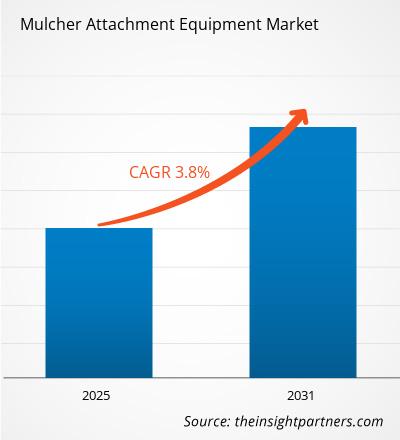
The Mulcher Attachment Equipment Market is projected to grow from US$ 552.81 Million in 2025 to US$ 1,020.75 Million by 2034, registering a CAGR of 7.05% during 2026–2034. Demand is tied to mechanized vegetation control, land clearing productivity, and equipment utilization across construction, forestry, agriculture, reclamation, and right-of-way maintenance.
Across North America, the Mulcher Attachment Equipment Market size is supported by road renewal, wildfire mitigation, utility corridor upkeep, and contractor rental penetration. The region is estimated to expand at a 6.6–7.2% CAGR during 2026–2034 as public agencies and private land managers shift toward attachments that reduce labor dependency, limit debris hauling, and improve site turnaround.
Mulcher Attachment Equipment Market Assessment and Insights
- North America held 34–37% share in 2025 and is projected to grow at a 6.6–7.2% CAGR during 2026–2034, supported by forestry contractors, wildfire fuel reduction, and road maintenance fleets.
- US accounted for 78–82% of North America in 2025 and is expected to grow at a 6.7–7.3% CAGR, led by utility and municipal users.
- Europe represented 25–28% share in 2025 and is forecast to grow at a 6.2–6.8% CAGR, with Germany, France, the UK, Italy, and Spain leading adoption.
- Asia Pacific captured 20–23% share in 2025 and is expected to grow at a 7.6–8.3% CAGR as China, India, Japan, South Korea, and Australia expand infrastructure and plantation mechanization.
- Largest Segment Excavators held 39–43% market share in 2025, growing at a 6.8–7.4% CAGR due to reach, slope access, and heavy vegetation handling.
- High Growth Segment Right-of-way Maintenance held 14–17% market share in 2025, advancing at a 7.9–8.6% CAGR as utility corridors and transport networks require recurring clearance.
- Key companies analyzed in detail: Bandit Industries, Inc., CNH Industrial America LLC, DENIS CIMAF Inc., Dougherty Forestry Manufacturing, FAE Group S.p.A., Fecon LLC, Foremost Industries LP, Lamtrac Global Inc., Loftness Specialized Equipment, Inc., and Morbark, LLC.
Source: The Insight Partners' analysis based on proprietary research, government publications, company annual reports, investor presentations, industry databases, and expert interviews.
The design of the machinery has developed from simple brush clearing to carrier-compatible hydraulic heads, more durable rotors, carbide cutting tools, and system controls that balance flow, pressure, and workload requirements. There is a change in production trends with the emergence of specialist equipment manufacturers targeting excavator, skid steer and compact track loader carriers through modular products.
Growth of the Mulcher Attachment Equipment Market will be driven by a shift from one-off brush clearing to vegetation management, whereby longevity and uptime will play a role in buying decisions. Future demand will increase geographically in developing countries due to fast-track ground preparation required for road constructions, plantations, expanding transmission lines, and land reclamation initiatives. Pressure from regulations on the reduction of open burning and soil conservation will support mechanical mulching.
Mulcher Attachment Equipment Market Report Scope
| Report Attribute | Details |
|---|---|
| Market size in 2025 | US$ 552.81 Million |
| Market Size by 2034 | US$ 1,020.75 Million |
| Global CAGR (2026 - 2034) | 7.05% |
| Historical Data | 2021-2024 |
| Forecast period | 2026-2034 |
Mulcher Attachment Equipment Market Analysis
Demand is being shaped by infrastructure expansion, forestry management, firebreak creation, and utility vegetation control. The Mulcher Attachment Equipment Market growth is strongest where operators can mount one attachment across multiple jobs, reducing idle fleet cost. Contractors increasingly compare clearing productivity, fuel consumption, tooth life, and service access before purchase because attachment downtime directly affects project schedules and margin realization.
The supply chain encompasses rotor suppliers, tooling suppliers, hydraulic component suppliers, attachment suppliers, equipment dealers, rental organizations, and end-users. Supply conditions continue to be influenced by the cost of steel, carbide supply, and carrier fitment. Manufacturers that clearly specify flow-rate requirements and offer mounting kits can reach out to a broader customer base, whereas dealers benefit from offering attachments along with skid steers, excavators, and compact track loaders.
The competition is moderately specialized, with FAE Group S.p.A., Fecon LLC, Bandit Industries, Inc., DENIS CIMAF Inc., Loftness Specialized Equipment, Inc., and Morbark, LLC offering competing products in terms of cutting capability, rotor construction, depth of dealer network, and product specialization. Carrier integration is furthered by CNH Industrial America LLC, while Lamtrac Global Inc., Foremost Industries LP, and Dougherty Forestry Manufacturing serve in the specialty heavy forestry and land management market segments.
Investment trends favor automation, remote operation, rental fleet suitability, and compact carrier compatibility. The Mulcher Attachment Equipment Market analysis indicates that strategic positioning depends less on broad catalog size and more on matching attachment capacity to specific vegetation density, terrain, and carrier hydraulics. Companies with durable wear parts and fast replacement networks can defend margins even when equipment buyers delay large capital purchases.
● REPORT CUSTOMIZATION
Tailor This Report To Align With Your Specific Business Requirements
This report can be customized to align precisely with your business objectives, scope, and target markets. Customization options include tailored segmentation, geography, competitive analysis, and strategic insights to support informed decision-making.
Customize This Report →WHAT YOU CAN ADJUST
- ● Segmentations
- ● Geography
- ● Competitive Analysis
- ● Language Preferences
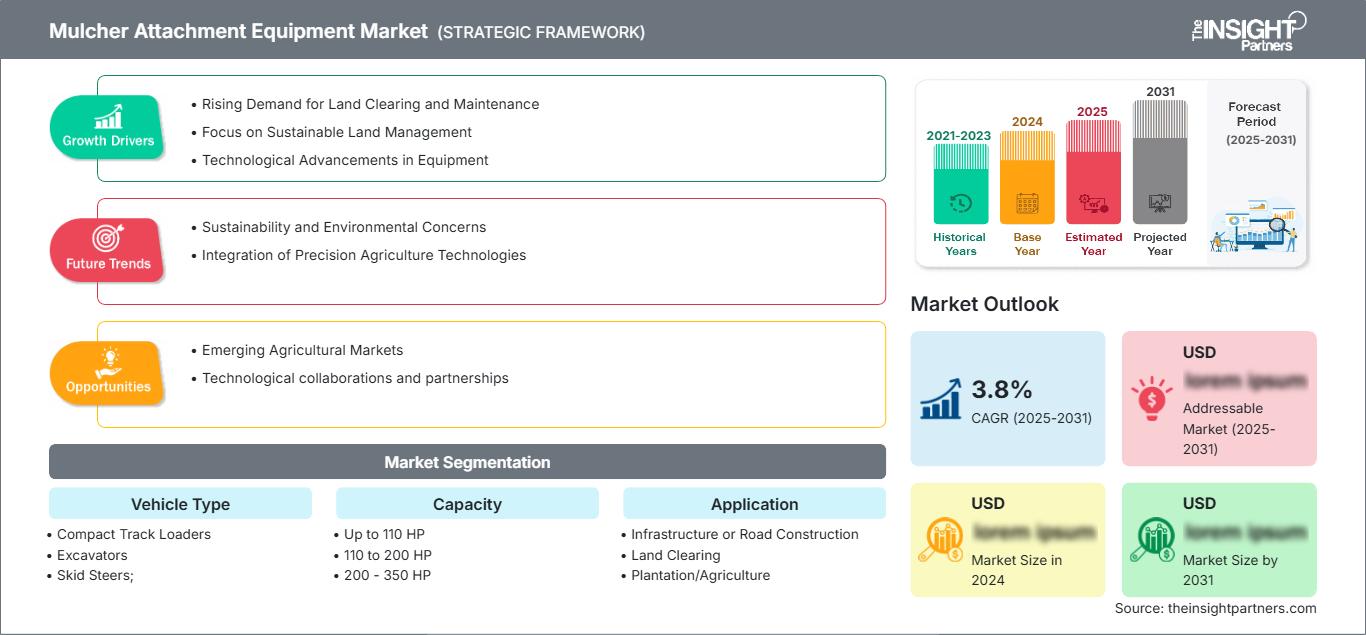
Mulcher Attachment Equipment Market: Strategic Insights
Regional Insights
North America Mulcher Attachment Equipment Market
North America accounted for 34–37% share in 2025 and is expected to grow at a 6.6–7.2% CAGR during 2026–2034. The Mulcher Attachment Equipment Market share is supported by municipal road departments, private land clearing contractors, wildfire mitigation programs, and pipeline or powerline corridor maintenance. Adoption is strongest where high-flow skid steers and compact track loaders are already deployed. Fleet owners in the region prioritize attachments that reduce manual chainsaw work and eliminate debris hauling. Contractors also value faster mobilization across residential lots, transportation corridors, and utility easements. Demand is reinforced by rental penetration because users can access specialized heads without purchasing dedicated forestry machines, while dealer parts availability supports repeat utilization across seasonal clearing cycles.
U.S. Mulcher Attachment Equipment Market
The US represented 78–82% of North America in 2025 and is projected to expand at a 6.7–7.3% CAGR. The demand is linked to vegetation management cycles for utilities, roadside management, storm clean-up, fire fuel reduction, and small contractor land clearing. Usage patterns include skid steer and compact track loader attachments for small areas and excavator attachments on slopes and drainage banks. Brand presence is extensive, with Bandit Industries, Inc., Fecon LLC, Morbark, LLC, Loftness Specialized Equipment, Inc., and CNH Industrial America LLC supplying national dealer networks. Consumers value hydraulic compatibility, tooth replacement costs, and repair time. Rental companies are becoming more significant as contractors require temporary equipment for right-of-way, brush management, and lot preparation.
Europe Mulcher Attachment Equipment Market
Europe held 25–28% share in 2025 and is forecast to grow at a 6.2–6.8% CAGR, with Germany leading due to forestry mechanization, road maintenance, and equipment quality requirements. The UK has a continuous demand from vegetation maintenance contractors who maintain the rail, roadside, and utility right-of-ways with compact carriers and mulching that complies with maintenance requirements. Germany takes advantage of the good availability of machinery and specialist forestry contractors to have increased use of excavators and high-power attachments. France, Italy, and Spain participate in the market through applications such as vineyard, orchard, urban and fire-prone areas management. Demand is influenced by emission concerns, debris removal and difficult terrains.
APAC Mulcher Attachment Equipment Market
APAC accounted for 20–23% share in 2025 and is projected to grow at a 7.6–8.3% CAGR, the fastest regional pace. China leads adoption due to infrastructure corridors and land improvement, while India is scaling road construction, plantation upkeep, and reclamation activities. Japan and South Korea emphasize compact equipment for constrained terrain, while Australia uses heavy-duty attachments for vegetation control, firebreaks, and rural infrastructure. Policy support for transport networks, agricultural mechanization, and sustainable clearing practices should lift attachment demand across mixed applications.
Middle East & Africa Mulcher Attachment Equipment Market
The Middle East & Africa is expected to grow at a 5.8–6.4% CAGR during 2026–2034. Saudi Arabia and the UAE lead regional demand through infrastructure corridors, industrial zones, and landscaping projects linked to urban expansion and energy asset maintenance. South Africa contributes through forestry plantations, utility corridors, and municipal vegetation management, while the rest of MEA remains project-based. Demand is shaped by harsh operating conditions, dealer support needs, and the value of attachments that can serve land clearing, reclamation, and roadside maintenance.
Segmentation Analysis
Vehicle Type
Vehicle Type is expected to grow at a 6.9–7.5% CAGR during 2026–2034 as users match attachment performance with carrier hydraulics, ground pressure, reach, and maneuverability. The Mulcher Attachment Equipment Market scope across carriers is broad because compact machines serve residential and municipal jobs, while excavators and high-horsepower units handle slopes, stumps, and dense vegetation.
- Compact Track Loaders are favored for lower ground pressure, traction, and stable operation on soft or uneven terrain, making them important for forestry edges, firebreaks, and mixed land clearing.
- Excavators lead heavy-duty applications because reach, boom articulation, and slope access allow operators to clear banks, drainage lines, and dense vegetation without repositioning carriers frequently.
- Skid Steers remain strategically important for contractors needing quick attachment swaps, strong maneuverability, and cost-effective deployment in road shoulders, urban lots, farms, and utility maintenance.
Capacity
Capacity is projected to grow at a 7.0–7.6% CAGR during 2026–2034 as buyers increasingly select heads based on horsepower bands, hydraulic flow, rotor torque, and vegetation density. Lower capacity units support farms and municipalities, while higher capacity categories serve industrial clearing, reclamation, and forestry contractors requiring deeper cutting and longer duty cycles.
- Up to 110 HP attachments support farms, municipalities, rental users, and compact carriers where maneuverability, lower acquisition cost, and lighter vegetation management are more important than maximum throughput.
- 110 to 200 HP units address professional contractors handling mixed brush, small trees, roadside clearance, and recurring land maintenance with stronger hydraulic performance and broader carrier compatibility.
- 200 - 350 HP capacity serves demanding forestry, reclamation, and infrastructure sites where dense vegetation, larger stems, and longer work cycles require robust frames and high-torque rotors.
- More than 350 HP equipment is used in intensive land clearing, right-of-way expansion, and severe-duty forestry work where productivity per hour and durability justify higher ownership costs.
Application
Application is forecast to expand at a 7.2–7.8% CAGR during 2026–2034, according to the Mulcher Attachment Equipment Market forecast, as users shift from manual clearing and debris hauling toward in-situ mulching. Infrastructure, land clearing, agriculture, reclamation, right-of-way maintenance, and special applications each require distinct tooling, making application-specific design a major differentiator in the Mulcher Attachment Equipment Market.
- Infrastructure or Road Construction uses mulchers for shoulder clearing, site preparation, and access route development, where contractors need rapid vegetation removal before grading, drainage, and civil works begin.
- Land Clearing remains a core use case because attachments can cut, grind, and distribute organic material on-site, reducing trucking, burning, and manual labor requirements.
- Plantation/Agriculture demand is tied to orchard maintenance, crop residue management, fence-line clearing, and land preparation, especially where operators already own compatible tractors or compact carriers.
- Reclamation applications include post-mining, industrial land restoration, and brownfield vegetation control, where mulching helps stabilize soil cover while preparing sites for reuse or ecological recovery.
- Right-of-way Maintenance is strategically important because utilities, railways, pipelines, and roads require repeat vegetation cycles, predictable productivity, and attachments that can operate near sensitive assets.
- Special Applications include wildfire fuel reduction, habitat management, storm cleanup, and municipal green-area maintenance, where operators value maneuverability, safety, and low-disturbance debris processing.
Opportunity Snapshot
| Application | Revenue Contribution | Trend Tag | Adoption Stage |
| Infrastructure or Road Construction | High | Road Prep | Scaling |
| Land Clearing | High | Site Clearing | Mature |
| Plantation/Agriculture | Medium | Orchard Care | Scaling |
| Reclamation | Medium | Land Restore | Emerging |
| Right-of-way Maintenance | High | Utility Access | Scaling |
| Special Applications | Medium | Firebreaks | Emerging |
Mulcher Attachment Equipment Market Growth Drivers and Impact Analysis
Mechanized Vegetation Control Replacing Manual Clearing
The equipment operator utilizes attachments that allow for the cutting and processing of vegetative growth in one go instead of chainsaws, dozers, hauling, and burning. The effect is most pronounced in areas such as roadsides, utility corridors, rural property, and forest margins, where disposal of vegetation waste is costly and time-consuming. In addition, mulching creates a protective cover of organic material in comparison to leaving the area clear of vegetation. It is due to this factor that the attachment usage will increase since the same machine will be used to conduct different operations.
Infrastructure and Utility Corridor Expansion
Vegetation clearance is necessary before the installation of transport routes, renewable energy interconnections, pipelines, and power lines. Mulchers are ideal since they can operate in narrow strips, uneven shoulders, and places where heavy machinery would have to be brought into the field. It is becoming increasingly important for utility companies to have consistent clearance periods and to minimize the removal of vegetative matter close to infrastructure. This results in the need by manufacturers for mulchers that can perform continuously, discharge effectively, and are compatible with standard carrier equipment.
Carrier Versatility and Rental Fleet Adoption
Contractors are opting more often for attachments that transform their skid steers, compact track loaders, and excavators into tools that help with vegetation control. Such attachments eliminate the need for specialized forestry machines and provide fast returns on investment for smaller players. There is an advantage for rental businesses since mulcher attachments are able to cater to the seasonal needs of landscapers, municipal authorities, agricultural operators, and utility contractors. The attachment provides an opportunity for addressing non-specialized users, making hydraulic systems less complicated, improving safety, and documenting compatibilities.
Mulcher Attachment Equipment Market Future Trends
Smarter Hydraulic Matching and Performance Monitoring
Future product development will increasingly focus on attachments that sense carrier flow, pressure, temperature, and rotor load, then help operators maintain productive cutting speeds. Mulcher Attachment Equipment Market trends point toward telematics-enabled maintenance alerts, automatic calibration, and usage tracking that support rental fleets and large contractors. These capabilities can reduce setup errors, prevent overheating, and extend tool life across mixed carriers. As buyers collect more job-site data, attachment selection will become more evidence-based, with productivity per fuel unit and downtime per operating hour influencing procurement decisions.
Growth of Compact and Remote-Controlled Platforms
Compact carriers and remote-controlled equipment are forecasted to become increasingly relevant on steep terrain, city green spaces, railroad perimeters, canals, and tight urban environments. Such machines can help operators stay safe from hazards such as slopes, flying debris, and unsafe terrain. Attachment makers must produce light-duty heads, effective rotors, and guarded hydraulic systems for use on lower-horsepower machines. This development is likely to increase the utilization of these machines by municipalities, landscapers, and environmental agencies who require precise clearance rather than heavy forestry production.
Mulcher Attachment Equipment Market Opportunities
Application-Specific Wear Parts and Service Bundles
Manufacturers can develop high-margin products by bundling up teeth, counter blades, belts, seals, and maintenance schedules tailored to the particular application being carried out, like rocky reclamation, roadside brush, orchard waste, or heavy forestry. Most buyers tend to misjudge their wear costs until they expose their attachments in tough situations; hence, lifecycle management is key. A dealer can bundle together their solutions to lower downtime and improve customer loyalty, particularly those companies renting attachments where consistent maintenance is required. This is also an opportunity to implement digital ordering of spare parts.
Localized Distribution in High-Growth Infrastructure Markets
There is room for suppliers to build local dealer networks in India, Southeast Asia, the Gulf region, and selected African countries where infrastructure and land development initiatives are on the rise, while support for attachment equipment is lacking. Entry into the market must focus on hydraulic compatibility, training of operators, and availability of spare parts rather than simply importing the equipment. Collaborations with carriers, rentals, and civil works will speed up the adoption process. Demonstrations of the equipment locally on road routes, plantations, and reclamation sites will help establish productivity benefits.
Recent Developments
- June 2026: FAE Group S.p.A. — launched the PML/RCU swinging hammer mulcher for the RCU45 remote-controlled tracked carrier, targeting grass, brambles, brush, and woody material up to 2 inches in diameter. The launch expands FAE’s compact remote-controlled vegetation management offering for roads, railways, pipelines, canals, and steep terrain applications.
- July 2026: FECON announced a major update to the Blackhawk mulching head, Fecon’s most field-serviceable head to date. Every Blackhawk ships standard with the X Lock tooling interface, a next-generation tool system that cuts torque requirements by 72% and eliminates the need for bushings entirely. X Lock is a completely redesigned tooling interface built from the ground up to be faster to service, stronger in the field, and simpler to maintain.
- March 2026: Caterpillar announces a range of new Cat attachments such as new TRS grading beam, bite-limiter mulcher and pin-on tilting ditch cleaning bucket options for cat mini excavators and backhoe loaders to increase application flexibility of its next generation skid steer loader (SSL) and compact track loader (CTL), mini hydraulic excavators and certain backhoe loader models. Built rugged to deliver reliable performance in the field, these new attachments are purpose-designed to optimize the performance advantages offered by next generation machines when completing land reclamation, grading, construction, demolition, agriculture, snow removal, trenching and other applications.
Frequently Asked Questions

- Comprehensive Market Sizing and Forecast Analysis
- Detailed Segmentation Analysis
- In-Depth Market Dynamics Assessment
- Regional and Country-Level Insights
- Competitive Landscape and Company Benchmarking
- Strategic Business Intelligence
Recent Reports
Testimonials

The Insight Partners' SCADA System Market report is comprehensive, with valuable insights on current trends and future forecasts. The team was highly professional, responsive, and supportive throughout. We are very satisfied and highly recommend their services.
RAN KEDEM Partner, Reali Technologies LTDs
I requested a report on a very specific software market and the team produced the report in a few days. The information was very relevant and well presented. I then requested some changes and additions to the report. The team was again very responsive and I got the final report in less than a week.
JEAN-HERVE JENN Chairman, Future Analytica
We worked with The Insight Partners for an important market study and forecast. They gave us clear insights into opportunities and risks, which helped shape our plans. Their research was easy to use and based on solid data. It helped us make smart, confident decisions. We highly recommend them.
PIYUSH NAGPAL Sr. Vice President, High Beam Global
The Insight Partners delivered insightful, well-structured market research with strong domain expertise. Their team was professional and responsive throughout. The user-friendly website made accessing industry reports seamless. We highly recommend them for reliable, high-quality research services
YUKIHIKO ADACHI CEO, Deep Blue, LLC.
This is the first time I have purchased a market report from The Insight Partners.While I was unsure at first, I visited their web site and felt more comfortable to take the risk and purchase a market report.I am completely satisfied with the quality of the report and customer service. I had several questions and comments with the initial report, but after a couple of dialogs over email with their analyst I believe I have a report that I can use as input to our strategic planning process.Thank you so much for taking the extra time and making this a positive experience.I will definitely recommend your service to others and you will be my first call when we need further market data.
JOHN SUZUKI President and Chief Executive Officer, Board Director, BK Technologies
I wish to appreciate your support and the professionalism you displayed in the course of attending to my request for information regarding to infectious disease IVD market in Nigeria. I appreciate your patience, your guidance, and the fact that you were willing to offer a discount, which eventually made it possible for us to close a deal. I look forward to engaging The Insight Partners in the future, all thanks to the impression you have created in me as a result of this first encounter.
DR CHIJIOKE ONYIA MANAGING DIRECTOR, PineCrest Healthcare Ltd.Reason to Buy
- Informed Decision-Making
- Understanding Market Dynamics
- Competitive Analysis
- Identifying Emerging Markets
- Customer Insights
- Market Forecasts
- Risk Mitigation
- Boosting Operational Efficiency
- Strategic Planning
- Investment Justification
- Tracking Industry Innovations
- Aligning with Regulatory Trends





 Get Free Sample for