MWIR Thermal Imaging Market Size, Share & Demand by 2034
MWIR Thermal Imaging Market Size and Forecast (2021 - 2034), Global and Regional Share, Trend, and Growth Opportunity Analysis Report Coverage: By Product Type (Modules, Cameras, and Scopes), Type (Handheld and Standstill), Technology (Cooled and Uncooled), and End-Use Industry (Automotive, Consumer, Industrial, Medical, Defense and Aerospace, and Others)
Historic Data: 2021-2024 | Base Year: 2025 | Forecast Period: 2026-2034- Status : Published
- Report Code : TIPRE00043062
- Category : Electronics and Semiconductor
- No. of Pages : 133
- Available Report Formats :


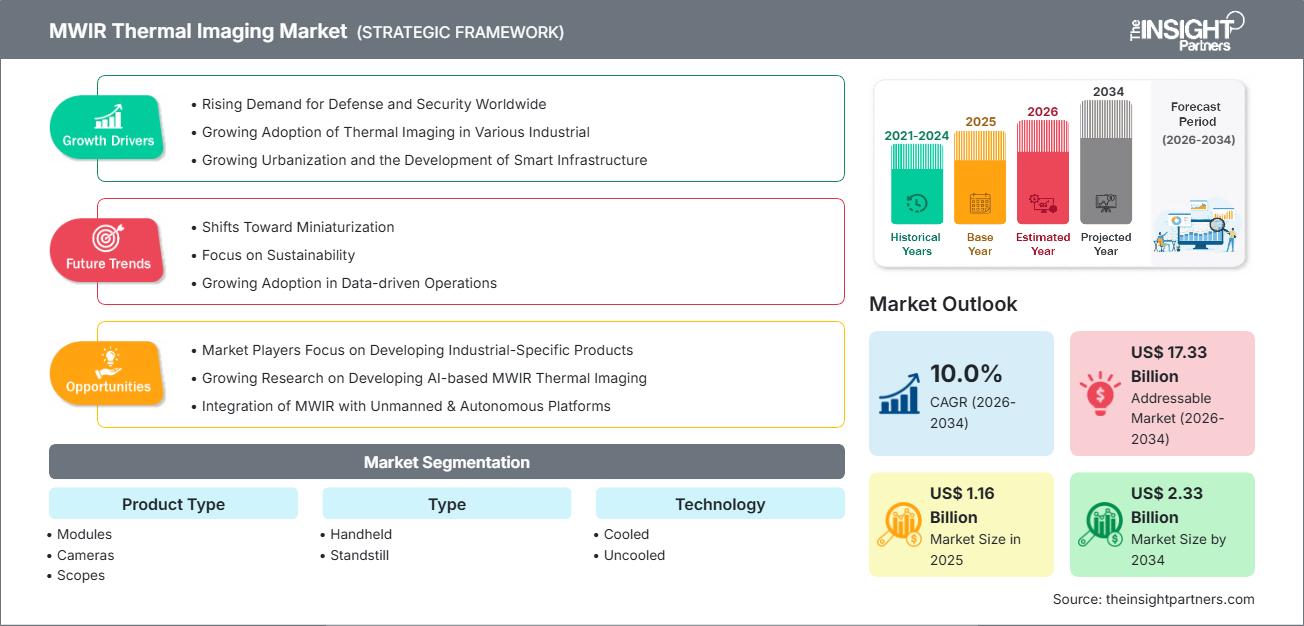
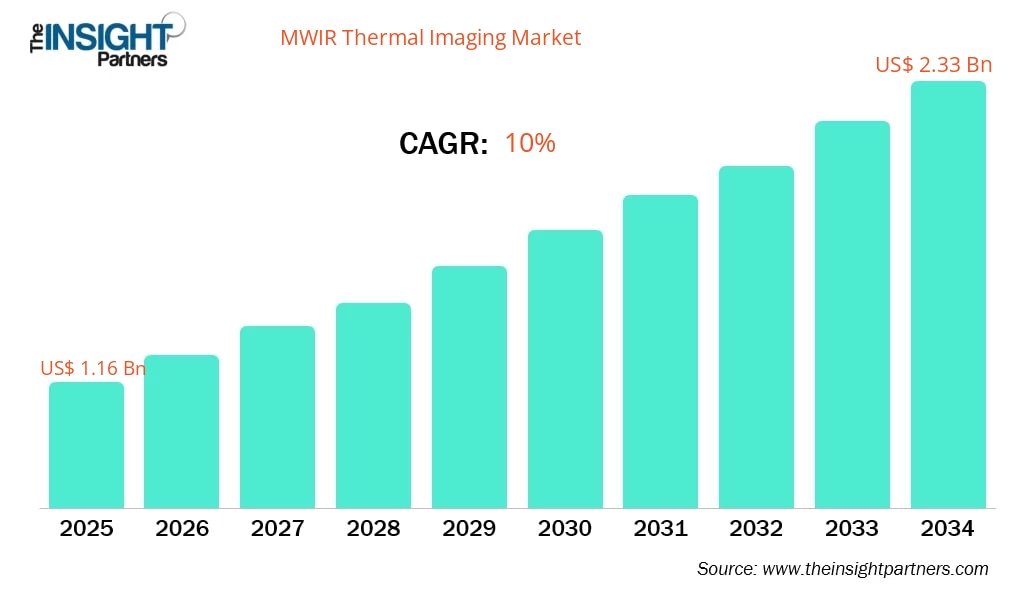
The MWIR thermal imaging market size is projected to reach US$ 2.33 billion by 2034, from US$ 1.16 billion in 2025. The market is expected to register a CAGR of 11.1% during 2026–2034
MWIR Thermal Imaging Market Analysis
The MWIR thermal imaging sector is experiencing robust growth due to the expansion of defense modernization programs, increased adoption of industrial automation, and rising demand for advanced surveillance systems. Governments worldwide continue to create substantial investments toward border security, battlefield awareness, and intelligence systems, with MWIR cameras featuring superior sensitivity and long-range detection. As more organizations adopt thermal imaging technologies—particularly in aerospace, maritime navigation, and critical infrastructure protection—the market growth is expected to accelerate.
Key market trends include technological developments such as cooled infrared detectors, higher-quality image resolution, compact-sized designs, and integration with artificial intelligence (AI) capabilities for real-time analytic processing. Emerging opportunities exist in oil and gas inspection, predictive maintenance of existing and new infrastructure projects, and self-driving vehicles. Other opportunities are expected to arise from the continued investment by local and state governments into smart cities, as well as the establishment of 24/7 surveillance infrastructure and service solutions.
MWIR Thermal Imaging Market Overview
The MWIR thermal imaging technique operates in the 3–5 micron range, as it measures temperature through thermal radiation emissions rather than reflected visible light. Because MWIR does not rely on light to provide images, it can work well under low-visibility conditions such as smoke, fog, or complete darkness. The MWIR thermal imaging system is widely employed for defense and security purposes, particularly with respect to target acquisition, missile guidance, and border control. The MWIR thermal imaging system is also utilized in industrial applications such as inspection, gas leak detection, and predictive maintenance. In the manufacturing and energy sector, MWIR thermal imaging facilitates the detection of overheating components, failures in insulation, and mechanical problems. Furthermore, MWIR thermal imaging systems will continue to play an important role in aerospace testing and environmental monitoring.
The MWIR thermal imaging system possesses several distinct advantages, including high clarity of images at long distances, accurate temperature measurement, and excellent performance in difficult environmental conditions. MWIR technology is widely adopted across multiple sectors, primarily due to stricter safety regulations, growing demand for preventive maintenance, advancements in cooled detector technology, and the reduced costs of MWIR systems.
Customize This Report To Suit Your Requirement
Get FREE CUSTOMIZATIONMWIR Thermal Imaging Market: Strategic Insights
-
Get Top Key Market Trends of this report.This FREE sample will include data analysis, ranging from market trends to estimates and forecasts.
MWIR Thermal Imaging Market Drivers and Opportunities
Market Drivers:
- Rise in Demand for Defense and Security Worldwide: Governments worldwide are increasing defense budgets in response to evolving geopolitical tensions, asymmetric warfare threats, and the imperative to safeguard territorial integrity. Escalating global defense and security requirements significantly propel the MWIR thermal imaging market.
- Increased Adoption of Thermal Imaging in Various Industries: MWIR devices—such as MWIR cameras—deliver high sensitivity and accuracy in the 3–5 µm wavelength range, making them valuable for critical industrial applications where precise thermal data directly impacts operational efficiency, reliability, and safety.
- Urbanization and the Development of Smart Infrastructure: Smart city initiatives rely heavily on real-time data collection and surveillance. MWIR thermal imaging systems offer a distinct advantage in this context because they can detect heat signatures even in low-visibility conditions such as fog, smoke, or complete darkness, providing a reliable layer of security for urban infrastructure.
- Digital Transformation & IoT Integration: MWIR data is increasingly incorporated into industrial IoT and analytics systems to improve decision-making and predictive capabilities.
- Demand in Automotive Safety & ADAS Integration: Drones, UAVs, and autonomous platforms integrate MWIR for navigation and long-range detection.
Market Opportunities:
- Market Players Focus on Developing Industrial-Specific Products: Unlike generic thermal cameras, industry‑tailored MWIR solutions are engineered to meet the nuanced performance, durability, and compliance needs of distinct sectors such as industrial inspection, oil and gas monitoring, manufacturing process control, and military/defense applications.
- Research on Developing AI-based MWIR Thermal Imaging: The surge in research focused on AI‑enhanced MWIR thermal imaging creates market opportunities by enabling smarter, faster, and more reliable systems across diverse applications.
- Integration of MWIR with Unmanned & Autonomous Platforms: In unmanned aerial vehicles (UAVs) or drones, MWIR cameras enable high-resolution thermal imaging for search-and-rescue operations, border monitoring, agricultural surveillance, and infrastructure inspection.
- Demand for Long-Range & High-Resolution Imaging: Growing demand for long-range detection in surveillance, aerospace, and border security.
- Focus on Automotive Safety & Autonomous Systems: MWIR sensors are vital for advanced driver-assistance systems (ADAS) and autonomous vehicle navigation, especially under low-visibility conditions.
MWIR Thermal Imaging Market Report Segmentation Analysis
The MWIR thermal imaging market is segmented into distinct categories to provide a detailed understanding of its product type, type, technology, and end-use industry specifications:
By Product Type:
- Modules: Growing demand for modules is driven by miniaturization trends, increasing autonomous systems, and the need for high‑accuracy thermal sensing in security, aerospace, and smart infrastructure applications.
- Cameras: The demand for cameras is propelled by expanding security and defense budgets, adoption in industrial process monitoring, and integration with automated analytics and AI for real‑time decision‑making across commercial and governmental sectors.
- Scopes: The demand for scopes is driven by the modernization of infantry equipment, the need for tactical advantages, law-enforcement surveillance requirements, and the growing interest of professional and enthusiast shooters in outdoor thermal optics that offer performance beyond traditional night vision.
By Type:
- Handheld
- Standstill
By Technology:
- Cooled
- Uncooled
By End Use Industry:
- Automotive
- Consumer
- Industrial
- Medical
- Defense and Aerospace
- Others
By Geography:
- North America
- Europe
- Asia Pacific
- Latin America
- Middle East & Africa
MWIR Thermal Imaging Market Report Scope
| Report Attribute | Details |
|---|---|
| Market size in 2025 | US$ 1.16 Billion |
| Market Size by 2026-2034 | US$ 2.33 Billion |
| Global CAGR (2026 - 2034) | 10.0% |
| Historical Data | 2021-2024 |
| Forecast period | 2026-2034 |
| Segments Covered |
By Product Type
|
| Regions and Countries Covered |
North America
|
| Market leaders and key company profiles |
|
MWIR Thermal Imaging Market Players Density: Understanding Its Impact on Business Dynamics
The MWIR Thermal Imaging Market is growing rapidly, driven by increasing end-user demand due to factors such as evolving consumer preferences, technological advancements, and greater awareness of the product's benefits. As demand rises, businesses are expanding their offerings, innovating to meet consumer needs, and capitalizing on emerging trends, which further fuels market growth.
MWIR Thermal Imaging Market Share Analysis by Geography
Asia Pacific is witnessing the fastest growth, driven by its automotive manufacturing hub. Emerging markets in Latin America, the Middle East, and Africa offer numerous untapped opportunities for MWIR thermal imaging providers.
The MWIR thermal imaging market experiences varying growth rates across different regions. Below is a summary of market share and trends by region:
1. North America
- Strong defense spending led by the United States Department of Defense drives procurement of advanced MWIR thermal imaging systems for surveillance, target acquisition, border security, and next-generation airborne and naval ISR platforms.
- Expanding oil & gas infrastructure across the US and Canada increases demand for MWIR-based gas leak detection, refinery monitoring, predictive maintenance, and high-temperature industrial process inspection applications.
2. Europe
- Rising geopolitical tensions following the Russian invasion of Ukraine have accelerated military modernization programs, boosting the adoption of MWIR thermal cameras in armored vehicles, UAV payloads, and border surveillance systems.
- Strict industrial safety and environmental compliance frameworks enforced by the European Union increase deployment of MWIR imaging for emissions monitoring, high-temperature manufacturing inspection, and energy-efficiency audits across heavy industries.
3. Asia Pacific
- Growing defense budgets in China and India support the indigenous development of airborne and naval electro-optical systems, expanding demand for MWIR sensors in missile guidance and surveillance platforms.
- Rapid industrialization across Japan and South Korea drives the adoption of MWIR cameras for semiconductor inspection, automotive testing, robotics, and smart factory predictive maintenance systems.
4. South and Central America
- Defense modernization programs in Brazil strengthen the adoption of MWIR thermal imaging in armored vehicles, border patrol aircraft, and naval patrol vessels for enhanced situational awareness.
- Growth in mining and energy sectors across Chile and Argentina increases MWIR usage for furnace monitoring, mineral processing inspection, and predictive maintenance in extreme operating environments.
5. Middle East and Africa
- Heightened border security and counter-terrorism initiatives in Saudi Arabia and the UAE increase procurement of MWIR thermal imaging for persistent surveillance and UAV-mounted reconnaissance systems.
- Expanding petrochemical infrastructure in Qatar and South Africa drives demand for MWIR cameras in flare monitoring, leak detection, and high-temperature process diagnostics.
High Market Density and Competition
Competition is strong due to the presence of established players such as Teledyne Technologies Inc (US), Fluke Corp (US), and L3Harris Technologies Inc (US). Regional and niche providers such as Leonardo S.p.A. (Italy) and UNI-TREND TECHNOLOGY (CHINA) CO., LTD. (China) also add to the competitive landscape across different regions.
A highly competitive environment drives companies to offer unique products and services, including:
- Vertical integration and scale
- Technological partnership
- Geographic footprint
Opportunities and Strategic Moves
- Consolidation through mergers & acquisitions
- Investing in automation
- Diversifying into high-growth verticals
- Sustainability and eco-friendly solutions
Major Companies operating in the MWIR Thermal Imaging Market are:
- Testo SE & Co. KGaA (Germany)
- Fluke Corp (US)
- UNI-TREND TECHNOLOGY (CHINA) CO., LTD. (China)
- Hangzhou Microimage Software Co., Ltd. (China)
- Megger Group Limited (UK)
- SDT International SA/NV (Belgium)
- Leonardo S.p.A. (Italy)
- L3Harris Technologies Inc (US)
- Safran SA (France)
- Teledyne Technologies Inc (US)
Other companies analyzed during the course of research:
- BAE Systems plc
- Northrop Grumman Corporation
- Lockheed Martin Corporation
- RTX Corporation
- Honeywell International Inc.
- Hamamatsu Photonics K.K.
- Xenics NV
- Lynred S.A.
- InfraTec GmbH
- OptoSigma Corporation
- VIGO System S.A.
- Excelitas Technologies Corp.
- Opgal Optronic Industries Ltd.
- Jenoptik AG
- Infrared Cameras Inc.
Disclaimer: The companies listed above are not ranked in any particular order.
MWIR Thermal Imaging Market News and Recent Developments
- HIKMICRO Sets a New Standard For Entry-Level Thermal Spotters with the Launch of The LYNX 3.0.: In December 2025, HIKMICRO set a new standard for “entry-level” thermal spotters with the launch of the LYNX 3.0. The world-leading technology pioneer raised the bar to another level when it unveiled the latest version of this acclaimed thermal monocular on October 30th 2025. The LYNX 3.0 boasts proven shutterless technology and delivers ultimate value in entry-level thermal imaging to surpass its “Rewriting Entry-level Standards” mantra.
- HIKMICRO Launches a Flagship Thermal Camera: In November 2025, HIKMICRO launched a flagship thermal camera— SP100H—designed to deliver precise infrared radiation measurement, rugged reliability, and enhanced workflow efficiency, meeting the electrical power industry’s demands to prevent failures, ensure grid stability, and protect personnel. The SP100H is a game-changer for electrical utilities, power generation plants, and renewable energy facilities, enabling inspectors, engineers, and asset managers to accurately detect minute temperature variations in connections, transformers, and circuit breakers from a safe distance, with absolute clarity.
MWIR Thermal Imaging Market Report Coverage and Deliverables
The "MWIR Thermal Imaging Market Size and Forecast (2021–2034)" report provides a detailed analysis of the market covering below areas:
- MWIR thermal imaging market size and forecast at global, regional, and country levels for all the segments covered under the scope
- MWIR thermal imaging market trends, as well as dynamics such as drivers, restraints, and key opportunities
- Detailed PEST and SWOT analysis
- MWIR thermal imaging market analysis covering key trends, global and regional framework, major players, regulations, and recent market developments
- Industry landscape and competition analysis covering market concentration, heat map analysis, prominent players, and recent developments for the MWIR thermal imaging market
- Detailed company profiles
Frequently Asked Questions

- Historical Analysis (2 Years), Base Year, Forecast (7 Years) with CAGR
- PEST and SWOT Analysis
- Market Size Value / Volume - Global, Regional, Country
- Industry and Competitive Landscape
- Excel Dataset
Recent Reports
Testimonials

The Insight Partners' SCADA System Market report is comprehensive, with valuable insights on current trends and future forecasts. The team was highly professional, responsive, and supportive throughout. We are very satisfied and highly recommend their services.
RAN KEDEM Partner, Reali Technologies LTDs
I requested a report on a very specific software market and the team produced the report in a few days. The information was very relevant and well presented. I then requested some changes and additions to the report. The team was again very responsive and I got the final report in less than a week.
JEAN-HERVE JENN Chairman, Future Analytica
We worked with The Insight Partners for an important market study and forecast. They gave us clear insights into opportunities and risks, which helped shape our plans. Their research was easy to use and based on solid data. It helped us make smart, confident decisions. We highly recommend them.
PIYUSH NAGPAL Sr. Vice President, High Beam Global
The Insight Partners delivered insightful, well-structured market research with strong domain expertise. Their team was professional and responsive throughout. The user-friendly website made accessing industry reports seamless. We highly recommend them for reliable, high-quality research services
YUKIHIKO ADACHI CEO, Deep Blue, LLC.
This is the first time I have purchased a market report from The Insight Partners.While I was unsure at first, I visited their web site and felt more comfortable to take the risk and purchase a market report.I am completely satisfied with the quality of the report and customer service. I had several questions and comments with the initial report, but after a couple of dialogs over email with their analyst I believe I have a report that I can use as input to our strategic planning process.Thank you so much for taking the extra time and making this a positive experience.I will definitely recommend your service to others and you will be my first call when we need further market data.
JOHN SUZUKI President and Chief Executive Officer, Board Director, BK Technologies
I wish to appreciate your support and the professionalism you displayed in the course of attending to my request for information regarding to infectious disease IVD market in Nigeria. I appreciate your patience, your guidance, and the fact that you were willing to offer a discount, which eventually made it possible for us to close a deal. I look forward to engaging The Insight Partners in the future, all thanks to the impression you have created in me as a result of this first encounter.
DR CHIJIOKE ONYIA MANAGING DIRECTOR, PineCrest Healthcare Ltd.Reason to Buy
- Informed Decision-Making
- Understanding Market Dynamics
- Competitive Analysis
- Identifying Emerging Markets
- Customer Insights
- Market Forecasts
- Risk Mitigation
- Boosting Operational Efficiency
- Strategic Planning
- Investment Justification
- Tracking Industry Innovations
- Aligning with Regulatory Trends




 Get Free Sample For