
Water Electrolysis Machine Market Demand, Size & Forecast by 2034
Coverage: By Product Type (Proton Exchange Membrane (PEM), Alkaline Water Electrolysis, Solid Oxide Electrolyte (SOE)); Industry (Chemical, Petroleum, Pharmaceuticals, Power Plants, Electronics and Semiconductors, Steel Plant, Others) , and Geography (North America, Europe, Asia Pacific, and South and Central America)
- Status : Data Released
- Report Code : TIPRE00009904
- Category : Electronics and Semiconductor
- No. of Pages : 150
- Available Report Formats :


- Last update date : September 28, 2026


2025 Market Size
US$ 13.37 Bn
Base year value
2034 Forecast
US$ 30.18 Bn
Projected by 2034
CAGR 2026-2034
9.47 %
Growth rate
Addressable Market
US$ 194.37 Bn
(2026-2034)
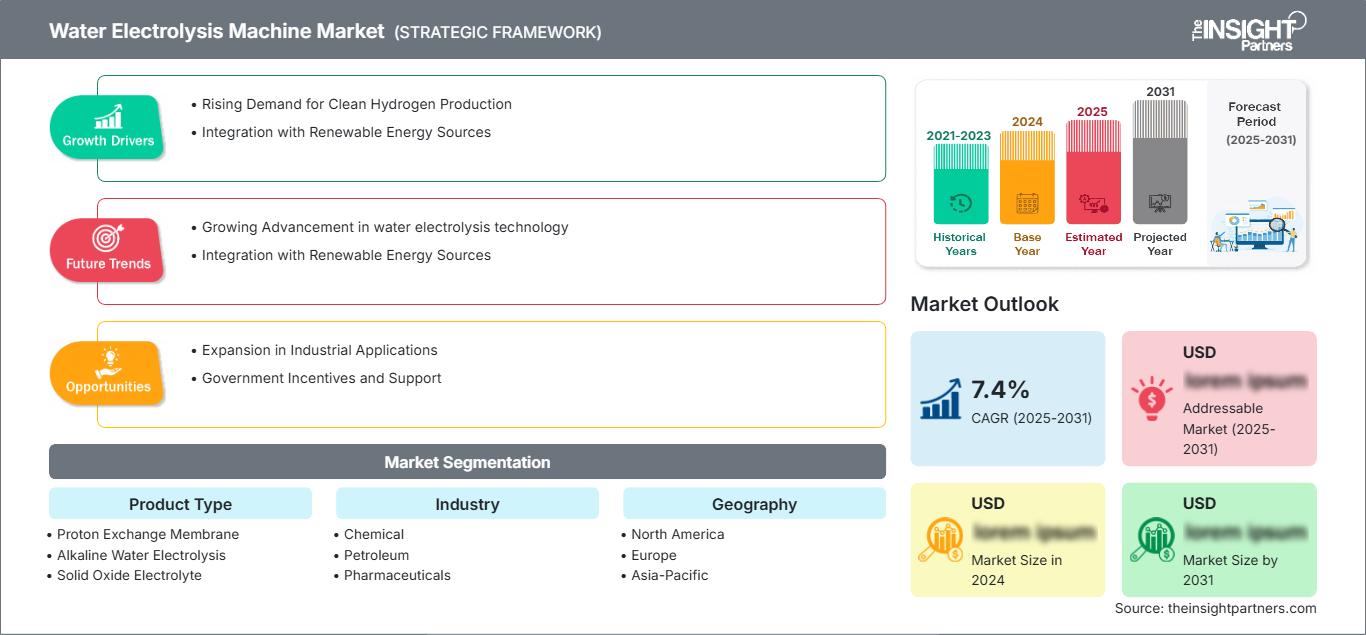
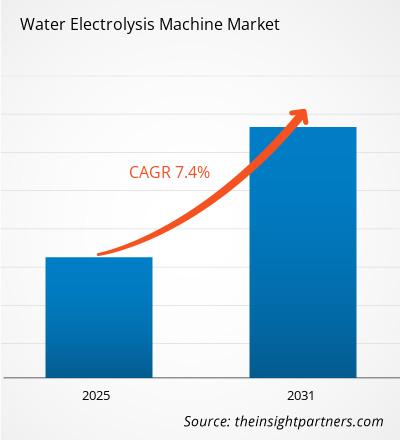
The Water electrolysis machine market is valued at US$ 13.37 Billion in 2025 and is projected to reach US$ 30.18 Billion by 2034, registering a CAGR of 9.47% during 2026–2034. The market covers electrolysis systems that use electricity to split water into hydrogen and oxygen, with deployment increasingly connected to renewable power, industrial decarbonization, and hydrogen production strategies across major economies.
North America is expected to record an estimated CAGR of 8.5–10.0% during 2026–2034, supported by clean hydrogen incentives, industrial decarbonization programs, and investment in electrolyzer-linked infrastructure. The regional Water electrolysis machine market size is further supported by demand from refining, chemicals, semiconductor manufacturing, and emerging clean-fuel applications, while project economics increasingly depend on electricity costs, utilization rates, and long-term hydrogen offtake agreements.
Water Electrolysis Machine Market Assessment and Insights
- North America: North America is expected to account for a 22–26% share in 2025 and grow at a CAGR of 8.5–10.0% between 2026–2034, supported by clean hydrogen incentives, industrial projects, and expanding integration of renewable electricity.
- US: The US is estimated to represent 72–76% of North American demand in 2025, growing at a CAGR of 8.5–10.0% during 2026–2034 as industrial users pursue low-carbon hydrogen.
- Europe: Europe is estimated to hold 25–29% share in 2025 and grow at a CAGR of 9.0–10.5%, led by Germany, the Netherlands, France, Spain, and Italy, where renewable hydrogen policies and industrial decarbonization support deployment.
- Asia Pacific: Asia Pacific is estimated to command 38–42% share in 2025 and expand at a CAGR of 10.0–11.5%, with China, Japan, South Korea, India, and Australia supporting large-scale industrial and renewable hydrogen projects.
- Largest Segment: Alkaline Water Electrolysis is estimated to hold a 48–52% market share in 2025 and grow at a CAGR of 8.0–9.0%, benefiting from technology maturity and cost advantages.
- High Growth Segment: Proton Exchange Membrane is estimated to hold a 32–36% share in 2025 and grow at a 10.0–11.5% CAGR, supported by dynamic integration of renewable power.
- Key companies analyzed in detail: Air Products and Chemicals, Inc.; AREVA H2Gen; ErreDue s.p.a.; Hydrogenics Corporation; Linde plc; Peak Scientific Instruments Ltd.; Proton OnSite; Siemens AG; Teledyne Energy Systems, Inc.; thyssenkrupp AG.
Source: The Insight Partners' analysis based on proprietary research, government publications, company annual reports, investor presentations, industry databases, and expert interviews.
The Water electrolysis machine market has evolved from specialized hydrogen-generation equipment toward modular systems capable of larger industrial deployments. Alkaline systems remain established due to their long operating history, while PEM technology is gaining importance in applications where variable renewable electricity requires rapid load response. Solid oxide electrolysis is progressing toward commercial applications where high-temperature process integration can improve electrical efficiency. Global installed electrolysis capacity exceeded 4 GW in 2025, doubling during the year, with China accounting for nearly three-quarters of new installations.
The Water Electrolysis Machine Market report indicates that forward momentum is increasingly linked to project bankability rather than technology availability alone. The economies of Europe, North America, China, India, Australia, and the Middle East are embarking on projects to integrate renewable energy, produce ammonia, refine, decarbonize steelmaking, and develop green fuels. The regulatory certification requirements, electricity supply approach, infrastructure availability, and reliability of offtake arrangements will determine which of the announced projects will actually proceed to implementation. The International Energy Agency (IEA) has pointed out that very few of the announced low-carbon hydrogen capacities have so far reached a level of firm investment decisions.
Water Electrolysis Machine Market Report Scope
| Report Attribute | Details |
|---|---|
| Market size in 2025 | US$ 13.37 Billion |
| Market Size by 2034 | US$ 30.18 Billion |
| Global CAGR (2026 - 2034) | 9.47% |
| Historical Data | 2021-2024 |
| Forecast period | 2026-2034 |
Water Electrolysis Machine Market Analysis
The Water electrolysis machine market's growth is driven by the substitution of fossil-based hydrogen with hydrogen produced from water using low-carbon electricity. These sectors include refining, ammonia, methanol, chemicals, and growing applications of direct-reduced iron. In terms of the value chain, this includes electrolyzers, membranes or diaphragms, electrodes, power electronics, water treatment, compression, storage, engineering, and hydrogen transport. Renewable electricity often accounts for a significant share of operating costs, making access to and use of renewable energy crucial for economic viability.
The supply chain is being altered by manufacturing scale, localization needs, and technological differences. China now leads in electrolyzer manufacturing and deployment, while European, North American, and Asian manufacturers focus on efficiency, reliability, after-sales services, and compliance with standards. The International Energy Agency (IEA) has found that China accounted for around 65% of global installed electrolyzer capacity and future decision-ready electrolyzer capacity as of its 2025 assessments, and that Chinese electrolyzer manufacturing capacity accounted for close to 60%.
The Water electrolysis machine market analysis also shows increasing competitive differentiation around system integration rather than stack technology alone. While Air Products and Chemicals, Inc. integrates hydrogen generation expertise with downstream facilities, Linde plc integrates electrolysis with industrial gas distribution. Siemens AG focuses on developing large-scale electrolyzer units and renewable hydrogen systems. Thyssenkrupp AG, owing to its electrolysis activities, concentrates on industrial-scale projects, whereas Teledyne Energy Systems, Inc., ErreDue s.p.a., AREVA H2Gen, Peak Scientific Instruments Ltd., Hydrogenics Corporation, and Proton OnSite offer their own technological and engineering solutions.
Financing is shifting towards larger projects despite the risks on both the financing and demand sides. Investments in low-emission hydrogen stood at $4.3 billion in 2024 and were expected to approach $8 billion in 2025, driven by final investment decisions for certain projects. Electrolysis was expected to account for around 80% of investment in low-emission hydrogen projects in 2025.
● REPORT CUSTOMIZATION
Tailor This Report To Align With Your Specific Business Requirements
This report can be customized to align precisely with your business objectives, scope, and target markets. Customization options include tailored segmentation, geography, competitive analysis, and strategic insights to support informed decision-making.
Customize This Report →WHAT YOU CAN ADJUST
- ● Segmentations
- ● Geography
- ● Competitive Analysis
- ● Language Preferences
Water Electrolysis Machine Market: Strategic Insights
Regional Insights
North America Water Electrolysis Machine Market
North America is estimated to represent 22–26% of the global Water electrolysis machine market share in 2025, with a projected CAGR of 8.5–10.0% through 2034. The US is the leading region in terms of regional demand due to hydrogen incentives, existing industrial gas distribution systems, and large refinery and chemical consumption. Canada offers additional possibilities through renewable energy and hydrogen export projects.
The region is influenced by the economics of individual projects through electricity prices, usage efficiency, tax advantages, local content, and hydrogen consumption. Different applications, such as semiconductor manufacturing, refining, chemicals, mobility, and power, ensure diversified demand. Companies such as Air Products and Chemicals, Inc., Linde plc, Siemens AG, and Teledyne Energy Systems, Inc. possess competencies in hydrogen generation. The main limiting factor is the ability to develop projects announced into contracted plants.
U.S. Water Electrolysis Machine Market
The U.S. is estimated to account for 72–76% of North America's Water electrolysis machine market share in 2025 and is projected to grow at a CAGR of 8.5–10.0% through 2034. Industries that use hydrogen, clean energy project developers, and equipment providers are already working on projects involving renewable power and hydrogen infrastructure.
The market has a high demand for oil refining, chemicals, mobility applications, electronics, and new processes in low-carbon industry sectors. The companies Air Products and Chemicals, Inc. and Linde plc have good industrial hydrogen experience, and Siemens AG provides electrolyzer equipment. Developers have begun to make their selections more rational by analyzing power prices, usage, transportation, water availability, permits, and product demand.
Europe Water Electrolysis Machine Market
Europe is estimated to hold 25–29% share of the Water electrolysis machine market in 2025 and is projected to grow at a CAGR of 9.0–10.5% through 2034. Germany tops the regionally deployed list, followed by the Netherlands, France, Spain, and Italy, supported by renewable hydrogen policy, industrial decarbonization, and cross-border infrastructure development. The EU's policy goals have made renewable hydrogen an important strategic industrial priority.
Germany continues to be the center of hydrogen because companies in chemicals, steel, refineries, and energy have developed integrated hydrogen projects. The hydrogen infrastructure development plan in Germany also aims to help distribute hydrogen across industries. In the UK, electrolyzer development is done through industrial clusters and clean energy projects. France focuses on hydrogen for refineries, chemicals, transport, and other industries, while Italy is working on hydrogen projects based on renewable energy and industry.
APAC Water Electrolysis Machine Market
APAC is estimated to command 38–42% of the Water Electrolysis Machine Market share in 2025 and grow at a CAGR of 10.0–11.5% through 2034, making it the largest regional market. While China is leading the way in deployment and manufacturing, Japan and South Korea focus more on energy security and industrial applications. India and Australia are establishing hydrogen-renewable ecosystems in refineries, ammonia, steel and exports.
China's size advantage is also strengthened by domestic manufacturing and significant industrial demand. Japan and South Korea are focusing on technology development and clean fuel logistics, while India is making progress in green hydrogen production using renewable energy. Australia is placing a strong emphasis on exports of hydrogen and ammonia. According to the IEA, China is the leading deployment market, with more than 2.5 GW of new capacity under construction globally.
Middle East & Africa Water Electrolysis Machine Market
The Middle East & Africa Water Electrolysis Machine Market is estimated to account for a smaller share of global demand but is projected to expand at a CAGR of 8.0–10.0% through 2034. Saudi Arabia drives large-scale efforts, with the UAE and South Africa following, focused on renewable energy sources, industry diversification, and export-focused hydrogen policy.
While Saudi Arabia uses large-scale solar and wind power alongside an existing ammonia export facility, the UAE is focusing on hydrogen technologies in industrial centers and ports. South Africa has been investigating the use of hydrogen in mining, the chemical industry, heavy transport, and exports. Elsewhere in MEA, implementation relies on renewable power prices, water availability, infrastructure, funding, and reliable export to other countries.
Segmentation Analysis
Product Type
The Water Electrolysis Machine Market forecast indicates that Product Type is a core technology dimension comprising Proton Exchange Membrane (PEM), Alkaline Water Electrolysis, and Solid Oxide Electrolyte technologies. Alkaline systems retain the largest installed base because of their technological maturity, lower capital costs, and established industrial operating experience, while PEM systems benefit from flexible operation and strong compatibility with variable renewable energy sources. The segment is projected to grow at a CAGR of 9.0–10.0% during 2026–2034, supported by rising investments in hydrogen production, decarbonization initiatives, and expanding adoption across industrial and energy applications.
- Proton Exchange Membrane: PEM systems are increasingly selected for applications requiring compact designs, rapid response, and frequent interaction with variable renewable electricity. Their strategic value is strongest where operating flexibility and high current density offset comparatively higher equipment costs.
- Alkaline Water Electrolysis: Alkaline systems maintain a strong position in large industrial installations because of technological maturity, established supply chains, and comparatively proven long-duration operation. They remain important for projects prioritizing cost optimization and stable operating conditions.
- Solid Oxide Electrolyte: Solid oxide systems offer opportunities where high-temperature steam and industrial waste heat are available. Their strategic relevance is increasing in integrated chemical and industrial facilities seeking improved energy efficiency and closer coupling between hydrogen production and process heat.
Industry
Industry comprises Chemical, Petroleum, Pharmaceuticals, Power Plants, Electronics and Semiconductors, Steel Plant, and Others. The industry segment is projected to expand at a CAGR of 9.2–10.2% during 2026–2034 as hydrogen users increasingly integrate electrolyzers directly with production facilities.
- Chemical: Chemical producers can use electrolytic hydrogen as a lower-carbon feedstock for ammonia, methanol, and specialty chemical processes, making integrated hydrogen production strategically important for emissions reduction and supply security.
- Petroleum: Refiners represent an established source of hydrogen demand. Electrolysis provides an alternative production pathway in which renewable electricity and policy incentives can support the replacement of hydrogen produced through conventional fossil-based processes.
- Pharmaceuticals: Pharmaceutical manufacturing requires high-purity gases and tightly controlled process environments. Electrolysis can support localized hydrogen availability while reducing dependence on delivered industrial gases in selected applications.
- Power Plants: Power-sector applications include hydrogen production linked with renewable generation and potential energy-system balancing. Adoption depends heavily on electricity economics, electrolyzer utilization, storage requirements, and the availability of suitable hydrogen infrastructure.
- Electronics and Semiconductors: Semiconductor facilities require high-purity process gases and a reliable supply. Electrolyzer deployment can support localized hydrogen generation where purity, continuity, and integration with broader clean-energy systems justify investment.
- Steel Plant: Green hydrogen is increasingly considered for direct-reduced-iron processes. Steel plants therefore represent a strategically important future demand center, particularly in regions that combine renewable electricity, iron ore supply, and decarbonization policies.
Opportunity Snapshot
| Industry | Revenue Contribution | Trend Tag | Adoption Stage |
| Chemical | High | Green Feedstock | Scaling |
| Petroleum | High | Refinery Decarbonization | Scaling |
| Pharmaceuticals | Medium | Onsite Hydrogen | Emerging |
| Power Plants | Medium | Renewable Coupling | Emerging |
| Electronics and Semiconductors | Medium | High Purity | Scaling |
| Steel Plant | High | Green Iron | Emerging |
Water Electrolysis Machine Market Growth Drivers and Impact Analysis
Industrial Decarbonization and Replacement of Fossil-Based Hydrogen
The most compelling reason from a structural standpoint is the necessity of decarbonizing the hydrogen used in refining, ammonia production, and methanol production, among others. Hydrogen demand was approaching 100 Mt in 2024 with less than 1% low-emission production, suggesting significant scope for conversion. The deployment of electrolysis allows industrial customers to substitute for traditional hydrogen generation through electrolysis, where electricity is cost-competitive. There are effects beyond the cost of electrolyzers, as electrolysis facilities will require rectification, water processing, compressors, storage, control, and hydrogen delivery. As industrial firms set reduction targets, considerations for equipment purchases include emissions, certification, and electricity source and asost.
Falling Technology Costs and Increasing Electrolyzer Scale
Growth in the scale of projects is enhancing the economics and technological readiness of electrolysis. Projects for large-scale electrolyzers have grown from tens of megawatts to hundreds of megawatts, and a 500 MW electrolyzer project is now under construction in China in 2025. In addition, by growing in size, projects make it possible to standardize engineering, procurement, construction, and operational expertise, whereas manufactures can distribute the expenses of research, manufacturing, and servicing across larger volumes of output. Moreover, an expansion in scale makes it more attractive to design modular stacks, automate the manufacturing process, develop sophisticated power electronics and improve the degradation control and digital monitoring of the equipment. Nonetheless, equipment cost is just one element in a project's economics.
Policy Support and Expansion of Renewable Electricity
With government backing, project development is being aided by a reduction in the cost gap between renewable hydrogen and traditional production methods. Europe has set targets and certification procedures for renewable hydrogen, while the US has introduced incentive schemes for clean hydrogen production and related infrastructure. India, China, Australia, Japan, South Korea, and Middle Eastern countries are also developing their hydrogen strategies. Policies have the greatest effect when there is synergy among incentives, increased renewable power generation, infrastructure, and demand creation. The European Union estimates that approximately 500 TWh of renewable energy would be required to meet its 2030 renewable fuel target, underscoring the need for integration into the electricity system.
Water Electrolysis Machine Market Future Trends
Integrated Electrolyzer Systems With Renewable Power and Industrial Heat
The water electrolysis machine market trends are moving toward integrated systems that coordinate electrolyzers with renewable generation, storage, industrial heat, water treatment, and downstream hydrogen conversion. Future projects will focus more on optimizing the entire energy chain rather than maximizing the electrolyzer's capacity in isolation. There may be applications where solid oxide electrolysis can be useful when steam or waste heat is available, but PEM electrolysis can provide flexibility when combined with intermittent renewable power sources. There will be an increasing focus on using digital controls to predict renewable availability, manage stack loads, monitor degradation, and optimize hydrogen production based on electricity costs.
Standardization, Localization, and Higher-Pressure Electrolysis Platforms
The other critical direction is the development of standardized and localized electrolyzer systems that can be installed across various regulatory and industrial environments. The manufacturers would likely consider module designs, high current densities, increased material efficiency, streamlined balance-of-plant system designs, and automation. Localization would become critical for countries striving to achieve domestic manufacturing, robust supply chains, and compliance with technical standards. Higher-pressure hydrogen production could also lower compression costs in some applications, resulting in lower overall system costs. At the same time, the manufacturers would have to prove their ability to deliver degradation performance, safety, maintainability, and lifecycle cost savings through real operating experience. Consolidation would be inevitable due to competition among suppliers with excess manufacturing capacity.
Water Electrolysis Machine Market Opportunities
Electrolyzers for Green Ammonia and Low-Carbon Steel
Water electrolysis machine market opportunities are expanding in industries where hydrogen already has a clear commercial role or where electrification alternatives are limited. Green ammonia and steel made via direct reduced iron are especially promising because they could utilize large amounts of hydrogen while offering tangible reductions in carbon emissions. The value proposition for the equipment supplier would involve aligning itself with the renewable energy company, steel producers, ammonia producers, engineering firms, and port operators. The key to creating opportunities would lie in aligning electrolyzer capacity with renewable power production and offtake agreements, not just in putting the equipment in place before demand arises. Those who can deliver flexible operations, high availability, predictable wear and tear, and lifecycle services are poised for success in these industrial-scale projects.
Localized Hydrogen Production for High-Purity Industrial Applications
The second business opportunity is the generation of hydrogen at local sites for use in electronics, semiconductor production, specialty chemicals, pharmaceuticals, and selected power generation applications. In these markets, the customer needs reliability and high purity, in addition to low hydrogen costs, thus creating a different market from the big commodity hydrogen projects. The PEM technology is especially applicable where space limitations, flexibility, and integration with renewable electricity sources are essential. Equipment manufacturers may generate ongoing revenue from maintenance services, stack replacements, monitoring, water treatment services, and performance guarantees. A good basis for these projects will be the growth of the semiconductor business in Asia, North America, and Europe.
Frequently Asked Questions

- Comprehensive Market Sizing and Forecast Analysis
- Detailed Segmentation Analysis
- In-Depth Market Dynamics Assessment
- Regional and Country-Level Insights
- Competitive Landscape and Company Benchmarking
- Strategic Business Intelligence
Recent Reports
Testimonials

The Insight Partners provided valuable market intelligence that supported our global go-to-market strategy. Their team was professional, responsive, and attentive to our feedback, providing thoughtful analysis and helpful methodological clarifications throughout the project.
Junmo Kim Chief Financial Officer (CFO), Enertech Co., Ltd.
The Insight Partners' SCADA System Market report is comprehensive, with valuable insights on current trends and future forecasts. The team was highly professional, responsive, and supportive throughout. We are very satisfied and highly recommend their services.
RAN KEDEM Partner, Reali Technologies LTDs
I requested a report on a very specific software market and the team produced the report in a few days. The information was very relevant and well presented. I then requested some changes and additions to the report. The team was again very responsive and I got the final report in less than a week.
JEAN-HERVE JENN Chairman, Future Analytica
We worked with The Insight Partners for an important market study and forecast. They gave us clear insights into opportunities and risks, which helped shape our plans. Their research was easy to use and based on solid data. It helped us make smart, confident decisions. We highly recommend them.
PIYUSH NAGPAL Sr. Vice President, High Beam Global
The Insight Partners delivered insightful, well-structured market research with strong domain expertise. Their team was professional and responsive throughout. The user-friendly website made accessing industry reports seamless. We highly recommend them for reliable, high-quality research services
YUKIHIKO ADACHI CEO, Deep Blue, LLC.
This is the first time I have purchased a market report from The Insight Partners.While I was unsure at first, I visited their web site and felt more comfortable to take the risk and purchase a market report.I am completely satisfied with the quality of the report and customer service. I had several questions and comments with the initial report, but after a couple of dialogs over email with their analyst I believe I have a report that I can use as input to our strategic planning process.Thank you so much for taking the extra time and making this a positive experience.I will definitely recommend your service to others and you will be my first call when we need further market data.
JOHN SUZUKI President and Chief Executive Officer, Board Director, BK Technologies
I wish to appreciate your support and the professionalism you displayed in the course of attending to my request for information regarding to infectious disease IVD market in Nigeria. I appreciate your patience, your guidance, and the fact that you were willing to offer a discount, which eventually made it possible for us to close a deal. I look forward to engaging The Insight Partners in the future, all thanks to the impression you have created in me as a result of this first encounter.
DR CHIJIOKE ONYIA MANAGING DIRECTOR, PineCrest Healthcare Ltd.Reason to Buy
- Informed Decision-Making
- Understanding Market Dynamics
- Competitive Analysis
- Identifying Emerging Markets
- Customer Insights
- Market Forecasts
- Risk Mitigation
- Boosting Operational Efficiency
- Strategic Planning
- Investment Justification
- Tracking Industry Innovations
- Aligning with Regulatory Trends





 Get Free Sample for