SWIR Thermal Imaging Market Trends, Demand & Growth by 2034
SWIR Thermal Imaging Market Size and Forecast (2021 - 2034), Global and Regional Share, Trend, and Growth Opportunity Analysis Report Coverage: By Product Type (Modules, Cameras, and Scopes), Type (Handheld and Standstill), Technology (Cooled and Uncooled), and End Use Industry (Automotive, Consumer, Industrial, Medical, Defense and Aerospace, and Others)
Historic Data: 2021-2024 | Base Year: 2025 | Forecast Period: 2026-2034- Status : Published
- Report Code : TIPRE00043063
- Category : Electronics and Semiconductor
- No. of Pages : 133
- Available Report Formats :


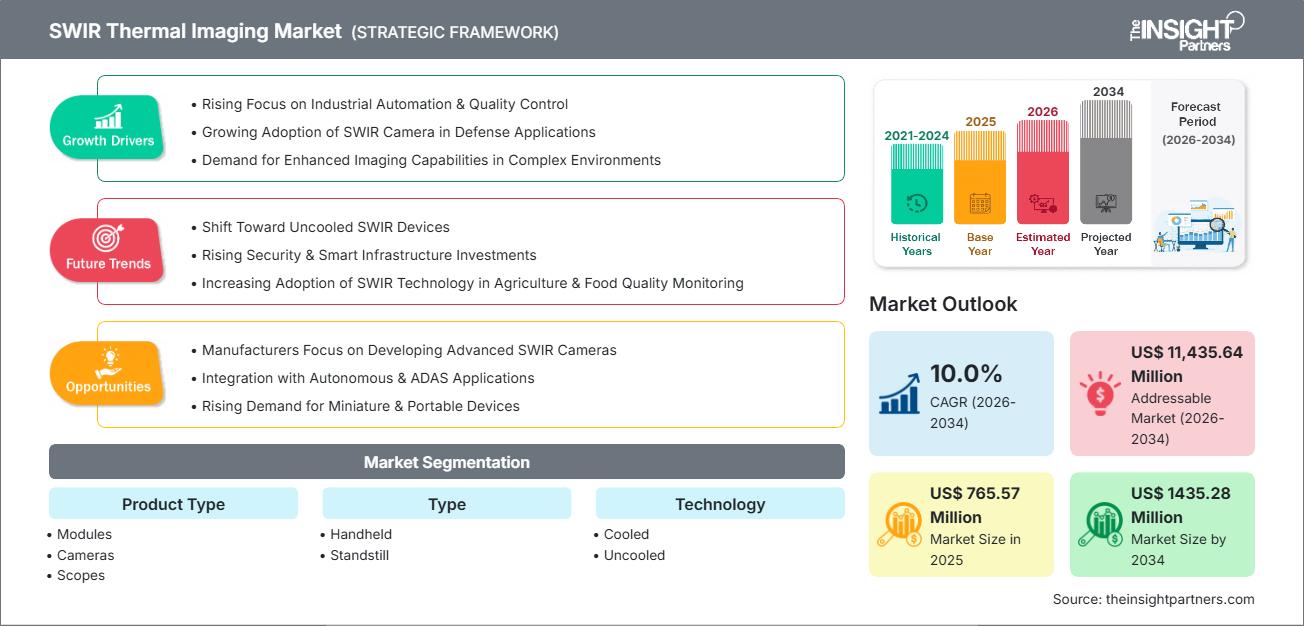
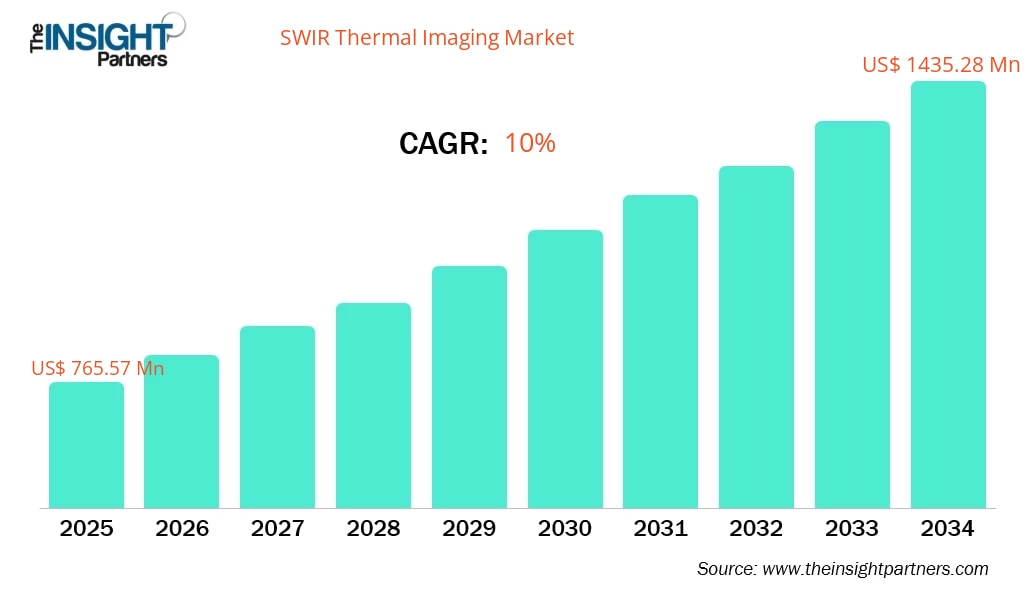
The SWIR thermal imaging market size is projected to reach US$ 1435.28 million by 2034, from US$ 765.57 million in 2025. The market is expected to register a CAGR of 10.0% during 2026–2034
SWIR Thermal Imaging Market Analysis
SWIR thermal imaging market growth is attributed to increased use in commercial, industrial, and military applications. As countries such as the US and China continue to modernize defense capabilities, SWIR cameras provide added benefit by improving surveillance, target acquisition, and night vision capabilities in low-luminance environments and poor weather conditions. Moreover, growing industrial automation systems and quality control inspection requirements for semiconductors and solar panel manufacturing are also driving demand for SWIR cameras in technology-rich areas such as Japan and Germany. With an increasing number of applications getting integrated with SWIR sensors (e.g., autonomous vehicles, hyperspectral Imaging systems, and advanced security), new opportunities are opening. Some of these trends include reduced size of sensors, a decrease in the cost of InGaAs detectors, and the integration of AI-based image analytics to enable real-time decision making. Ongoing investment in smart infrastructure and border security initiatives worldwide continues to drive growth in SWIR thermal imaging systems, making them a key part of any future high-performance sensing application.
SWIR Thermal Imaging Market Overview
Short-wave Infrared (SWIR) imaging utilizes advanced technologies to create images by recording light at short waived infrared wavelengths or in bands produced between 0.9 and 1.7 micrometers. SWIR cameras provide higher quality images than standard infrared systems and use advanced processing techniques to increase image contrast and clarity. The major advantages of using SWIR technology are the ability to inspect materials and parts, the ability to conduct non-destructive testing, to detect moisture, to inspect semiconductor materials, and to conduct surveillance operations for law enforcement and military purposes. SWIR thermal imaging is used for quality control in industrial processes; for aerospace applications such as diagnostics of medical conditions; and for military applications. As the global market demand for automation continues to grow, the cost of manufacturing SWIR thermal imaging systems continues to decline, resulting in an increase in the global market for SWIR thermal imaging systems. Furthermore, the growth of the automotive, aerospace, and defense industries is contributing to the growth of the SWIR thermal imaging system. Advancements in sensor technology and lower prices will also help improve SWIR thermal imaging system use in emerging economies throughout the world.
Customize This Report To Suit Your Requirement
Get FREE CUSTOMIZATIONSWIR Thermal Imaging Market: Strategic Insights
-
Get Top Key Market Trends of this report.This FREE sample will include data analysis, ranging from market trends to estimates and forecasts.
SWIR Thermal Imaging Market Drivers and Opportunities
Market Drivers:
- Rising Focus on Industrial Automation & Quality Control: Industrial automation and quality control are key growth factors propelling the global SWIR thermal imaging market forward, creating opportunities for manufacturers to advanced sensor development and integration across multiple sectors.
- Growing Adoption of SWIR Camera in Defense Applications: The growing adoption of SWIR cameras in defense applications is a significant driver of the SWIR thermal imaging market, particularly for surveillance, reconnaissance, and border security operations.
- Increasing Demand for Enhanced Imaging Capabilities: SWIR sensors can penetrate atmospheric obscurants such as haze, smoke, fog, and dust, providing reliable imaging in conditions that would otherwise degrade or obscure visual clarity. This capability is particularly valuable in applications such as surveillance, security, defense, and industrial inspection, where operational environments are often unpredictable and visually challenging.
- Demand for Agriculture & Environmental Monitoring: SWIR sensors enable moisture analysis and soil/crop health evaluation in precision agriculture and sustainability initiatives.
- Expansion into Consumer Electronics: Potential integration into smartphones, AR/VR headsets, and smart devices opens new high‑volume segments.
Market Opportunities:
- Market Players Focus on Developing Industrial-Specific Products: Unlike generic thermal cameras, industry‑tailored SWIR solutions are engineered to meet the nuanced performance, durability, and compliance needs of distinct sectors such as industrial inspection, oil and gas monitoring, manufacturing process control, and military/defense applications.
- Growing Research on Developing AI-based SWIR Thermal Imaging: The surge in research focused on AI‑enhanced SWIR thermal imaging creates growth opportunities for the SWIR thermal imaging market by enabling systems that are smarter, faster, and more reliable across diverse applications.
- Integration of SWIR with Unmanned & Autonomous Platforms: In unmanned aerial vehicles (UAVs) or drones, SWIR cameras enable high-resolution thermal imaging for search-and-rescue operations, border monitoring, agricultural surveillance, and infrastructure inspection.
- Emergence of Alternative Detector Materials: Advancements in cost‑effective materials (e.g., GeSn, and CQDs) could reduce costs and broaden applications.
- Growth in Hyperspectral Imaging Demand: SWIR hyperspectral imaging is expanding into precision agriculture, mineralogy, and environmental sectors.
SWIR Thermal Imaging Market Report Segmentation Analysis
The SWIR thermal imaging market is segmented into distinct categories to provide a detailed understanding of its product type, type, technology, and end-use industry specifications:
By Product Type:
- Modules: Market demand for modules is driven by rapid adoption in autonomous vehicles, surveillance, and machine vision applications seeking enhanced detection accuracy and system scalability.
- Cameras: Cameras demand is driven by increased investment in smart infrastructure and automated safety systems that rely on advanced vision capabilities for situational awareness and risk mitigation.
- Scopes: The increasing need for reliable imaging in tactical operations and search‑and‑rescue missions contributes to market growth.
By Type:
- Handheld
- Standstill
By Technology:
- Cooled
- Uncooled
By End Use Industry:
- Automotive
- Consumer
- Industrial
- Medical
- Defense and Aerospace
- Others
By Geography:
- North America
- Europe
- Asia Pacific
- Latin America
- Middle East & Africa
SWIR Thermal Imaging Market Report Scope
| Report Attribute | Details |
|---|---|
| Market size in 2025 | US$ 765.57 Million |
| Market Size by 2026-2034 | US$ 1435.28 Million |
| Global CAGR (2026 - 2034) | 10.0% |
| Historical Data | 2021-2024 |
| Forecast period | 2026-2034 |
| Segments Covered |
By Product Type
|
| Regions and Countries Covered |
North America
|
| Market leaders and key company profiles |
|
SWIR Thermal Imaging Market Players Density: Understanding Its Impact on Business Dynamics
The SWIR Thermal Imaging Market is growing rapidly, driven by increasing end-user demand due to factors such as evolving consumer preferences, technological advancements, and greater awareness of the product's benefits. As demand rises, businesses are expanding their offerings, innovating to meet consumer needs, and capitalizing on emerging trends, which further fuels market growth.
SWIR Thermal Imaging Market Share Analysis by Geography
Asia Pacific is witnessing the fastest growth, driven by its automotive manufacturing hub. Emerging markets in Latin America, the Middle East, and Africa offer numerous untapped opportunities for SWIR thermal imaging providers.
The SWIR thermal imaging market experiences varying growth rates across different regions. Below is a summary of market share and trends by region:
1. North America
- Increasing military surveillance, border monitoring, and counter-drone operations fuel demand for SWIR thermal imaging, offering enhanced target detection under low-light and obscuring visibility conditions across diverse terrains.
- Adoption in semiconductor inspection, quality control, and autonomous vehicle sensing rises as manufacturers leverage SWIR imaging to detect defects invisible to standard cameras, improving precision and operational efficiency.
2. Europe
- Heightened urban security and critical infrastructure protection drive SWIR imaging uptake, enabling authorities to monitor through smoke, fog, and poor visibility for faster incident response.
- Growing use in forestry, wildlife observation, and atmospheric studies supports EU sustainability initiatives, leveraging SWIR sensors for noninvasive monitoring of vegetation health and pollution tracking.
3. Asia Pacific
- Rapid urbanization and government investment in intelligent transportation and city monitoring systems escalate demand for SWIR thermal imaging in low-light traffic and security surveillance scenarios.
- Booming semiconductors and electronics industries utilize SWIR imaging for wafer inspection, material sorting, and predictive maintenance, ensuring high yields and minimizing operational defects.
4. South and Central America
- Growing precision agriculture and deforestation monitoring initiatives boost SWIR thermal imaging adoption, allowing farmers and environmental agencies to detect water stress, plant health, and illegal logging efficiently.
- Investments in power generation, transmission, and urban security systems drive SWIR usage for predictive maintenance, fault detection, and improved monitoring of remote or high-risk facilities.
5. Middle East and Africa
- Heightened geopolitical tensions prompt investment in advanced SWIR thermal imaging for military operations, perimeter security, and counter-IED applications in challenging desert and urban environments.
- Energy and mining sectors adopt SWIR imaging for gas leak detection, equipment monitoring, and environmental compliance, reducing operational hazards and supporting safer extraction and processing.
High Market Density and Competition
Competition is strong due to the presence of established players such as Teledyne Technologies Inc (US), Fluke Corp (US), and L3Harris Technologies Inc (US). Regional and niche providers such as Leonardo S.p.A. (Italy) and UNI-TREND TECHNOLOGY (CHINA) CO., LTD. (China) also add to the competitive landscape across different regions.
A highly competitive environment drives companies to offer unique products and services, including:
- Vertical Integration and Scale
- Technological Partnership
- Geographic Footprint
Opportunities and Strategic Moves
- Consolidation through Mergers & Acquisitions
- Investing in Automation
- Diversifying into High-Growth Verticals
- Sustainability and Eco-Friendly Solutions
Major Companies operating in the SWIR Thermal Imaging Market are:
- Testo SE & Co. KGaA (Germany)
- Fluke Corp (US)
- UNI-TREND TECHNOLOGY (CHINA) CO., LTD. (China)
- Hangzhou Microimage Software Co., Ltd. (China)
- Megger Group Limited (UK)
- SDT International SA/NV (Belgium)
- Leonardo S.p.A. (Italy)
- L3Harris Technologies Inc (US)
- Safran SA (France)
- Teledyne Technologies Inc (US)
Other companies analyzed during the course of research:
- Hamamatsu Photonics
- Xenics (Exosens)
- Allied Vision Technologies
- Sensors Unlimited (Collins Aerospace)
- New Imaging Technologies (NIT)
- Raptor Photonics
- Princeton Infrared Technologies
- IRCameras LLC
- First Light Imaging
- Teledyne Digital Imaging
- SVS-Vistek GmbH
- Nedinsco
- BitFlow, Inc.
- Active Silicon
- Pleora Technologies
Disclaimer: The companies listed above are not ranked in any particular order.
SWIR Thermal Imaging Market News and Recent Developments
- HIKMICRO Set a New Standard For “Entry-Level” Thermal Spotters with the Launch of the LYNX 3.0.: In December 2025, HIKMICRO set a new standard for “entry-level” thermal spotters with the launch of the LYNX 3.0. The world-leading technology pioneer raised the bar to another level when it unveiled the latest version of this acclaimed thermal monocular on October 30th, 2025. The LYNX 3.0 boasts proven shutterless technology and delivers ultimate value in entry-level thermal imaging to surpass its “Rewriting Entry-level Standards” mantra.
- HIKMICRO has launched a Flagship Thermal Camera: In November 2025, HIKMICRO launched a flagship thermal camera to deliver the ultimate in infrared radiation precision, rugged reliability, and workflow efficiency that the electrical power industry demands to prevent failures, ensure grid stability, and protect personnel. The introduction of the SP100H is a game-changer for electrical utilities, power generation plants, and renewable energy facilities, as it allows inspectors, engineers, and asset managers to accurately detect minute temperature variations in connections, transformers, and circuit breakers from a safe distance, but with absolute clarity.
SWIR Thermal Imaging Market Report Coverage and Deliverables
The "SWIR Thermal Imaging Market Size and Forecast (2021–2034)" report provides a detailed analysis of the market covering below areas:
- SWIR thermal imaging market size and forecast at global, regional, and country levels for segments covered under the scope
- SWIR thermal imaging market trends, as well as dynamics such as drivers, restraints, and key opportunities
- Detailed PEST and SWOT analysis
- SWIR thermal imaging market analysis covering key trends, global and regional framework, major players, regulations, and recent market developments
- Industry landscape and competition analysis covering market concentration, heat map analysis, prominent players, and recent developments for the SWIR thermal imaging market
- Detailed company profiles
Frequently Asked Questions

- Historical Analysis (2 Years), Base Year, Forecast (7 Years) with CAGR
- PEST and SWOT Analysis
- Market Size Value / Volume - Global, Regional, Country
- Industry and Competitive Landscape
- Excel Dataset
Recent Reports
Testimonials

The Insight Partners' SCADA System Market report is comprehensive, with valuable insights on current trends and future forecasts. The team was highly professional, responsive, and supportive throughout. We are very satisfied and highly recommend their services.
RAN KEDEM Partner, Reali Technologies LTDs
I requested a report on a very specific software market and the team produced the report in a few days. The information was very relevant and well presented. I then requested some changes and additions to the report. The team was again very responsive and I got the final report in less than a week.
JEAN-HERVE JENN Chairman, Future Analytica
We worked with The Insight Partners for an important market study and forecast. They gave us clear insights into opportunities and risks, which helped shape our plans. Their research was easy to use and based on solid data. It helped us make smart, confident decisions. We highly recommend them.
PIYUSH NAGPAL Sr. Vice President, High Beam Global
The Insight Partners delivered insightful, well-structured market research with strong domain expertise. Their team was professional and responsive throughout. The user-friendly website made accessing industry reports seamless. We highly recommend them for reliable, high-quality research services
YUKIHIKO ADACHI CEO, Deep Blue, LLC.
This is the first time I have purchased a market report from The Insight Partners.While I was unsure at first, I visited their web site and felt more comfortable to take the risk and purchase a market report.I am completely satisfied with the quality of the report and customer service. I had several questions and comments with the initial report, but after a couple of dialogs over email with their analyst I believe I have a report that I can use as input to our strategic planning process.Thank you so much for taking the extra time and making this a positive experience.I will definitely recommend your service to others and you will be my first call when we need further market data.
JOHN SUZUKI President and Chief Executive Officer, Board Director, BK Technologies
I wish to appreciate your support and the professionalism you displayed in the course of attending to my request for information regarding to infectious disease IVD market in Nigeria. I appreciate your patience, your guidance, and the fact that you were willing to offer a discount, which eventually made it possible for us to close a deal. I look forward to engaging The Insight Partners in the future, all thanks to the impression you have created in me as a result of this first encounter.
DR CHIJIOKE ONYIA MANAGING DIRECTOR, PineCrest Healthcare Ltd.Reason to Buy
- Informed Decision-Making
- Understanding Market Dynamics
- Competitive Analysis
- Identifying Emerging Markets
- Customer Insights
- Market Forecasts
- Risk Mitigation
- Boosting Operational Efficiency
- Strategic Planning
- Investment Justification
- Tracking Industry Innovations
- Aligning with Regulatory Trends




 Get Free Sample For