
Smart Gas Meter Market Share, Size & Demand by 2034
Coverage: By Type (AMI and AMR), End User (Residential, Commercial, and Industrial), and Geography (North America, Europe, Asia Pacific, Middle East and Africa, and South and Central America)
- Status : Data Released
- Report Code : TIPRE00020184
- Category : Electronics and Semiconductor
- No. of Pages : 283
- Available Report Formats :


- Last update date : August 11, 2026


2025 Market Size
US$ 2.87 Bn
Base year value
2034 Forecast
US$ 7.71 Bn
Projected by 2034
CAGR 2026-2034
11.60 %
Growth rate
Addressable Market
US$ 46.53 Bn
(2026-2034)
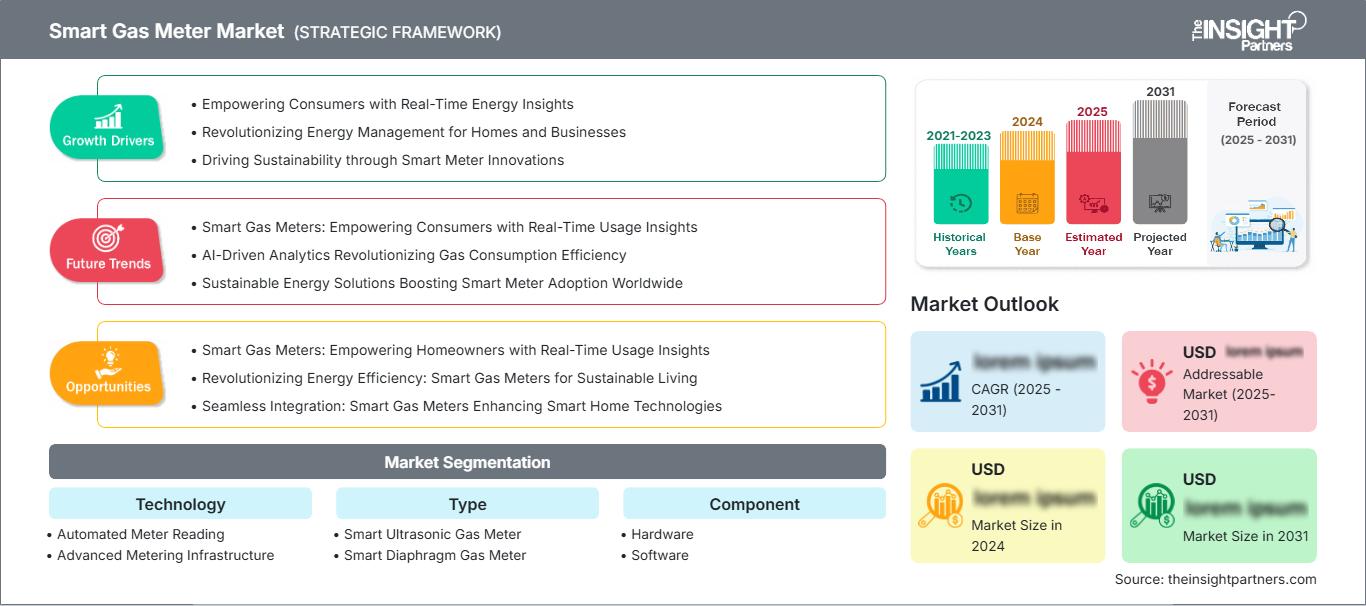
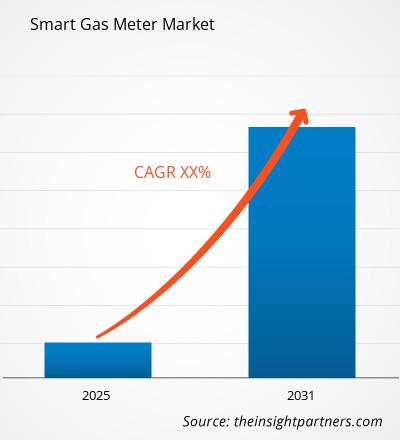
The Smart Gas Meter Market was valued at US$ 2.87 billion in 2025 and is projected to reach US$ 7.71 billion by 2034, registering a CAGR of 11.60% during the forecast period from 2026 to 2034. The market growth is fueled by the high demand for accurate billing, better consumption monitoring, and real-time detection of losses, as well as government policies supporting the digitization of utility infrastructure. Another factor contributing to market growth is the shift towards sustainable energy consumption which necessitates the adoption of systems that increase energy accountability. The Market includes Advanced Metering Infrastructure (AMI) and Automatic Meter Reading (AMR), catering to the residential, commercial, and industrial end-users.
The North American Smart Gas Meter Market size is growing due to the rapidly developing metering technology and the desire to move towards energy-efficient practices. The region experiences widespread adoption due to the necessity to improve grid reliability and efficiency at a CAGR of 10.5%–11.5% between 2026 and 2034. The utilities are modernizing the current infrastructure by installing smarter systems based on environmental objectives and regulations. Adoption of smart meters by the utilities and the consumers is likely to fuel the growth in the North American market.
Smart Gas Meter Market Assessment and Insights
- North America – North America is a key market for smart gas meters, driven by infrastructure upgrades and regulatory support. The region held a 28%–32% share in 2025 and is projected to grow at a 10.5%–11.5% CAGR from 2026 to 2034.
- US – The US market is characterized by rapid technological advancements and a strong push toward modernizing utility infrastructure. It accounted for 75%–80% of North America's market in 2025, with a CAGR of 10%–12% during the forecast period.
- Europe – Europe is a mature market, holding a 25%–29% share in 2025, with a CAGR of 9.5%–10.5%. Leading countries include the UK, Germany, France, and Italy, driven by national smart metering rollout programs and regulatory mandates for energy efficiency.
- Asia Pacific – Asia Pacific is emerging as a high-growth region, holding a 30%–34% share in 2025, with a CAGR of 12.5%–13.5%. Leading countries are China, Japan, and India, supported by rapid urbanization and government-led smart city initiatives.
- Largest Segment – The residential segment held the largest market share of 37%–41% in 2025, driven by consumer demand for real-time energy visibility and accurate billing, growing at a CAGR of 11%–12%.
- High Growth Segment – The AMI segment is the high-growth segment, with a 43%–47% share in 2025 and a CAGR of 12.5%–13.5%, driven by the need for two-way communication and real-time data collection.
- Key companies analyzed in detail: Siemens AG, Schneider Electric SE, Honeywell International Inc., Hubbell Inc., Landis+Gyr Group AG, Itron Inc., BOVE Technology, ZENNER International GmbH & Co. KG, Xylem Inc., Sagemcom UK Ltd.
Source: The Insight Partners' analysis based on proprietary research, government publications, company annual reports, investor presentations, industry databases, and expert interviews.
The Smart Gas Meter is undergoing a technological shift whereby it moves from one way Automatic Meter Reading (AMR) technology to two-way Advanced Metering Infrastructure (AMI) technology. As a result, utilities do not only get to know the consumption data but are also able to issue command to control their settings, firmware, valves among others which help to cut down operational costs to the minimum and eliminate field work. There is a greater use of cloud based technology to integrate smart meters to provide real time monitoring and predictive maintenance.
In terms of future outlook, the Market is likely to witness tremendous growth in emerging geographic areas, with Asia Pacific leading the way. The development of smart cities and gas distribution networks has been creating huge business prospects for players operating in the market. Favorable regulatory winds such as government regulations mandating smart meters and energy efficiency goals are expected to boost demand in both advanced and emerging economies. The adoption of blockchain for efficient billing and peer-to-peer gas trading and 5G technology for improved data transfer are likely to impact the market's future outlook.
Smart Gas Meter Market Report Scope
| Report Attribute | Details |
|---|---|
| Market size in 2025 | US$ 2.87 Billion |
| Market Size by 2034 | US$ 7.71 Billion |
| Global CAGR (2026 - 2034) | 11.60% |
| Historical Data | 2021-2024 |
| Forecast period | 2026-2034 |
Smart Gas Meter Market Analysis
Smart Gas Meters Demand is propelled by various factors such as the rising consumption levels of natural gas globally and the requirement for effective measurement and monitoring techniques. Industries using natural gas as fuel and feedstock also provide high demand levels for the technology as it requires precise billing. The value chain includes component suppliers, software vendors, communication vendors, and utility companies that work together to provide a complete smart metering solution. Supply is affected by the availability of advanced components and the scale of manufacturing. The utility providers have begun incorporating the use of smart meters to minimize non-revenue gas levels.
Competitive Analysis of Smart Gas Meter Market report reveals that the market has a moderate fragmentation level with some of the main vendors being Siemens AG, Schneider Electric SE, Honeywell International Inc., Landis+Gyr Group AG and Itron Inc. All these players are concentrating on improving their manufacturing capacity and technological advances along with global supply chain management. Collaboration with energy and technology companies to win larger deals is becoming common. Large amount of money is invested by them in research and development to bring about technological innovations related to sustainability of meters. Partnerships and acquisitions have become common for adding value to their portfolio and geographic footprint. They are giving importance to local manufacturing and excellent after sales support.
● REPORT CUSTOMIZATION
Tailor This Report To Align With Your Specific Business Requirements
This report can be customized to align precisely with your business objectives, scope, and target markets. Customization options include tailored segmentation, geography, competitive analysis, and strategic insights to support informed decision-making.
Customize This Report →WHAT YOU CAN ADJUST
- ● Segmentations
- ● Geography
- ● Competitive Analysis
- ● Language Preferences
Smart Gas Meter Market: Strategic Insights
Regional Insights
North America Smart Gas Meter Market
North America has a share of 28% to 32% in the global Smart Gas Meter Market Share in 2025, and it will see a CAGR of 10.5% to 11.5%. The growth in the region is attributed to rapid technology advancement in metering technologies and adoption of clean energy initiatives. There is modernization of the existing systems with more advanced systems through technological advances in order to attain the desired results and objectives. USA is the leading country in the region and adoption is fueled by policies of the government and presence of market leaders. There is use of advanced technology such as IoT and cloud platforms in the region due to the need for monitoring and maintenance of the system. Growth in adoption among utilities and consumers will ensure that there is growth in the region.
U.S. Smart Gas Meter Market
The market for smart gas meters in the United States accounted for about 75% - 80% of the North American market in 2025 and is forecasted to post a CAGR of 10% - 12% between 2026 and 2034. The market has been driven by technological developments and strong regulatory pressure to adopt smart technology for upgrading utility infrastructure. In 2024, the market size of the U.S. market stood at USD 1.1 billion, which can be attributed to the increased need for reliability and efficiency in the grid. Major players in the industry, such as Itron, Honeywell, and Landis+Gyr, are operating in the U.S. and entering into strategic alliances with utilities. The demand for smart meters has also increased due to consumers' consciousness towards energy saving through automated meter reading.
Europe Smart Gas Meter Market
The market share of Europe was found to be 25%-29% in 2025 and will have a CAGR of 9.5%-10.5% from 2026-2034. The United Kingdom is the largest market in the region owing to government initiatives for a simultaneous implementation of smart meters with the support of existing infrastructure [citation:4]. The Department of Energy & Industrial Policy implements an organized rollout plan in which more than 27.8 million smart meters were installed until 2021. Germany and France are some other major countries in this regard due to the increasing investments being made in the field of smart grids and advanced technologies. In addition, sustainability efforts and energy efficiency regulations are the key factors driving growth in the region.
APAC Smart Gas Meter Market
Asia Pacific is the fastest-growing region, holding 30%–34% of the global share in 2025, with a projected CAGR of 12.5%–13.5% during the forecast period. The region is dominated by China, Japan, and India, driven by rapid urbanization, government-led smart city initiatives, and rising demand for efficient utility management. China is the leading country, with massive infrastructure investments and a strong focus on energy efficiency. India is also emerging as a significant market with large-scale rollout projects. Industrial and policy drivers, including regulatory mandates and the need to reduce non-revenue gas, are accelerating the adoption of smart gas meters in the region. The expansion of gas pipeline networks and the increasing integration of IoT-enabled city platforms are further contributing to market growth.
Middle East & Africa Smart Gas Meter Market
The Middle East & Africa region is experiencing steady growth in the Market, with a CAGR of 8%–9% from 2026 to 2034. Saudi Arabia, UAE, and South Africa are the leading countries, driven by infrastructure development and the need for efficient energy management. The region is focusing on modernizing its gas distribution networks to improve operational efficiency and reduce losses. Investments in smart grid technologies and the adoption of smart metering solutions are gaining traction as part of broader national development plans. The Rest of MEA is also showing promising growth potential, with increasing awareness about the benefits of smart gas meters in reducing energy consumption and improving sustainability practices.
Segmentation Analysis
Type
By type the market is segmented into Advanced Metering Infrastructure (AMI) and Automatic Meter Reading (AMR). AMI is the high-growth segment, projected to register a CAGR of 12.5%–13.5% from 2026 to 2034, driven by widespread rollouts of smart infrastructure as part of broader modernization initiatives. AMI solutions offer two-way communication between utilities and end-users, enabling dynamic control over gas usage and real-time data collection, which supports faster issue resolution and improved energy management. The demand for AMI is also fueled by the need for advanced analytics, remote management capabilities, and integration with smart grid systems. AMR, which primarily supports one-way communication, remains a cost-effective solution for utilities with lower investment capacities or less emphasis on advanced energy management. While AMR is simpler to implement, the market is witnessing a clear shift toward AMI as utilities seek more comprehensive data and operational insights.
- AMI (Advanced Metering Infrastructure) – Advanced Metering Infrastructure offers two-way communication, real-time data, and remote management, making it the preferred choice for utilities seeking operational efficiency and consumer engagement.
- AMR (Automatic Meter Reading) – Automatic Meter Reading provides one-way communication for automated data collection, reducing labor costs and errors, making it a cost-effective choice for regions with limited investment capacity.
End User
Based on end user the market is segmented into Residential, Commercial, and Industrial. The residential segment accounted for approximately 39% of the global market share in 2025, leading all other segments. Consumers in this segment are increasingly seeking real-time visibility into their energy usage, and smart meters provide the tools needed to achieve that. Supportive regulatory policies, incentives, and the trend of switching to cleaner energy sources are contributing significantly to the expansion of this segment. The commercial segment is also witnessing steady growth, driven by the need for accurate billing and consumption monitoring in businesses. The industrial segment represents a significant market, as natural gas is used as fuel and feedstock in various industrial processes, making precision in measurement critical.
- Residential – The residential segment leads the market, driven by consumer demand for real-time monitoring, accurate billing, and energy efficiency. Government initiatives and smart city projects are further accelerating adoption in households.
- Commercial – The commercial segment is growing due to the need for accurate billing and consumption monitoring in business establishments. Smart meters help commercial users optimize energy usage and reduce operational costs.
- Industrial – The industrial segment relies on smart gas meters for precise measurement in manufacturing and power generation, where natural gas is a critical fuel and feedstock.
Opportunity Snapshot
| End User Segment | Revenue Contribution | Trend Tag | Adoption Stage |
|---|---|---|---|
| Residential | High | Energy Efficiency | Scaling |
| Commercial | Medium | Cost Optimization | Emerging |
| Industrial | Medium | Precision Monitoring | Scaling |
Smart Gas Meter Market Growth Drivers and Impact Analysis
Rising Global Demand for Natural Gas
The increasing global demand for natural gas is a primary driver for the Smart Gas Meter Market. As natural gas remains a dominant fuel for electricity generation and industrial applications, the need for accurate consumption monitoring and billing becomes critical. The International Energy Agency projects a steady increase in natural gas consumption, which directly supports the adoption of smart metering solutions. Industries that rely heavily on natural gas require precise measurement to ensure operational efficiency and cost management, thereby driving market growth. Additionally, the expansion of gas pipeline networks and urbanization are contributing to the rising demand for smart gas meters.
Regulatory Mandates and Energy Efficiency Initiatives
Government mandates and energy efficiency initiatives are significantly propelling the Market. Many countries are implementing regulations that promote the use of smart meters to curb non-revenue gas, improve grid performance, and achieve sustainability targets. Initiatives such as smart city projects and national smart metering rollout programs are creating a strong demand for advanced metering infrastructure. These regulatory frameworks are encouraging utilities to invest in smart gas meters to enhance energy accountability and transparency, thereby boosting market growth.
Technological Advancements and IoT Integration
Technological advancements, particularly the integration of IoT and AI, are driving the Market by enabling real-time monitoring, predictive maintenance, and enhanced data analytics. The shift from AMR to AMI has provided utilities with robust two-way communication capabilities, allowing remote management and dynamic control over gas usage. The deployment of 5G and edge computing is further enhancing data transmission speeds and connectivity, making smart gas meters more reliable and scalable. These technological innovations are not only improving operational efficiency but also enabling utilities to offer personalized energy insights to consumers.
Smart Gas Meter Market Future Trends
Shift from AMR to AMI for Enhanced Operational Efficiency
A defining Smart Gas Meter Market Trends is the shift from traditional one-way Automatic Meter Reading (AMR) to advanced two-way Advanced Metering Infrastructure (AMI). Unlike legacy meters that only send periodic consumption data, smart gas meters with two-way communication create a dynamic link between utilities and end devices, enabling remote management and real-time data exchange. This trend is driven by the need for granular consumption insights, early leak detection, and faster emergency responses. The adoption of AMI also supports remote firmware upgrades and tariff updates, ensuring meters stay current with evolving regulatory requirements. The market is witnessing a clear pivot toward AMI as the preferred technology for smart gas metering.
Integration of Blockchain and Edge Computing in Smart Metering
The Smart Gas Meter Market is evolving with the deeper integration of blockchain and edge computing technologies. Blockchain is being explored for transparent billing and secure peer-to-peer gas trading in decentralized energy markets. Edge-enabled meters allow local data processing, improving responsiveness and reducing dependence on cloud services. This trend is part of a broader movement toward intelligent energy management systems that leverage advanced analytics for personalized energy insights and anomaly detection. The expansion of 5G networks is further supporting this trend by enhancing data transmission speeds and connectivity for smart meters deployed in dense urban environments.
Smart Gas Meter Market Opportunities
Expansion in Emerging Economies with Smart City Initiatives
The Smart Gas Meter Market Forecast presents significant opportunities in emerging economies, particularly in Asia Pacific and Latin America, driven by rapid urbanization, industrial growth, and smart city initiatives. Countries like India, China, and Brazil are investing heavily in modernizing their utility infrastructure, creating a substantial demand for smart metering solutions. The deployment of smart gas meters aligns with national sustainability goals and offers a cost-effective way to improve energy management and billing accuracy. Companies can capitalize on these opportunities by forming strategic partnerships with local utilities and governments to secure large-scale contracts. The focus on energy efficiency and regulatory support in these regions further enhances the growth potential for market players.
Development of Prepayment and IoT-Enabled Smart Metering Models
There is a growing opportunity for smart gas meter manufacturers to develop prepayment and IoT-enabled metering models, particularly in developing countries. Prepaid smart metering models improve energy access and billing flexibility for lower-income households, while IoT integration enables real-time monitoring and predictive maintenance. The development of next-generation meters with ultra-low current consumption and advanced communication technologies is gaining traction. Companies that focus on offering end-to-end solutions, combining hardware with cloud-based analytics and software platforms, are well-positioned to capture market share. This opportunity aligns with the global push for sustainable and data-driven energy management systems.
Recent Developments
- May 2026: India's power distribution sector is poised for a major transformation, with an estimated INR 11.2 lakh cr capital expenditure pipeline through 2035 set to drive the next phase of reforms, as the smart metering programme shifts focus from installations to measurable outcomes, Vivek Goel, Chief Engineer (Distribution Planning & Technology), Central Electricity Authority (CEA) said.
- April 2026: A committee set up to recommend a road map for the implementation of smart domestic piped natural gas (PNG) meters has suggested shifting to a prepaid billing regime nationwide to improve commercial viability, along with offering a production-linked incentive (PLI) for meter manufacturers. The five-member committee found that, based on technical performance, lifecycle cost analysis, and implementation readiness, smart diaphragm-based domestic PNG meters are the most feasible and cost-effective solution for large-scale deployment across the city gas distribution (CGD) sector.
- December 2025: Vi Business, the enterprise arm of telecom service provider Vodafone Idea, has expanded its Advanced Metering Infrastructure (AMI) portfolio by introducing Smart Gas Metering solutions for City Gas Distribution (CGD) companies. Vi Business, which deployed India’s first smart energy meters in 2018, is now bringing its Internet of Things (IoT) and AMI expertise to the fast-growing natural gas sector. The company says this move will support the government’s efforts to modernise the country’s utility systems and promote digital metering.
Frequently Asked Questions

- Comprehensive Market Sizing and Forecast Analysis
- Detailed Segmentation Analysis
- In-Depth Market Dynamics Assessment
- Regional and Country-Level Insights
- Competitive Landscape and Company Benchmarking
- Strategic Business Intelligence
Recent Reports
Testimonials

The Insight Partners' SCADA System Market report is comprehensive, with valuable insights on current trends and future forecasts. The team was highly professional, responsive, and supportive throughout. We are very satisfied and highly recommend their services.
RAN KEDEM Partner, Reali Technologies LTDs
I requested a report on a very specific software market and the team produced the report in a few days. The information was very relevant and well presented. I then requested some changes and additions to the report. The team was again very responsive and I got the final report in less than a week.
JEAN-HERVE JENN Chairman, Future Analytica
We worked with The Insight Partners for an important market study and forecast. They gave us clear insights into opportunities and risks, which helped shape our plans. Their research was easy to use and based on solid data. It helped us make smart, confident decisions. We highly recommend them.
PIYUSH NAGPAL Sr. Vice President, High Beam Global
The Insight Partners delivered insightful, well-structured market research with strong domain expertise. Their team was professional and responsive throughout. The user-friendly website made accessing industry reports seamless. We highly recommend them for reliable, high-quality research services
YUKIHIKO ADACHI CEO, Deep Blue, LLC.
This is the first time I have purchased a market report from The Insight Partners.While I was unsure at first, I visited their web site and felt more comfortable to take the risk and purchase a market report.I am completely satisfied with the quality of the report and customer service. I had several questions and comments with the initial report, but after a couple of dialogs over email with their analyst I believe I have a report that I can use as input to our strategic planning process.Thank you so much for taking the extra time and making this a positive experience.I will definitely recommend your service to others and you will be my first call when we need further market data.
JOHN SUZUKI President and Chief Executive Officer, Board Director, BK Technologies
I wish to appreciate your support and the professionalism you displayed in the course of attending to my request for information regarding to infectious disease IVD market in Nigeria. I appreciate your patience, your guidance, and the fact that you were willing to offer a discount, which eventually made it possible for us to close a deal. I look forward to engaging The Insight Partners in the future, all thanks to the impression you have created in me as a result of this first encounter.
DR CHIJIOKE ONYIA MANAGING DIRECTOR, PineCrest Healthcare Ltd.Reason to Buy
- Informed Decision-Making
- Understanding Market Dynamics
- Competitive Analysis
- Identifying Emerging Markets
- Customer Insights
- Market Forecasts
- Risk Mitigation
- Boosting Operational Efficiency
- Strategic Planning
- Investment Justification
- Tracking Industry Innovations
- Aligning with Regulatory Trends





 Get Free Sample for