
Nail Gun Market Trends, Size & Growth by 2034
Coverage: by Type (Corded, Cordless); Application (Industrial, Household, Others) , and Geography (North America, Europe, Asia Pacific, and South and Central America)
- Status : Data Released
- Report Code : TIPRE00007025
- Category : Manufacturing and Construction
- No. of Pages : 150
- Available Report Formats :


- Last update date : July 28, 2026


2025 Market Size
US$ 637.0 Mn
Base year value
2034 Forecast
US$ 1,182.25 Mn
Projected by 2034
CAGR 2026-2034
7.11 %
Growth rate
Addressable Market
US$ 8,209.94 Mn
(2026-2034)
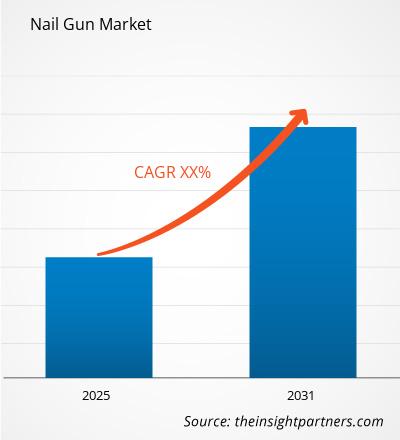
The Nail Gun Market was valued at US$ 637.0 Million in 2025 and is projected to reach US$ 1,182.25 Million by 2034, registering a CAGR of 7.11% during 2026–2034. Demand is moving beyond traditional pneumatic fastening as contractors, furniture producers, and household users increasingly evaluate speed, precision, and portability in purchase decisions. The market reflects the steady replacement of manual fastening methods across residential construction, woodworking, and industrial assembly applications.
North America remains a structurally important demand center, with an estimated 2026–2034 CAGR range of 6.6–7.0% supported by residential remodeling, trade labor productivity needs, and wider use of battery platforms. The Nail Gun Market size in the region is shaped by professional contractor replacement cycles, direct-to-contractor distribution, and safety-oriented tool upgrades. Modular construction and prefabricated framing further reinforce fastening consistency requirements.
Nail Gun Market Assessment and Insights
- North America accounted for 31–34% share in 2025 and is expected to grow at a CAGR of 6.6–7.0% between 2026–2034, supported by remodeling, wood-frame construction, and cordless adoption.
- US represented 77–80% of North America in 2025 and is forecast to grow at a CAGR of 6.7–7.1% between 2026–2034.
- Europe held 24–27% share in 2025 and is projected to expand at a CAGR of 6.2–6.6% between 2026–2034, led by Germany, the UK, and France.
- Asia Pacific captured 30–33% share in 2025 and is expected to grow at a CAGR of 7.6–8.0% between 2026–2034, led by China, India, Japan, and South Korea.
- Largest Segment Industrial accounted for 65–68% market share in 2025 and is expected to grow at a CAGR of 7.0–7.4% between 2026–2034.
- High Growth Segment Cordless held 42–45% market share in 2025 and is projected to grow at a CAGR of 8.0–8.4% between 2026–2034.
- Key companies analyzed in detail: Emerson Electric Co., Hilti Aktiengesellschaft, Illinois Tool Works Inc., Koki Holdings Co., Ltd., Makita U.S.A., Inc., MAX USA CORP., Robert Bosch GmbH, Kyocera Senco Industrial Tools, Inc., Stanley Black & Decker, Inc., and Techtronic Industries Co. Ltd.
Source: The Insight Partners' analysis based on proprietary research, government publications, company annual reports, investor presentations, industry databases, and expert interviews.
Adoption of tools has shifted from compressor-based jobsite setups to hybrid fleet systems that integrate pneumatic reliability with battery-powered convenience. Improvements being made include better designs of magazines, firing mechanisms, brushless motors, and depth settings in an effort to minimize accidental discharge as well as user fatigue. Changes are also being observed in production dynamics as battery ecosystems will be key in repeat purchases of such products, but pneumatic tools are still relevant where large-scale industrial assembly takes place with air infrastructure installed.
Future demand will be shaped by factors such as the growing trend of urban construction, renovation inducements, and controlled fastening operations in terms of safety. India, Southeast Asia, and some economies in the Gulf region are opening up new markets for professional tools, whereas Europe and North America will see more of low-vibration, ergonomic, and reduced-dust jobsite tools.
Nail Gun Market Report Scope
| Report Attribute | Details |
|---|---|
| Market size in 2025 | US$ 637.0 Million |
| Market Size by 2034 | US$ 1,182.25 Million |
| Global CAGR (2026 - 2034) | 7.11% |
| Historical Data | 2021-2024 |
| Forecast period | 2026-2034 |
Nail Gun Market Analysis
The Nail Gun Market growth is supported by the need to shorten fastening time in framing, roofing, cabinetry, pallet production, and furniture assembly. Contractors use powered nailers to standardize output where labor availability is constrained and project schedules are compressed. Demand also benefits from wood-based construction, home improvement activity, and factory assembly lines requiring repeatable fastening pressure.
The value chain links steel fastener suppliers, battery-cell sourcing, motor components, housings, distributors, and repair networks. Supply dynamics increasingly depend on lithium-ion pack availability for cordless tools and compressor compatibility for corded or pneumatic models. Channel partners influence adoption through demonstration, warranty support, and bundled kits that reduce switching barriers for contractors.
Nail Gun Market Analysis reveals a competitive market in which platform dominance, ease of servicing, and specialization of trade are more important than individual product pricing. Hilti Aktiengesellschaft, Makita U.S.A., Inc., Stanley Black & Decker, Inc., and Techtronic Industries Co. Ltd. focus on cordless platforms, whereas Illinois Tool Works Inc., MAX USA CORP., and Kyocera Senco Industrial Tools, Inc. offer reliable fastening systems.
Market investment focuses on battery adaptability, lightweight construction, connectivity, and specialized applications, including framing, finishing, and industrial assembly. Robert Bosch GmbH and Koki Holdings Co., Ltd. differentiate themselves through larger ranges of power tools, and Emerson Electric Co. adds industrial technology competencies. Strategic position favors companies that balance premium quality with mid-range products.
● REPORT CUSTOMIZATION
Tailor This Report To Align With Your Specific Business Requirements
This report can be customized to align precisely with your business objectives, scope, and target markets. Customization options include tailored segmentation, geography, competitive analysis, and strategic insights to support informed decision-making.
Customize This Report →WHAT YOU CAN ADJUST
- ● Segmentations
- ● Geography
- ● Competitive Analysis
- ● Language Preferences
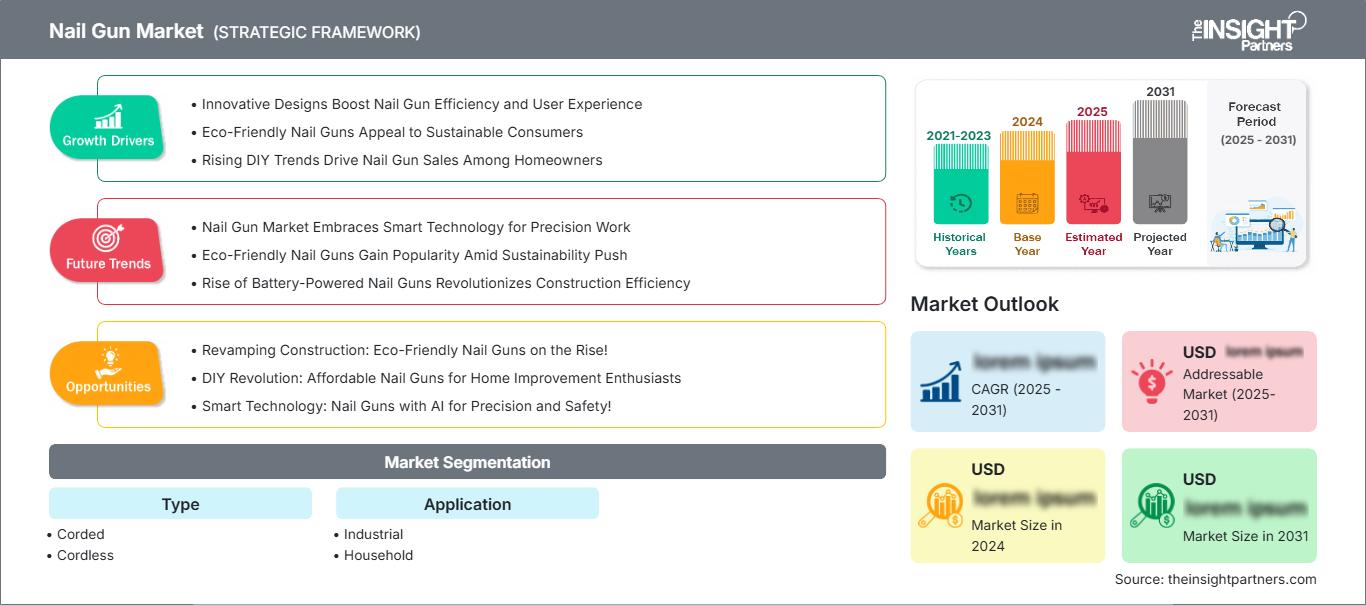
Nail Gun Market: Strategic Insights
Regional Insights
North America Nail Gun Market
North America held 31–34% share in 2025 and is projected to grow at a CAGR of 6.6–7.0% during 2026–2034. The Nail Gun Market share is supported by wood-frame residential building, remodeling, and contractor demand for productivity-enhancing tools. Cordless systems are gaining popularity because they reduce setup time and improve mobility across active jobsites. Procurement patterns are shaped by professional dealer networks, home improvement retail, and online channels. Demand is strongest in framing, roofing, decking, and finish carpentry, where speed and fastening consistency directly affect labor utilization. Safety features, depth control, and lighter tool designs are becoming key differentiators for contractors managing extended daily use.
U.S. Nail Gun Market
The U.S. accounted for 77–80% of North America in 2025 and is expected to register a CAGR of 6.7–7.1% from 2026–2034. Demand is supported by residential renovation, professional carpentry, pallet fabrication, and commercial fit-out operations. Wide retail and distribution coverage enables upgrades to tool kits to be available to both trade professionals and knowledgeable homeowners for replacements. Brand presence is prominent through the networks of DEWALT, Milwaukee, Makita, Bosch, Hilti, Senco, and MAX. Application trends involve the use of cordless framing and finish nailers due to the ease of mobility and increased efficiency in terms of productivity and site utility; on the other hand, corded and pneumatic variants are being utilized by the industrial sector in cases where repeated fastening, high duty cycles, and economic maintenance outweigh portability concerns.
Europe Nail Gun Market
Europe represented 24–27% of the market in 2025 and is forecast to expand at a CAGR of 6.2–6.6% through 2034. Germany continues to lead, with support from the woodworking industry, prefabricated building elements, and stringent safety regulations. The UK gets a boost from the market for refurbishment and contractors' preference for smaller and cordless machines for interior finishes, with rising use of battery-powered machines helping efficiency on site. France, Italy, and Spain also play their part with furniture manufacturing, restoration activities, and housing renovations. Europeans tend to give priority to noise levels, vibrations, dust inhalation, and reparability, thus allowing for more expensive models with safety switches, ergonomically designed bodies, and improved ergonomics. There are several distribution channels present, making channel management an important factor.
APAC Nail Gun Market
APAC captured 30–33% share in 2025 and is expected to grow at a CAGR of 7.6–8.0% between 2026–2034. China is the leading country due to its large-scale construction activity, strong woodworking export sector, and extensive tool manufacturing ecosystem. Japan and South Korea support premium demand through high-quality carpentry, precision industrial assembly, and a preference for advanced professional-grade equipment. India and Australia add growth through housing development, infrastructure investments, and renovation activity. Policy support for urban development and industrial corridors continues to increase demand for efficient fastening tools, while local distribution partnerships help global brands address price sensitivity and expand market reach. Cordless nailers are seeing particularly strong adoption as contractors seek greater mobility, reduced setup time, and improved productivity across dispersed construction and woodworking sites.
Middle East & Africa Nail Gun Market
The Middle East & Africa is projected to grow at a CAGR of 6.4–6.8% during 2026–2034. Saudi Arabia remains the leading country, supported by large construction programs, hospitality developments, and ongoing infrastructure investments. The UAE shows steady demand in commercial interiors, fit-outs, and maintenance-driven tool replacement, supported by continued activity in the construction and real estate sectors. South Africa and the rest of MEA contribute through residential construction, warehousing, and energy-linked infrastructure projects. Demand remains uneven because professional tool penetration varies by contractor scale and project type. While durable corded and pneumatic tools continue to hold a strong position due to their reliability and lower operating costs, cordless models are gaining traction as contractors increasingly seek flexibility, mobility, and faster workflow transitions between interior and exterior fastening applications.
Segmentation Analysis
Type
Type is expected to register a CAGR of 7.2–7.6% during 2026–2034, reflecting the transition from stationary power dependence to flexible tool platforms. The Nail Gun Market scope within type is defined by corded reliability in repetitive work and cordless expansion in mobile construction. Buyers increasingly compare total system cost, runtime, weight, trigger precision, and maintenance requirements before standardizing fleets.
- Corded tools remain important in workshops, industrial production, and contractor environments where continuous power access, predictable output, and lower upfront cost outweigh mobility requirements.
- Cordless tools are gaining strategic relevance because battery platforms reduce hoses, compressors, and setup time while supporting framing, trim, cabinetry, and repair applications across distributed worksites.
Application
Application is projected to grow at a CAGR of 7.0–7.4% between 2026–2034. Industrial use leads because nail guns shorten cycle times in framing, furniture, pallets, packaging, and modular components. Household adoption is rising as safer trigger systems, lighter tools, and online product education encourage homeowners to use powered fastening for renovation, repair, and woodworking projects.
- Industrial applications dominate due to repetitive fastening needs, workforce productivity pressures, and standardized output requirements across construction, furniture production, packaging, and component assembly operations.
- Household demand is expanding through DIY renovation, trim installation, garden structures, and furniture repair, especially where compact cordless models improve confidence and reduce manual effort.
Opportunity Snapshot
| Application | Revenue Contribution | Trend Tag | Adoption Stage |
| Industrial | High | Modular Build | Mature |
| Household | Medium | DIY Repair | Scaling |
Nail Gun Market Growth Drivers and Impact Analysis
Labor Productivity Pressure in Construction
The shortage of skilled labor, shortened time frames, and high standards of quality have led to an increasing use of power fastening equipment among construction contractors. With the help of a nail gun, a contractor can perform repetitive framing, sheathing and finishing work much faster and with better quality compared to hammering. This effect can be seen in shorter cycle times, less need for corrections, and increased labor productivity in the field of both housing and non-residential construction. Due to the growing popularity of prefabricated panels, module construction, and factory-made building elements, fastening becomes especially important. This factor contributes to the increase in demand for nail guns among both industrial and professional users.
Cordless Platform Standardization
Standardization in battery platforms has altered buying habits since contractors favor equipment whose batteries have compatible charging systems, batteries, and services. This lowers the cost of owning additional units and makes it easier for buyers to integrate nailers within their existing cordless platforms. It is beneficial to manufacturers because it enhances customer loyalty by having customers standardize drills, saws, grinders, and fasteners. This has had the most significant effect in finish carpentry, renovation, and remote job sites, which are constrained by hoses and compressors. Improved battery packs, brushless motors, and electronics make cordless nailers competitive to pneumatic nailers.
Expansion of Renovation and Woodworking Activity
There is constant demand in renovation, repair works, furniture production and woodworks due to the cyclicality of construction. The owners of houses and smaller contractors are now opting for portable nail guns for the finishing, cabinet making, floor installation, fencing and furniture repairs due to the fact that powered fasteners improve quality, increase efficiency and save physical effort. There is retail and online comparison shopping, which helps the customers evaluate different models and videos and guides that help first-time buyers learn how to use nail guns. These factors expand the client base and increase demand for mid and entry-level tools.
Nail Gun Market Future Trends
Smart Fastening Controls
The Nail Gun Market trends point toward smarter firing controls, battery diagnostics, jam alerts, and usage tracking that help contractors manage fleets more efficiently. Future models are likely to integrate electronic depth memory, tool-lock functions, and maintenance prompts that reduce downtime and improve operational consistency. These features will be particularly valuable for large contractors, rental companies, and industrial users who manage multiple tools and operators across job sites. Data-enabled service models could also help manufacturers predict wear patterns, streamline maintenance planning, and improve warranty economics. As connected tools become more common, differentiation will increasingly shift from raw driving power to uptime, safety, fleet management capabilities, and overall jobsite accountability.
Low-Noise and Ergonomic Jobsite Tools
Factors such as noise, vibration, and operator fatigue will continue to play roles in future product design, as contractors adjust their safety concerns and increased tool use throughout the day. Manufacturers are expected to develop lighter composite bodies, better balance, less recoiling components, and enhanced triggering systems that ensure there is a reduced chance of accidentally discharging the tool while improving operator comfort levels. There will be an increasing demand for quieter cordless solutions at urban construction and interior renovation sites because of noise, space, and mobility issues created by compressors. There is likely to be an increased emphasis on ergonomic differentiation for finish carpentry, cabinet making, and assembly work where operator comfort impacts productivity.
Nail Gun Market Opportunities
Localized Service and Rental Networks
Localized repair, rental, and demonstration networks can unlock adoption among small contractors that hesitate to invest in premium systems without service assurance. Nail Gun Market Forecasts indicate stronger gains where brands combine tool availability with fast parts replacement and operator training. Rental channels also allow contractors to test cordless framing or finish nailers before committing to fleet purchases. This opportunity is particularly relevant in emerging markets, where purchase budgets are constrained but productivity needs are rising. Companies that build reliable service coverage can convert trial usage into repeat equipment sales.
Application-Specific Cordless Expansion
Manufacturers can achieve incremental growth through the production of application-specific nailers designed for particular uses like engineered wood, cabinet construction, roofing, pallet repair, and light-gauge fastening. Application-specific nailers help manufacturers bridge gaps that general-purpose tools cannot fill in terms of nail length, magazine angle, finish surface, and continuous firing rate. Bundling fasteners, batteries, and warranty service contracts helps build customer loyalty. This strategy is also valuable in premium segmenting since customers value equipment that minimizes jams, preserves material integrity, and maintains productivity.
Recent Developments
- April 2026: MAX USA Corp. launches their new SuperFramer Coil Nailer. The CN890F3 drives 2” to 3-1/2” 15-degree wire welded coil nails, making it a versatile and safe tool for jobs such as framing, sheathing, decking, subflooring, and furring. This model now includes both a sequential actuation (orange) and a contact actuation (black) trigger.
- September 2025: Makita U.S.A., Inc. — Makita expanded its LXT cordless nailer and stapler lineup with three new nailers and one stapler for finish, brad, and fastening applications. The launch targeted contractors seeking pneumatic-like output without compressors or hoses.
- May 2025: Makita U.S.A., Inc. released 18V LXT 21° and 30° framing nailers designed to drive nails into dense engineered lumber while operating on the existing LXT battery platform. The launch strengthened its cordless framing proposition for professional builders.
Frequently Asked Questions

- Comprehensive Market Sizing and Forecast Analysis
- Detailed Segmentation Analysis
- In-Depth Market Dynamics Assessment
- Regional and Country-Level Insights
- Competitive Landscape and Company Benchmarking
- Strategic Business Intelligence
Recent Reports
Testimonials

The Insight Partners' SCADA System Market report is comprehensive, with valuable insights on current trends and future forecasts. The team was highly professional, responsive, and supportive throughout. We are very satisfied and highly recommend their services.
RAN KEDEM Partner, Reali Technologies LTDs
I requested a report on a very specific software market and the team produced the report in a few days. The information was very relevant and well presented. I then requested some changes and additions to the report. The team was again very responsive and I got the final report in less than a week.
JEAN-HERVE JENN Chairman, Future Analytica
We worked with The Insight Partners for an important market study and forecast. They gave us clear insights into opportunities and risks, which helped shape our plans. Their research was easy to use and based on solid data. It helped us make smart, confident decisions. We highly recommend them.
PIYUSH NAGPAL Sr. Vice President, High Beam Global
The Insight Partners delivered insightful, well-structured market research with strong domain expertise. Their team was professional and responsive throughout. The user-friendly website made accessing industry reports seamless. We highly recommend them for reliable, high-quality research services
YUKIHIKO ADACHI CEO, Deep Blue, LLC.
This is the first time I have purchased a market report from The Insight Partners.While I was unsure at first, I visited their web site and felt more comfortable to take the risk and purchase a market report.I am completely satisfied with the quality of the report and customer service. I had several questions and comments with the initial report, but after a couple of dialogs over email with their analyst I believe I have a report that I can use as input to our strategic planning process.Thank you so much for taking the extra time and making this a positive experience.I will definitely recommend your service to others and you will be my first call when we need further market data.
JOHN SUZUKI President and Chief Executive Officer, Board Director, BK Technologies
I wish to appreciate your support and the professionalism you displayed in the course of attending to my request for information regarding to infectious disease IVD market in Nigeria. I appreciate your patience, your guidance, and the fact that you were willing to offer a discount, which eventually made it possible for us to close a deal. I look forward to engaging The Insight Partners in the future, all thanks to the impression you have created in me as a result of this first encounter.
DR CHIJIOKE ONYIA MANAGING DIRECTOR, PineCrest Healthcare Ltd.Reason to Buy
- Informed Decision-Making
- Understanding Market Dynamics
- Competitive Analysis
- Identifying Emerging Markets
- Customer Insights
- Market Forecasts
- Risk Mitigation
- Boosting Operational Efficiency
- Strategic Planning
- Investment Justification
- Tracking Industry Innovations
- Aligning with Regulatory Trends





 Get Free Sample for