North America Unit Heater Market Growth, Share & Trends by 2034
North America Unit Heater Market Size and Forecast (2021 - 2034), Regional Share, Trend, and Growth Opportunity Analysis Report Coverage: By Product Type (Gas Unit Heaters, Electric Unit Heaters, Hydronic, and Infrared or Radiant Heaters), Application (Commercial, Industrial, and Residential), Installation Type (New Construction and Replacement or Retrofit), and Country
Historic Data: 2021-2023 | Base Year: 2025 | Forecast Period: 2025-2031- Report Code : TIPRE00025721
- Category : Electronics and Semiconductor
- No. of Pages : 143
- Available Report Formats :


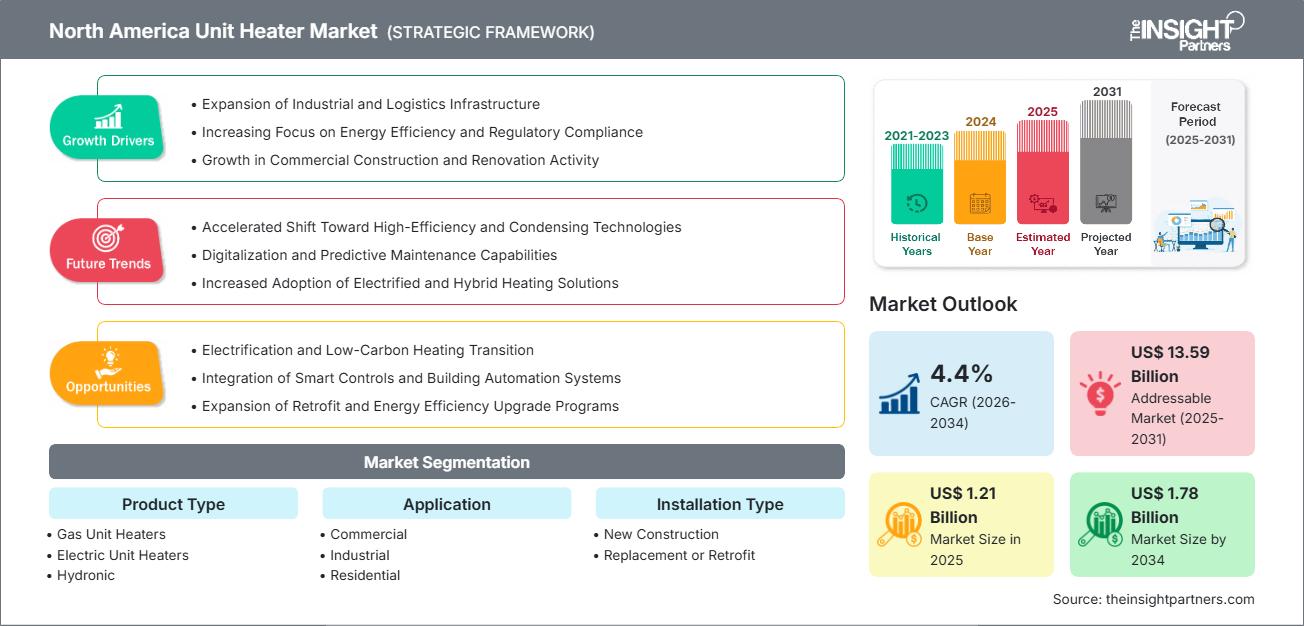
The North America unit heater market size the market was valued at US$ 1219.38 million in 2025 and is projected to reach US$ 1786.08 million by 2034; it is expected to register a CAGR of 4.4% during 2026–2034.
North America Unit Heater Market Analysis
The North America unit heater market is positioned for steady growth, driven by a robust convergence of industrial expansion, commercial retrofitting, and stringent energy efficiency mandates. As a subset of the broader heating equipment sector, unit heaters—including gas-fired, electric, and hot water models—provide space heating in large, open areas such as warehouses, manufacturing facilities, retail spaces, and institutional buildings. Market momentum is underpinned by government-led infrastructure investments and legislative pushes, such as the CHIPS Act in the US, catalyzing the construction of new industrial facilities and the demand for reliable heating solutions. The commercial sector is witnessing a wave of renovation and retrofit projects aimed at reducing operational expenses and meeting corporate sustainability goals, favoring the installation of high-efficiency units.
North America Unit Heater Market Overview
Unit heaters are self-contained heating systems designed to deliver targeted and efficient space heating in industrial, commercial, and residential environments. These systems are installed in ceilings or mounted on walls, making them ideal for warehouses, manufacturing facilities, garages, workshops, retail spaces, and institutional buildings. Unit heaters operate using natural gas, electricity, hot water (hydronic), or infrared radiant technology. Their compact design, ease of installation, and ability to provide rapid heat distribution make them a preferred solution for localized and supplemental heating requirements.
Customize This Report To Suit Your Requirement
Get FREE CUSTOMIZATIONNorth America Unit Heater Market: Strategic Insights
-
Get Top Key Market Trends of this report.This FREE sample will include data analysis, ranging from market trends to estimates and forecasts.
North America Unit Heater Market Drivers and Opportunities
Market Drivers:
- Expansion of Industrial and Logistics Infrastructure: North America is experiencing a structural expansion of industrial manufacturing and logistics infrastructure to create sustained demand momentum for the unit heater market. As North America strengthens regional supply chain resilience and industrial self-sufficiency, the requirement for durable, energy-efficient heating systems will remain a long-term structural growth catalyst for the unit heater market.
- Increasing Focus on Energy Efficiency and Regulatory Compliance: Unit heaters equipped with high-efficiency heat exchangers, condensing technology, variable-speed fans, and smart control integration are gaining preference due to their measurable performance advantages. Regulatory enforcement, investor scrutiny, and cost-optimization strategies are converging to drive sustained replacement demand and technology upgrades within the North America unit heater market.
- Growth in Commercial Construction and Renovation Activity: Robust commercial construction and renovation activity across North America is reinforcing stable growth fundamentals for the unit heater market. As developers and investors prioritize operational efficiency, sustainability certifications, and asset value enhancement, heating infrastructure upgrades are becoming a strategic capital allocation decision, sustaining consistent demand within the North America unit heater market.
Market Opportunities:
- Electrification and Low-Carbon Heating Transition: As federal, state, and provincial governments advance decarbonization targets, commercial and industrial property owners are evaluating electric-based heating alternatives to reduce carbon emissions and future-proof their assets. This shift creates favorable conditions for electric unit heaters and hybrid-compatible systems that align with evolving building codes and sustainability benchmarks.
- Integration of Smart Controls and Building Automation Systems: Commercial and industrial facility operators are prioritizing digitalization to improve energy management, operational efficiency, and predictive maintenance capabilities. Unit heaters are integrated with advanced thermostats, occupancy sensors, cloud-based monitoring platforms, and building management systems can deliver optimized performance and real-time energy insights.
- Expansion of Retrofit and Energy Efficiency Upgrade Programs: Many facilities continue to operate legacy heating systems characterized by lower efficiency ratings, inconsistent performance, and higher maintenance costs. As energy prices remain volatile and regulatory standards tighten, building owners are prioritizing equipment upgrades to improve operational economics and compliance alignment.
North America Unit Heater Market Report Segmentation Analysis
The North America unit heater market is divided into different segments to give a clearer view of how it works, its growth potential, and the latest trends. Below is the standard segmentation approach used in most industry reports:
By Product Type:
- Gas Unit Heaters: Gas unit heaters represent a significant share of the unit heater market, particularly in large-scale industrial and commercial environments where high heat output and rapid temperature recovery are essential. These systems are widely deployed in warehouses, manufacturing facilities, distribution centers, and service garages due to their ability to efficiently heat expansive spaces with high ceilings.
- Electric Unit Heaters: Electric unit heaters are gaining traction across the unit heater market due to their compact design, ease of installation, and suitability for spaces where gas infrastructure is limited or unavailable. These systems are used in residential garages, small workshops, offices, retail spaces, and supplementary heating zones within larger commercial facilities.
- Hydronic: Hydronic unit heaters represent a durable and energy-efficient segment within the unit heater market, leveraging heated water or steam supplied from a central boiler system to deliver consistent warmth. These systems are used in commercial buildings, educational institutions, healthcare facilities, and certain industrial settings where an existing hydronic infrastructure is already in place.
- Infrared or Radiant Heaters: Infrared and radiant heaters occupy a specialized but expanding niche within the unit heater market, particularly in industrial and semi-open commercial environments. Unlike conventional convention-based systems, these heaters warm objects and occupants rather than heating the surrounding air, making them highly efficient in large, draft-prone, or high-ceiling spaces.
By Application:
- Commercial: The commercial segment shapes demand patterns within the unit heater market, encompassing retail stores, office buildings, schools, healthcare facilities, hospitality spaces, and recreational centers. These environments require dependable and evenly distributed heating to ensure occupant comfort and regulatory compliance.
- Industrial: The industrial application segment constitutes a major demand driver in the unit heater market, fueled by the need to maintain operational continuity and worker safety in temperature-sensitive environments. Manufacturing plants, warehouses, logistics hubs, automotive facilities, and heavy equipment workshops rely on robust heating systems capable of handling large volumes and high ceilings.
- Residential: The residential segment represents a growing niche within the unit heater market, primarily serving garages, basements, workshops, and accessory dwelling units. Unlike central HVAC systems, residential unit heaters provide localized heating for secondary spaces that require temperature control but are not connected to the main system.
By Installation Type:
- New Construction
- Replacement or Retrofit
North America Unit Heater Market Share Analysis
In North America, the unit heater market is witnessing steady growth driven by expanding construction activities, industrial development, and increasing demand for energy-efficient heating systems. Stringent building energy codes and evolving environmental regulations are encouraging the adoption of high-efficiency and low-emission heating solutions. Manufacturers are focusing on advanced heat exchanger designs, smart controls, and improved airflow systems to enhance performance while reducing operational costs. Additionally, the integration of programmable thermostats and building management systems supports better energy optimization and user control:
US
- Market Share: Dominates the North America unit heater market, accounting for the largest revenue share due to extensive industrial and commercial infrastructure.
- Key Drivers:
- Strong Industrial Base: Presence of manufacturing plants, warehouses, and distribution centers drives steady demand for unit heaters.
- Cold Climate Regions: Northern states require efficient space heating solutions for commercial and industrial facilities.
- Infrastructure Modernization: Upgrades of aging HVAC systems in schools, hospitals, and public buildings boost replacement demand.
- Trends: Increasing adoption of energy-efficient gas-fired and electric unit heaters, integration with smart thermostats, and compliance with updated DOE energy efficiency standards.
Canada
- Market Share: Holds a significant share within the region, supported by extreme winter conditions and industrial activity.
- Key Drivers:
- Harsh Winter Climate: Sustained demand for reliable heating systems in industrial and commercial buildings.
- Mining & Oil Sands Operations: Use of heavy-duty unit heaters in remote and resource-based facilities.
- Energy Efficiency Regulations: Government incentives encourage adoption of high-efficiency heating equipment.
- Trends: Rising demand for high-efficiency condensing unit heaters and increased preference for low-emission and environmentally friendly heating systems.
Mexico
- Market Share: Emerging market with gradual growth, particularly in northern industrial zones.
- Key Drivers:
- Industrial Expansion: Growth in automotive and manufacturing sectors increases need for warehouse and plant heating.
- Commercial Construction Growth: Development of retail and logistics spaces drives demand.
- Trends: Growing preference for cost-effective electric unit heaters in light industrial applications and gradual adoption of energy-efficient heating technologies in export-oriented manufacturing hubs.
North America Unit Heater Market Report Scope
| Report Attribute | Details |
|---|---|
| Market size in 2025 | US$ 1.21 Billion |
| Market Size by 2034 | US$ 1.78 Billion |
| CAGR (2026 - 2034) | 4.4% |
| Historical Data | 2021-2023 |
| Forecast period | 2025-2031 |
| Segments Covered |
By Product Type
|
| Regions and Countries Covered |
North America
|
| Market leaders and key company profiles |
|
North America Unit Heater Market Players Density: Understanding Its Impact on Business Dynamics
The North America Unit Heater Market is growing rapidly, driven by increasing end-user demand due to factors such as evolving consumer preferences, technological advancements, and greater awareness of the product's benefits. As demand rises, businesses are expanding their offerings, innovating to meet consumer needs, and capitalizing on emerging trends, which further fuels market growth.
High Market Density and Competition
Competition is strong due to the presence of established players such as Modine Manufacturing Company; Mestek, Inc. (Sterling HVAC); Advanced Distributor Products (ADP); and TPI Corporation; are also adding to the competitive landscape across country.
This high level of competition urges companies to stand out by offering:
- Energy-Efficient Technologies: Development of high-efficiency gas-fired, hydronic, and electric unit heaters compliant with evolving regulatory standards.
- Advanced Product Innovation: Integration of smart controls, improved heat exchangers, and low-NOx burner systems.
- Robust Aftermarket Support & Service Networks: Fast replacement parts availability, technical support, and nationwide distribution capabilities.
- Cost-Effective & Scalable Solutions: Flexible product portfolios catering to commercial, industrial, institutional, and warehouse applications.
- Customization Capabilities: Tailored heating solutions for specialized environments such as manufacturing plants, agricultural buildings, and logistics facilities.
Opportunities and Strategic Moves
- Integration with Smart Building Systems: Increasing incorporation of unit heaters with building automation systems (BAS), IoT-enabled thermostats, and remote monitoring platforms to improve energy management and operational efficiency.
- Focus on Sustainability & Low-Emission Technologies: Development of high-efficiency condensing gas unit heaters, electrified heating solutions, and low-NOx systems to align with tightening environmental regulations and decarbonization goals.
- Expansion in Retrofit & Replacement Market: Significant opportunities in upgrading aging HVAC infrastructure across warehouses, schools, manufacturing plants, and commercial facilities.
- Electrification Trend: Growing demand for electric unit heaters driven by carbon reduction policies and the shift away from fossil fuel-based heating systems.
Major Companies operating in the North America Unit Heater Market are:
- Modine Manufacturing Company
- Mestek, Inc. (Sterling HVAC)
- Advanced Distributor Products (ADP)
- Schwank
- Detroit Radiant Products Company
- Superior Radiant Products
- The Marley Company LLC
- TPI Corporation
- Stelpro, Inc.
- Ouellet
- Glen Dimplex Americas (Cadet)
- King Electric
- Reznor
- Beacon Morris
- Space-Ray
Disclaimer: The companies listed above are not ranked in any particular order.
Other companies analyzed during research:
- Airtherm
- Armstrong International Inc.
- Dunham-Bush
- Kroll Energy GmbH
- Turbonics
- Daikin Industries Ltd.
- Lennox International Inc.
- Johnson Controls
- Carrier Corporation
- Thermofin
- Danfoss
- Roberts Gordon LLC
- Heatrex
- Williams Comfort Products
- QMark
North America Unit Heater Market News and Recent Developments
- In May 2025, Modine announced to enter a definitive agreement to acquire L.B. White: Modine, a diversified global leader in thermal management technology and solutions, announced to acquire L.B. White, a leading global provider of specialty heating solutions for the agriculture, construction and special event industries. Modine expects the transaction to close on May 31, 2025, subject to customary closing conditions.
- In October 2025, Mestek, Inc. has entered a strategic collaboration with BioTherm Solutions: Mestek, Inc. has collaborated with BioTherm Solutions to introduce Sterling HVAC and RBI-branded climate control products into greenhouse, indoor farm, and controlled environment agriculture (CEA) sectors. The partnership combines Mestre’s HVAC expertise with BioTherm’s CEA systems to deliver efficient, integrated heating, cooling, and environmental control solutions tailored for modern agricultural facilities.
North America Unit Heater Market Report Coverage and Deliverables
The "North America Unit Heater Market Size and Forecast (2021–2034)" report provides a detailed analysis of the market covering below areas:
- North America Unit Heater Market size and forecast at country levels for all the key market segments covered under the scope
- North America Unit Heater Market trends, as well as market dynamics such as drivers, restraints, and key opportunities
- Detailed PEST and SWOT analysis
- North America Unit Heater Market analysis covering key market trends, global and regional framework, major players, regulations, and recent market developments
- Industry landscape and competition analysis covering market concentration, heat map analysis, prominent players, and recent developments for the North America Unit Heater Market
- Detailed company profiles
Frequently Asked Questions

- Historical Analysis (2 Years), Base Year, Forecast (7 Years) with CAGR
- PEST and SWOT Analysis
- Market Size Value / Volume - Regional, Country
- Industry and Competitive Landscape
- Excel Dataset
Recent Reports
Testimonials

The Insight Partners' SCADA System Market report is comprehensive, with valuable insights on current trends and future forecasts. The team was highly professional, responsive, and supportive throughout. We are very satisfied and highly recommend their services.
RAN KEDEM Partner, Reali Technologies LTDs
I requested a report on a very specific software market and the team produced the report in a few days. The information was very relevant and well presented. I then requested some changes and additions to the report. The team was again very responsive and I got the final report in less than a week.
JEAN-HERVE JENN Chairman, Future Analytica
We worked with The Insight Partners for an important market study and forecast. They gave us clear insights into opportunities and risks, which helped shape our plans. Their research was easy to use and based on solid data. It helped us make smart, confident decisions. We highly recommend them.
PIYUSH NAGPAL Sr. Vice President, High Beam Global
The Insight Partners delivered insightful, well-structured market research with strong domain expertise. Their team was professional and responsive throughout. The user-friendly website made accessing industry reports seamless. We highly recommend them for reliable, high-quality research services
YUKIHIKO ADACHI CEO, Deep Blue, LLC.
This is the first time I have purchased a market report from The Insight Partners.While I was unsure at first, I visited their web site and felt more comfortable to take the risk and purchase a market report.I am completely satisfied with the quality of the report and customer service. I had several questions and comments with the initial report, but after a couple of dialogs over email with their analyst I believe I have a report that I can use as input to our strategic planning process.Thank you so much for taking the extra time and making this a positive experience.I will definitely recommend your service to others and you will be my first call when we need further market data.
JOHN SUZUKI President and Chief Executive Officer, Board Director, BK Technologies
I wish to appreciate your support and the professionalism you displayed in the course of attending to my request for information regarding to infectious disease IVD market in Nigeria. I appreciate your patience, your guidance, and the fact that you were willing to offer a discount, which eventually made it possible for us to close a deal. I look forward to engaging The Insight Partners in the future, all thanks to the impression you have created in me as a result of this first encounter.
DR CHIJIOKE ONYIA MANAGING DIRECTOR, PineCrest Healthcare Ltd.Reason to Buy
- Informed Decision-Making
- Understanding Market Dynamics
- Competitive Analysis
- Identifying Emerging Markets
- Customer Insights
- Market Forecasts
- Risk Mitigation
- Boosting Operational Efficiency
- Strategic Planning
- Investment Justification
- Tracking Industry Innovations
- Aligning with Regulatory Trends




 Get Free Sample For