
Nylon Cable Ties Market Trends, Demand & Growth by 2034
Coverage: by Product Type (PA66 Cable Ties, PA6 Cable Ties, Others); Application (Electronic and Electrical, Building and Construction, Automotive, Consumer Goods, Others) , and Geography (North America, Europe, Asia Pacific, and South and Central America)
- Status : Data Released
- Report Code : TIPRE00009058
- Category : Chemicals and Materials
- No. of Pages : 150
- Available Report Formats :


- Last update date : September 23, 2026


2025 Market Size
US$ 187.53 Mn
Base year value
2034 Forecast
US$ 319.61 Mn
Projected by 2034
CAGR 2026-2034
6.10 %
Growth rate
Addressable Market
US$ 2,295.90 Mn
(2026-2034)
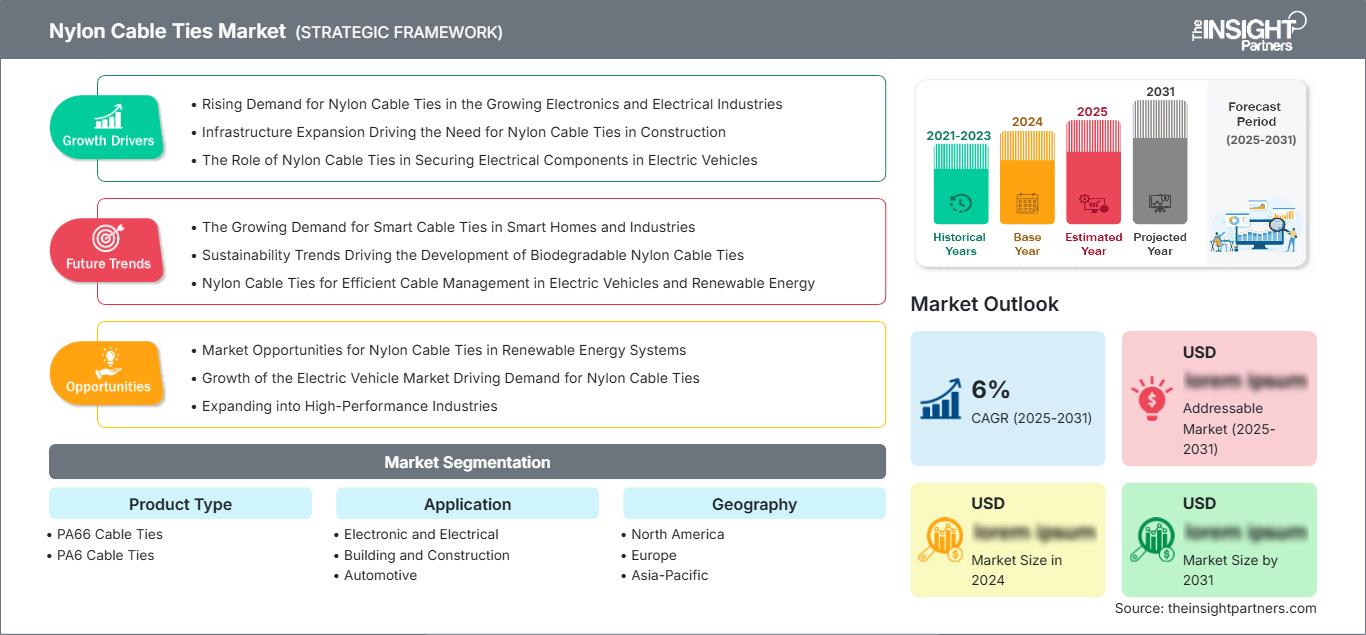
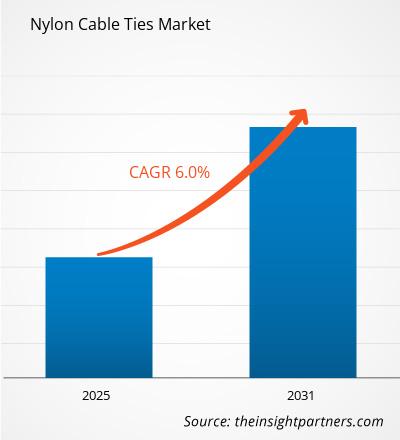
The nylon cable ties market is valued at US$ 187.53 Million in 2025 and is projected to reach US$ 319.61 Million by 2034, expanding at a CAGR of 6.10% from 2026 to 2034. Demand is supported by recurring requirements for wire bundling, harness organization, equipment assembly, and infrastructure installation. Product differentiation increasingly centers on tensile strength, temperature resistance, UV stability, flame performance, installation efficiency, and material sustainability across industrial and commercial applications.
North America remains a structurally attractive market, supported by data-center construction, electrical infrastructure renewal, industrial automation, and automotive production. The nylon cable ties market size benefits from established distribution networks and stringent installation requirements. Demand is also shifting toward specialized ties for high-temperature, outdoor, plenum, transportation, and critical electrical applications, while procurement increasingly considers certification, traceability, service life, and total installation cost.
Nylon Cable Ties Market Assessment and Insights
- North America commands a 34–38% nylon cable ties market share in 2025 and is expected to grow at a 5.8–6.3% CAGR between 2026–2034. Data-center investment, electrical modernization, industrial automation, and established OEM distribution support sustained adoption.
- US represents 84–88% of North American demand in 2025 and is projected to expand at a 5.7–6.2% CAGR during 2026–2034, supported by infrastructure, construction, and industrial applications.
- Europe accounts for 26–30% share in 2025 and is projected to grow at a 5.2–5.8% CAGR through 2034. Germany, the UK, France, Italy, and Spain benefit from automotive, industrial, building, and electrification applications.
- Asia Pacific represents 24–28% share in 2025 and is expected to record a 6.8–7.5% CAGR between 2026–2034. China, Japan, South Korea, and India provide the strongest manufacturing and electronics demand base.
- Largest Segment is PA66 Cable Ties, with a 76–80% market share in 2025 and a 5.8–6.2% CAGR from 2026–2034, reflecting broad mechanical and thermal performance.
- High Growth Segment is Automotive, representing an estimated 18–22% share in 2025 and expanding at a 7.0–7.6% CAGR from 2026–2034 as vehicle electrical content rises.
- Key companies analyzed in detail: HellermannTyton GmbH, ABB Installation Products, Panduit Corp., Legrand SA, 3M Company, KAI SUH SUH ENTERPRISE CO., LTD., Cable Tie Express, Inc., Molex, LLC, SAB North America, Shenzhen Zhaolong Interconnect Technology Co., Ltd., Inolectric AG, U.S. Tsubaki Power Transmission, LLC, Arno Werkzeuge GmbH, and Kingcable.
Source: The Insight Partners' analysis based on proprietary research, government publications, company annual reports, investor presentations, industry databases, and expert interviews.
Nylon cable tie products are transitioning from commoditized standardized fasteners into custom-engineered applications. Injection molding plays a key role in high-volume manufacturing, whereas resin properties, mold design, lock structure, and automation of the application process increasingly become decisive factors for product performance. Nylon PA66 materials are being expanded by properties such as UV resistance, heat resistance, flame retardance, low smoke, and other environmental qualities. Also, releasable, detectable, and integrated-mounting varieties are growing in number.
In the future, growth in the nylon cable ties market will be more evenly geographically distributed due to the increase of manufacturing in Southeast Asia, electronics production in India, infrastructure needs in the Middle East, and renewable energy deployment. Regulatory pressure in the form of transparency, recycling, fire performance, and chemicals is making suppliers pay attention to documentation and product tracking. Investments, therefore, will be increasingly made in localized production, automation of molding, sustainable resins, and digitalized distribution.
Nylon Cable Ties Market Report Scope
| Report Attribute | Details |
|---|---|
| Market size in 2025 | US$ 187.53 Million |
| Market Size by 2034 | US$ 319.61 Million |
| Global CAGR (2026 - 2034) | 6.10% |
| Historical Data | 2021-2024 |
| Forecast period | 2026-2034 |
Nylon Cable Ties Market Analysis
The demand in the nylon cable ties market emanates from an ecosystem that includes polymer manufacturers, compounders, molders, distributors, electrical contractors, OEMS, and industrial users. The material PA66 continues to be favored when tensile strength, stability, and heat performance are considered critical. The supply factors include engineering plastic material availability, cost of additives, productivity of the molding process, packaging options, and logistics. Suppliers benefit from standardization through offering application-tailored products.
Value chains today favor suppliers who can manage resin properties, tooling, quality and delivery processes. The certification of products with respect to electrical, fire, environmental and installation standards determines whether a product qualifies in infrastructure projects and OEMs. In addition, buyers consider installation labor cost, probability of failure and replacement costs. This situation favors engineered ties with specific requirements for which high specifications are justified.
Competition is made up of global cable management specialists and regional suppliers. HellermannTyton GmbH relies on its depth of product range and application engineering, while ABB Installation Products relies on Ty-Rap and its existing electrical contacts. Panduit Corporation stresses wire management integration and sustainability certification, and Legrand SA takes advantage of its electrical system contacts. 3M Company and Molex, LLC enjoy a more comprehensive connectivity portfolio to facilitate cross-selling of their products into electrical and electronic applications.
Companies such as KAI SUH SUH ENTERPRISE CO., LTD., Cable Tie Express, Inc., SAB North America, Shenzhen Zhaolong Interconnect Technology Co., Ltd., Inolectric AG, U.S. Tsubaki Power Transmission, LLC, Arno Werkzeuge GmbH, and Kingcable compete through regional presence, customization, specialist products, or channel contacts. Investment needs include automated molding machines, quality assurance programs, recycled content approval, regional warehouses, and application-oriented product development.
● REPORT CUSTOMIZATION
Tailor This Report To Align With Your Specific Business Requirements
This report can be customized to align precisely with your business objectives, scope, and target markets. Customization options include tailored segmentation, geography, competitive analysis, and strategic insights to support informed decision-making.
Customize This Report →WHAT YOU CAN ADJUST
- ● Segmentations
- ● Geography
- ● Competitive Analysis
- ● Language Preferences
Nylon Cable Ties Market: Strategic Insights
Regional Insights
North America Nylon cable ties market
North America holds an estimated 34–38% nylon cable ties market share in 2025 and is expected to expand at a 5.8–6.3% CAGR through 2034. The area enjoys mature electrical infrastructure distribution, extensive commercial building programs, data center growth, modernization of utilities, and substantial industrial automation. Demand is driven by the US while Canada participates through infrastructure, transportation, energy, and commercial building projects. Procurement practices tend to favor certified products that have known tensile properties and stability in terms of temperature resistance and installation.
There exists a mature local supply chain in the nylon cable ties market comprised of manufacturers, electrical distributors, OEMs, and industrial MRO suppliers. Increased application of automated assembly and dense wiring results in greater demand for ties that will be installed at consistent tensions. Infrastructure modernization and electrification contribute to demand for UV-protected and weather resistant ties. Sustainability-related documentation is becoming an increasingly important aspect due to institutional buyer requests for environmentally friendly ties along with their certification.
U.S. Nylon cable ties Market
The US represents 84–88% of North American demand in 2025 and is projected to grow at a 5.7–6.2% CAGR through 2034. The demand drivers are construction, data centers, electrical devices, industrial equipment, telecommunication, and automobile production industries. ABB Installation Products, Panduit Corp., 3M Company, HellermannTyton GmbH, Molex, LLC, and Cable Tie Express, Inc. hold significant channel or product presence in all these segments.
More sophisticated application requirements distinguish basic indoor cable ties from the UV stabilized, plenum rated, high temperature, rugged, and specialty versions. Reliable routing and quick installation are the criteria for data center and industrial segment, whereas consistency, vibration resistance, compact design, and bundle retention become crucial in the automobile sector. Distributors' access is vital since cable ties are usually bought along with terminals, conduits, labeling products, connectors, and other wire management devices.
Europe Nylon cable ties Market
Europe accounts for 26–30% share in 2025 and is expected to grow at a 5.2–5.8% CAGR through 2034. German demand is predominant due to auto manufacturing and industrial engineering activities. UK benefits from strong commercial, infrastructure, and MRO consumption, whereas France has its advantage due to transportation, energy, and industrial requirements. Moreover, demand in Europe comes from Italy and Spain through their activities in machinery, construction, electrical installation, and renewables.
Germany is the country with the strongest demand since auto manufacturing, industrial equipment, electrical machines, and manufacturing automation need fastening products on a continuous basis. Moreover, Germany serves as a basis for differentiated suppliers and application engineering.
United Kingdom has a combination of construction, data infrastructure, industrial MRO, and electrical distribution demand. France benefits from transportation and energy investments, whereas Italy and Spain create demand via their activities in machinery, construction, automotive components, and renewables. Increasingly, European procurement takes into consideration product conformity, material declaration, recyclability, and performance.
APAC Nylon cable ties Market
According to the nylon cable ties market report, APAC holds 24–28% share in 2025 and is projected to grow at a 6.8–7.5% CAGR through 2034, led by China. Electronics manufacturing, industrial equipment, construction, and renewable energy are some of the areas where China gains an advantage. Japan and South Korea help out with their automotive manufacturing, electronics, and precision manufacturing capabilities while India gains through its industrialization, infrastructure development, and electronics localization capabilities.
Australia gains through its infrastructure, mining, utility, and renewable energy projects. Manufacturing development and localization efforts backed by governments help drive regional growth. Increased manufacturing of automobiles, electronic products, appliances, and electrical systems means ongoing demand for fasteners. Manufacturers who manufacture locally, have extensive inventory, and technical certifications are poised to take advantage of growing OEM and distributor demands.
Middle East & Africa Nylon cable ties Market
Middle East and Africa demand is supported by infrastructure construction, utilities, industrial facilities, telecommunications, and energy projects. Saudi Arabia and the UAE lead the regional opportunity, while South Africa represents a major African demand center. The region is projected to expand at a 5.5–6.2% CAGR through 2034 as project activity increases.
The nylon cable ties market forecast shows that Saudi Arabia benefits from large-scale infrastructure and industrial development, while the UAE combines construction, logistics, data infrastructure, and commercial development. South Africa contributes through mining, utilities, manufacturing, and construction. Buyers generally prioritize UV resistance, heat performance, durability, and availability because installations may face demanding outdoor conditions. Local distribution and inventory reliability remain important competitive factors.
Segmentation Analysis
Product Type
The Product Type segment is expected to expand at a 5.9–6.3% CAGR from 2026–2034. PA66 remains the dominant material because it combines mechanical strength, dimensional stability, processing consistency, and established electrical-use acceptance. PA6 provides an alternative where application requirements and procurement economics favor its characteristics, creating a complementary product base.
- PA66 Cable Ties maintain the leading position because of established OEM qualification, tensile performance, thermal stability, and broad availability. Demand remains strong across electrical installation, automotive harnessing, machinery, construction, and outdoor applications requiring engineered material performance.
- PA6 Cable Ties serve applications where balanced mechanical properties and material economics are important. Their adoption is supported by electrical assembly, industrial equipment, consumer products, and applications where environmental exposure requirements remain within the material specification.
Application
The Application segment is projected to grow at a 6.0–6.5% CAGR through 2034. Demand varies by wiring density, environmental exposure, installation frequency, and required fastening reliability. Automotive represents the fastest-expanding application, while electronic and electrical uses provide the broadest recurring demand base.
- Electronic and Electrical applications represent a core demand pool because cable ties organize wiring in control panels, equipment, cabinets, power systems, and electronic assemblies where compact routing and dependable retention are required.
- Building and Construction demand is driven by electrical installation, communications infrastructure, HVAC systems, lighting, and building services. Contractors favor standardized products that simplify installation, support multiple bundle sizes, and remain readily available through distributors.
- Automotive applications require repeatable fastening for harnesses, sensors, connectors, and electrical systems. Rising electronic content, electrified powertrains, advanced driver-assistance systems, and tighter packaging requirements increase the need for compact, durable fastening solutions.
- Consumer Goods applications include appliances, electronics, household equipment, and packaged electrical products. Demand is generally tied to production volumes and assembly efficiency, with suppliers competing on consistency, cost, dimensions, and ease of installation.
Opportunity Snapshot
| Application | Revenue Contribution | Trend Tag | Adoption Stage |
| Electronic and Electrical | High | Dense Wiring | Mature |
| Building and Construction | Medium | Smart Buildings | Scaling |
| Automotive | Medium | EV Harnessing | Scaling |
| Consumer Goods | Low | Compact Assembly | Mature |
Nylon Cable Ties Market Growth Drivers and Impact Analysis
Expansion of Data Centers and High-Density Electrical Infrastructure
The proliferation of digital infrastructure is leading to increased use and density of cables used within data centers, network infrastructure, and power infrastructures. High-density conditions call for well-organized cable management that is secure and repeatable. This calls for standardization in fastening components. The effects of such an increase are not limited to new infrastructures, as repairs and upgrading existing equipment results in a need for replacements. Vendors that are able to provide smaller ties, mounts, and installation equipment will be better suited to deal with installation issues compared to just vendors of commoditized fasteners. The purchasing team is also becoming increasingly concerned with consistent installation and life cycle performance of the infrastructure. Therefore, the proliferation of high-density electrical infrastructure will help drive both unit consumption and product specialization.
Vehicle Electrification Raises Wiring Density and Harness Complexity
Electrification in vehicles increases the need for electrical component installation and protection. Electrical systems such as battery systems, power electronics, sensors, communications, and auxiliary electric components increase the need for harness management. The fastening component must be able to work in situations involving vibration, temperature changes, limited space, and extended life span without interfering with other parts of the system. This makes purchase decisions shift from price considerations to repeatable processes, size control, and suitability of use. Manufacturers and tier-one suppliers of automotive products are increasingly using standardized components in their platforms to simplify the assembly process. This demand makes it favorable for fastening component suppliers with engineering capacity, molding consistency, and special materials. The more electronic-intensive the vehicle architecture is, the greater the incremental demand for the fastening component.
Infrastructure Modernization Supports Recurring Electrical Installation Demand
The modernization of office complexes, utility companies, factories, transportation and communication infrastructure leads to repeated need for cables installation and management. Modernization projects include existing cables which may require either being routed elsewhere or added on to without interfering with operational processes, increasing the usefulness of reliable components that can be easily installed. Construction companies prefer products that can handle several sizes of cable bundles and varying environmental conditions without making many changes to the component itself. Such diverse range of project scope lowers the risk of relying on a particular industry alone and helps in generating repeated orders through electrical distributors. Localized infrastructure projects may also create localized demand for products that resist UV exposure and weather.
Nylon Cable Ties Market Future Trends
Material Circularity and Lower-Impact Product Design
The nylon cable ties market trends indicate that future product development is expected to place greater emphasis on material circularity, recycled content, and design approaches that reduce lifecycle impacts without compromising fastening performance. Manufacturers are likely to expand environmental product documentation and provide clearer information about resin composition, manufacturing impacts, and end-of-life considerations. Recycled PA66 formulations may become increasingly relevant where mechanical performance can be maintained at required levels. Product design can also reduce material consumption through optimized cross-sections, lower-profile heads, and more efficient locking geometries. Buyers with formal sustainability requirements may increasingly differentiate suppliers according to documented environmental performance rather than generic claims. This shift should favor manufacturers capable of combining resin engineering, process control, traceability, and environmental documentation within standardized product platforms.
Application-Specific Smart Fastening Ecosystems
The next phase of product development is likely to connect cable ties with broader fastening and identification ecosystems. Releasable designs, integrated markers, mounting features, detectable materials, and application-specific geometries can reduce installation steps while improving maintenance visibility. In industrial and infrastructure environments, fastening products may increasingly be specified as part of complete cable-management systems rather than purchased independently. Digital product data can further support procurement, configuration, and traceability by linking dimensions, certifications, materials, and application requirements to individual product references. This approach is particularly relevant for complex installations where engineers need to select components against multiple constraints. Suppliers that combine fastening hardware with identification, routing, mounting, and tooling capabilities can therefore strengthen their position in specification-driven projects.
Nylon Cable Ties Market Opportunities
Localized Production for High-Growth Manufacturing Hubs
Manufacturing localization in India, Southeast Asia, and selected Middle Eastern economies creates an opportunity for cable-management suppliers to establish regional molding, warehousing, and technical support capabilities. Local production can shorten lead times, reduce freight exposure, and improve responsiveness to OEM customization requirements. India is particularly attractive because automotive, electronics, infrastructure, and industrial manufacturing are expanding simultaneously. Southeast Asian markets provide complementary opportunities through electronics, appliances, automotive components, and industrial assembly. Suppliers can prioritize standard PA66 products while progressively adding UV-resistant, heat-stabilized, flame-performance, and mounting-integrated variants. Regional technical centers can further support customer qualification and application engineering. A localized model can therefore address both cost competitiveness and the increasing importance of reliable supply for project-based and OEM procurement.
Specialty Products for Harsh and Regulated Environments
Specialty fastening products offer an opportunity to capture higher-value demand where conventional nylon ties do not meet environmental or regulatory requirements. Food processing, pharmaceuticals, transportation, renewable energy, outdoor utilities, and industrial facilities can require detectable, antimicrobial, flame-retardant, low-smoke, UV-resistant, or heat-stabilized designs. These applications generally place greater emphasis on compliance, traceability, and documented performance than general-purpose installations. Suppliers can use specialized resin systems and locking mechanisms to develop differentiated products while leveraging existing molding platforms. The opportunity is also supported by customers seeking to reduce failure risk in critical installations. Building product families around defined environmental and regulatory requirements can improve specification visibility and create recurring replacement demand, particularly where products become embedded in standardized maintenance procedures.
Recent Developments
- November 13, 2025: ABB Installation Products expanded availability of Ty-Rap TyGenic antimicrobial and detectable cable ties into Canada. The two-piece nylon-based solution combines antimicrobial performance with visual, metal, and X-ray detectability for food, pharmaceutical, healthcare, and hygiene-sensitive environments. The development broadens specialty fastening applications beyond conventional electrical bundling.
- April 23, 2025: ABB Installation Products highlighted Ty-Rap TyGenic cable ties within its food-and-beverage industry portfolio. The company described the nylon-resin solution as suitable for hygiene-sensitive environments and emphasized antimicrobial performance, detectability, and operation at temperatures up to 85 °C, reinforcing specialty applications beyond conventional cable management.
Frequently Asked Questions

- Comprehensive Market Sizing and Forecast Analysis
- Detailed Segmentation Analysis
- In-Depth Market Dynamics Assessment
- Regional and Country-Level Insights
- Competitive Landscape and Company Benchmarking
- Strategic Business Intelligence
Recent Reports
Testimonials

The Insight Partners' SCADA System Market report is comprehensive, with valuable insights on current trends and future forecasts. The team was highly professional, responsive, and supportive throughout. We are very satisfied and highly recommend their services.
RAN KEDEM Partner, Reali Technologies LTDs
I requested a report on a very specific software market and the team produced the report in a few days. The information was very relevant and well presented. I then requested some changes and additions to the report. The team was again very responsive and I got the final report in less than a week.
JEAN-HERVE JENN Chairman, Future Analytica
We worked with The Insight Partners for an important market study and forecast. They gave us clear insights into opportunities and risks, which helped shape our plans. Their research was easy to use and based on solid data. It helped us make smart, confident decisions. We highly recommend them.
PIYUSH NAGPAL Sr. Vice President, High Beam Global
The Insight Partners delivered insightful, well-structured market research with strong domain expertise. Their team was professional and responsive throughout. The user-friendly website made accessing industry reports seamless. We highly recommend them for reliable, high-quality research services
YUKIHIKO ADACHI CEO, Deep Blue, LLC.
This is the first time I have purchased a market report from The Insight Partners.While I was unsure at first, I visited their web site and felt more comfortable to take the risk and purchase a market report.I am completely satisfied with the quality of the report and customer service. I had several questions and comments with the initial report, but after a couple of dialogs over email with their analyst I believe I have a report that I can use as input to our strategic planning process.Thank you so much for taking the extra time and making this a positive experience.I will definitely recommend your service to others and you will be my first call when we need further market data.
JOHN SUZUKI President and Chief Executive Officer, Board Director, BK Technologies
I wish to appreciate your support and the professionalism you displayed in the course of attending to my request for information regarding to infectious disease IVD market in Nigeria. I appreciate your patience, your guidance, and the fact that you were willing to offer a discount, which eventually made it possible for us to close a deal. I look forward to engaging The Insight Partners in the future, all thanks to the impression you have created in me as a result of this first encounter.
DR CHIJIOKE ONYIA MANAGING DIRECTOR, PineCrest Healthcare Ltd.Reason to Buy
- Informed Decision-Making
- Understanding Market Dynamics
- Competitive Analysis
- Identifying Emerging Markets
- Customer Insights
- Market Forecasts
- Risk Mitigation
- Boosting Operational Efficiency
- Strategic Planning
- Investment Justification
- Tracking Industry Innovations
- Aligning with Regulatory Trends





 Get Free Sample for