
Oil Fired Boiler Market Demand, Size & Forecast by 2034
Coverage: By Fuel Type (Heating Oils, Diesel, Others); Type (Combi Oil Boiler, Regular Oil Boiler, System Oil Boiler); Consumer (Industrial, Commercial, Residential); End Use (Chemical, Metal, Food and Beverages, Oil and Gas) , and Geography (North America, Europe, Asia Pacific, and South and Central America)
- Status : Data Released
- Report Code : TIPRE00027573
- Category : Manufacturing and Construction
- No. of Pages : 150
- Available Report Formats :


- Last update date : August 03, 2026


2025 Market Size
US$ 18.41 Bn
Base year value
2034 Forecast
US$ 24.6 Bn
Projected by 2034
CAGR 2026-2034
3.27 %
Growth rate
Addressable Market
US$ 195.28 Bn
(2026-2034)
The Oil Fired Boiler market was valued at US$ 18.41 billion in 2025 and is expected to reach US$ 24.6 billion by 2034; it is estimated to record a CAGR of 3.27% during 2026-2034.
Oil Fired Boiler Market Assessment and Insights
- North America accounted for 31–34% share in 2025 and is expected to grow at a CAGR of 3.1–3.5% between 2026–2034, supported by replacement demand and cold-climate heating.
- US represented 70–74% of North America in 2025 and is projected to grow at a CAGR of 3.0–3.4% between 2026–2034.
- Europe held 27–30% share in 2025 and may grow at 2.6–3.0% CAGR between 2026–2034, led by Germany, the UK, France, and Italy.
- Asia Pacific captured 24–27% share in 2025 and is forecast to grow at 4.2–4.6% CAGR between 2026–2034, led by China, India, Japan, and South Korea.
- Largest Segment Industrial consumers held 46–49% market share in 2025 and are expected to grow at 3.4–3.8% CAGR between 2026–2034.
- High Growth Segment Food and beverages end use held 16–19% market share in 2025 and is projected to grow at 4.4–4.8% CAGR between 2026–2034.
- Key companies analyzed in detail: Babcock & Wilcox Enterprises, Inc.; Thermax Limited; Forbes Marshall Private Limited; The Fulton Companies; Alfa Laval AB; Clayton Industries; Bradford White Corporation; Weil-McLain; ANDRITZ AG; and A. O. Smith Corporation.
Source: The Insight Partners' analysis based on proprietary research, government publications, company annual reports, investor presentations, industry databases, and expert interviews.
Development in technology will transform the market into high-efficiency burners, digital instrumentation, skid-mounted systems, and condensate treatment technologies from traditional combustion equipment. Trends in the production sector will shift towards customization for industry applications where there is a need for quick installation, steam pressure, and flexible fuel sources. It is important for manufacturers to strike a balance between regulation compliance and retrofits since some plants are unable to fully replace their thermal system without interrupting production.
In the future, demand for Oil Fired Boilers will focus on regions where there is industrial growth, security of winter heating, and dispersed fuel storage. Investments will center around package boilers, emission control equipment, and services to modernize equipment rather than widespread greenfield installation. Regulatory tailwinds will not necessarily grow the market, but they will definitely aid in replacing inefficient equipment with efficient oil-fired equipment.
Oil Fired Boiler Market Report Scope
| Report Attribute | Details |
|---|---|
| Market size in 2025 | US$ 18.41 Billion |
| Market Size by 2034 | US$ 24.6 Billion |
| Global CAGR (2026 - 2034) | 3.27% |
| Historical Data | 2021-2024 |
| Forecast period | 2026-2034 |
Oil Fired Boiler Market Analysis
The Oil Fired Boiler Market will be fueled by replacement cycles in process industry plants, heating requirements of cold environments, and situations where secondary fuel is required. Plants for chemical processes, metal fabrication, food production, and the oil and gas industries require regular production of steam such that disruptions could affect safety, quality, and/or efficiency. Growth will be more about reliability of the thermal operation rather than the story of any energy transition.
The industry’s value chain is made up of burners, heat exchangers, control equipment suppliers, installers, fuel suppliers, and after-market service companies. Increasingly, service will be driving the supply dynamic because of operator emphasis on lifecycle cost, accessibility, and regulatory compliance. There is also additional value being provided through fuel-oil distribution in locations where pipeline natural gas supplies are insufficient or dual fuel is an installation requirement.
The Oil Fired Boiler Market Report shows a competitive market landscape comprising both global industrial boilers and packaged-boilers makers. Whereas Babcock & Wilcox Enterprises, Inc. and ANDRITZ AG are aligned to large industrial boiler markets, Thermax Limited, Forbes Marshall Private Limited, The Fulton Companies, and Clayton Industries align themselves with packaged steam boilers and applications engineering through services.
The investment model has changed from capacity growth only to regulation, emissions management, modularization, and repeat business. Heat transfer technologies form the focus area for the company Alfa Laval AB, whereas building heating applications are the focal point for Bradford White Corporation, Weil-McLain, and A.O. Smith Corporation. Consolidated firms take advantage of the existing installation base to maintain profitability levels. Strategic fit is determined by the economics of retrofit business, regulatory knowledge, and rapid response.
● REPORT CUSTOMIZATION
Tailor This Report To Align With Your Specific Business Requirements
This report can be customized to align precisely with your business objectives, scope, and target markets. Customization options include tailored segmentation, geography, competitive analysis, and strategic insights to support informed decision-making.
Customize This Report →WHAT YOU CAN ADJUST
- ● Segmentations
- ● Geography
- ● Competitive Analysis
- ● Language Preferences
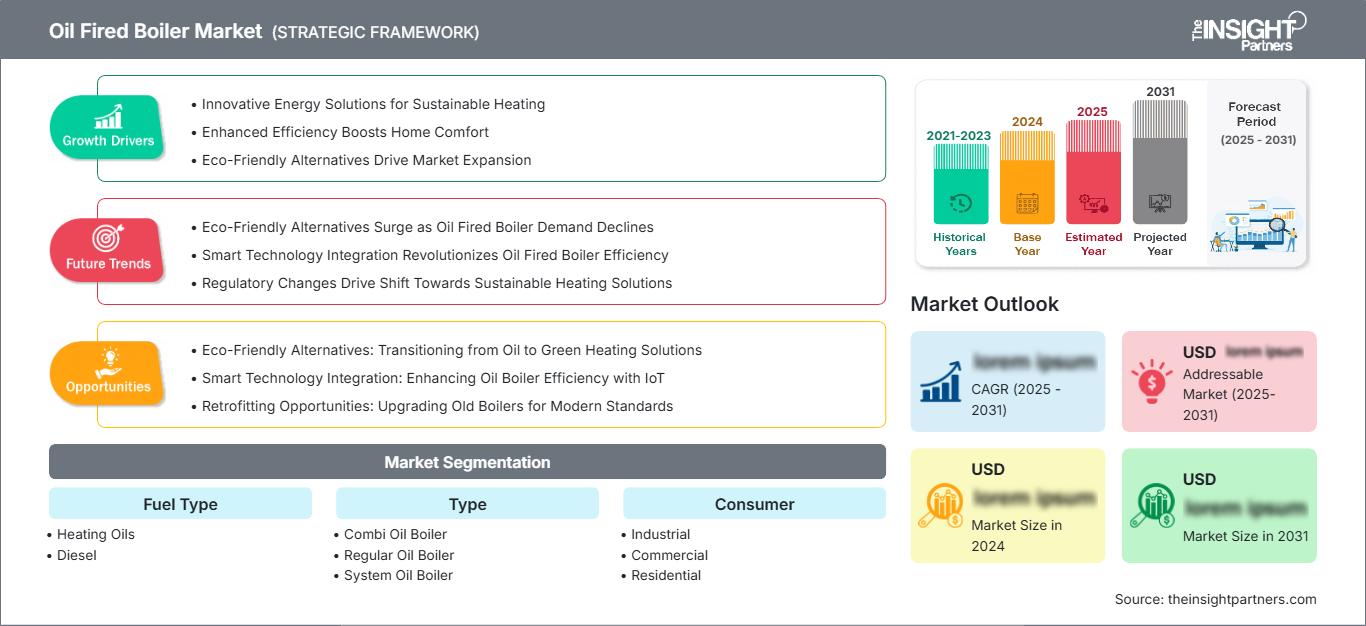
Oil Fired Boiler Market: Strategic Insights
Regional Insights
North America Oil Fired Boiler Market
In 2025, North America made up 31-34% of the market share, and the Oil Fired Boiler Market Share analysis demonstrates the high level of penetration of these units in industries, commercial premises, and homes. North America is projected to grow at a 3.1-3.5% CAGR till 2034 due to the replacement of old installations by more efficient equipment.
Factors driving growth are heating safety in cold states/provinces, fuel supply security, and ongoing process steam generation needs for chemical processes, food processing, and institutions. Spending in this area is on modernizing burners, feedwater systems, and monitoring technology.
U.S. Oil Fired Boiler Market
U.S. constitutes 70–74% share in North America in 2025 and is expected to register a CAGR of 3.0–3.4% in 2026–2034. Demand will be driven by heating needs in the Northeast region, industrial replacement, healthcare campuses, food processing plants, and oil firing capacity to ensure reliability of operations.
Companies operating in the market include Babcock & Wilcox Enterprises, Inc., The Fulton Companies, Bradford White Corporation, Weil-McLain, and A. O. Smith Corporation covering the industrial, commercial, and hydronic heating segments. Demand is likely to emerge from packaged steam, service contracts, combustion tuning, and controls.
Europe Oil Fired Boiler Market
Europe had a market share of 27–30% in 2025 and will maintain growth at a CAGR of 2.6–3.0% from 2026 to 2034. Germany is dominant because of the demands in process industries and engineered heating systems, whereas the UK has demands for replacements in off-grid installations and commercial sites using liquid fuel.
Other countries that are contributing to the European market are France, Italy, and Spain through food processing, light manufacturing, and institutional heating systems. There is an environmental regulation to curb its unrestricted growth but on the other hand it also speeds up replacement of the older machines.
APAC Oil Fired Boiler Market
APAC held 24–27% market share in 2025 and is projected to witness a CAGR of 4.2–4.6%, the fastest regional growth rate. China ranks as the largest country owing to industrial manufacturing capability, while India, Japan, South Korea, and Australia will make their contributions through food, chemicals, metals, and remote infrastructure.
There are contradictory policy drivers with efficiency and emissions regulations driving innovation and industrial growth continuing to keep the steam turbine requirement alive. Consumers seek compact and maintainable turbines capable of meeting the schedule and performing in areas with better fuel oil logistics than natural gas.
Middle East & Africa Oil Fired Boiler Market
Middle East and Africa is expected to expand at a 3.3-3.7% CAGR until 2034, propelled by growth from Saudi Arabia and the UAE, with additional demand coming from South Africa and Rest of MEA. Energy, refining, chemical projects, and infrastructure development drive strategic purchases of boilers.
The area offers a good atmosphere for dependable heating products in buildings vulnerable to poor fuel quality, water treatment and operational difficulties. The growth is opportunistic rather than generalized, with buyers looking out for reliability in terms of product design and maintenance.
Segmentation Analysis
Fuel Type
Fuel Type is expected to grow at a 3.4–3.8% CAGR during 2026–2034 as buyers balance fuel availability, energy density, storage economics, and emission requirements. The Oil Fired Boiler Market scope across heating oils and diesel remains tied to site resilience, burner compatibility, and locations where pipeline gas or electrified process heat is not yet operationally preferred.
- Heating Oils remain important for industrial and building-heating applications needing stable combustion, bulk storage, and established distribution networks in cold regions and off-grid locations.
- Diesel supports backup heating and process steam where rapid availability, standardized storage, and emergency resilience are valued, especially in remote, temporary, or infrastructure-constrained sites.
Type
Type is projected to grow at a 3.2–3.6% CAGR from 2026 to 2034, reflecting differentiated use cases across space heating, hot water supply, and process needs. Selection depends on load profile, installation footprint, domestic hot water requirements, and retrofit constraints. Suppliers are improving controls and heat-transfer efficiency to extend relevance across commercial and residential settings.
- Combi Oil Boiler units serve compact sites that need heating and hot water from one system, making them relevant in residential and small commercial retrofits.
- Regular Oil Boiler systems retain demand where existing tanks, cylinders, and radiator networks make like-for-like replacement cost-effective and operationally familiar for installers.
- System Oil Boiler configurations suit properties and facilities requiring stronger hot water performance, better pressure management, and compatibility with larger heating circuits.
Consumer
Consumer is expected to grow at a 3.5–3.9% CAGR during 2026–2034. Industrial consumers lead because process heat, steam continuity, and site reliability directly affect production economics. Commercial demand is linked to schools, healthcare, hospitality, and offices in cold or off-grid areas, while residential uptake is concentrated in replacement rather than new installations.
- Industrial users dominate through continuous steam needs in chemicals, metals, food processing, and oil and gas operations where downtime can disrupt production schedules.
- Commercial buyers prioritize reliability, service access, and heating continuity for campuses, healthcare facilities, hospitality assets, and buildings outside dense gas-grid coverage.
- Residential demand is mainly replacement-led, supported by rural homes, colder climates, existing tank infrastructure, and preference for familiar hydronic heating systems.
End Use
End Use is projected to grow at a 3.7–4.1% CAGR from 2026 to 2034, with demand shaped by process temperature, uptime tolerance, and steam quality. Chemicals and metals require robust thermal systems, food and beverages emphasize hygienic steam and steady heat, and oil and gas sites prioritize ruggedness in distributed or remote operations.
- Chemical applications require stable steam for reactions, distillation, drying, and utility systems, making reliability, safety controls, and burner efficiency central procurement criteria.
- Metal facilities use boilers for cleaning, surface treatment, heating loops, and auxiliary process needs where durability and pressure stability matter.
- Food and Beverages demand reflects pasteurization, sterilization, cooking, cleaning, and packaging processes that require consistent steam quality and rapid service response.
- Oil and Gas operations use oil-fired systems for distributed heating, utility steam, and site resilience where infrastructure constraints require flexible fuel logistics.
Opportunity Snapshot
| End Use | Revenue Contribution | Trend Tag | Adoption Stage |
| Chemical | High | Process Steam | Mature |
| Metal | Medium | Heat Treatment | Scaling |
| Food and Beverages | High | Hygienic Steam | Scaling |
| Oil and Gas | Medium | Field Heating | Mature |
Oil Fired Boiler Market Growth Drivers and Impact Analysis
Replacement of aging thermal infrastructure
Many industrial/commercial customers have boilers that were installed long before such technologies like control systems, combustion optimization and fuel efficiency became widely available. Thus, replacement of such equipment is motivated by concerns about the safety of its maintenance, fuel costs and insurance requirements, as well as the ability to decrease downtime. In the case of the Oil Fired Boiler Market, the effect would be greater if operators implement upgrades in stages, preserving their current fuel storage facilities, pipelines and heat distribution. Such a scenario would entail less risk than changing fuels entirely.
Need for dependable process steam in industry
Process industries require steam that is predictable, controllable, and available during production cycles. Oil-fired units remain relevant where steam loads fluctuate, gas supply is constrained, or backup heat is part of risk management. Their high energy density and on-site fuel storage help facilities maintain operations during supply disruptions or winter peaks. Market impact is visible in food sterilization, chemical reactions, metal cleaning, and oilfield heating, where boiler reliability affects yield, product quality, and worker safety. Procurement decisions increasingly combine equipment price with lifecycle service capability and controls integration.
Retrofit economics in off-grid and cold-climate locations
In rural, remote, and cold-climate areas, replacing an oil-fired system can be more practical than installing new gas connections or electrifying high-temperature loads. Existing tanks, trained service networks, and familiar hydronic infrastructure reduce switching friction. The market gains from this retrofit logic, especially when customers seek efficient burners, better insulation, and smarter diagnostics without redesigning entire buildings or plants. The impact is selective but durable: demand persists where energy security, winter reliability, and capital discipline outweigh the benefits of immediate fuel conversion.
Oil Fired Boiler Market Future Trends
Smart combustion and predictive service models
Oil Fired Boiler Market trends are moving toward connected control panels, sensor-based combustion tuning, and predictive service contracts that reduce downtime and improve fuel use. Over the forecast period, suppliers will differentiate through remote diagnostics, burner analytics, and automated alerts rather than basic hardware capacity alone. This trend will be most visible in industrial campuses and commercial buildings with multiple thermal assets, where service teams need faster fault detection. Data-enabled maintenance also supports compliance documentation, helping operators demonstrate efficiency improvements without frequent manual inspections or disruptive testing.
Compatibility with lower-carbon liquid fuels
Future product development will increasingly address compatibility with blended heating oils, renewable liquid fuels, and improved combustion systems. While availability varies by region, customers are expected to ask whether new boilers can accommodate evolving fuel specifications without major retrofit costs. Manufacturers that design burners, seals, controls, and heat exchangers for fuel flexibility will reduce customer transition risk. This trend does not eliminate oil-fired demand; instead, it reframes the category around adaptable thermal assets that can meet reliability needs while supporting lower emissions pathways where suitable fuels are accessible.
Oil Fired Boiler Market Opportunities
Service-led modernization of installed boiler fleets
The strongest near-term opportunity lies in replacing controls, burners, pumps, insulation, and monitoring systems across existing fleets. Oil Fired Boiler Market Forecasts indicate that customers will often fund incremental upgrades faster than full system conversions because payback can be linked to fuel savings, reduced downtime, and compliance readiness. Suppliers that bundle audits, parts, financing, installation, and service contracts can capture recurring revenue while protecting installed-base relationships. This opportunity favors companies with field technicians, spare-part availability, and application engineers who understand site-specific steam loads and maintenance constraints.
Packaged systems for food and specialty manufacturing
Food, beverage, pharmaceuticals-adjacent processing, and specialty manufacturing require compact steam systems that can be installed quickly and maintained with minimal production interruption. Packaged oil-fired boilers with integrated controls, water treatment interfaces, and safety systems can address this need. The opportunity is attractive because buyers value reliability and hygiene-related steam consistency over lowest equipment cost. Vendors can strengthen conversion by offering pre-engineered packages, documentation support, operator training, and maintenance plans. This approach is particularly relevant for expanding plants in APAC and North America where process uptime drives investment timing.
Recent Developments
- November 2025: Sitong Boiler mainly showcased 3 core boiler series at The Jakarta International Expo played host to Heatech Indonesia 2025 from November 5 to 7, 2025. The company showcased biomass boilers customized for the palm oil industry, gas-fired boilers meeting high-end manufacturing needs, and circulating fluidized bed (CFB) boilers for energy-intensive industries fully covering mainstream industrial application scenarios in Indonesia.
- November 2025: Utica Boilers announce a new TriFire oil fired triple pass boiler platform. The new TRC will consolidate the product line and offer improved performance. It will replace the TRB series. The TriFire TRC is offered in a packaged configuration with 3, 4, 5, and 6 section models. The updated design uses an advanced cast iron heat exchanger with excellent thermal properties. Maximum inputs range from 93,000 btu/h to 215,000 btu/h.
- September 2025: Weil-McLain®opens in a new tab has announced that its Ultra® Oilopens in a new tab, WGOopens in a new tab, WTGOopens in a new tab and SGOopens in a new tab residential oil boilers are now certified for use with biofuel blends up to 100% (B100). This achievement has been made possible through collaboration with industry leaders R.W. Beckett and Carlin Combustion, as Weil-McLain validates the adaptability of their burners to the elevated blend of biofuel when combined with its popular oil-fired boiler product lines. This advancement underscores Weil-McLain’s commitment to delivering sustainable heating options and driving environmental progress in the industry. A B100 compatible boiler is one that operates with a fuel blend consisting of 100% biodiesel. Biodiesel is a renewable fuel made from organic materials such as plant and vegetable oils, animal fats and used cooking oils.
Frequently Asked Questions

- Comprehensive Market Sizing and Forecast Analysis
- Detailed Segmentation Analysis
- In-Depth Market Dynamics Assessment
- Regional and Country-Level Insights
- Competitive Landscape and Company Benchmarking
- Strategic Business Intelligence
Recent Reports
Testimonials

The Insight Partners' SCADA System Market report is comprehensive, with valuable insights on current trends and future forecasts. The team was highly professional, responsive, and supportive throughout. We are very satisfied and highly recommend their services.
RAN KEDEM Partner, Reali Technologies LTDs
I requested a report on a very specific software market and the team produced the report in a few days. The information was very relevant and well presented. I then requested some changes and additions to the report. The team was again very responsive and I got the final report in less than a week.
JEAN-HERVE JENN Chairman, Future Analytica
We worked with The Insight Partners for an important market study and forecast. They gave us clear insights into opportunities and risks, which helped shape our plans. Their research was easy to use and based on solid data. It helped us make smart, confident decisions. We highly recommend them.
PIYUSH NAGPAL Sr. Vice President, High Beam Global
The Insight Partners delivered insightful, well-structured market research with strong domain expertise. Their team was professional and responsive throughout. The user-friendly website made accessing industry reports seamless. We highly recommend them for reliable, high-quality research services
YUKIHIKO ADACHI CEO, Deep Blue, LLC.
This is the first time I have purchased a market report from The Insight Partners.While I was unsure at first, I visited their web site and felt more comfortable to take the risk and purchase a market report.I am completely satisfied with the quality of the report and customer service. I had several questions and comments with the initial report, but after a couple of dialogs over email with their analyst I believe I have a report that I can use as input to our strategic planning process.Thank you so much for taking the extra time and making this a positive experience.I will definitely recommend your service to others and you will be my first call when we need further market data.
JOHN SUZUKI President and Chief Executive Officer, Board Director, BK Technologies
I wish to appreciate your support and the professionalism you displayed in the course of attending to my request for information regarding to infectious disease IVD market in Nigeria. I appreciate your patience, your guidance, and the fact that you were willing to offer a discount, which eventually made it possible for us to close a deal. I look forward to engaging The Insight Partners in the future, all thanks to the impression you have created in me as a result of this first encounter.
DR CHIJIOKE ONYIA MANAGING DIRECTOR, PineCrest Healthcare Ltd.Reason to Buy
- Informed Decision-Making
- Understanding Market Dynamics
- Competitive Analysis
- Identifying Emerging Markets
- Customer Insights
- Market Forecasts
- Risk Mitigation
- Boosting Operational Efficiency
- Strategic Planning
- Investment Justification
- Tracking Industry Innovations
- Aligning with Regulatory Trends





 Get Free Sample for