
Oilfield Equipment Rental Market Growth, Trends & Demand by 2034
Coverage: by Equipment (Pressure and Flow Control Equipment, Drilling Equipment, Fishing Equipment, Others); Application (Onshore, Offshore) , and Geography (North America, Europe, Asia Pacific, and South and Central America)
- Status : Data Released
- Report Code : TIPRE00008848
- Category : Manufacturing and Construction
- No. of Pages : 150
- Available Report Formats :


- Last update date : September 28, 2026


2025 Market Size
US$ 25.88 Bn
Base year value
2034 Forecast
US$ 37.37 Bn
Projected by 2034
CAGR 2026-2034
4.17 %
Growth rate
Addressable Market
US$ 287.30 Bn
(2026-2034)
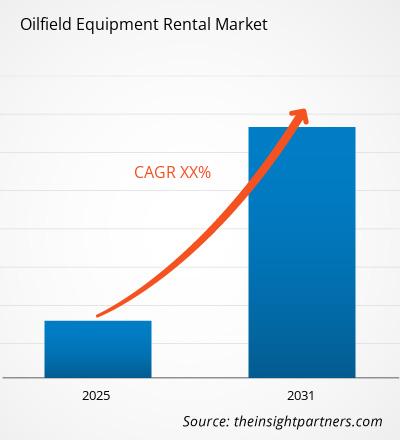
The oilfield equipment rental market is positioned for measured expansion as producers balance drilling requirements with capital discipline, asset utilization, and project-specific equipment needs. The market is valued at US$ 25.88 Billion in 2025 and is projected to reach US$ 37.37 Billion by 2034, representing a CAGR of 4.17% during 2026–2034. Demand is shaped by recurring drilling activity, equipment replacement cycles, offshore development, and the preference for flexible access to specialized field assets.
North America remains the principal regional demand center, supported by established shale production, mature service infrastructure, and sustained offshore activity in the Gulf of Mexico. The regional oilfield equipment rental market size is expected to expand at an estimated 4.3–4.9% CAGR from 2026–2034. Flexible capital allocation, high equipment utilization, and requirements for specialized drilling and pressure-control assets are supporting rental adoption.
Oilfield Equipment Rental Market Assessment and Insights
- North America: The region is expected to account for 39–43% share in 2025 and grow at a 4.3–4.9% CAGR between 2026–2034, supported by shale drilling, offshore projects, established rental networks, and disciplined producer capital spending.
- US: The US is estimated to represent 72–76% of North American demand in 2025, with a 4.1–4.7% CAGR between 2026–2034, reflecting Permian activity, workover requirements, and Gulf Coast operations.
- Europe: Europe is estimated at 18–22% share in 2025, with a 3.5–4.2% CAGR between 2026–2034. Norway, the UK, Germany, France, Italy, and Spain support demand through offshore operations, maintenance programs, and specialized equipment requirements.
- Asia Pacific: Asia Pacific is estimated at 20–24% share in 2025 and is projected to grow at a 5.0–5.8% CAGR between 2026–2034. China, India, Australia, Indonesia, and Malaysia provide the strongest structural opportunities.
- Largest Segment: Drilling Equipment is estimated to hold a 52–56% market share in 2025, expanding at a 4.4–5.0% CAGR during 2026–2034 as operators prioritize flexible access to high-value drilling assets.
- High Growth Segment: Offshore applications represent an estimated 32–36% share in 2025 and are expected to register a 5.0–5.8% CAGR during 2026–2034, driven by deepwater development and specialized equipment requirements.
- Key companies analyzed in detail: Bois Equipment Rentals B.V.; Circle T Service & Rental Ltd.; Graco Oilfield Services; John Energy Ltd.; KIT Oil and Gas Equipment Industry, LLC; Parker Drilling Company; Precision Drilling Corporation; Superior Energy Services, Inc.; Weatherford International plc; Nabors Industries Ltd.; NOV Inc.
Source: The Insight Partners' analysis based on proprietary research, government publications, company annual reports, investor presentations, industry databases, and expert interviews.
The market has evolved from basic short-term equipment access toward integrated rental models covering drilling, pressure management, well intervention, fishing, testing, and production support. Digital monitoring, higher-specification equipment, and predictive maintenance are increasing asset availability and reducing unplanned downtime. Rental providers increasingly compete on equipment condition, mobilization speed, technical support, refurbishment capability, and geographic coverage rather than equipment ownership alone. Baker Hughes identifies active rig counts as an important leading indicator for demand across drilling and related oilfield products and services.
Looking forward, equipment rental demand should benefit from investment in technically complex wells, selective offshore developments, and brownfield redevelopment. The Oilfield Equipment Rental Market report highlights that the IEA estimated global upstream oil and gas investment at about US$570 billion for 2025, with most investment directed toward replacing declining production rather than satisfying incremental demand. This environment favors rental models that help operators preserve liquidity while obtaining specialized equipment for defined project periods. Emerging activity in India, Southeast Asia, the Middle East, and Latin America should broaden geographic demand.
Oilfield Equipment Rental Market Report Scope
| Report Attribute | Details |
|---|---|
| Market size in 2025 | US$ 25.88 Billion |
| Market Size by 2034 | US$ 37.37 Billion |
| Global CAGR (2026 - 2034) | 4.17% |
| Historical Data | 2021-2024 |
| Forecast period | 2026-2034 |
Oilfield Equipment Rental Market Analysis
The oilfield equipment rental market growth is closely linked to drilling intensity, well intervention schedules, equipment replacement requirements, and operators' capital allocation preferences. The rental system helps in avoiding major investments in equipment that might suffer from irregular usage. Demand follows the value chain, which includes OEMs, specialty rental fleets, refurbishers, logistics companies, drilling contractors, and E&P companies looking for dependable field availability.
Increasingly, supply is dominated by fleet diversification and regional storage locations. The high-value drilling and pressure control equipment needs testing, certification, and fast mobilization, thus making the service network an essential competitive advantage for suppliers. Fleet suppliers with the capability to deploy equipment across basins can optimize equipment availability while minimizing idle equipment. Offshore operations also demand rigorous testing, transportation coordination, and compliance with offshore platform/subsea operation specifications.
The oilfield equipment rental market analysis indicates a fragmented competitive environment combining diversified oilfield service companies with regional specialists. Weatherford International plc, Superior Energy Services, Inc., and Precision Drilling Corporation participate across specialized service and equipment categories, while Bois Equipment Rentals B.V. focuses on surface rental equipment for well testing and cleanup. Graco Oilfield Services maintains expertise in fishing tools, rentals, pressure control, and completion equipment.
Investment is increasingly directed toward fleet modernization, refurbishment, digital tracking, and equipment capable of supporting complex wells. Nabors Industries Ltd. reported 242 actively marketed land drilling rigs at the end of 2025, illustrating the scale of equipment-intensive service operations. Parker Drilling Company, KIT Oil and Gas Equipment Industry, LLC, John Energy Ltd., and Circle T Service & Rental Ltd. strengthen the specialist and regional landscape, while NOV Inc. contributes broad equipment capabilities.
● REPORT CUSTOMIZATION
Tailor This Report To Align With Your Specific Business Requirements
This report can be customized to align precisely with your business objectives, scope, and target markets. Customization options include tailored segmentation, geography, competitive analysis, and strategic insights to support informed decision-making.
Customize This Report →WHAT YOU CAN ADJUST
- ● Segmentations
- ● Geography
- ● Competitive Analysis
- ● Language Preferences
Oilfield Equipment Rental Market: Strategic Insights

Regional Insights
North America oilfield equipment rental market
North America remains the leading regional demand center, supported by extensive drilling infrastructure, mature rental channels, shale development, and offshore operations. The region is estimated to hold 39–43% share in 2025 and expand at a 4.3–4.9% CAGR through 2034. US unconventional activity remains particularly important because drilling and completion programs require equipment with frequent deployment cycles. Canada adds demand through oil sands, conventional wells, and high-specification drilling programs.
Rental economics are reinforced by equipment utilization considerations and producer efforts to preserve capital flexibility. Baker Hughes describes active rig counts as a leading indicator for oilfield product and service demand, linking drilling activity with equipment consumption. Offshore Gulf of Mexico projects require specialized pressure-control, drilling, testing, and well-intervention assets. The combination of shale maintenance, offshore development, and refurbishment demand supports steady regional rental requirements despite commodity-price volatility.
U.S. oilfield equipment rental Market
The US represents approximately 72–76% of North American Oilfield Equipment Rental Market demand in 2025 and is expected to grow at a 4.1–4.7% CAGR through 2034. Permian Basin drilling remains central, while Eagle Ford, Bakken, Gulf Coast, and offshore operations broaden equipment requirements across drilling and well-service activities.
Rental demand is supported by contractors seeking flexible access to drilling equipment, fishing tools, pressure-control packages, pumps, tanks, and handling systems. Precision Drilling Corporation, Graco Oilfield Services, Superior Energy Services, Weatherford International plc, and Nabors Industries Ltd. maintain relevant operational exposure. Application trends increasingly favor high-utilization assets, rapid mobilization, refurbishment, and equipment packages that can support changing well designs without requiring operators to expand owned fleets.
Europe oilfield equipment rental Market
Europe is estimated to account for 18–22% of the Oilfield Equipment Rental Market share in 2025 and is projected to grow at a 3.5–4.2% CAGR. Norway leads regional activity through offshore production and drilling, while the UK remains important for North Sea maintenance and redevelopment. Germany, France, Italy, and Spain contribute through industrial service capabilities, mature energy infrastructure, and specialized equipment demand. European operators increasingly prioritize equipment reliability, certification, emissions management, and efficient asset utilization. Offshore requirements support rental opportunities for pressure-control, testing, drilling, and intervention equipment, while brownfield projects create recurring demand for equipment that can be mobilized without substantial permanent capital deployment.
APAC oilfield equipment rental Market
APAC is estimated at 20–24% share of the Oilfield Equipment Rental Market in 2025 and is expected to register a 5.0–5.8% CAGR. China remains the leading market, followed by India, Australia, Japan, South Korea, Indonesia, and Malaysia. National energy-security programs and exploration activity support equipment demand.
Growth is reinforced by offshore exploration, mature-field redevelopment, and expanding domestic service capabilities. India is increasing attention on upstream production, while Australia maintains significant offshore and LNG-linked activity. China combines domestic drilling requirements with extensive equipment manufacturing capacity. Rental providers can benefit where operators need specialized equipment without establishing large permanent fleets.
Middle East & Africa oilfield equipment rental Market
The Middle East and Africa Oilfield Equipment Rental Market demand is expected to expand at a 4.6–5.3% CAGR, supported by Saudi Arabia, the UAE, Qatar-linked service activity, and selected African developments. Saudi Arabia remains the leading regional market due to its large upstream base and continuing field-development requirements.
Rental opportunities are concentrated in drilling, pressure-control, well testing, intervention, and maintenance applications. The UAE provides an important service and logistics hub, while South Africa contributes through regional industrial infrastructure. Rest-of-MEA demand remains project-dependent, with infrastructure availability and operating conditions influencing equipment deployment. Long-term production programs can favor rental arrangements when contractors require specialized assets for defined campaigns.
Segmentation Analysis
Equipment
Equipment is expected to expand at a 4.4–5.0% CAGR during 2026–2034, supported by recurring drilling programs, replacement requirements, well intervention, and operator preference for flexible access to specialized assets. Rental providers increasingly differentiate through equipment reliability, refurbishment, certification, technical support, and fleet availability. According to the Oilfield Equipment Rental Market forecast, the segment benefits from customers seeking to match equipment capacity with project duration rather than carrying ownership costs throughout commodity cycles.
- Pressure and Flow Control Equipment: Demand is linked to well-control requirements, testing, completion, and intervention activities. Operators value certified equipment, rapid mobilization, and maintenance support, particularly where operating pressures and project specifications vary across wells.
- Drilling Equipment: This remains the dominant equipment category because drilling programs require high-value assets with substantial capital requirements. Rental arrangements help contractors manage utilization, campaign timing, transportation, maintenance, and access to specialized drilling capabilities.
- Fishing Equipment: Fishing tools support retrieval of stuck, damaged, or lost downhole components. Demand is project-specific but strategically important because rapid access can reduce nonproductive time and help operators restore wellbore operations.
Application
Application is projected to grow at a 4.6–5.4% CAGR during 2026–2034, with rental intensity shaped by the different logistical, technical, and maintenance requirements of onshore and offshore projects. Offshore applications are expected to grow faster as deepwater and brownfield projects require specialized equipment with high certification and mobilization requirements. Onshore activity remains larger because of extensive shale and conventional drilling programs. Current Oilfield Equipment Rental Market trends indicate increasing demand for specialized rental assets, enhanced fleet utilization, and service-oriented rental models that support operational efficiency across both offshore and onshore developments.
- Onshore: Onshore operations generate recurring rental demand because drilling, workover, completion, and maintenance programs require equipment to move among wells and basins. Rental fleets improve operational flexibility and limit idle owned assets.
- Offshore: Offshore projects require high-specification equipment, certification, testing, and coordinated logistics. Rental models can reduce capital exposure for operators while providing access to specialized drilling, pressure-control, testing, and intervention assets during defined campaigns.
Opportunity Snapshot
| Application | Revenue Contribution | Trend Tag | Adoption Stage |
| Onshore | High | Shale Optimization | Mature |
| Offshore | Medium | Deepwater Development | Scaling |
Oilfield Equipment Rental Market Growth Drivers and Impact Analysis
Capital Discipline Is Increasing Preference for Flexible Equipment Access
Discipline with regard to capital expenditure is becoming increasingly prevalent among E&P operators, thus making the case for rental more economically sound. Operators will be able to use specialized drilling, pressure control, and intervention equipment without necessarily having to spend all of the cost of purchasing such equipment on assets that do not get used across different operations. In this way, rental is an excellent option, especially when there is uncertainty regarding commodity prices and drilling schedules. The implication for rental firms is that there will be increased demand for well-maintained, readily relocatable fleets. Increasingly, rental firms are being evaluated on the basis of operating economics, including transportation costs, maintenance, certification costs, risks associated with downtime, and technical assistance.
Complex Well Designs Are Raising Requirements for Specialized Equipment
The growing complexity of wells is generating a need for machinery that can cater to high technological standards, fluctuating pressure, long horizontal sections, and difficult intervention needs. Specialized drilling, fishing, testing, and pressure control rigs for deep water wells and mature field reclamation might not be affordable for each oil and gas company to purchase and keep in their inventory. By leasing such machinery, several clients can share the cost of specialized equipment. The market effect goes beyond just the volume of the machinery since the specialized equipment also necessitates advanced services related to inspection, refurbishment, certification, and engineering. Advanced technical knowledge among equipment suppliers allows for competitiveness in terms of reliability and application assistance, not just rental rates.
Upstream Production Replacement Needs Sustain Equipment Utilization
The need to compensate for reductions in production helps keep the upstream sector active despite any slowdown in the pace at which demand grows globally. According to the International Energy Agency, about 90 percent of investments made in upstream projects between 2019 and the present date have gone towards compensating for the decline in production levels and not for growing demand. Replacement activities create recurring needs for drilling, workover, completions, and intervention. The rental industry stands to benefit from this in that such activities tend to be done using equipment whose campaign-specific usage pattern makes rental feasible. Rather than increase their fleet size, contractors can add to their fleets using rentals during high activity times.
Oilfield Equipment Rental Market Future Trends
Digital Fleet Intelligence Will Become a Core Rental Differentiator
There will be increasing demand for digital fleet intelligence as more rental companies try to maximize their usage and customers want better insight into the status of the rented equipment. The sensors, telematics systems, remote diagnostics, digitalized equipment inspection reports, and maintenance analysis can allow the rental companies to detect any degradation of their equipment before any failure occurs. In the future, there will be an increasing number of rental agreements that include equipment availability, condition-based maintenance, and performance monitoring in addition to equipment access. This can enable customers to compare utilization rates, downtime, maintenance frequencies, and mobilization performance among the different rental companies using digital data.
Integrated Rental Packages Will Expand Beyond Individual Equipment Items
The rental procurement process is expected to shift towards integrated equipment packages that include complementary equipment for drilling, testing, completion, and intervention operations. The practice of obtaining equipment on an individual basis from different suppliers may gradually shift to an integrated package approach, where all the logistics, inspection, maintenance and other related services will be easier to arrange. It can be especially beneficial for offshore and remote locations where changing equipment might be limited by the available timeframes and availability of specialists. There might also be a potential benefit in terms of accountability since the customer will be able to hold one company responsible for equipment availability and performance.
Oilfield Equipment Rental Market Opportunities
Regional Fleet Hubs Can Capture Emerging Basin Demand
Establishment of regional fleet hubs constitutes a strategic opportunity for providers that aim to minimize mobilization lead-times and optimize their equipment use. Being in proximity to emerging drilling basins may help deliver equipment faster, conduct local inspections and servicing, and provide parts readily available. Possible candidates include India, Southeast Asia, Middle East countries, and select markets of Latin America, where new investments in the oil sector create periodic demand for specialized equipment. Logistical expenses can be minimized by deploying equipment kits in proximity to clients and keeping the technical expertise of the company centralized when dealing with complex equipment types.
Refurbishment and Lifecycle Services Can Improve Rental Economics
Refurbishment provides an opportunity to increase returns from existing equipment while extending fleet life and supporting customer demand for reliable, lower-capital solutions. Rental companies can establish structured inspection, repair, recertification, and component-replacement programs that prepare equipment for repeated deployment. This approach is particularly relevant for drilling and pressure-control assets where maintenance quality directly affects field reliability. Lifecycle services can also create additional revenue through repair contracts, spare components, inspection services, and technical support. Providers with established refurbishment capabilities may reduce fleet replacement requirements and improve asset utilization. Strategic investment should focus on standardized maintenance procedures, digital asset histories, qualified technicians, and rapid turnaround facilities positioned near major operating basins.
Frequently Asked Questions

- Comprehensive Market Sizing and Forecast Analysis
- Detailed Segmentation Analysis
- In-Depth Market Dynamics Assessment
- Regional and Country-Level Insights
- Competitive Landscape and Company Benchmarking
- Strategic Business Intelligence
Recent Reports
Testimonials

The Insight Partners provided valuable market intelligence that supported our global go-to-market strategy. Their team was professional, responsive, and attentive to our feedback, providing thoughtful analysis and helpful methodological clarifications throughout the project.
Junmo Kim Chief Financial Officer (CFO), Enertech Co., Ltd.
The Insight Partners' SCADA System Market report is comprehensive, with valuable insights on current trends and future forecasts. The team was highly professional, responsive, and supportive throughout. We are very satisfied and highly recommend their services.
RAN KEDEM Partner, Reali Technologies LTDs
I requested a report on a very specific software market and the team produced the report in a few days. The information was very relevant and well presented. I then requested some changes and additions to the report. The team was again very responsive and I got the final report in less than a week.
JEAN-HERVE JENN Chairman, Future Analytica
We worked with The Insight Partners for an important market study and forecast. They gave us clear insights into opportunities and risks, which helped shape our plans. Their research was easy to use and based on solid data. It helped us make smart, confident decisions. We highly recommend them.
PIYUSH NAGPAL Sr. Vice President, High Beam Global
The Insight Partners delivered insightful, well-structured market research with strong domain expertise. Their team was professional and responsive throughout. The user-friendly website made accessing industry reports seamless. We highly recommend them for reliable, high-quality research services
YUKIHIKO ADACHI CEO, Deep Blue, LLC.
This is the first time I have purchased a market report from The Insight Partners.While I was unsure at first, I visited their web site and felt more comfortable to take the risk and purchase a market report.I am completely satisfied with the quality of the report and customer service. I had several questions and comments with the initial report, but after a couple of dialogs over email with their analyst I believe I have a report that I can use as input to our strategic planning process.Thank you so much for taking the extra time and making this a positive experience.I will definitely recommend your service to others and you will be my first call when we need further market data.
JOHN SUZUKI President and Chief Executive Officer, Board Director, BK Technologies
I wish to appreciate your support and the professionalism you displayed in the course of attending to my request for information regarding to infectious disease IVD market in Nigeria. I appreciate your patience, your guidance, and the fact that you were willing to offer a discount, which eventually made it possible for us to close a deal. I look forward to engaging The Insight Partners in the future, all thanks to the impression you have created in me as a result of this first encounter.
DR CHIJIOKE ONYIA MANAGING DIRECTOR, PineCrest Healthcare Ltd.Reason to Buy
- Informed Decision-Making
- Understanding Market Dynamics
- Competitive Analysis
- Identifying Emerging Markets
- Customer Insights
- Market Forecasts
- Risk Mitigation
- Boosting Operational Efficiency
- Strategic Planning
- Investment Justification
- Tracking Industry Innovations
- Aligning with Regulatory Trends





 Get Free Sample for