
Optical Data Storage Devices Market Size, Demand & Growth by 2034
Coverage: by Product Type (CD and DVDs, Erasable and Re-writable Optical Discs, Near Field Optical Devices, Holographic Storage, Blu-ray Discs, Others); End-User (BFSI, Manufacturing Industries, Media and Entertainment, Educational Institutes, Others) , and Geography (North America, Europe, Asia Pacific, and South and Central America)
- Status : Data Released
- Report Code : TIPTE100000233
- Category : Electronics and Semiconductor
- No. of Pages : 150
- Available Report Formats :


- Last update date : October 16, 2026


2025 Market Size
US$ 4.86 Bn
Base year value
2034 Forecast
US$ 7.64 Bn
Projected by 2034
CAGR 2026-2034
5.16 %
Growth rate
Addressable Market
US$ 56.73 Bn
(2026-2034)
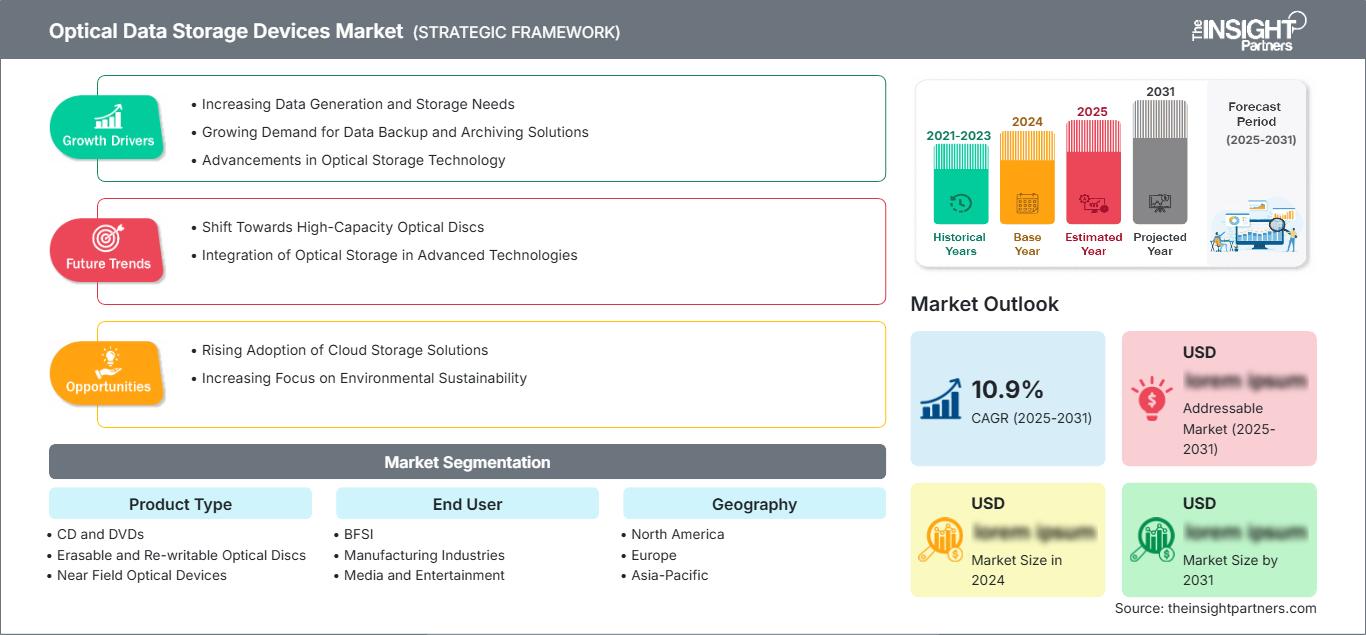
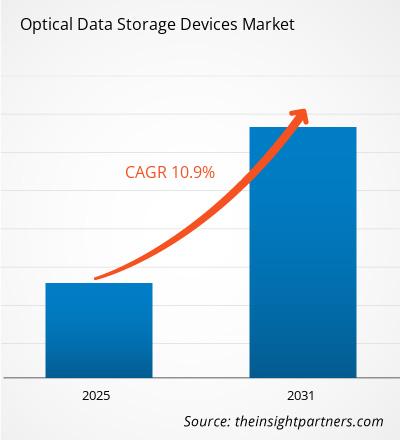
The Optical Data Storage Devices Market was valued at US$ 4.86 Billion in 2025 and is projected to reach US$ 7.64 Billion by 2034, expanding at a CAGR of 5.16% during 2026–2034. Demand remains supported by the long-term requirement for secure archival storage, regulatory data retention obligations, and the continued use of optical media in enterprise backup environments. Improvements in storage density, durability, and preservation capabilities continue to reinforce adoption across institutional and industrial applications requiring immutable data records.
Across North America, demand remains driven by enterprise archiving requirements, cybersecurity-focused offline storage strategies, and expanding digital content repositories. The optical data storage devices market size in the region benefits from growing investment in long-term preservation technologies among government agencies, financial institutions, and media organizations. Regional expansion is expected to advance at a CAGR range of 4.8%–5.4% during 2026–2034, supported by the modernization of data governance frameworks and increasing deployment of hybrid storage infrastructures.
Optical Data Storage Devices Market Assessment and Insights
- North America: Strong adoption across enterprise archives, government records management, and media preservation supports regional leadership. Share in 2025 is estimated at 34%–38%, while growth is expected at a CAGR of 4.8%–5.4% during 2026–2034.
- US: The country benefits from established technology infrastructure, regulatory archiving requirements, and broad enterprise adoption of secure storage solutions. Share in 2025 is estimated at 76%–80% of North America, with CAGR ranging 4.9%–5.5% during 2026–2034.
- Europe: Strong data preservation regulations and digital heritage initiatives continue supporting adoption across Germany, the UK, and France. Regional share in 2025 is estimated at 26%–30%, expanding at a CAGR of 4.7%–5.3% during 2026–2034.
- Asia Pacific: Increasing data generation, expanding digital media industries, and manufacturing investments support market expansion across China, Japan, South Korea, and India. Regional share in 2025 is estimated at 28%–32%, with CAGR of 5.8%–6.4% during 2026–2034.
- Largest Segment: Blu-ray Discs maintain leadership owing to superior storage capacity, durability, and archival suitability. The segment accounts for approximately 30%–34% market share in 2025 and is projected to expand at 5.0%–5.6% CAGR during 2026–2034.
- High Growth Segment: Holographic Storage benefits from advances in ultra-high-density storage technologies and long-term archival applications. The segment represents 8%–12% market share in 2025 and is expected to grow at 7.8%–8.6% CAGR during 2026–2034.
- Key companies analyzed in detail: Fujitsu Laboratories Ltd., Hitachi, Ltd., IBM Corporation, LG Electronics Inc., Moser Baer India Limited, Samsung Electronics Co., Ltd., Seagate Technology Holdings plc, Sony Group Corporation, Toshiba Corporation, Western Digital Corporation.
Source: The Insight Partners' analysis based on proprietary research, government publications, company annual reports, investor presentations, industry databases, and expert interviews.
Optical storage technology has shifted its focus from being used in media applications to becoming an archival system for the safe storage of data. The constant improvements in the area of recording density, accuracy of lasers, and robustness of discs have made optical storage more economically viable for the current IT infrastructure. In light of growing amounts of data and more stringent retention requirements that companies are faced with, optical systems are gaining ground as an additional method of storage next to cloud and magnetic storage. Additionally, the manufacturing process has become automated, allowing for a more uniform quality of media and improving the efficiency of the process.
In terms of the future, the trend will be more and more oriented towards investments into advanced archiving technologies, preservation environment, and next generation of storage systems. Emerging countries will keep on developing their digital infrastructures, thus creating positive preconditions for the implementation of the technology in educational establishments, governmental institutions, and media companies. The regulatory demand for authenticity and long-term data storage will also create positive prerequisites for market growth. Besides, the scientific projects directed at high-capacity optical media and energy-efficient storage systems will enlarge business prospects.
Optical Data Storage Devices Market Report Scope
| Report Attribute | Details |
|---|---|
| Market size in 2025 | US$ 4.86 Billion |
| Market Size by 2034 | US$ 7.64 Billion |
| Global CAGR (2026 - 2034) | 5.16% |
| Historical Data | 2021-2024 |
| Forecast period | 2026-2034 |
Optical Data Storage Devices Market Analysis
Growth momentum within the industry is being supported by expanding requirements for reliable long-term data retention. Organizations managing large repositories of legal, financial, healthcare, and multimedia content increasingly prioritize storage formats that provide durability, security, and low maintenance requirements. The optical data storage devices market growth trajectory also benefits from increasing awareness of ransomware risks, prompting enterprises to adopt offline storage architectures capable of protecting critical information from cyber threats.
Within the value chain, raw material suppliers, media manufacturers, drive producers, software developers, and archival service providers collectively contribute to market development. Demand remains concentrated among institutions requiring extended retention periods and immutable records. Supply dynamics continue improving through advancements in precision manufacturing, optical engineering, and automation technologies that support enhanced media performance and lower lifecycle ownership costs.
The competitive environment remains characterized by a combination of established technology leaders and specialized storage innovators. The optical data storage devices market analysis indicates that companies are prioritizing research initiatives focused on storage density, archival lifespan, and system integration capabilities. Strategic collaborations between hardware manufacturers and enterprise storage providers continue supporting the commercialization of advanced optical solutions.
The industry players like Fujitsu Laboratories Ltd., Hitachi, Ltd., IBM Corporation, Sony Group Corporation, Toshiba Corporation, and Western Digital Corporation are establishing their market position through technological advancement and intellectual property growth. On the other hand, Samsung Electronics Co., Ltd., LG Electronics Inc., Seagate Technology Holdings plc, and Moser Baer India Limited are continuously adding value to the ecosystem through innovation in storage media, manufacturing capability, and more broadly, data management. The investment trend is now shifting towards advanced archiving technologies that can handle large volumes of enterprise data.
● REPORT CUSTOMIZATION
Tailor This Report To Align With Your Specific Business Requirements
This report can be customized to align precisely with your business objectives, scope, and target markets. Customization options include tailored segmentation, geography, competitive analysis, and strategic insights to support informed decision-making.
Customize This Report →WHAT YOU CAN ADJUST
- ● Segmentations
- ● Geography
- ● Competitive Analysis
- ● Language Preferences
Optical Data Storage Devices Market: Strategic Insights
Regional Insights
North America Optical Data Storage Devices Market
North America accounted for an estimated 34%–38% share in 2025 and remains the leading regional market for optical storage technologies. Growth is projected at a CAGR of 4.8%–5.4% during 2026–2034, supported by increasing enterprise demand for secure archival storage and compliance-focused data preservation solutions. Financial institutions, healthcare organizations, and government agencies continue investing in storage platforms capable of maintaining long-term information integrity while reducing vulnerability to cyberattacks and unauthorized data modification.
The region also benefits from advanced technology infrastructure and substantial investment in digital transformation initiatives. Major enterprises increasingly deploy hybrid storage architectures that combine cloud resources with offline archival systems. The optical data storage devices market share in North America is reinforced by strong adoption across media preservation, legal record management, and scientific research applications. Growing awareness of ransomware resilience and data authenticity requirements is expected to sustain demand throughout the forecast period, particularly among organizations managing large-scale digital archives.
U.S. Optical Data Storage Devices Market
The United States represents approximately 76%–80% of North American revenue in 2025 and is expected to expand at a CAGR of 4.9%–5.5% during 2026–2034. The demand will be maintained through enterprise data management needs, the huge creation of digital content, and the involvement of technology leaders. Firms operating in the fields of banking, healthcare, defense, and media will continue to make investments in storage solutions intended for data preservation and compliance with regulations.
The involvement of the leaders of technology development and storage solutions will help to drive new product development and their market launches. Enterprises use optical archive solutions in the broader context of information management solutions to make their operations more resilient against cyber attacks. High adoption rates will be seen in firms that need permanent data storage, secure backup solutions, and cost-efficient archival storage solutions.
Optical Data Storage Devices Market Regional Insights (Continued)
Europe Optical Data Storage Devices Market
Europe accounted for an estimated 26%–30% share in 2025 and is projected to expand at a CAGR of 4.7%–5.3% during 2026–2034. The area takes advantage of strict data retention policies, increased spending on digital preservation initiatives, and more demand for archival systems infrastructure. Governmental bodies, banking institutions, and hospitals still use optical storage technology as part of their strategy to ensure secure information management and compliance.
Germany remains the top market in Europe due to its strong industry presence, well-developed infrastructure of enterprise IT, and substantial spending on archive technologies. Optical storage integration is ongoing in the manufacturing and engineering spheres where data integrity and archival are crucial.
The United Kingdom maintains substantial demand through digital heritage preservation projects, financial services applications, and public-sector data management programs. Organizations increasingly utilize optical storage technologies to address compliance requirements and strengthen protection against data loss. Continued investment in secure archival systems supports stable market expansion.
France, Italy, and Spain collectively contribute a significant portion of regional demand. Government digitization programs, healthcare information management requirements, and media content preservation initiatives continue encouraging adoption. These countries are also witnessing increased investment in long-term storage infrastructure as enterprises seek resilient alternatives for safeguarding valuable digital assets.
APAC Optical Data Storage Devices Market
Asia Pacific represented approximately 28%–32% of the global Optical Data Storage Devices Market revenue in 2025 and is expected to register the fastest regional expansion with a CAGR of 5.8%–6.4% during 2026–2034. This area enjoys the advantages of increased digitalization, higher volumes of data created by enterprises, and growing capabilities for producing technological products. China and Japan continue contributing to the development because of their well-established electronics industry and high investments into modern storage solutions.
South Korea, India, and Australia contribute to the growth of the market through increased implementation of digital archives in educational, media, and enterprise sectors. Government projects related to digital transformation and the understanding of the need for long-term safe data storage increase the demand.
Middle East & Africa Optical Data Storage Devices Market
The Middle East & Africa Optical Data Storage Devices Market is expected to expand at a CAGR of 4.3%–4.9% during 2026–2034. Adoption remains concentrated in government institutions, financial organizations, and infrastructure-related sectors requiring secure archival capabilities. Increasing digitization efforts and modernization of information management systems continue to create opportunities for optical storage technologies across the region.
Saudi Arabia and the United Arab Emirates lead regional demand through investments in digital government initiatives, smart infrastructure programs, and enterprise technology deployment. South Africa remains an important market due to expanding data management requirements across public and private sectors. Growing emphasis on data security and long-term preservation is expected to support gradual market expansion across the broader region.
Segmentation Analysis
Product Type
The Product Type segment is projected to expand at a CAGR of 5.2%–5.8% during 2026–2034. Product innovation continues to improve storage capacity, media durability, and archival lifespan. Enterprises increasingly evaluate optical media based on reliability, security, and long-term preservation performance. The optical data storage devices market scope continues expanding as advanced optical technologies support growing enterprise requirements for secure and cost-efficient archival storage across diverse industries.
- CD and DVDs remain relevant in educational content distribution, legacy data storage environments, and cost-sensitive applications where moderate storage capacity requirements continue to support demand.
- Erasable and Re-writable Optical Discs provide flexibility for organizations requiring periodic data updates, making them suitable for operational record management and controlled archival workflows.
- Near Field Optical Devices support specialized storage applications requiring precise data retrieval and enhanced recording performance, particularly within research and industrial environments.
- Holographic Storage is attracting attention for its potential to deliver ultra-high-density storage and extended archival lifespans suitable for future enterprise-scale data preservation needs.
- Blu-ray Discs maintain strong market positioning through superior storage capacity, durability, and suitability for high-volume content archiving across commercial and institutional users.
End User
The End User segment is anticipated to register a CAGR of 5.4%–6.0% during 2026–2034. Adoption patterns vary according to regulatory requirements, information management complexity, and digital content generation volumes. Organizations increasingly utilize optical storage technologies to strengthen data integrity, support compliance obligations, and establish resilient long-term archival frameworks across operational environments.
- BFSI institutions utilize optical storage for regulatory record retention, transaction archiving, audit readiness, and cybersecurity-focused offline backup strategies supporting business continuity objectives.
- Manufacturing Industries employ archival storage solutions to preserve engineering documentation, production records, quality assurance information, and intellectual property requiring long-term accessibility.
- Media and Entertainment organizations rely on optical technologies for the preservation of high-value digital assets, production archives, historical content libraries, and distribution master files.
- Educational Institutes increasingly deploy archival systems to preserve research records, academic resources, institutional documentation, and digital learning content generated across campuses.
Opportunity Snapshot
| End User | Revenue Contribution | Trend Tag | Adoption Stage |
| BFSI | High | Compliance Archive | Mature |
| Manufacturing Industries | High | Industrial Records | Scaling |
| Media and Entertainment | High | Content Preservation | Mature |
| Educational Institutes | Medium | Digital Libraries | Scaling |
| Others | Low | Public Archives | Emerging |
Optical Data Storage Devices Market Growth Drivers and Impact Analysis
Growing Demand for Long-Term Data Preservation and Regulatory Compliance
The exponential rise in the amount of digital information generated in various government organizations, healthcare firms, financial organizations, and research facilities has led to a need for secure archiving solutions. The regulatory environment that defines the requirement for record keeping, auditing, and information authenticity makes it necessary for organizations to keep their information safe for an extended period. Optical archive technology brings about benefits due to its ability to withstand environmental factors as well as any kind of modifications. While many other storage technologies make it difficult to archive for long periods without regular maintenance, optical archiving technology is able to provide such solutions easily. With the rise in the amount of information being created by organizations, the need to have a good archival storage solution will become more pronounced.
Rising Importance of Cyber-Resilient Offline Storage Infrastructure
Rampant ransomware and cyber threats are driving enterprises to seek diverse forms of data security solutions. Businesses have started realizing the usefulness of having storage environments that can help to shield information from cyberattacks using networks. The technologies in optical storage are useful because they give an independent environment that will protect the data from any damage, encryption, or any form of intrusion. Organizations such as banks, hospitals, and governments have been at the forefront of embracing multi-level storage infrastructure that utilizes offline storage media. The ability to store immutable information will support disaster recovery and business continuity plans. As budgets for cybersecurity continue to increase worldwide, there will be growing significance for optical archival solutions in the data protection ecosystem.
Expansion of Digital Content Creation Across Industries
The amount of digital content produced by corporations, media companies, educational institutes, and research institutions will be growing at a considerable rate. Content, including high-definition videos, scientific data, engineering documents, and corporate archives, needs storage mechanisms that have the capacity to store them for long periods without affecting their data integrity. The use of optical storage solutions can prove beneficial in storing such content, thereby minimizing costs incurred during its storage process. Media companies will store their intellectual property, whereas educational and research institutes will store their content for future usage. Growth in content creation, along with the demand for archival storage, is expected to contribute toward stable demand in both mature and emerging markets during the forecast period.
Optical Data Storage Devices Market Future Trends
Development of High-Density Archival Storage Technologies
Research and development activities are increasingly focused on improving storage density, retrieval performance, and archival longevity. The optical data storage devices market trends indicate growing interest in advanced recording technologies capable of supporting exponentially larger datasets without significantly increasing physical storage footprints. Innovations in multilayer recording structures, laser technologies, and media engineering are expected to enhance commercial viability for enterprise-scale archival applications. As organizations continue managing expanding information repositories, high-capacity optical formats may become an increasingly attractive component of long-term storage strategies. Technology providers are expected to prioritize solutions that balance scalability, durability, and cost efficiency while supporting evolving enterprise preservation requirements over the coming decade.
Integration with Hybrid Data Management Architectures
Future storage environments are expected to combine cloud platforms, magnetic systems, solid-state technologies, and optical archives within unified management frameworks. Organizations increasingly seek storage ecosystems that optimize cost, performance, security, and preservation requirements across different information categories. Optical media are expected to serve as dedicated archival layers supporting long-term retention and cyber-resilience objectives. Advances in automation, intelligent data classification, and archive management software are likely to simplify integration into enterprise infrastructures. As hybrid storage strategies mature, optical technologies may benefit from broader adoption among organizations seeking balanced approaches to data protection, compliance management, and lifecycle optimization.
Optical Data Storage Devices Market Opportunities
Expansion of Enterprise Archival Infrastructure in Emerging Economies
Emerging markets continue investing in digital government platforms, financial modernization initiatives, healthcare information systems, and educational technology infrastructure. These developments are generating substantial volumes of information requiring long-term preservation. The availability of cost-effective archival solutions creates attractive opportunities for storage technology providers seeking expansion beyond mature markets. Optical data storage devices market forecasts indicate that organizations in Asia Pacific, the Middle East, and selected African economies will increasingly prioritize secure archival capabilities as data governance requirements become more sophisticated. Companies capable of delivering scalable solutions, localized support services, and compliance-focused offerings are likely to benefit from expanding procurement activity and infrastructure investment across rapidly digitizing economies.
Commercialization of Next-Generation Holographic Storage Platforms
Holographic storage technologies represent a significant opportunity for innovation-driven market participants. Continued improvements in recording density, retrieval speed, and media reliability could position these platforms as viable alternatives for large-scale archival environments. Investors and technology developers are increasingly evaluating commercialization pathways capable of addressing enterprise requirements for long-term preservation of massive datasets. Applications spanning scientific research, digital media preservation, healthcare records management, and government archives offer promising growth potential. Successful commercialization could enable vendors to differentiate offerings while addressing evolving storage challenges associated with accelerating data generation. Strategic partnerships, intellectual property development, and targeted research investment are expected to play important roles in advancing adoption.
Frequently Asked Questions

- Comprehensive Market Sizing and Forecast Analysis
- Detailed Segmentation Analysis
- In-Depth Market Dynamics Assessment
- Regional and Country-Level Insights
- Competitive Landscape and Company Benchmarking
- Strategic Business Intelligence
Recent Reports
Testimonials

The Insight Partners provided valuable market intelligence that supported our global go-to-market strategy. Their team was professional, responsive, and attentive to our feedback, providing thoughtful analysis and helpful methodological clarifications throughout the project.
Junmo Kim Chief Financial Officer (CFO), Enertech Co., Ltd.
The Insight Partners' SCADA System Market report is comprehensive, with valuable insights on current trends and future forecasts. The team was highly professional, responsive, and supportive throughout. We are very satisfied and highly recommend their services.
RAN KEDEM Partner, Reali Technologies LTDs
I requested a report on a very specific software market and the team produced the report in a few days. The information was very relevant and well presented. I then requested some changes and additions to the report. The team was again very responsive and I got the final report in less than a week.
JEAN-HERVE JENN Chairman, Future Analytica
We worked with The Insight Partners for an important market study and forecast. They gave us clear insights into opportunities and risks, which helped shape our plans. Their research was easy to use and based on solid data. It helped us make smart, confident decisions. We highly recommend them.
PIYUSH NAGPAL Sr. Vice President, High Beam Global
The Insight Partners delivered insightful, well-structured market research with strong domain expertise. Their team was professional and responsive throughout. The user-friendly website made accessing industry reports seamless. We highly recommend them for reliable, high-quality research services
YUKIHIKO ADACHI CEO, Deep Blue, LLC.
This is the first time I have purchased a market report from The Insight Partners.While I was unsure at first, I visited their web site and felt more comfortable to take the risk and purchase a market report.I am completely satisfied with the quality of the report and customer service. I had several questions and comments with the initial report, but after a couple of dialogs over email with their analyst I believe I have a report that I can use as input to our strategic planning process.Thank you so much for taking the extra time and making this a positive experience.I will definitely recommend your service to others and you will be my first call when we need further market data.
JOHN SUZUKI President and Chief Executive Officer, Board Director, BK Technologies
I wish to appreciate your support and the professionalism you displayed in the course of attending to my request for information regarding to infectious disease IVD market in Nigeria. I appreciate your patience, your guidance, and the fact that you were willing to offer a discount, which eventually made it possible for us to close a deal. I look forward to engaging The Insight Partners in the future, all thanks to the impression you have created in me as a result of this first encounter.
DR CHIJIOKE ONYIA MANAGING DIRECTOR, PineCrest Healthcare Ltd.Reason to Buy
- Informed Decision-Making
- Understanding Market Dynamics
- Competitive Analysis
- Identifying Emerging Markets
- Customer Insights
- Market Forecasts
- Risk Mitigation
- Boosting Operational Efficiency
- Strategic Planning
- Investment Justification
- Tracking Industry Innovations
- Aligning with Regulatory Trends





 Get Free Sample for