
Overhead Cranes Market Share and Forecast by 2034
Coverage: By Type (Gantry Crane, Bridge Crane, Jib Crane, Monorail Crane, and Others), Installation (Mobile Crane and Fixed Crane), Operation Type (Electric, Hydraulic, and Hybrid), Verticals (Logistics, Automotive, Marine, and Others), and Geography
- Status : Data Released
- Report Code : TIPMC00002697
- Category : Manufacturing and Construction
- No. of Pages : 150
- Available Report Formats :


- Last update date : August 05, 2026


2025 Market Size
US$ 5.84 Bn
Base year value
2034 Forecast
US$ 11.48 Bn
Projected by 2034
CAGR 2026-2034
7.8 %
Growth rate
Addressable Market
US$ 77.96 Bn
(2026-2034)
The Overhead Cranes Market held a value of US$ 5.84 Billion in 2025 and is projected to reach a market size of US$ 11.48 Billion by 2034 with a CAGR of 7.8% between 2026 and 2034. Growth drivers include automation of industries, improvements in heavy manufacturing, development in logistics, and material handling safety measures at production facilities, warehouses, shipyards, and construction sites.
In North America, capital expenditure in the automotive industry, aerospace industry, metal working industry, utility and logistics facilities will grow at an estimated 5.4–5.8% CAGR up to 2034. The Overhead Cranes Market size in the region is being helped by factory investments related to reshoring and warehouse automation, as well as increased demands for safe working environment shifting buyers towards monitored and electrical cranes.
Overhead Cranes Market Assessment and Insights
- North America held 27–29% share in 2025 and is projected to grow at a 5.4–5.8% CAGR during 2026–2034, supported by factory automation, aerospace capacity, metal processing, and replacement of aging lifting systems.
- US accounted for 78–82% of North America in 2025 and is expected to grow at a 5.5–5.9% CAGR during 2026–2034 as manufacturers prioritize safety and uptime.
- Europe represented 21–23% share in 2025 and is forecast to expand at a 5.0–5.4% CAGR during 2026–2034, led by Germany, the UK, France, Italy, and Spain.
- Asia Pacific captured 35–38% share in 2025 and is expected to grow at a 6.6–7.0% CAGR during 2026–2034, driven by China, India, Japan, South Korea, and Australia.
- Largest Segment Bridge Crane held 39–42% market share in 2025 and is projected to grow at a 5.8–6.2% CAGR during 2026–2034 due to plant-wide handling flexibility.
- High Growth Segment Gantry Crane held 24–27% market share in 2025 and is projected to grow at a 6.6–7.0% CAGR during 2026–2034, supported by ports and outdoor fabrication yards.
- Key companies analyzed in detail: Ace World Companies, Sumitomo Heavy Industries, Ltd., Liebherr-International Deutschland GmbH, Demag Cranes & Components GmbH, ABUS Kransysteme GmbH, American Crane & Equipment Corporation, Konecranes Plc, Gorbel Inc., Henan Dongqi Machinery Co., Ltd., Whiting Corporation, Weihua Group Co., Ltd., and Cargotec Corporation.
Source: The Insight Partners' analysis based on proprietary research, government publications, company annual reports, investor presentations, industry databases, and expert interviews.
Requirements for lifting machines have gone away from manual labor hoisting to the use of crane systems which incorporate variable speed drives, diagnostic monitoring capability, radio controls, anti-sway capabilities, and preventive maintenance. Production units have become more focused on throughput reduction and fewer interruptions during handling operations, while steel, automobile, shipbuilding, aerospace, energy and warehousing businesses have become interested in cranes as elements of the material flow system as opposed to stand-alone equipment.
Future growth will depend on industrial corridors in Asia Pacific, renovation of production facilities in North America and safer and low energy consumption equipment investments in Europe. Increasing regulatory requirements concerning load handling, safety, and documentation are contributing to the increasing importance of certified designs, while infrastructure construction, renewable energy, defense manufacturing, and logistics automation expand the market opportunity space.
Overhead Cranes Market Report Scope
| Report Attribute | Details |
|---|---|
| Market size in 2025 | US$ 5.84 Billion |
| Market Size by 2034 | US$ 11.48 Billion |
| Global CAGR (2026 - 2034) | 7.8% |
| Historical Data | 2021-2024 |
| Forecast period | 2026-2034 |
Overhead Cranes Market Analysis
Overhead Cranes Market growth will be driven by manufacturing cell modernization, warehouse densification, and improved handling of heavier parts. The largest demands are expected from manufacturing operations, which will feature regular movement of loads along set routes, including metal working operations, automotive assembly lines, power equipment manufacturing, aerospace machining, and shipyard operations. Robotic deployments and factory automation investments will further enhance the demand for overhead cranes that will be able to work in conjunction with automated guided vehicle and conveyor systems and digital factories.
The supply will still be influenced by the costs of steel, motors, electronics, fabricating expertise, and licensing. Customers become increasingly more concerned about maintenance capabilities, inspectability, spare parts availability, and adaptability to upgrades when selecting crane solutions. Thus, the value becomes increasingly tilted towards manufacturers offering complete packages with engineered structures, hoisting systems, electrification and controls in addition to basic lifting machines.
According to the Overhead Cranes Market Report, the market is characterized by competition driven by global lifting companies and regional engineering suppliers. Konecranes Plc, Demag Cranes & Components GmbH, ABUS Kransysteme GmbH, American Crane & Equipment Corporation, and Gorbel Inc. are competing in automation, service networks, and application engineering, whereas Weihua Group Co., Ltd. and Henan Dongqi Machinery Co., Ltd. are focusing on cost-competitive supply.
Priorities in investments include digital monitoring for equipment, modular crane designs, electrical hoists, and retrofits, which help to increase productivity within the installed base. Among companies focusing on such products and services are Liebherr-International Deutschland GmbH, Sumitomo Heavy Industries, Ltd., Cargotec Corporation, Whiting Corporation, and Ace World Companies.
● REPORT CUSTOMIZATION
Tailor This Report To Align With Your Specific Business Requirements
This report can be customized to align precisely with your business objectives, scope, and target markets. Customization options include tailored segmentation, geography, competitive analysis, and strategic insights to support informed decision-making.
Customize This Report →WHAT YOU CAN ADJUST
- ● Segmentations
- ● Geography
- ● Competitive Analysis
- ● Language Preferences
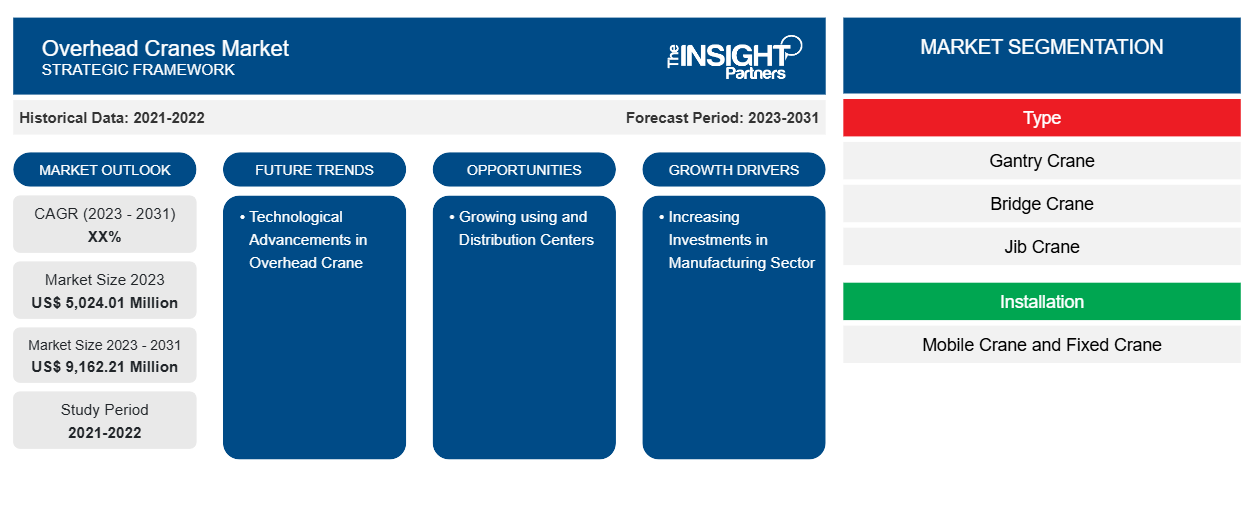
Overhead Cranes Market: Strategic Insights
Regional Insights
North America Overhead Cranes Market
North America accounted for 27–29% share in 2025 and is projected to expand at a 5.4–5.8% CAGR during 2026–2034. The regional Overhead Cranes Market share is supported by automotive retooling, aerospace part handling, metals processing, utilities maintenance, and warehouse automation. Safety standards and insurance-driven inspection practices are strengthening demand for cranes with load monitoring and service documentation.
Owners of facilities are also upgrading their old systems that were operated manually to new systems that include electric cranes, radios, and predictive maintenance packages. The area is lucky to have local vendors, support networks, and engineering procurement practices. The demand comes mainly from the United States with contributions from Canada and Mexico.
U.S. Overhead Cranes Market
United States is 78–82% of the entire North American region in 2025 and estimated to be growing at a CAGR of 5.5–5.9% through 2034. The trend of reshoring of factories, semiconductor fabs, battery manufacturing plants, defense manufacturing and aircraft assembly ensures steady stream of requirements for cranes, monorails and workstation jib cranes.
Some of the manufacturers who have a significant presence in the United States include American Crane & Equipment Corporation, Gorbel Inc., Whiting Corporation, Konecranes Plc and Demag Cranes & Components GmbH. There is an increasing demand for compliance-ready crane products, crane modernization and controls from buyers.
Europe Overhead Cranes Market
In 2025, Europe occupied 21–23% of the market share and is expected to experience a 5.0–5.4% CAGR between 2026 and 2034. In Europe, Germany dominates because of the presence of machinery, automotive, steel processing, and engineered manufacturing. The UK has the advantage of investments in aerospace, defense, logistics, and rail maintenance. France helps to drive demand through industrial modernization and energy infrastructure.
Italy and Spain help through metalworking, ship repair, construction equipment, and port activities. In Europe, the buyers have high importance of energy efficiency, ergonomics, documentation, and regulatory compliance in lifting equipment. The companies that benefit include Demag Cranes & Components GmbH, ABUS Kransysteme GmbH, Liebherr-International Deutschland GmbH, and Konecranes Plc.
APAC Overhead Cranes Market
The Asia Pacific region held a market share of 35–38% in 2025 and is projected to expand at a CAGR of 6.6–7.0% over 2026–2034. The dominant country in the region is China, driven by demand from steel, machinery, shipbuilding, power equipment, and logistics services. Japan and South Korea contribute to the market share through precision machining, automotive industry, electronics sector, and heavy maintenance operations.
Other countries driving the market growth include India and Australia through their development in infrastructure, mining, industrial zones, and warehousing operations. Favorable government policies encouraging localization and development of industrial corridors increase the installed base of both stationary and mobile crane systems.
Middle East & Africa Overhead Cranes Market
Middle East & Africa is expected to grow at a 5.8–6.2% CAGR during 2026–2034, led by Saudi Arabia, the UAE, and South Africa. Oil and gas maintenance, metals, ports, power projects, and construction supply yards sustain demand for heavy-duty lifting. Saudi Arabia is the leading country due to industrial diversification and infrastructure programs.
UAE market ties are connected with logistics centers, ports, fabrication yards, and warehouse automation; whereas South Africa participation will be on the back of mining and industrial maintenance. RoMEA deployment is project based, and sourcing will be centered on energy projects, public sector infrastructure, and maintenance facilities outsourcing.
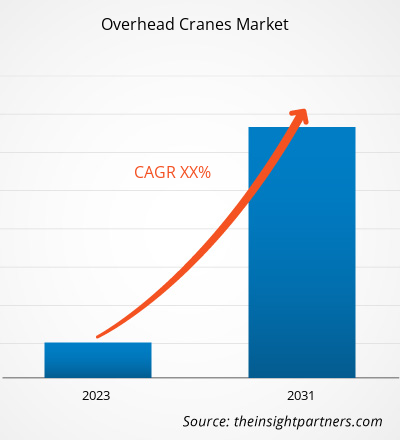
Segmentation Analysis
Type
Type is projected to grow at a 5.9–6.3% CAGR during 2026–2034. The Overhead Cranes Market scope across type reflects different duty cycles, bay layouts, span requirements, and mobility needs. Bridge cranes dominate enclosed production halls, while gantry, jib, and monorail cranes address outdoor yards, workstations, and linear handling routes where flexibility matters.
- Gantry Crane serves outdoor fabrication, ports, storage yards, and construction-linked handling where runway structures are impractical, offering mobility, high load capacity, and flexible deployment across temporary or expanding sites.
- Bridge Crane remains the leading type for indoor manufacturing because it uses building runways efficiently, supports repetitive heavy lifting, and integrates well with electric hoists and automated positioning systems.
- Jib Crane supports localized lifting near workstations, machining cells, and maintenance areas, improving ergonomics and cycle time where loads need short-radius movement rather than full bay coverage.
- Monorail Crane fits linear production flows, paint lines, assembly tracks, and material transfer corridors, providing predictable movement paths and compact installation for facilities with constrained floor space.
Installation
Installation is forecast to expand at a 5.7–6.1% CAGR during 2026–2034. Fixed cranes lead in permanent production environments where structural integration, route predictability, and high utilization justify installation cost. Mobile crane configurations address flexible production, rental-linked industrial tasks, and yards where lifting points shift frequently.
- Mobile Crane supports temporary lifting, project-based industrial work, and multi-location handling needs, making it relevant for construction yards, maintenance shutdowns, and facilities avoiding permanent runway investment.
- Fixed Crane provides high utilization in factories, warehouses, and processing plants, where engineered runways, predictable duty cycles, and integration with safety systems improve throughput.
Operation Type
Operation Type is expected to grow at a 6.0–6.4% CAGR during 2026–2034. Electric systems are gaining preference because they support precise control, energy efficiency, remote operation, and lower maintenance intensity. Hydraulic systems remain relevant for high-force applications, while hybrid solutions respond to energy optimization and resilience requirements.
- Electric cranes dominate modern installations due to controllability, cleaner operation, compatibility with automation, and suitability for indoor facilities pursuing lower energy use and simplified maintenance.
- Hydraulic systems remain important where high starting torque, rugged load movement, or specialized heavy-duty functions are required, especially in demanding fabrication and maintenance environments.
- Hybrid solutions are emerging for users balancing power availability, energy recovery, and operational resilience, particularly where sustainability targets and uptime requirements influence equipment specification.
Number of Axis
Number of Axis is projected to grow at a 6.1–6.5% CAGR during 2026–2034. Axis configuration determines positioning precision, spatial reach, and compatibility with automated handling. Three-axis cranes cover standard plant movement, while four-axis and five-axis systems support complex positioning, rotation, and advanced manufacturing workflows.
- 3-Axis cranes address conventional lifting across travel, cross travel, and hoist movement, making them suitable for most manufacturing bays, warehouses, and maintenance applications.
- 4-Axis configurations add greater handling flexibility for assemblies requiring rotation, controlled orientation, or expanded positioning, improving productivity in machinery, aerospace, and fabrication settings.
- 5-Axis cranes serve advanced workflows where high precision, multi-directional control, and complex load orientation are required, supporting specialized manufacturing and automation-linked material movement.
Opportunity Snapshot
| Type | Revenue Contribution | Trend Tag | Adoption Stage |
| Gantry Crane | High | Yard Automation | Scaling |
| Bridge Crane | High | Factory Flow | Mature |
| Jib Crane | Medium | Cell Lifting | Scaling |
| Monorail Crane | Medium | Linear Handling | Scaling |
Overhead Cranes Market Growth Drivers and Impact Analysis
Factory Automation Raises Precision Lifting Requirements
Automation is transforming crane purchase decisions due to the fact that today cranes tend to be used in interconnected production settings as opposed to being used in work bays. Factories that have opted for automation such as robotics, automated storage and automated production scheduling require cranes that move loads consistently, with minimal manual input and enable repeatable positioning. As a result, there will be increased use of features like electric drives, sway control, radio operation, automatic travel and condition monitoring. The effect of which is an increased spend on crane replacement in mature factories and increased spec value in new facilities.
Industrial Safety Compliance Drives Modernization
Workplace safety laws are leading businesses to upgrade old cranes to new ones that have overload protection, reliable emergency stops, good visibility for operators, and documentation of inspection results. Heavy load accidents may disrupt operations, damage property, and increase risks of insurance, which make the cost of preventative upgrades economical. This trend is especially relevant in industries such as automotive, metal, energy, aerospace, and shipbuilding where there is extensive use of cranes and expensive loads. Service suppliers earn from inspections, modifications, and lifecycle agreements, and equipment makers earn from the demand for improved hoists, control systems, and structures.
Infrastructure and Energy Projects Expand Heavy-Lift Demand
Large infrastructure, renewable energy, grid equipment, rail, ports, and industrial construction projects create demand for cranes that can handle bulky assemblies safely and consistently. Fabrication yards require gantry cranes for outdoor movement, while component plants need bridge and monorail systems to support production of turbines, transformers, structural steel, and heavy machinery. As countries expand energy infrastructure and logistics capacity, suppliers gain opportunities across both permanent facilities and project-based installations. The driver also supports aftermarket demand because high-duty cranes require periodic inspections, replacement parts, and control upgrades to maintain uptime.
Overhead Cranes Market Future Trends
Predictive Maintenance Becomes a Standard Buying Criterion
Overhead Cranes Market trends are moving toward sensor-enabled maintenance models that track motor temperature, brake wear, load cycles, vibration, and operating hours. Future procurement will likely treat diagnostics as a standard feature because unplanned crane downtime can halt entire production lines. Data-driven service contracts will help operators schedule maintenance during planned shutdowns, reduce emergency repairs, and extend asset life. This trend favors suppliers with installed-base visibility, software capability, and regional service teams that can translate crane data into actionable maintenance decisions rather than simply selling hardware.
Energy-Efficient Electric Systems Gain Procurement Priority
Electric cranes with regenerative drives, variable-frequency control, and optimized hoists are expected to gain share as industrial operators link equipment choices to energy efficiency, emissions reduction, and operating cost targets. Future purchasing decisions will compare not only lifting capacity and price but also power consumption, maintenance intervals, and compatibility with facility energy-management systems. Hybrid designs may emerge in sites with variable power availability or resilience needs. Suppliers that document lifecycle energy savings and provide retrofit pathways for older cranes can strengthen competitive positioning.
Overhead Cranes Market Opportunities
Brownfield Crane Modernization Programs
Many factories operate cranes that remain structurally usable but lack modern controls, monitoring, and safety functions. This creates a scalable opportunity for suppliers to offer audits, hoist replacements, electrification upgrades, radio controls, anti-sway systems, and digital inspection packages. Brownfield modernization is attractive because it reduces disruption compared with full replacement and can be funded through productivity, safety, and maintenance savings. Vendors that standardize retrofit kits while retaining application-specific engineering can address a broad installed base in automotive, metals, warehouses, utilities, and general manufacturing facilities.
Localized Manufacturing and Service Networks
Regional supply chains are becoming more important as buyers seek shorter lead times, localized compliance support, and dependable spare-part availability. Manufacturers can capture value by expanding fabrication partnerships, assembly capacity, and service coverage near industrial clusters. The opportunity is strongest in Asia Pacific, North America, and the Middle East, where new manufacturing zones and infrastructure projects require responsive technical support. Localized presence also helps suppliers manage steel cost volatility, shipping constraints, and project customization, improving bid competitiveness while strengthening long-term maintenance relationships with asset owners.
Recent Developments
- May 2026: Konecranes Plc announced an order to supply nine overhead cranes to PT Tata Metal Lestari’s Sadang facility in Indonesia, supporting coil and steel-product handling requirements with industrial crane technology and service capability.
- 2026: Crane Expo 2026 emerged as one of the most anticipated industrial exhibitions in India’s material handling sector. Hosted from 26–28 February 2026 at the Chennai Trade Centre, the event brought together manufacturers, engineers, technology providers, and industry decision-makers under one roof. The expo is recognized as a dedicated platform focused on crane technology, lifting equipment, and advanced industrial handling systems.
- November 2025: Jekko s.r.l. unveiled new compact crane models at Bauma 2025. The Italian manufacturer launched several products, including the SPX328 EVO+ with integrated electric jib, the updated SPX532.2, the new JCX80 telescopic crawler crane, and the TRX32 – Jekko’s first truck-mounted crane.
Frequently Asked Questions

- Comprehensive Market Sizing and Forecast Analysis
- Detailed Segmentation Analysis
- In-Depth Market Dynamics Assessment
- Regional and Country-Level Insights
- Competitive Landscape and Company Benchmarking
- Strategic Business Intelligence
Recent Reports
Testimonials

The Insight Partners' SCADA System Market report is comprehensive, with valuable insights on current trends and future forecasts. The team was highly professional, responsive, and supportive throughout. We are very satisfied and highly recommend their services.
RAN KEDEM Partner, Reali Technologies LTDs
I requested a report on a very specific software market and the team produced the report in a few days. The information was very relevant and well presented. I then requested some changes and additions to the report. The team was again very responsive and I got the final report in less than a week.
JEAN-HERVE JENN Chairman, Future Analytica
We worked with The Insight Partners for an important market study and forecast. They gave us clear insights into opportunities and risks, which helped shape our plans. Their research was easy to use and based on solid data. It helped us make smart, confident decisions. We highly recommend them.
PIYUSH NAGPAL Sr. Vice President, High Beam Global
The Insight Partners delivered insightful, well-structured market research with strong domain expertise. Their team was professional and responsive throughout. The user-friendly website made accessing industry reports seamless. We highly recommend them for reliable, high-quality research services
YUKIHIKO ADACHI CEO, Deep Blue, LLC.
This is the first time I have purchased a market report from The Insight Partners.While I was unsure at first, I visited their web site and felt more comfortable to take the risk and purchase a market report.I am completely satisfied with the quality of the report and customer service. I had several questions and comments with the initial report, but after a couple of dialogs over email with their analyst I believe I have a report that I can use as input to our strategic planning process.Thank you so much for taking the extra time and making this a positive experience.I will definitely recommend your service to others and you will be my first call when we need further market data.
JOHN SUZUKI President and Chief Executive Officer, Board Director, BK Technologies
I wish to appreciate your support and the professionalism you displayed in the course of attending to my request for information regarding to infectious disease IVD market in Nigeria. I appreciate your patience, your guidance, and the fact that you were willing to offer a discount, which eventually made it possible for us to close a deal. I look forward to engaging The Insight Partners in the future, all thanks to the impression you have created in me as a result of this first encounter.
DR CHIJIOKE ONYIA MANAGING DIRECTOR, PineCrest Healthcare Ltd.Reason to Buy
- Informed Decision-Making
- Understanding Market Dynamics
- Competitive Analysis
- Identifying Emerging Markets
- Customer Insights
- Market Forecasts
- Risk Mitigation
- Boosting Operational Efficiency
- Strategic Planning
- Investment Justification
- Tracking Industry Innovations
- Aligning with Regulatory Trends





 Get Free Sample for