
Pallet Forks Market Growth, Trends & Forecast by 2034
Coverage: By Type (Hydraulic, Manually); Application (Agriculture, Industrial, Others) , and Geography (North America, Europe, Asia Pacific, and South and Central America)
- Status : Data Released
- Report Code : TIPRE00022041
- Category : Manufacturing and Construction
- No. of Pages : 150
- Available Report Formats :


- Last update date : August 03, 2026


2025 Market Size
US$ 2.04 Bn
Base year value
2034 Forecast
US$ 3.1 Bn
Projected by 2034
CAGR 2026-2034
4.76 %
Growth rate
Addressable Market
US$ 23.33 Bn
(2026-2034)
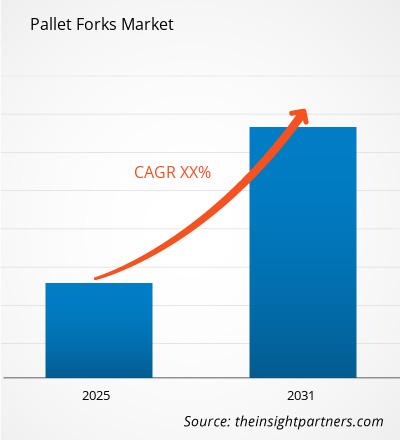
The Pallet Forks market was valued at US$ 2.04 billion in 2025 and is expected to reach US$ 3.1 billion by 2034; it is estimated to record a CAGR of 4.76% during 2026-2034.
Pallet Forks Market Assessment and Insights
- North America accounted for 34–37% share in 2025 and is expected to grow at a CAGR of 5.1–5.6% between 2026–2034, led by rental fleet refresh cycles and high compact equipment penetration.
- US represented 74–78% of North America in 2025 and is projected to record a 5.2–5.7% CAGR between 2026–2034, supported by construction, farming, and warehousing use.
- Europe held 26–29% share in 2025 and is forecast to grow at a 4.7–5.2% CAGR between 2026–2034, with Germany, the UK, France, Italy, and Spain leading demand.
- Asia Pacific captured 22–25% share in 2025 and is expected to expand at a 5.8–6.4% CAGR between 2026–2034, driven by China, India, Japan, South Korea, and Australia.
- Largest Segment Hydraulic type held 58–62% market share in 2025, with a CAGR of 5.5–6.0% between 2026–2034, reflecting higher productivity in loader-mounted operations.
- High Growth Segment Industrial application held 61–65% market share in 2025, with a CAGR of 5.6–6.2% between 2026–2034, supported by warehousing, manufacturing, and construction handling needs.
- Key companies analyzed in detail: Avant Tecno Oy, Certex Lifting AB, Caterpillar Inc., CEAttachments Inc., Manitou Group, HEIDEN GmbH, KINSHOFER GmbH, Koyker Manufacturing Inc., Meijer Handling Solutions B.V., Probst GmbH, and Bobcat Company.
Source: The Insight Partners' analysis based on proprietary research, government publications, company annual reports, investor presentations, industry databases, and expert interviews.
Buyers of equipment have shifted from simple fork frames to better quality, adjustable, hydraulic and quick coupler capable systems, which minimize manual positioning efforts and facilitate load control. The production dynamics have become focused on forged steel quality, ISO compatible tine, welded frame strength, and compatibility with skid steers, compact wheel loaders, telehandlers, and tractor loaders. The market is developing into an attachment type market, which relates to fleet flexibility rather than being a lifting attachment alone.
The emerging geographies are expected to capture visibility through the forecast period on the back of rising mechanization of farming, better organized warehousing and construction of infrastructure. Investments would be made in attachments having the load-backrest facility, hydraulic side shift, reinforced carriage, and safety labeling. Tailwinds arising out of workplace injury prevention and standardization in pallet handling would boost replacement demand, especially in labor-deficit areas.
Pallet Forks Market Report Scope
| Report Attribute | Details |
|---|---|
| Market size in 2025 | US$ 2.04 Billion |
| Market Size by 2034 | US$ 3.1 Billion |
| Global CAGR (2026 - 2034) | 4.76% |
| Historical Data | 2021-2024 |
| Forecast period | 2026-2034 |
Pallet Forks Market Analysis
The most significant driver of growth in the Pallet Forks Market is the requirement to handle palletized loads using smaller machines in the yard, farm, warehouse, and construction site where larger fork lifts cannot be used effectively. Fork attachments improve the utilization of the loader that the contractor or farmer has by reducing the cost per operation.
Factors affecting supply continue to depend on steel supply, machining capabilities, welding skills, and dealer stock management. Product differentiation occurs through different load capacities, tine spacings, visibility, hydraulic adjustability, and fitment on the carrier machine. The market environment involves OEM brands of forks, manufacturers of forks, rental distribution, and parts replacements.
Competitive dynamics of the Pallet Forks Market Report includes competition on the basis of product portfolio, dealer support, degree of certification required, and machine compatibility. Caterpillar Inc. is benefited by virtue of the global availability of their machinery, whereas Avant Tecno Oy, KINSHOFER GmbH, Probst GmbH, and Meijer Handling Solutions B.V. compete because of their engineering and design of attachment machines.
The trends related to investments favor modular frame structure, better visibility of tines, hydraulic side shift, and ability to mount onto compact loaders for rental purposes. Certex Lifting AB, HEIDEN GmbH, Koyker Manufacturing Inc., CEAttachments Inc., Manitou Group, and Bobcat Company function under the purview of strong channel, production know-how, and need for strong attachments.
● REPORT CUSTOMIZATION
Tailor This Report To Align With Your Specific Business Requirements
This report can be customized to align precisely with your business objectives, scope, and target markets. Customization options include tailored segmentation, geography, competitive analysis, and strategic insights to support informed decision-making.
Customize This Report →WHAT YOU CAN ADJUST
- ● Segmentations
- ● Geography
- ● Competitive Analysis
- ● Language Preferences
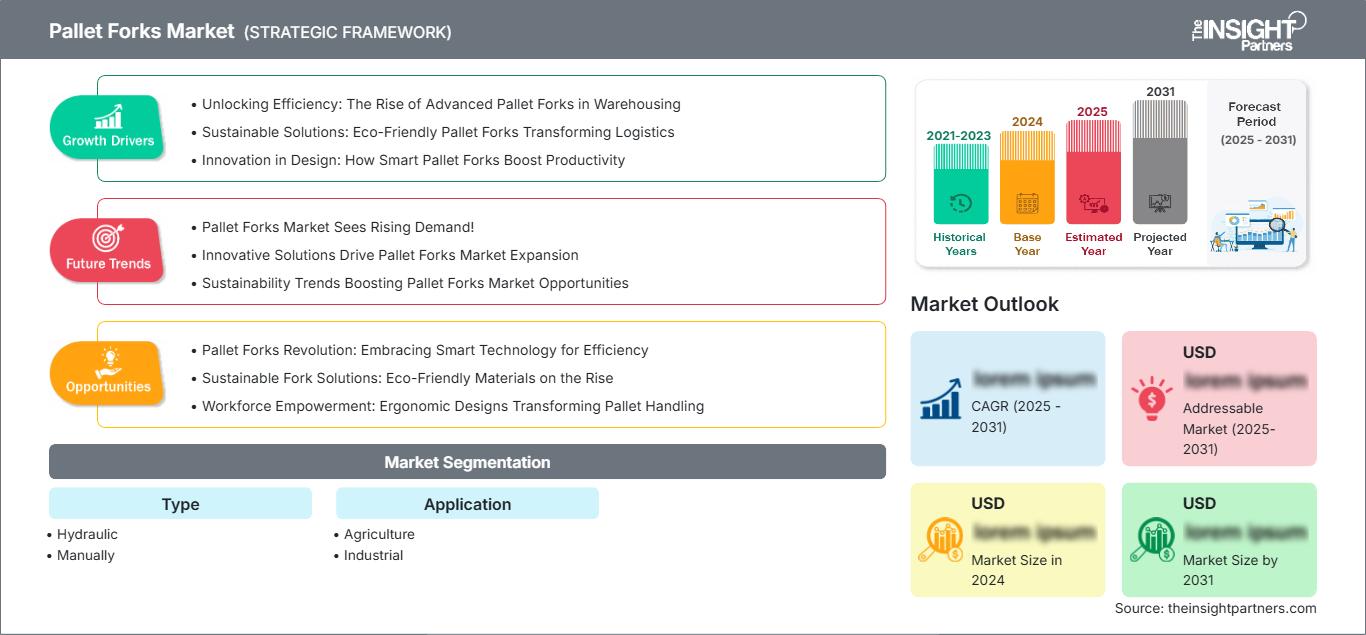
Pallet Forks Market: Strategic Insights
Regional Insights
North America Pallet Forks Market
North America held 34–37% share in 2025 and is expected to post a 5.1–5.6% CAGR through 2034. The Pallet Forks Market share is supported by strong skid steer, telehandler, tractor-loader, and compact wheel loader penetration across construction contractors, farms, municipalities, rental fleets, and industrial yards.
Demand is reinforced by replacement of worn fork frames, safety-driven upgrades, and attachment standardization across mixed fleets. Buyers increasingly prefer reinforced tines, hydraulic adjustment, and better operator visibility. The region’s mature dealer networks help shorten lead times, while rental utilization keeps attachment turnover steady in urban infrastructure and agricultural logistics.
U.S. Pallet Forks Market
In 2025, U.S. accounted for 74-78% of North America and is expected to grow with a CAGR of 5.2-5.7%. The application requirement covers farms involved with feeding, seeding, fertilization, and cutting hay, industries with pallets to be moved and compact loaders being utilized by contractors for material transport on site.
Caterpillar Inc., Bobcat Company, CEAttachments Inc., Koyker Manufacturing Inc., and Avant Tecno Oy can be seen having channel visibility in the U.S. The focus of buyers is on capacity rating, fast attachment changing, and robust build since the same forks could be used in warehouses, landscaping, livestock management, and construction.
Europe Pallet Forks Market
Share of Europe was 26-29% in 2025 and estimated to rise at a CAGR of 4.7-5.2%, owing to leadership of Germany in machinery engineering, dealership strength, and intensity of industrial handling. United Kingdom displays consistent adoption from the rental fleet, agriculture, builders’ merchants, and construction contractors demanding safer handling of pallets.
France, Italy, and Spain display their contributions in the form of agriculture, infrastructure maintenance, and small-scale industries requiring versatile machines in limited space. Demand in Europe is influenced by the requirement of CE certification, preference for small equipment, and high level of acceptance of specialized attachments from companies like KINSHOFER GmbH, Probst GmbH, and Meijer Handling Solutions B.V.
APAC Pallet Forks Market
In 2025, APAC was estimated to hold around 22-25% of market share and will register the highest CAGR of 5.8-6.4%. China leads in volume, but Japan and South Korea focus on engineered attachments for use in industries for industrial handling, small construction equipment, and logistics activities.
India and Australia drive growth in this segment due to their involvement in agricultural mechanization, mining support yards, rural warehousing, and infrastructure development projects. The importance of logistics upgrading and increased farm productivity drives the usage of fork attachments as an economical alternative to forklifts.
Middle East & Africa Pallet Forks Market
The Middle East and Africa will be growing between a 4.9-5.5% CAGR, wherein Saudi Arabia leads demand in the region via construction, logistics zones, and energy yards. UAE has applications in ports, warehouses, and infrastructural applications while South Africa will have mining, agriculture, and maintenance of industries driving demand in the country.
Rest of MEA applications continue to be project-based where procurement will be connected to contractors, rental fleets, and agricultural associations. Operating in harsh conditions will increase the need for reinforced frames, load-backrest visibility, and durable parts.
Segmentation Analysis
Type
Type is expected to grow at a 5.2–5.8% CAGR between 2026–2034. The Pallet Forks Market scope within this segment is shaped by productivity, operator control, and equipment compatibility. Hydraulic models gain preference in high-frequency loading, while manual options remain relevant where affordability, simplicity, and low maintenance matter more than adjustment speed.
- Hydraulic forks lead demand where operators need faster tine positioning, reduced manual handling, and better productivity in repetitive industrial, rental, construction, and large farm material movement tasks.
- Manually adjusted forks remain important for price-sensitive buyers, smaller farms, and occasional-use fleets that value mechanical simplicity, easy maintenance, and compatibility with basic loader operations.
Application
Application is projected to expand at a 5.4–6.0% CAGR during 2026–2034. Industrial use leads revenue contribution because pallet movement is continuous across manufacturing, building materials, logistics, and rental fleets. Agriculture remains structurally important as farms mechanize feed, fertilizer, seed, produce, and bale handling with tractor loaders and compact machines.
- Agriculture demand is steady because pallet forks improve farm labor productivity, seasonal storage handling, feed movement, and material transfers across livestock, crop, nursery, and rural supply operations.
- Industrial applications hold stronger revenue contribution as warehouses, construction yards, plants, and rental operators require durable fork systems for repetitive palletized goods and building material movement.
Opportunity Snapshot
| Application | Revenue Contribution | Trend Tag | Adoption Stage |
| Agriculture | Medium | Farm Mechanization | Scaling |
| Industrial | High | Yard Logistics | Mature |
Pallet Forks Market Growth Drivers and Impact Analysis
Rising Use of Compact Loaders for Material Handling
Compact loaders, skid steers, and telehandlers are increasingly used as multipurpose assets rather than single-task machines, and pallet forks are among the most frequently purchased attachments for that strategy. The market benefits when contractors, farms, and industrial yards avoid buying dedicated forklifts for outdoor or uneven-terrain handling. A fork attachment can convert an existing carrier into a pallet mover within minutes, improving asset utilization and lowering capital intensity. This driver has practical impact in rental fleets, where each additional attachment can raise revenue per machine and broaden the customer base served by one loader platform.
Labor Scarcity and Safety Pressure in Load Movement
Manual load handling is becoming less viable as employers face labor shortages, injury prevention expectations, and pressure to move materials faster with smaller crews. Pallet forks reduce repeated lifting, repositioning, and carrying of heavy goods, especially in farms, yards, and facilities where palletized inputs arrive regularly. The impact is strongest for fertilizer, feed, construction supplies, packaging, and manufacturing components. Buyers increasingly view rated forks, visible backrests, and hydraulic adjustment as risk-control tools, not only productivity accessories. This supports steady replacement demand and encourages standardization across fleets.
Expansion of Palletized Distribution Across End Markets
Palletized movement has expanded beyond warehouses into farms, building supply yards, landscape depots, municipal stores, and small factories. This broadening of pallet use creates recurring demand for fork attachments that work with equipment already operating on-site. The market is therefore linked to packaging standardization, bulk purchasing, and supplier delivery practices. As more inputs arrive on pallets, operators need forks with suitable load ratings, tine lengths, and frame visibility. The result is a durable demand base that is less dependent on one end-use sector and more tied to everyday material flow.
Pallet Forks Market Future Trends
Hydraulic Adjustment Becoming a Productivity Standard
Pallet Forks Market trends point toward wider adoption of hydraulic adjustment as operators seek faster alignment with different pallet widths and load types. Over time, hydraulic features are likely to move from premium attachments into mid-range products, especially for rental fleets and industrial users that measure cycle time closely. This trend will also encourage better hose routing, guarded cylinders, and simplified controls. Suppliers that combine hydraulic convenience with durable frames and clear load ratings should gain preference among buyers replacing manually adjusted forks in high-frequency workflows.
Attachment Data and Fleet Compatibility Discipline
Procurement teams are expected to place greater emphasis on documented compatibility, rated capacities, serial tracking, and maintenance records. As fleets become more mixed, buyers will need confidence that fork frames fit carrier couplers correctly and do not compromise machine stability. Digital catalogs, QR-linked manuals, and dealer-supported inspection records may become more common. The market should benefit from this discipline because professionalized purchasing favors suppliers that provide technical documentation, service support, and clear lifecycle accountability.
Pallet Forks Market Opportunities
Aftermarket Replacement Programs for High-Cycle Users
High-cycle users in rental, logistics yards, and building materials distribution create an opportunity for structured aftermarket replacement programs. Suppliers can bundle inspection guidance, replacement tines, load-backrest components, and dealer service reminders to reduce downtime and improve safety discipline. This approach shifts the commercial model from one-time attachment sale to lifecycle support. It is especially relevant for the market because wear, bending, and misuse risk can affect performance. Companies that document safe replacement intervals and maintain parts availability can strengthen customer retention while protecting brand credibility.
Localized Products for Emerging Farm Mechanization
Emerging farm mechanization creates room for localized pallet fork designs matched to tractor loaders, small compact machines, and regional pallet practices. Suppliers can tailor tine length, frame weight, pricing, and coupler options for India, Southeast Asia, Africa, and Latin America, where buyers often seek durable but affordable attachments. Dealer education is critical because many first-time users need guidance on load limits and safe handling. This opportunity can expand the market beyond established construction and industrial channels by making palletized farm logistics more accessible.
Recent Developments
- November 2025: Noblelift successfully hosted its 2025 Product Launch Event for the Asia market, bringing together distributors and partners from across Asia and beyond to witness the global debut of more than ten next-generation products ranging from forklifts to aerial work platforms such as PPK200 Electric Pallet Truck, PRS200 Stand-on Pallet Truck, and others.
- November 2025: U.Emme introduces the new FP Pallet Fork Frames with hydraulically adjustable teeth, designed to make lifting operations faster, safer, and more precise than ever. This innovative system ensures smooth, quick, and safe operation, saving valuable time while increasing comfort and efficiency.
- March 2025: Bobcat Company is set to showcase two new forklifts which offer industry-leading features at ProMat 2025, March 17-20 at McCormick Place in Chicago. The DV160S-9 and D45S-9 will be introduced along with several other cutting-edge Bobcat products. The new forklift helps operators achieve optimal productivity with class-leading travel speeds and lift speeds along with having one of the tightest turning radiuses in the industry.
Frequently Asked Questions

- Comprehensive Market Sizing and Forecast Analysis
- Detailed Segmentation Analysis
- In-Depth Market Dynamics Assessment
- Regional and Country-Level Insights
- Competitive Landscape and Company Benchmarking
- Strategic Business Intelligence
Recent Reports
Testimonials

The Insight Partners' SCADA System Market report is comprehensive, with valuable insights on current trends and future forecasts. The team was highly professional, responsive, and supportive throughout. We are very satisfied and highly recommend their services.
RAN KEDEM Partner, Reali Technologies LTDs
I requested a report on a very specific software market and the team produced the report in a few days. The information was very relevant and well presented. I then requested some changes and additions to the report. The team was again very responsive and I got the final report in less than a week.
JEAN-HERVE JENN Chairman, Future Analytica
We worked with The Insight Partners for an important market study and forecast. They gave us clear insights into opportunities and risks, which helped shape our plans. Their research was easy to use and based on solid data. It helped us make smart, confident decisions. We highly recommend them.
PIYUSH NAGPAL Sr. Vice President, High Beam Global
The Insight Partners delivered insightful, well-structured market research with strong domain expertise. Their team was professional and responsive throughout. The user-friendly website made accessing industry reports seamless. We highly recommend them for reliable, high-quality research services
YUKIHIKO ADACHI CEO, Deep Blue, LLC.
This is the first time I have purchased a market report from The Insight Partners.While I was unsure at first, I visited their web site and felt more comfortable to take the risk and purchase a market report.I am completely satisfied with the quality of the report and customer service. I had several questions and comments with the initial report, but after a couple of dialogs over email with their analyst I believe I have a report that I can use as input to our strategic planning process.Thank you so much for taking the extra time and making this a positive experience.I will definitely recommend your service to others and you will be my first call when we need further market data.
JOHN SUZUKI President and Chief Executive Officer, Board Director, BK Technologies
I wish to appreciate your support and the professionalism you displayed in the course of attending to my request for information regarding to infectious disease IVD market in Nigeria. I appreciate your patience, your guidance, and the fact that you were willing to offer a discount, which eventually made it possible for us to close a deal. I look forward to engaging The Insight Partners in the future, all thanks to the impression you have created in me as a result of this first encounter.
DR CHIJIOKE ONYIA MANAGING DIRECTOR, PineCrest Healthcare Ltd.Reason to Buy
- Informed Decision-Making
- Understanding Market Dynamics
- Competitive Analysis
- Identifying Emerging Markets
- Customer Insights
- Market Forecasts
- Risk Mitigation
- Boosting Operational Efficiency
- Strategic Planning
- Investment Justification
- Tracking Industry Innovations
- Aligning with Regulatory Trends





 Get Free Sample for