
Pan Feeder Market Size, Trends & Growth by 2034
Coverage: By Capacity (Below 200 MTPH, 200 - 350 MTPH, Above 350 MTPH); End-user (Construction, Mining, Waste and Recycling, Others), and Geography (North America, Europe, Asia Pacific, and South and Central America)
- Status : Data Released
- Report Code : TIPRE00013828
- Category : Manufacturing and Construction
- No. of Pages : 150
- Available Report Formats :


- Last update date : August 04, 2026


2025 Market Size
US$ 968.14 Mn
Base year value
2034 Forecast
US$ 1,307.44 Mn
Projected by 2034
CAGR 2026-2034
3.39 %
Growth rate
Addressable Market
US$ 10,331.92 Mn
(2026-2034)
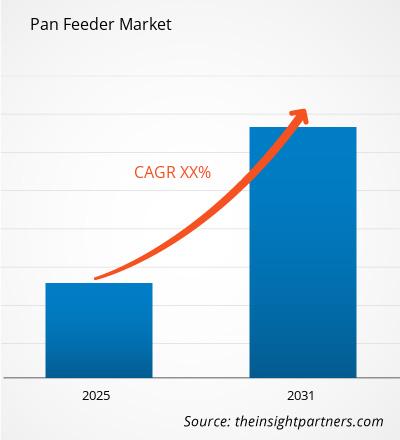
The Pan Feeder Market is expected to increase from US$ 968.14 Million in 2025 to US$ 1,307.44 Million by 2034, at a CAGR of 3.39% during the forecast period 2026-2034, due to continuous investments made in aggregates processing operations, mining material handling activities, quarrying activities, and recycling plant up-gradation.
North America is a technically advanced market, with the Pan Feeder Market size driven by the cycle of quarry replacements, brownfield crushing operations, and consumption of aggregates tied to infrastructure. The region is anticipated to grow at a CAGR between 3.0% and 3.4% through 2034, on account of automated pan feeder control systems, safety-oriented replacement of machinery, and increased use of modular processing facilities..
Pan Feeder Market Assessment and Insights
- North America: Accounted for 31–34% share in 2025 and is expected to grow at a CAGR range of 3.0–3.4% during 2026–2034, supported by aggregates renewal, mining maintenance, and automated plant retrofits.
- US: Represented 72–76% of North America in 2025 and is projected to grow at a CAGR range of 3.1–3.5% from 2026–2034, led by quarry and recycling applications.
- Europe: Held 24–27% share in 2025 and may expand at a CAGR range of 2.7–3.1% during 2026–2034, with Germany, the UK, France, Italy, and Spain leading adoption.
- Asia Pacific: Captured 28–31% share in 2025 and is forecast to grow at a CAGR range of 3.8–4.4% during 2026–2034, led by China, India, Japan, South Korea, and Australia.
- Largest Segment: Mining held 43–47% market share in 2025 and is expected to grow at a CAGR range of 3.2–3.6% during 2026–2034 due to ore handling intensity.
- High Growth Segment: Waste and Recycling held 14–18% market share in 2025 and is expected to grow at a CAGR range of 4.1–4.7% during 2026–2034 as sorting plants expand.
- Key companies analyzed in detail: Astec Industries, Inc.; Deister Machine Company, Inc.; Hewitt Robins International Ltd.; MEKA Global; Metso Corporation; Oreflow Australia Pty Ltd; Sandvik AB; Terex Corporation; The Weir Group PLC; and Vibramech (Pty) Ltd.
Source: The Insight Partners' analysis based on proprietary research, government publications, company annual reports, investor presentations, industry databases, and expert interviews.
Evolving machinery is making pan feeders move away from simple machinery into more sophisticated feed control mechanisms, integrated with crushers, screens, hoppers, and conveyors. There is currently an increasing importance being placed on abrasion-resistant liners, adjustable speed drive systems, modular design, and easy access by users who value uptime more than minimizing cost of acquisition. Trends in production have also led to a standardization towards heavier-duty machinery that can accommodate capacities of 200-350 MTPH and above 350 MTPH without extending lead times.
Future developments will see replacement play an equally crucial role alongside the procurement of new equipment. Mining corridors in Asia Pacific, copper, and critical minerals development in Australia, as well as waste processing capacity increases in Europe, will all expand the available market base. Regulations pertaining to dust management, safe maintenance access, and consistent feed rates will also be significant, particularly when operators are looking to update older quarry or recycling lines.
Pan Feeder Market Report Scope
| Report Attribute | Details |
|---|---|
| Market size in 2025 | US$ 968.14 Million |
| Market Size by 2034 | US$ 1,307.44 Million |
| Global CAGR (2026 - 2034) | 3.39% |
| Historical Data | 2021-2024 |
| Forecast period | 2026-2034 |
Pan Feeder Market Analysis
The demand for the equipment results from quarrying, mining, and recycling activities, whereby the feeding uniformity determines the crusher performance. The Pan Feeder Market is expected to be influenced by the increase in demands for availability of the plant, labor, and processing of non-uniform feeds without creating any bottlenecks. In case of construction aggregates, the feeder system may be used for controlling the flow of the material from the surge bin to the primary crusher.
Value chain participants include steel fabricators, drive makers, vibration parts fabricators, liners producers, system integrators, distributors, and after-sales services. Supply chain advantages accrue to firms that have fabricating capabilities and after-market components in place because of the associated cost of downtime. More procurement officers are adopting an overall cost assessment based on energy efficiency, ease of maintenance, and compatibility with existing crushing circuitry rather than price alone.
In the Pan Feeder Market report, there is evidence of intense competition from diversified companies offering crushing and screening products and dedicated feeder producers. Metso Corporation, Sandvik AB, Terex Corporation, and Astec Industries, Inc. are competing using integrated plant solutions, whereas Deister Machine Company, Inc., Hewitt Robins International Ltd., Oreflow Australia Pty Ltd, and Vibramech (Pty) Ltd are competing with engineering solutions for specific applications.
Investments are targeted towards automation-ready feeders, equipment packages, and aftermarket parts. MEKA Global and The Weir Group PLC have strategic positioning based on the need for reliable feeders in aggregate, mining, and infrastructure projects. Strategic positioning will depend on the installed base, engineering reaction time, and customer service during project cycles.
● REPORT CUSTOMIZATION
Tailor This Report To Align With Your Specific Business Requirements
This report can be customized to align precisely with your business objectives, scope, and target markets. Customization options include tailored segmentation, geography, competitive analysis, and strategic insights to support informed decision-making.
Customize This Report →WHAT YOU CAN ADJUST
- ● Segmentations
- ● Geography
- ● Competitive Analysis
- ● Language Preferences
Pan Feeder Market: Strategic Insights
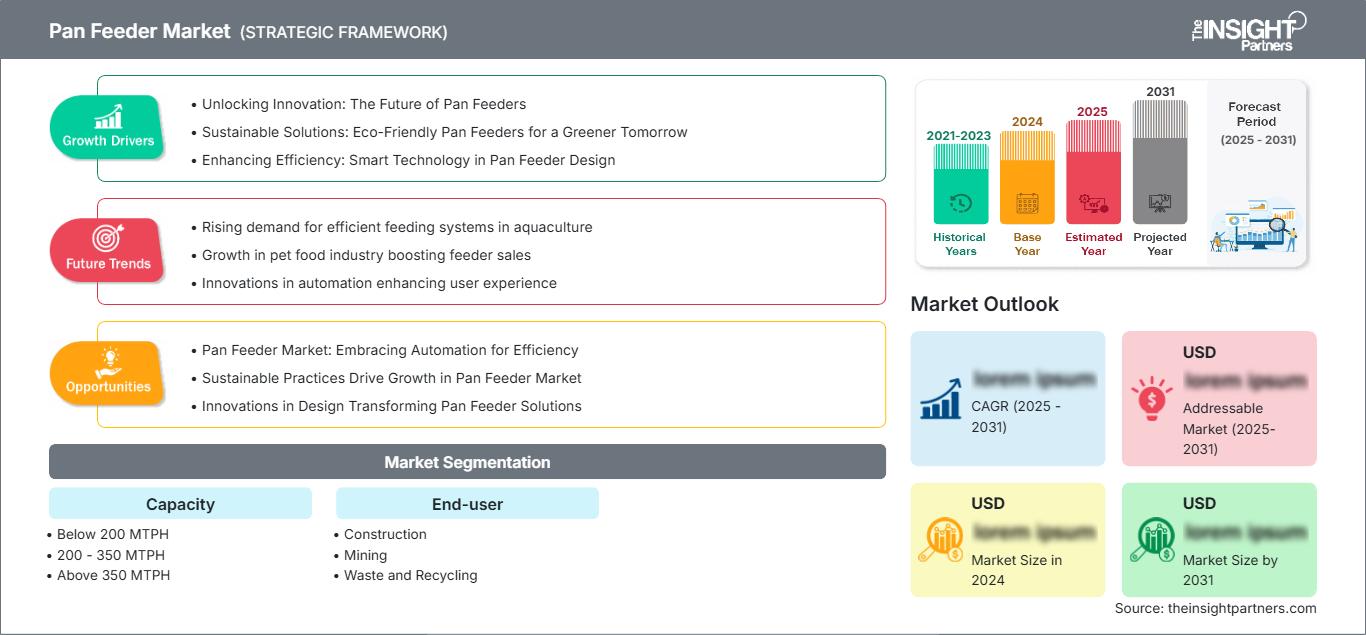
Regional Insights
North America Pan Feeder Market
North America held 31–34% of global revenue in 2025 and is projected to expand at a CAGR range of 3.0–3.4% during 2026–2034. The Pan Feeder Market share in the region is supported by extensive aggregates production, mature quarry networks, and replacement demand from plants built during previous infrastructure cycles.
Structural drivers include safety upgrades, automated feed-rate control, and equipment standardization across multi-site operators. Producers are increasingly choosing feeders that reduce spillage, protect crushers from surges, and simplify liner replacement. Mining and recycling operators also support demand, particularly where high-utilization plants require rugged, serviceable feeding systems for abrasive and mixed materials.
U.S. Pan Feeder Market
United States has constituted 72%-76% share of North America in 2025 and is expected to record CAGR in the range of 3.1%-3.5% during 2026-2034. The demand is seen more in aggregates, cement raw materials, demolition recycling, and minerals processing where reliable feeding leads to improved crushing performance.
The market presence is high since companies such as Astec Industries, Inc., Deister Machine Company, Inc., Terex Corporation, Metso Corporation, and Sandvik AB offer product/service/representation support to their quarry owners. The application trends reveal that modular feeders along with mobile and fixed plants are favored as construction contractors feed recycled concrete, asphalt, limestone, granite, and sand-and-gravel materials.
Europe Pan Feeder Market
Market Share: Europe accounted for 24% to 27% share in 2025 and will expand at a CAGR of 2.7% to 3.1% during 2026-2034. Germany is dominated by engineered aggregates and industrial minerals. In the UK, the growth will be fueled by recycling facilities, upgraded quarries, and recovery of construction material.
In France, Italy, and Spain, growth in volume is generated by cements, limestones, tunneling spoil treatment, and demolition waste recycling. Customers’ concerns revolve around energy efficiency, protection, dust handling, and maintenance. However, although there are fewer greenfield projects, this is compensated by replacements, compliance, and feeders for compact plants.
APAC Pan Feeder Market
APAC commanded a market share of 28-31% in 2025 and will expand at a compound annual growth rate of 3.8-4.4% from 2026 to 2034. China continues to be the largest country on account of the installed processing capacity, whereas India's roadways, railways, cement production, and pipeline infrastructure boost the demand for aggregates.
The preference for compact and robust equipment for quarrying and recycling activities is observed in Japan and South Korea. The iron ore, copper, and critical minerals extraction activities in Australia support the demand for rugged machinery.
Middle East & Africa Pan Feeder Market
Middle East & Africa is projected to grow at a CAGR range of 3.3–3.8% during 2026–2034. Saudi Arabia leads regional demand as infrastructure, quarrying, and industrial diversification projects increase the need for robust aggregates processing equipment.
The UAE will facilitate demand by means of construction materials and recycling plants, but South Africa will continue to be a key player in terms of mining related feeders. The rest of MEA will use cement, road construction, and minerals processing investments as an enabler for adoption. Energy-related projects will also affect aggregate demand.
Segmentation Analysis
Capacity
Capacity is expected to grow at a CAGR range of 3.2–3.7% from 2026–2034, reflecting diverse requirements across compact recycling plants, mid-sized quarry installations, and high-throughput mining circuits. The Pan Feeder Market scope is shaped by throughput, feed size, material abrasiveness, and downstream crusher configuration, making capacity selection central to lifecycle performance.
- Below 200 MTPH: This range is suited to compact plants, mobile recycling lines, and smaller quarry operations where equipment footprint, installation flexibility, and controlled capital spending matter most.
- 200 - 350 MTPH: Mid-capacity feeders serve mainstream aggregates and industrial mineral plants, balancing productivity, wear resistance, and procurement affordability for operators upgrading existing crushing circuits.
- Above 350 MTPH: Heavy-duty models are strategically important in mining and large quarry settings where high impact loads, abrasive ore, and continuous operation require stronger frames and liners.
End-user
End-user demand is expected to grow at a CAGR range of 3.3–3.9% during 2026–2034 as construction, mining, and recycling operators standardize material handling systems. Mining remains the largest end-user, while waste and recycling delivers faster growth because mixed feedstock requires controlled, reliable, and easily serviceable feeding equipment.
- Construction: Construction users require feeders for aggregates, concrete recycling, asphalt recovery, and road-base production, with procurement decisions often linked to contractor utilization and plant mobility.
- Mining: Mining applications demand heavy structures, wear liners, and stable feeding into crushers or screens, making reliability and maintenance access more important than initial equipment cost.
- Waste and Recycling: Recycling plants use feeders to handle demolition waste, mixed aggregates, and recovered materials, where controlled flow supports sorting quality and reduces downstream blockages.
Opportunity Snapshot
| End-user | Revenue Contribution | Trend Tag | Adoption Stage |
| Construction | High | Aggregate Plants | Mature |
| Mining | High | Ore Handling | Mature |
| Waste and Recycling | Medium | Material Recovery | Scaling |
Pan Feeder Market Growth Drivers and Impact Analysis
Quarry Modernization and Crusher Utilization
Feeders are being upgraded in an attempt to address the inefficiency associated with material flow inconsistency, leading to increased wear and maintenance costs in the aggregates industry. The proper design of pan feeders ensures the stabilization of material flow from surge bins while minimizing bridging problems, allowing the crushers to work near their full capacity. The significance of the issue is more pronounced in quarry operations that run on multiple shifts since production hours lost can lead to missed delivery times of material for roads, railways, concrete, and asphalt applications.
Mining Throughput and Abrasive Material Handling
Mining customers require feeders that can absorb impact, manage high-density ore, and withstand abrasive material streams. The market impact is visible in demand for reinforced pans, replaceable liners, robust drive systems, and designs that reduce unplanned shutdowns. Copper, iron ore, gold, coal, and industrial minerals projects all depend on reliable feeding between extraction, crushing, and screening stages. As mines push for higher plant availability, feeder selection increasingly affects process continuity, energy efficiency, and maintenance planning across the broader material handling system.
Recycling Capacity Expansion and Mixed Feedstock Processing
Recycling facilities are expanding mechanical processing capacity for construction and demolition waste, recovered aggregates, metals, and mixed industrial materials. Pan feeders support these lines by metering irregular feedstock into crushers, screens, magnets, and sorting equipment. The impact is stronger in regions with landfill diversion policies, urban demolition activity, and circular-economy targets. For operators, reliable feeding improves sorting quality, reduces blockages, and enables more predictable downstream throughput, making feeders a practical investment for plants seeking higher recovery rates and lower manual handling exposure.
Pan Feeder Market Future Trends
Automation-Ready Feed Control
Pan Feeder Market trends will increasingly center on automation-ready systems that connect feeder speed, load feedback, crusher draw, and plant-level controls. Instead of operating as isolated mechanical assets, feeders will become part of closed-loop material handling strategies. This shift will support predictive maintenance, remote diagnostics, and energy optimization, especially in large quarries and mines. Suppliers that provide controls compatibility, sensor-ready designs, and digital service support will gain advantage as operators seek measurable improvements in throughput stability and maintenance scheduling.
Modular and Application-Specific Platforms
Future product development will favor modular feeder platforms that reduce engineering lead time while allowing configuration for impact load, capacity, liner type, and installation layout. This trend will help suppliers serve contractors, miners, and recyclers with shorter delivery cycles and more predictable performance. Application-specific options, including sealed designs, compact frames, and high-wear packages, will become more important as customers balance capital discipline with demanding operating conditions across brownfield upgrades and new processing facilities.
Pan Feeder Market Opportunities
Aftermarket Parts and Wear-Liner Programs
Aftermarket programs represent a durable opportunity because feeders operate in abrasive environments where liners, springs, drives, bearings, and structural components require periodic replacement. Suppliers can improve customer retention by offering inspection services, lifecycle kits, and regionally stocked parts that reduce downtime. This opportunity is strongest among quarry and mining fleets with installed equipment across multiple sites. Service-led revenue also helps manufacturers stabilize earnings when new equipment orders soften during commodity or construction cycles.
Recycling Plant Retrofits in Urban Markets
Urban recycling facilities offer an actionable opportunity as demolition volumes rise and municipalities push material recovery. Retrofitting older lines with pan feeders can improve flow control before crushers, trommels, screens, and optical or magnetic sorting equipment. Manufacturers can target this opportunity with compact designs, dust-conscious configurations, and retrofit engineering support. The business case is strongest where operators need to raise throughput without acquiring new sites, making equipment upgrades a practical route to higher recovery efficiency.
Recent Developments
- January 2026: Hewitt Robins has recently supplied a 1.25m x 4.8m Vibrating Pan Feeder to a customer in Southern France. The new heavy-duty unit was engineered to meet the demands of the application and supplied complete with a welded feeder frame, Hardox 450 pan liners, coiled springs, a twin-shaft vibrator unit, V-belt drive assembly, 22kW motor, and variable speed drive.
- October 2024: RCR Mining Technologies has announced the launch of the Sealed Pan Feeder (SPF), a world-first, industry-leading product redefining the future of apron feeder technology. Both the RCR Sealed Pan Feeder and the RCR Apron Feeder boast low-maintenance designs, outperforming alternatives in the market. The Sealed Pan Feeder shares over 90% of its components with the RCR Apron Feeder, ensuring durability while introducing key improvements.
- March 2022: Weir partnered with OMV’s Stilfontein crushing plant in South Africa to address inconsistent feed to the cone crushers and safety risks in their crushing circuit, with the installation of a Trio EF3606 pan feeder. The site achieved a 40% increase in production and eliminated manual chute clearing, creating a safer working environment.
Frequently Asked Questions

- Comprehensive Market Sizing and Forecast Analysis
- Detailed Segmentation Analysis
- In-Depth Market Dynamics Assessment
- Regional and Country-Level Insights
- Competitive Landscape and Company Benchmarking
- Strategic Business Intelligence
Recent Reports
Testimonials

The Insight Partners provided valuable market intelligence that supported our global go-to-market strategy. Their team was professional, responsive, and attentive to our feedback, providing thoughtful analysis and helpful methodological clarifications throughout the project.
Junmo Kim Chief Financial Officer (CFO), Enertech Co., Ltd.
The Insight Partners' SCADA System Market report is comprehensive, with valuable insights on current trends and future forecasts. The team was highly professional, responsive, and supportive throughout. We are very satisfied and highly recommend their services.
RAN KEDEM Partner, Reali Technologies LTDs
I requested a report on a very specific software market and the team produced the report in a few days. The information was very relevant and well presented. I then requested some changes and additions to the report. The team was again very responsive and I got the final report in less than a week.
JEAN-HERVE JENN Chairman, Future Analytica
We worked with The Insight Partners for an important market study and forecast. They gave us clear insights into opportunities and risks, which helped shape our plans. Their research was easy to use and based on solid data. It helped us make smart, confident decisions. We highly recommend them.
PIYUSH NAGPAL Sr. Vice President, High Beam Global
The Insight Partners delivered insightful, well-structured market research with strong domain expertise. Their team was professional and responsive throughout. The user-friendly website made accessing industry reports seamless. We highly recommend them for reliable, high-quality research services
YUKIHIKO ADACHI CEO, Deep Blue, LLC.
This is the first time I have purchased a market report from The Insight Partners.While I was unsure at first, I visited their web site and felt more comfortable to take the risk and purchase a market report.I am completely satisfied with the quality of the report and customer service. I had several questions and comments with the initial report, but after a couple of dialogs over email with their analyst I believe I have a report that I can use as input to our strategic planning process.Thank you so much for taking the extra time and making this a positive experience.I will definitely recommend your service to others and you will be my first call when we need further market data.
JOHN SUZUKI President and Chief Executive Officer, Board Director, BK Technologies
I wish to appreciate your support and the professionalism you displayed in the course of attending to my request for information regarding to infectious disease IVD market in Nigeria. I appreciate your patience, your guidance, and the fact that you were willing to offer a discount, which eventually made it possible for us to close a deal. I look forward to engaging The Insight Partners in the future, all thanks to the impression you have created in me as a result of this first encounter.
DR CHIJIOKE ONYIA MANAGING DIRECTOR, PineCrest Healthcare Ltd.Reason to Buy
- Informed Decision-Making
- Understanding Market Dynamics
- Competitive Analysis
- Identifying Emerging Markets
- Customer Insights
- Market Forecasts
- Risk Mitigation
- Boosting Operational Efficiency
- Strategic Planning
- Investment Justification
- Tracking Industry Innovations
- Aligning with Regulatory Trends





 Get Free Sample for