
Paper Chemicals Market Growth, Trends & Demand by 2034
Coverage: By Type (Bleaching Chemicals, Functional Chemicals, Others); Application (Packaging, Printing, Labelling, Others) , and Geography (North America, Europe, Asia Pacific, and South and Central America)
- Status : Data Released
- Report Code : TIPRE00005110
- Category : Chemicals and Materials
- No. of Pages : 150
- Available Report Formats :


- Last update date : September 17, 2026


2025 Market Size
US$ 104.30 Bn
Base year value
2034 Forecast
US$ 139.72 Bn
Projected by 2034
CAGR 2026-2034
3.30 %
Growth rate
Addressable Market
US$ 1,108.03 Bn
(2026-2034)
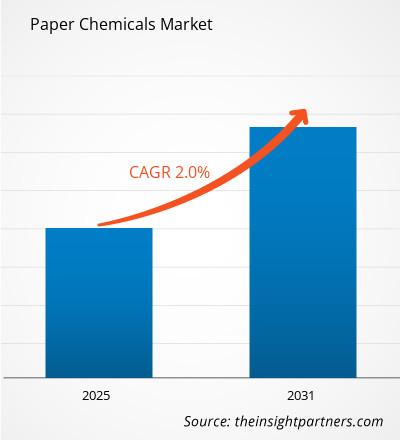
The Paper Chemicals Market was valued at US$ 104.30 Billion in 2025 and is projected to reach US$ 139.72 Billion by 2034, registering a CAGR of 3.30% during 2026–2034. The market covers chemistries used to improve pulp processing, bleaching, paper formation, coating, sizing, strength, printability, and functional performance. Demand is increasingly connected with packaging conversion, recycled fiber utilization, resource efficiency, and tighter environmental requirements affecting mills and downstream converters.
North America remains a technically mature market supported by modernization of paper mills, recycled-fiber processing, and demand for higher-performance packaging grades. The Paper Chemicals Market size outlook is supported by an estimated regional CAGR of 3.0–3.5% during 2026–2034, with adoption increasingly focused on lower chemical consumption, improved process control, water efficiency, and functional additives that enable lightweight paper structures without sacrificing strength or barrier performance.
Paper Chemicals Market Assessment and Insights
- North America: North America is expected to represent a 20–24% Paper Chemicals Market share in 2025 and grow at a 3.0–3.5% CAGR between 2026 and 2034, supported by recycled fiber utilization, packaging-grade conversion, mill modernization, and demand for efficient wet-end and functional chemistries.
- U.S.: The U.S. is expected to account for 78–82% of North America's 2025 market and expand at a 3.0–3.4% CAGR between 2026–2034, supported by packaging, tissue, and recycled-paper production.
- Europe: Europe is estimated at a 23–27% share in 2025, growing at a 2.6–3.1% CAGR between 2026 and 2034. Germany, Italy, France, Finland, and Sweden remain important markets because of advanced mills and stringent environmental requirements.
- Asia Pacific: Asia Pacific is estimated to hold a 43–47% share in 2025 and grow at a 3.7–4.2% CAGR between 2026–2034, led by China, Japan, India, South Korea, and Indonesia through packaging expansion and manufacturing localization.
- Largest Segment: Functional Chemicals is estimated to hold a 55–59% market share in 2025 and grow at a 3.5–3.9% CAGR during 2026–2034, reflecting broad use in strength, sizing, retention, and coating applications.
- High Growth Segment: Packaging is estimated to represent a 47–51% market share in 2025 and expand at a 3.7–4.2% CAGR during 2026–2034, driven by fiber-based packaging conversion.
- Key companies analyzed in detail: Kemira Oyj, BASF SE, Solenis LLC, Akzo Nobel N.V., Ecolab Inc., Ashland Inc., Harima Chemicals Group, Inc., Buckman Laboratories International, Inc., Archroma Management GmbH, Chemisphere Paper Technologies.
Source: The Insight Partners' analysis based on proprietary research, government publications, company annual reports, investor presentations, industry databases, and expert interviews.
The trend towards paper chemicals has progressed from commodity-type process components to purpose-built formulations based on productivity, fiber efficiency, and functional characteristics. In contemporary pulp mills, the trend of combining bleaching, retention, size, strength, coating, and contaminants control chemicals with process controls is becoming more common. The use of recycled pulp has increased the need for control of dissolved and colloidal materials, drainage, deposit, foam formation, and strength loss without process disruption.
The future development of the Paper Chemicals Market will be focused on chemistry for circular fiber systems, reduced water usage, and safer formulations. New emerging markets in South and Southeast Asia provide additional capacity for growth, and European regulations accelerate the substitution of the formulations into recyclable and reduced-impact chemistries. Additionally, manufacturers are enhancing technical service capability since mills measure their chemical programs by production stability, energy consumption, fiber retention, wastewater load, and end-product characteristics.
Paper Chemicals Market Report Scope
| Report Attribute | Details |
|---|---|
| Market size in 2025 | US$ 104.30 Billion |
| Market Size by 2034 | US$ 139.72 Billion |
| Global CAGR (2026 - 2034) | 3.30% |
| Historical Data | 2021-2024 |
| Forecast period | 2026-2034 |
Paper Chemicals Market Analysis
Paper Chemicals Market growth prospects are dependent on packaging paper, board, tissue, and specialty papers since their production involves maintaining controlled strength, surface characteristics, brightness, and performance of machinery. The value chain of this market consists of chemical and material supply, formulation, logistics, application at the mill, process control, and technical service provision. The use of recycled fibers increases the variability of furnish quality and creates a need for retention, drainage, strength, defoaming, and contamination control.
Supply factors in the Paper Chemicals Market differ from one chemistry type to another. Bleaching is based on intermediates with chlorines, oxygen oxidants, caustic soda, hydrogen peroxide, and utility supply, while the production of functional formulations is associated with polymers, starches, resins, pigments, fatty acid derivatives, and other specialty chemicals. Transportation and energy costs could influence the delivered price especially when it comes to bulk chemicals.
Formulation versatility, technical services, and chemical integration with mill processes are becoming key aspects of competitive positioning in the market. The Paper Chemicals Market report states that players with diverse product lines are able to offer cross-selling solutions, which include bleaching, wet end, sizing, coating, and water treatment chemicals, while specialists can compete with their unique additives. Kemira Oyj and Solenis LLC occupy leading positions in fiber processing and functional chemistry, while BASF SE and Archroma Management GmbH provide specialty formulations and sustainable packaging chemistry.
In the Paper Chemicals Market, investments are being directed towards regional manufacturing, application laboratories, digital monitoring, and less invasive formulations. Harima Chemicals Group, Inc. has a sizable paper-chemicals line in sizing and strength chemicals, whereas Buckman Laboratories International, Inc. concentrates on process and performance chemistry. Ecolab Inc., Ashland Inc., Akzo Nobel N.V., and Chemisphere Paper Technologies extend competition with their specialty process, coating, water management, and functional chemistries. Increasingly, strategic differentiation relies on measurable mill performance.
● REPORT CUSTOMIZATION
Tailor This Report To Align With Your Specific Business Requirements
This report can be customized to align precisely with your business objectives, scope, and target markets. Customization options include tailored segmentation, geography, competitive analysis, and strategic insights to support informed decision-making.
Customize This Report →WHAT YOU CAN ADJUST
- ● Segmentations
- ● Geography
- ● Competitive Analysis
- ● Language Preferences
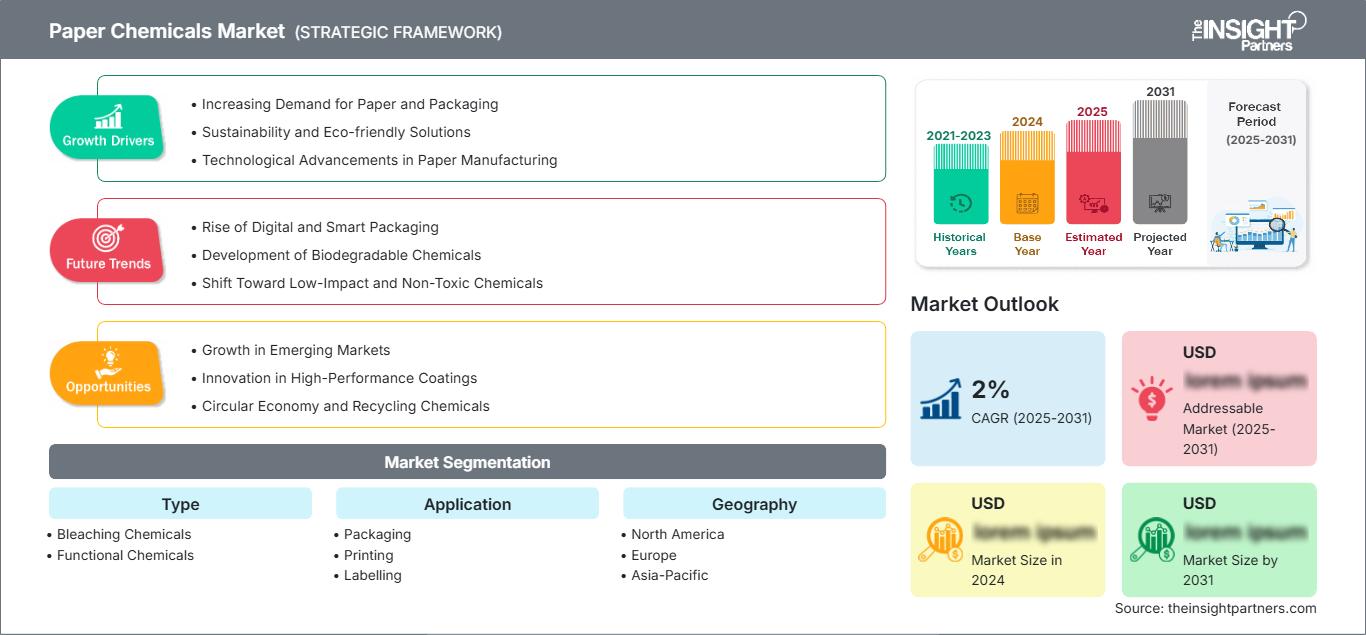
Paper Chemicals Market: Strategic Insights
Regional Insights
North America Paper Chemicals Market
North America is estimated to hold a 20–24% share in 2025 and expand at a 3.0–3.5% CAGR during 2026–2034. The U.S. dominates regional demand because of its extensive packaging, tissue, printing, and specialty-paper base. Mill modernization, recovered-fiber processing, and efforts to reduce freshwater consumption support greater use of performance-oriented chemistries.
Canada supplies via its pulp & paper making activities, while Mexico gains through increased manufacturing and packaging operations. Suppliers have been offering their products in an integrated fashion, dealing with retention, drainage, strength, sizing, bleaching, and water management. The regional consumers consider the effectiveness of chemicals because labor, energy, wastewater treatment, and maintenance expenses represent a major part of the total cost structure at mills.
U.S. Paper Chemicals Market
The U.S. accounts for approximately 78–82% of North America's 2025 market and is expected to grow at a 3.0–3.4% CAGR during 2026–2034. The demand is focused on packaging, tissue, board, and specialty papers. The suppliers are Kemira Oyj, Solenis LLC, BASF SE, Ecolab Inc., Ashland Inc., and Buckman Laboratories International, Inc.
Increasingly important applications in the Paper Chemicals Market focus on compatibility with recycled fibers, dry and wet strength, sizing, retention, deposits control, and coating properties. The producers are also looking into the chemistry of the processes based on water usage, energy needs, equipment availability, and end product characteristics. An important downstream influence comes from food and beverages packaging because the fiber constructions are increasingly expected to have functional barriers to grease and moisture with recycling capabilities.
Europe Paper Chemicals Market
Europe is estimated to account for a 23–27% share in 2025 and grow at a 2.6–3.1% CAGR during 2026–2034, with Germany representing a leading national market. European demand is strongly influenced by recycling, resource efficiency, chemical compliance, and conversion toward fiber-based packaging. In the UK and Germany, efficiency formulations have been preferred to maintain performance but at lower process intensity levels. There is also additional demand in France, Italy, and Spain through packaging, specialty papers, and converting sectors. Regional suppliers are now looking at environmentally friendly additives, water-based systems, and recyclable barrier systems as key business areas.
UK market is driven through the use of packaging conversion and recycling of papers, while the German market is favored due to its large industry and advanced paper machinery system. France and Italy drive the demand through food packaging, labels, and specialty papers, while in Spain there is demand through packaging and tissue manufacturing. In Europe, selection of chemicals takes into consideration wastewater properties, substance limitations, recyclability, and suitability with circular fiber systems.
APAC Paper Chemicals Market
APAC is estimated at a 43–47% share in 2025 and is expected to grow at a 3.7–4.2% CAGR during 2026–2034. China is the largest consumer market, followed by Japan, India, South Korea, and Australia. Increases in packaging production, mill investments, recycled fiber processing, and industrial localization drive local consumption of chemicals.
China offers a combination of significant paper production with high packaging consumption, whereas India is growing in importance through increased manufacturing. Japan and South Korea focus on process efficiency and high-value grades, and Australia prioritizes resource efficiency and recycling. Circular material policies, industrial modernization, and reduced pollution will drive efficient bleaching, functional, and process chemicals in APAC.
Middle East & Africa Paper Chemicals Market
The Middle East & Africa is expected to record a 4.2–4.8% CAGR during 2026–2034, making it one of the fastest-growing regional markets from a smaller base. Saudi Arabia and the UAE benefit from industrial diversification and packaging investment, while South Africa remains important for established paper manufacturing and recycling activity.
Opportunities for The Rest of MEA come through food packaging, tissue, corrugation, and industrialization based on infrastructure. Water is a factor to consider, especially for those markets that have dry environments, and hence there is more interest in chemistries which would aid in reuse of process water and minimize wastewater. The supply chain is becoming more regional and favors distributors more than imports of chemicals.
Segmentation Analysis
Type
Type segmentation is divided into Bleaching Chemicals and Functional Chemicals. Functional Chemicals remain the larger category, with a modeled 3.5–3.9% CAGR during 2026–2034, supported by their use across strength, sizing, retention, coating, and process-control requirements. Bleaching chemistry remains essential for brightness, pulp quality, and recycled-fiber processing, while improved oxidation sequences increasingly emphasize efficiency and environmental compatibility.
- Bleaching Chemicals: These chemicals support pulp brightness and consistency through oxidation and bleaching stages. Demand remains closely linked to virgin pulp production, recycled-fiber quality, brightness specifications, wastewater requirements, and mills seeking lower chemical consumption.
- Functional Chemicals: Functional formulations improve strength, sizing, retention, drainage, coating, printability, and surface characteristics. Their strategic importance increases as mills' lightweight products while maintaining mechanical performance and stable machine operation.
Application
Application segmentation comprises Packaging, Printing, and Labeling. Packaging is the leading application and is modeled to expand at a 3.7–4.2% CAGR during 2026–2034, reflecting continued demand for paperboard, corrugated materials, and fiber-based alternatives. Printing remains comparatively mature, while labeling requires specialized surface, coating, adhesion, and print-performance characteristics.
- Packaging: Packaging consumes diverse chemical formulations because strength, barrier performance, moisture resistance, printability, and recyclability must be balanced. Demand is supported by food, beverage, consumer products, e-commerce, and industrial packaging conversion.
- Printing: Printing applications depend on coating quality, ink interaction, surface smoothness, brightness, and dimensional stability. Chemistry demand increasingly favors formulations that maintain print performance while accommodating lower basis weights and recycled fiber.
- Labeling: Labels require controlled surface energy, opacity, smoothness, wet strength, and printability. Specialty chemical systems help converters maintain reliable printing and converting performance across paper labels used in food, beverage, household, and industrial applications.
Opportunity Snapshot
| Application | Revenue Contribution | Trend Tag | Adoption Stage |
|---|---|---|---|
| Packaging | High | Fiber Barriers | Scaling |
| Printing | Medium | Surface Control | Mature |
| Labelling | Medium | Label Performance | Scaling |
Paper Chemicals Market Growth Drivers and Impact Analysis
Expansion of Fiber-Based Packaging Applications
The shift toward fiber-based packaging is creating incremental demand for chemicals that improve strength, moisture resistance, grease resistance, printability, and converting performance. This type of packaging is especially critical because the requirements of paper structures have to be very high and yet must still work in harmony with recycling processes. Suppliers of chemicals stand to gain from higher percentages of either lightweight fibers or recycled fibers, as performance additives could help make up for the inferior qualities of furnish. The economic significance of the trend is not restricted to chemical volumes alone; mills will be able to operate their machines more effectively, lower their basis weights, and keep their products within specification due to improved formulations. In packaging conversion, there will be increased use of coatings and surface treatments that offer barrier properties but do not hinder repulpability.
Growing Use of Recycled Fiber and Process Optimization
Higher recovered-fiber utilization is increasing the complexity of papermaking because recycled furnish can contain contaminants, dissolved substances, shorter fibers, and variable bonding characteristics. Mills therefore require chemistry programs that stabilize retention, drainage, formation, strength, deposit control, and machine cleanliness. The operational impact is significant because unstable wet-end conditions can increase breaks, downtime, energy consumption, and production losses. Functional chemicals provide a mechanism for restoring performance without relying solely on higher fiber inputs. Suppliers that combine chemistry with process diagnostics can demonstrate value through measurable improvements in machine runnability and resource efficiency. This driver is particularly relevant in mature paper-producing regions where mills are optimizing existing assets rather than adding large amounts of new capacity. The resulting demand favors customized chemical programs over standardized commodity formulations.
Tighter Environmental Requirements and Resource Efficiency
Environmental requirements are encouraging paper producers to reduce water consumption, chemical intensity, emissions, and wastewater impacts while maintaining production economics. Regulations affecting chemical substances, packaging recyclability, wastewater discharge, and product safety are influencing formulation decisions across major markets. The commercial effect is strongest where mills operate under stringent permitting requirements or serve customers with documented sustainability specifications. Suppliers are responding with lower-impact bleaching sequences, renewable or recycled feedstocks, waterborne coatings, efficient retention systems, and chemistries designed for closed-loop process conditions. These solutions can reduce resource consumption while supporting consistent paper quality. The impact is therefore not limited to compliance. Chemical optimization can improve mill productivity and reduce operating costs, making environmental performance increasingly connected with purchasing decisions and long-term supplier relationships.
Paper Chemicals Market Future Trends
Bio-Based and Lower-Impact Formulations
The next phase of Paper Chemicals Market trends is expected to emphasize renewable feedstocks, bio-based polymers, waterborne formulations, and chemistries designed for lower environmental impact. Suppliers are developing solutions that reduce reliance on fossil-derived inputs while maintaining strength, sizing, coating, and barrier performance. Adoption will depend on cost parity, supply reliability, food-contact requirements, and compatibility with existing mill equipment. Bio-based chemistry is particularly relevant for packaging applications because brand owners increasingly evaluate the material composition and end-of-life characteristics of fiber-based formats. Suppliers that can demonstrate comparable technical performance alongside improved environmental profiles are likely to gain preference in qualification programs. Over time, formulation development should move from individual sustainable products toward integrated chemistry platforms covering pulp preparation, wet-end treatment, coating, and converting performance.
Digital Chemistry Management and Closed-Loop Optimization
Digitalization is expected to change how mills purchase and manage process chemistry by linking chemical dosage with online measurements of drainage, retention, formation, turbidity, conductivity, and machine performance. Instead of optimizing individual chemical additions independently, mills can increasingly manage chemistry as part of a connected process-control system. Sensors, automated dosing, predictive analytics, and remote technical support can help stabilize production and reduce over-application. This approach also creates opportunities for suppliers to move toward performance-based service models in which chemical programs are evaluated against agreed operational indicators. Adoption should initially be strongest among large mills with advanced automation infrastructure, although modular monitoring solutions can expand access for smaller producers. The longer-term effect will be greater transparency over chemical efficiency, process variability, and resource consumption.
Paper Chemicals Market Opportunities
Integrated Chemistry Programs for Circular Fiber Mills
An important investment opportunity lies in integrated chemistry programs designed specifically for mills operating with high recycled-fiber content. The Paper Chemicals Market Forecasts indicate that circular production models will require coordinated solutions rather than isolated additives because contaminants, fiber quality, drainage, strength, and wastewater characteristics interact throughout the process. Suppliers can develop bundled programs covering retention, strength, sizing, deposit control, bleaching, and water management, supported by process analytics. Such models can deepen customer relationships while creating opportunities for recurring technical-service revenue. The strongest prospects are likely to emerge in Asia Pacific and North America, where packaging demand and recycling initiatives are encouraging mills to increase recovered-fiber utilization. Suppliers should prioritize application laboratories, local technical teams, and digital monitoring capabilities to shorten qualification cycles and demonstrate measurable mill-level returns.
Specialty Chemistry for High-Performance Paper Packaging
The transition toward fiber-based packaging creates opportunities for specialty chemicals that deliver barrier, strength, heat-seal, grease resistance, and moisture protection while maintaining recycling compatibility. Suppliers can target premium food, beverage, healthcare, and consumer-product applications where converters require performance beyond conventional paper grades. Product development should focus on waterborne coatings, low-impact additives, and multifunctional formulations that reduce the number of treatment stages. The opportunity is particularly attractive for suppliers capable of collaborating with mills, converters, and brand owners during qualification. The Paper Chemicals Market scope, therefore, extends beyond conventional papermaking inputs toward chemistry-enabled material engineering. Commercial strategies should prioritize application-specific formulations, regulatory documentation, pilot testing, and scalable manufacturing. These capabilities can help suppliers secure specification-driven business rather than compete primarily on chemical unit price.
Recent Developments
- June 2025: Kemira Oyj — Kemira Oyj and Shanghai Bluepha Microbiology Technology Co., Ltd. entered a three-year strategic collaboration to commercialize fully biobased PHA barrier coatings for paper, board, and molded fiber in APAC. The coatings provide oil, water, and grease resistance while supporting repulpability and recyclability, positioning the partnership toward PFAS-free and lower-carbon packaging solutions.
- January 2026: Mitsubishi Chemical Corporation — Mitsubishi Chemical Corporation introduced a paper-coating technology using its SoarnoL EVOH copolymer and an anchor coating agent to provide strong gas-barrier and oil-resistance properties. The solution targets food-packaging applications and is designed as a PFAS-free alternative, with customer assessments planned during fiscal 2026 as regulations on PFAS-containing packaging tighten.
Frequently Asked Questions

- Comprehensive Market Sizing and Forecast Analysis
- Detailed Segmentation Analysis
- In-Depth Market Dynamics Assessment
- Regional and Country-Level Insights
- Competitive Landscape and Company Benchmarking
- Strategic Business Intelligence
Recent Reports
Testimonials

The Insight Partners' SCADA System Market report is comprehensive, with valuable insights on current trends and future forecasts. The team was highly professional, responsive, and supportive throughout. We are very satisfied and highly recommend their services.
RAN KEDEM Partner, Reali Technologies LTDs
I requested a report on a very specific software market and the team produced the report in a few days. The information was very relevant and well presented. I then requested some changes and additions to the report. The team was again very responsive and I got the final report in less than a week.
JEAN-HERVE JENN Chairman, Future Analytica
We worked with The Insight Partners for an important market study and forecast. They gave us clear insights into opportunities and risks, which helped shape our plans. Their research was easy to use and based on solid data. It helped us make smart, confident decisions. We highly recommend them.
PIYUSH NAGPAL Sr. Vice President, High Beam Global
The Insight Partners delivered insightful, well-structured market research with strong domain expertise. Their team was professional and responsive throughout. The user-friendly website made accessing industry reports seamless. We highly recommend them for reliable, high-quality research services
YUKIHIKO ADACHI CEO, Deep Blue, LLC.
This is the first time I have purchased a market report from The Insight Partners.While I was unsure at first, I visited their web site and felt more comfortable to take the risk and purchase a market report.I am completely satisfied with the quality of the report and customer service. I had several questions and comments with the initial report, but after a couple of dialogs over email with their analyst I believe I have a report that I can use as input to our strategic planning process.Thank you so much for taking the extra time and making this a positive experience.I will definitely recommend your service to others and you will be my first call when we need further market data.
JOHN SUZUKI President and Chief Executive Officer, Board Director, BK Technologies
I wish to appreciate your support and the professionalism you displayed in the course of attending to my request for information regarding to infectious disease IVD market in Nigeria. I appreciate your patience, your guidance, and the fact that you were willing to offer a discount, which eventually made it possible for us to close a deal. I look forward to engaging The Insight Partners in the future, all thanks to the impression you have created in me as a result of this first encounter.
DR CHIJIOKE ONYIA MANAGING DIRECTOR, PineCrest Healthcare Ltd.Reason to Buy
- Informed Decision-Making
- Understanding Market Dynamics
- Competitive Analysis
- Identifying Emerging Markets
- Customer Insights
- Market Forecasts
- Risk Mitigation
- Boosting Operational Efficiency
- Strategic Planning
- Investment Justification
- Tracking Industry Innovations
- Aligning with Regulatory Trends





 Get Free Sample for