
Paper Cups Market Trends, Size & Growth by 2034
Coverage: by Cup Type (Hot Beverage Cups, Cold Beverage Cups); End-User (Residential, Commercial); Distribution Channel (Supermarkets and Hypermarkets, Convenience Stores, Online Stores, Others) , and Geography (North America, Europe, Asia Pacific, and South and Central America)
- Status : Data Released
- Report Code : TIPRE00012557
- Category : Chemicals and Materials
- No. of Pages : 150
- Available Report Formats :


- Last update date : September 15, 2026


2025 Market Size
US$ 9.65 Bn
Base year value
2034 Forecast
US$ 13.43 Bn
Projected by 2034
CAGR 2026-2034
3.74 %
Growth rate
Addressable Market
US$ 104.82 Bn
(2026-2034)
The global Paper Cups market was valued at US$ 9.65 billion in 2025 and is expected to reach US$ 13.43 billion by 2034; it is estimated to record a CAGR of 3.74% during 2026-2034.
Paper Cups Market Assessment and Insights
- North America: North America represented a 35–37% Paper Cups Market share in 2025 and is expected to grow at a 3.8–4.4% CAGR between 2026 and 2034, supported by mature foodservice infrastructure, takeaway beverage consumption, and sustainability-led packaging procurement.
- U.S.: The U.S. accounted for 82–85% of North American demand in 2025 and is projected to expand at a 3.7–4.3% CAGR between 2026 and 2034, led by cafés, QSRs, convenience channels, and institutional consumption.
- Europe: Europe held a 24–26% share in 2025 and is anticipated to grow at a 3.0–3.6% CAGR between 2026 and 2034, with Germany, the UK, France, Italy, and Spain supported by sustainability requirements and established beverage-service channels.
- Asia Pacific: Asia Pacific represented a 20–22% share in 2025 and is forecast to register a 5.0–5.7% CAGR between 2026 and 2034, with China, Japan, India, South Korea, and Australia benefiting from expanding foodservice and urban consumption.
- Largest Segment: Single-Wall Hot Cups held a 38–42% market share in 2025 and is expected to grow at a 3.8–4.3% CAGR during 2026–2034, reflecting broad standard-format utilization.
- High Growth Segment: PLA-Coated cups represented an estimated 8–12% market share in 2025 and are projected to grow at a 6.0–7.0% CAGR during 2026–2034, supported by coating substitution.
- Key companies analyzed in detail: F Bender Limited, Coveris Holdings S.A., Dart Container Corporation, Genpak LLC, GO-PAK UK LIMITED, Huhtamäki Oyj, International Paper Company, Nippon Paper Industries Co., Ltd., Pactiv LLC, Graphic Packaging Holding Company.
Source: The Insight Partners' analysis based on proprietary research, government publications, company annual reports, investor presentations, industry databases, and expert interviews.
Product development in the Paper Cups Market is now progressing from conventional single-use drinkware to sophisticated fibers that offer distinct thermal and barrier characteristics. The single-wall type maintains high penetration due to their material efficiency, while double walls are employed to provide insulation but without the need for sleeves. Improvement in product accuracy, printing quality, coating efficiency, and bottom seam quality are other improvements being made. The recyclability of the product is now a factor to be considered at the time of designing as opposed to its use as recyclable waste afterwards.
During the forecast period, investments in the Paper Cups Market nwill mainly focus on coating materials, fiber efficiency, automation, and capacity in specific regions. Capacity in emerging markets in the Asia Pacific region will become necessary due to urbanization and the expansion of coffee shops and quick service restaurants, while European manufacturers will have to meet strict criteria in regards to sustainability in packaging. Regulations will also force manufacturers to prove the material composition, recyclability, and responsible fiber sourcing.
Paper Cups Market Report Scope
| Report Attribute | Details |
|---|---|
| Market size in 2025 | US$ 9.65 Billion |
| Market Size by 2034 | US$ 13.43 Billion |
| Global CAGR (2026 - 2034) | 3.74% |
| Historical Data | 2021-2024 |
| Forecast period | 2026-2034 |
Paper Cups Market Analysis
Prospects for growth in the Paper Cups Market depend on developments within the foodservice system, where cup sales depend not only on population but also on throughput of beverages. Producers of paperboard deliver cup grade paperboard to converters, while coating suppliers deliver water and grease resistant coatings before printing and cup forming. Distributors cater to QSRs, cafes, caterers, retailers, office, and institutions purchasers. Leak-resistance, heat resistance, lid-friendliness, printing qualities, minimum order size, and environmental characteristics become more and more important in procurement evaluation.
Supply situation in the Paper Cups Market still depends on prices for paperboard, energy, coatings, transportation, and converting capacities in the region. In terms of supply risk reduction, integrated producers are able to control several stages in the chain while converters rely on specialization and quick response. Highest potential demand clusters are characterized by both high frequency of consumption of beverages and standardized cups. As more and more demands for paper cups with recyclable or plant-based coatings arise, suppliers who have already built up testing and converting experience get an upper hand.
From the Paper Cups Market report, the competition structure features diversified packaging players as well as specialty foodservice makers. Huhtamäki Oyj, Graphic Packaging Holding Company, International Paper Company, and Dart Container Corporation have involvement in large volume programs and engineered foodservice offerings. Flexible and rigid packaging offerings are provided by Coveris Holdings S.A., whereas differentiated foodservice packaging solutions are offered by Genpak LLC, Pactiv LLC, GO-PAK UK LIMITED, and F Bender Limited.
Competitive positioning of the Paper Cups Market appears to be based more on production scale, product variety, geographic spread, and sustainability capability than just paper cups manufacturing. The emphasis on developing renewable and recyclable packaging solutions has been made by Huhtamäki Oyj, whereas paper-cup recycling solutions have been pioneered by Graphic Packaging. The portfolio of Dart Container Corporation features hot, cold, double-wall, compostable, and recycled paper cup offerings. This strategy suggests that the focus is now being shifted towards material development, automation, customization, and recoverability.
● REPORT CUSTOMIZATION
Tailor This Report To Align With Your Specific Business Requirements
This report can be customized to align precisely with your business objectives, scope, and target markets. Customization options include tailored segmentation, geography, competitive analysis, and strategic insights to support informed decision-making.
Customize This Report →WHAT YOU CAN ADJUST
- ● Segmentations
- ● Geography
- ● Competitive Analysis
- ● Language Preferences
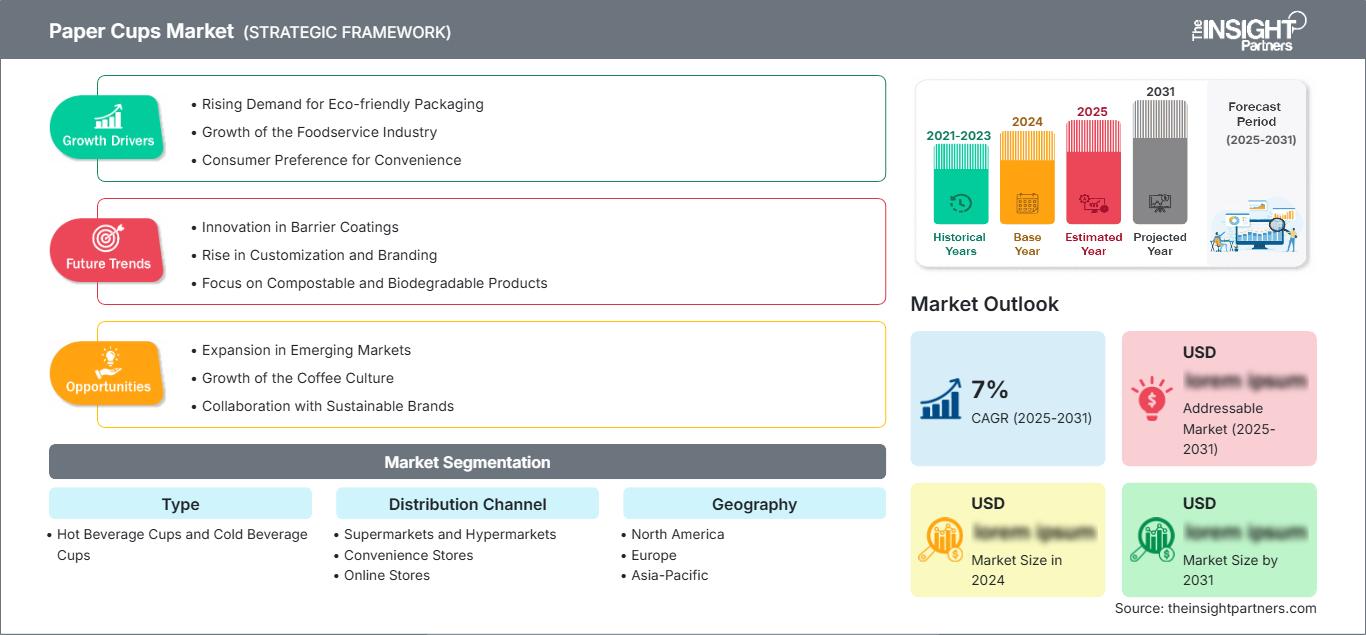
Paper Cups Market: Strategic Insights
Regional Insights
North America Paper Cups Market
North America accounted for a 35–37% Paper Cups Market in 2025 and is projected to grow at a 3.8–4.4% CAGR during 2026–2034. Strengths in the area include existing QSR infrastructure, heavy penetration by cafes, convenience-driven beverage consumption, and institutional food service operations. The U.S. continues to lead in terms of market size, with Canada contributing in terms of sustainability initiatives for packaging and organized food service operations. Mexico represents an additional volume opportunity in terms of urbanization and modernized retail environments.
A competitive landscape that favors manufacturers who can provide standard national initiatives while at the same time enabling customized printing and multiple cup designs is evident in the region. Increasing differentiation exists between low-cost single wall cups and more expensive insulated varieties. Increasing procurement interest includes cups made from recycled materials, bio-barriers, and recyclable designs.
U.S. Paper Cups Market
The U.S. represented approximately 82–85% of North American paper cup demand in 2025 and is expected to grow at a 3.7–4.3% CAGR during 2026–2034. The large QSRs, coffee chains, convenience stores, educational institutes, office places, and special events generate consistent need for standardized cups for hot and cold beverages. The capabilities that exist within the industry are available at Dart Container Corporation, Graphic Packaging Holding Company, International Paper Company, and Pactiv LLC.
There is variation in application usage ranging from coffee cups, soft drink cups, iced drink cups, specialty cups, and institutional catering cups. The single-wall hot cups are still required for regular coffee consumption whereas the double-wall cups are needed for premium takeaway applications needing insulation. Also, there is an increasing emphasis on recycled and recyclable cups for consideration along with price and performance aspects by the buying departments.
Europe Paper Cups Market
Europe represented 24–26% of global Paper Cups Market in 2025 and is projected to expand at a 3.0–3.6% CAGR during 2026–2034. Germany is the largest consumer, followed by the UK, France, Italy, and Spain. This region combines the tradition of café culture with more advanced packaging sustainability regulations. The European market was estimated at 60.8 billion units by the end of 2025 according to the external industry estimate, showing the magnitude of beverage-serving applications.
In the UK, there is high consumption of coffee shops, takeaways, and institutional foodservice that affects the choice of material due to sustainability requirements. In Germany, the benefit is seen in the presence of an organized foodservice sector and advanced recycling facilities. In France, Italy, and Spain, the opportunity is present due to café culture, tourism, hospitality, and takeaways. The regulation on packaging and packaging waste of the EU went into effect on August 12, 2026.
APAC Paper Cups Market
Asia Pacific held a 20–22% Paper Cups Market in 2025 and is forecast to grow at a 5.0–5.7% CAGR during 2026–2034. Leading the way in the regional demand for such products are China, Japan, India, South Korea, and Australia. The growing urban market food service, café chain, convenience retailing, and delivery channels are contributing to the growing demands for disposable beverage packaging.
The volume potential is high in China and India, but quality and performance are critical in Japan and South Korea. In Australia, there is the combination of foodservice consumption together with sustainability considerations. There is the commitment of regional converters toward investment in converting, printing, and PLA barriers to cater to their domestic and export markets.
Middle East & Africa Paper Cups Market
The Middle East & Africa is projected to grow at a 4.0–4.8% CAGR during 2026–2034, with Saudi Arabia representing a leading market. Tourism, hospitality, aviation, and high-end foodservice generate demand for cups in the UAE, whereas South Africa boasts a relatively well-organized retail and restaurant environment.
Saudi Arabia’s tourism investments and infrastructure provide demand for beverages, whereas the hospitality industry in the UAE generates demand for cups, including branded and premium products. However, South Africa and the rest of MEA are still relatively price-sensitive and will be looking for standard single wall cups. Increasing competition is expected in the form of availability and customization.
Segmentation Analysis
Type
Type segment in the Paper Cups Market is expected to expand at a 4.0–4.6% CAGR during 2026–2034, with purchasing determined by beverage temperature, insulation requirements, serving environment, and unit economics. Standard hot cups remain the broadest-volume format, while double-wall and specialty structures address premium applications. Cold cups benefit from growing iced beverage consumption and increasingly diverse beverage menus. Product differentiation increasingly depends on thermal performance, rigidity, stacking efficiency, lid compatibility, and print quality.
- Single-Wall Hot Cups: These cups remain the principal standard format for coffee, tea, and other hot beverages because they balance material efficiency, operational simplicity, stacking performance, and broad compatibility with conventional foodservice lids.
- Double-Wall hot Cups: Double-wall structures provide enhanced insulation and reduce reliance on separate sleeves, supporting premium takeaway beverages and applications where handling comfort is an important purchasing consideration.
- Cold Cups: Cold cups address soft drinks, juices, iced coffee, smoothies, and chilled beverages, with demand shaped by condensation control, rigidity, coating performance, and compatibility with dome or flat lids.
- Special Cups: Special cups serve niche beverage, promotional, seasonal, and customized applications where distinctive shapes, graphics, insulation, or functional features can command greater customer value.
By Material
The Material segment is forecast to grow at a 4.2–4.9% CAGR during 2026–2034, reflecting continued use of food-contact-grade virgin paperboard alongside increasing interest in recycled fiber where regulatory, safety, and performance requirements permit. Material decisions depend on strength, cleanliness, printability, barrier compatibility, sourcing credentials, and end-of-life requirements. Manufacturers increasingly optimize fiber weight to reduce material consumption while maintaining cup rigidity and forming performance. This is central to the Paper Cups Market scope because material selection influences both manufacturing economics and environmental positioning.
- Virgin Paperboard: Virgin paperboard remains widely used for food-contact cups because of consistent strength, cleanliness, printability, and predictable forming performance across high-volume converting operations.
- Recycled Paperboard: Recycled paperboard supports circular-material strategies where suitable food-contact compliance, barrier performance, and supply availability can be achieved without compromising product integrity.
By Coating Technology
By Coating Technology is projected to register a 5.0–6.0% CAGR during 2026–2034, reflecting growing investment in barrier systems that balance liquid resistance with recycling or compostability objectives. Conventional coatings remain commercially important because of established converting compatibility and cost advantages. PLA-coated products are gaining strategic attention where renewable feedstocks and compostability or alternative end-of-life pathways align with customer requirements. Coating suppliers increasingly compete through heat resistance, sealability, low coating weight, and compatibility with food-contact regulations.
- PLA-Coated: PLA-coated cups provide a plant-derived barrier option and are increasingly considered for sustainability-focused applications requiring liquid resistance and differentiated environmental attributes.
- Others: Other coating technologies remain important where producers prioritize established processing performance, cost efficiency, moisture resistance, heat stability, and compatibility with existing cup-forming equipment.
By End-Use Industry
By end-use industry, it is expected to grow at a 4.4–5.0% CAGR during 2026–2034, led by foodservice consumption. QSRs, cafés, catering operators, retailers, offices, and institutions require dependable cup availability across hot and cold beverage occasions. Standardized procurement favors suppliers with consistent quality and geographic coverage, while smaller operators often prioritize customization and flexible order sizes. The segment's evolution will increasingly reflect takeaway penetration, beverage menu diversification, branding requirements, and sustainability specifications.
- Foodservice: Foodservice represents the core consumption environment, encompassing QSRs, cafés, restaurants, caterers, and takeaway operators that require continuous supplies of standardized beverage-serving formats.
- Retail: Retail channels use cups for packaged foodservice offerings, ready-to-consume beverages, private-label applications, and convenience-oriented products requiring differentiated presentation.
- Commercial: Commercial demand includes offices, corporate facilities, hospitality locations, and workplace catering, where convenient beverage service supports recurring consumption.
- Institutional: Institutional applications cover schools, universities, hospitals, government facilities, and other organized settings where hygiene, procurement consistency, and operational convenience are central requirements.
Opportunity Snapshot
| End-Use Industry | Revenue Contribution | Trend Tag | Adoption Stage |
|---|---|---|---|
| Foodservice | High | Takeaway Beverages | Mature |
| Retail | Medium | Private Label | Scaling |
| Commercial | Medium | Office Catering | Scaling |
| Institutional | Low | Managed Service | Scaling |
Paper Cups Market Growth Drivers and Impact Analysis
Expansion of Organized Foodservice and Beverage Consumption
With the ongoing growth of foodservice, there will be an increased demand for standardized disposable beverage packaging. Quick service restaurants (QSR), cafes, convenience stores, delivery businesses, and caterers all need reliable cup sizes, compatible lids, printing capability, and availability of the same. Growth of specialized coffees, iced drinks, smoothies, and ready-to-drink drinks increases the variety of drinking occasions in disposable cups. For big players, suppliers who can manage multi-site sourcing and specifications are highly valued. It brings advantages to integrated converters and pushes regional manufacturers to automate production and quality control processes. The impact affects all involved companies – paperboard manufacturers, coating companies, printers, cup-forming machine suppliers, and distributors. It follows that the development of foodservice drives not only volume but product diversification as well, especially in case of beverage offerings including premium products with double wall insulation and improved barrier properties.
Shift Toward Fiber-Based Alternatives and Sustainable Packaging
Sustainability considerations are now playing a role in the selection of foodservice and retail packages. The trend involves brand owners considering fiber origin, chemistry of coating, recyclability, renewable content, and compatibility of the material with existing waste management systems in their choice of disposable cups. Such a trend does not mean the instant discontinuation of conventional coated papers because performance, economics, and infrastructures are still major factors. Rather, it represents a move towards an optimization of paperboard structure as well as of barrier technologies. The suppliers who are capable of proving their ability to provide liquid resistance along with improved recovery attributes will be eligible for procurement through sustainability-based programs. The business significance of such a trend will be especially pronounced among multinational foodservice customers using standardized packaging specifications in several countries.
Advances in Coating, Forming, and Manufacturing Automation
Manufacturing technology is improving the economics and performance of disposable cups by enabling tighter dimensional control, more efficient material use, higher-speed forming, and better barrier application. Automation not only helps decrease the work effort and the variability of production but allows for highly complex printing and customization. During the barrier phase, lighter barriers, bio-materials and construction facilitating recovery are being considered. This could help producers solve a range of conflicting requirements related to resistance to leaks, resistance to high temperatures, recycling capability, and the cost factor. Technical advancements also help converters quickly adapt to any changes in their customers' demands without major production disruptions. This increased efficiency will add to the competitive edge of regional manufacturing and decrease the cost disadvantages of advanced cup constructions. Investments are thus directed towards the integration of production lines, quality control through digital means and automated testing, flexible conversion equipment for various cup constructions.
Paper Cups Market Future Trends
Greater Integration of Recyclability Into Cup Design
Paper Cups Market trends are increasingly shifting toward designs created around end-of-life compatibility rather than only product performance. Future structures are likely to combine optimized paperboard, thinner functional coatings, and improved separation characteristics so that cups can enter established fiber-recovery systems more efficiently. Manufacturers will increasingly test cup structures against actual recycling processes rather than relying solely on material-level claims. Collection infrastructure, mill acceptance, and consumer sorting behavior will influence commercialization as much as coating technology. This direction favors suppliers that can coordinate cup design with recyclers, paper mills, foodservice customers, and waste-management organizations. Digital traceability may also become more relevant as buyers seek documentation covering fiber origin, coating composition, and compliance. The result should be a more system-oriented approach in which cup manufacturers consider production, use, collection, sorting, recycling, and secondary fiber applications during product development.
Premiumization Through Insulation and Functional Design
Future demand will increasingly differentiate cups through functionality rather than basic disposable convenience. Double-wall structures, improved thermal barriers, condensation control, ergonomic shapes, and lid integration can support higher-value beverage experiences. Premium coffee, specialty tea, smoothies, chilled beverages, and seasonal drinks provide opportunities for distinctive formats that improve handling and visual presentation. Custom printing will remain important because cups also function as mobile brand communication for foodservice operators. Manufacturers are likely to combine improved structural engineering with lighter material weights to preserve efficiency while enhancing performance. Automated forming and digital printing can make shorter production runs more economical, allowing regional chains and independent operators to order differentiated products. Over time, premiumization should therefore increase the value contribution of engineered cup formats even where standard single-wall products continue to account for substantial volumes.
Paper Cups Market Opportunities
Investment in Alternative Barrier Technologies
Investment in alternative barrier technologies represents a strategic opportunity because coatings increasingly determine whether paper cups can meet performance and sustainability requirements simultaneously. Suppliers can prioritize water-based, bio-based, PLA, and other barrier systems that provide liquid resistance while improving compatibility with targeted recovery or composting pathways. Commercial success will depend on heat resistance, seal integrity, shelf stability, food-contact compliance, converting speed, and total cost rather than environmental positioning alone. Technology providers should therefore work with paperboard manufacturers and cup converters during scale-up instead of treating coating development as a standalone chemical innovation. Equipment compatibility also requires attention because new coatings can alter drying conditions and forming behavior. Companies that establish validated application windows and customer qualification protocols can reduce commercialization risk. This opportunity is particularly relevant to high-volume foodservice customers seeking consistent performance across multiple geographic markets.
Regional Capacity Expansion and Customized Foodservice Supply
Paper Cups Market Forecasts indicate attractive opportunities for suppliers that combine regional manufacturing with customer-specific product development. Expanding foodservice networks in the Asia Pacific, the Middle East, and selected Latin American markets can increase the need for locally available cups, reducing reliance on long-distance imports. Regional plants can improve lead times, reduce logistics exposure, and tailor products to local beverage preferences. Investment priorities should include automated cup-forming lines, flexible printing, coating capability, quality laboratories, and scalable warehousing. Partnerships with QSRs, café chains, distributors, and beverage companies can provide predictable demand while improving capacity utilization. Producers can also use regional facilities to develop localized specifications before transferring successful products across wider networks. This approach offers a practical route to capture growth while limiting transportation costs and allowing faster responses to changing regulatory and customer requirements.
Recent Developments
- July 2026: Footprint expanded production of PE-free paper cups, introducing a recyclable and home-compostable alternative to conventional plastic-lined paper cups. The development strengthens the company's focus on replacing PE barriers with fiber-based solutions and demonstrates growing commercial interest in cup structures designed to improve recyclability and end-of-life performance.
- March 2026: BioPak / Everest launched paper cups with an integrated spoon, combining beverage or foodservice functionality with a simplified serving format. The development reflects continued product innovation in disposable fiber packaging, particularly for takeaway and convenience-oriented applications where packaging can integrate additional functionality while reducing the need for separate serving accessories.
- January 2026: Notpla continued developing seaweed-based packaging solutions as an alternative to conventional plastic components used in food and beverage packaging. Its technology development is relevant to paper-cup sustainability because alternative bio-based barrier materials could potentially reduce dependence on conventional plastic coatings and support the transition toward more compostable packaging structures.
Frequently Asked Questions

- Comprehensive Market Sizing and Forecast Analysis
- Detailed Segmentation Analysis
- In-Depth Market Dynamics Assessment
- Regional and Country-Level Insights
- Competitive Landscape and Company Benchmarking
- Strategic Business Intelligence
Recent Reports
Testimonials

The Insight Partners provided valuable market intelligence that supported our global go-to-market strategy. Their team was professional, responsive, and attentive to our feedback, providing thoughtful analysis and helpful methodological clarifications throughout the project.
Junmo Kim Chief Financial Officer (CFO), Enertech Co., Ltd.
The Insight Partners' SCADA System Market report is comprehensive, with valuable insights on current trends and future forecasts. The team was highly professional, responsive, and supportive throughout. We are very satisfied and highly recommend their services.
RAN KEDEM Partner, Reali Technologies LTDs
I requested a report on a very specific software market and the team produced the report in a few days. The information was very relevant and well presented. I then requested some changes and additions to the report. The team was again very responsive and I got the final report in less than a week.
JEAN-HERVE JENN Chairman, Future Analytica
We worked with The Insight Partners for an important market study and forecast. They gave us clear insights into opportunities and risks, which helped shape our plans. Their research was easy to use and based on solid data. It helped us make smart, confident decisions. We highly recommend them.
PIYUSH NAGPAL Sr. Vice President, High Beam Global
The Insight Partners delivered insightful, well-structured market research with strong domain expertise. Their team was professional and responsive throughout. The user-friendly website made accessing industry reports seamless. We highly recommend them for reliable, high-quality research services
YUKIHIKO ADACHI CEO, Deep Blue, LLC.
This is the first time I have purchased a market report from The Insight Partners.While I was unsure at first, I visited their web site and felt more comfortable to take the risk and purchase a market report.I am completely satisfied with the quality of the report and customer service. I had several questions and comments with the initial report, but after a couple of dialogs over email with their analyst I believe I have a report that I can use as input to our strategic planning process.Thank you so much for taking the extra time and making this a positive experience.I will definitely recommend your service to others and you will be my first call when we need further market data.
JOHN SUZUKI President and Chief Executive Officer, Board Director, BK Technologies
I wish to appreciate your support and the professionalism you displayed in the course of attending to my request for information regarding to infectious disease IVD market in Nigeria. I appreciate your patience, your guidance, and the fact that you were willing to offer a discount, which eventually made it possible for us to close a deal. I look forward to engaging The Insight Partners in the future, all thanks to the impression you have created in me as a result of this first encounter.
DR CHIJIOKE ONYIA MANAGING DIRECTOR, PineCrest Healthcare Ltd.Reason to Buy
- Informed Decision-Making
- Understanding Market Dynamics
- Competitive Analysis
- Identifying Emerging Markets
- Customer Insights
- Market Forecasts
- Risk Mitigation
- Boosting Operational Efficiency
- Strategic Planning
- Investment Justification
- Tracking Industry Innovations
- Aligning with Regulatory Trends





 Get Free Sample for