
Paper Slitting Machine Market Trends, Demand & Growth by 2034
Coverage: By Blade Type (Razor Blade, Shear Blade, Air Score Blade); Technology (Manual, Semi-Automatic, Fully Automatic) , and Geography (North America, Europe, Asia Pacific, and South and Central America)
- Status : Data Released
- Report Code : TIPRE00022042
- Category : Manufacturing and Construction
- No. of Pages : 150
- Available Report Formats :


- Last update date : August 05, 2026


2025 Market Size
US$ 505.75 Mn
Base year value
2034 Forecast
US$ 748.49 Mn
Projected by 2034
CAGR 2026-2034
4.45 %
Growth rate
Addressable Market
US$ 5,694.57 Mn
(2026-2034)
The Paper Slitting Machine Market size is projected to touch US$ 748.49 Million by 2034 from US$ 505.75 Million in 2025. The market is expected to witness a CAGR of 4.45% during the forecast period 2026-2034. Market growth is driven by factors such as precise paper converting, reduced lot sizes, and packaging formats made from paper requiring accurate roll separation without any material deformation.
In North America, Paper Slitting Machine Market size is driven by the trend of repatriating packaging manufacturing, upgrading the existing aging converting machinery, and increased use of recyclable paperboard. The regional demand for market is expected to grow at a CAGR of 3.9-4.3% from 2026 to 2034.
Paper Slitting Machine Market Assessment and Insights
- North America accounted for 28–31% share in 2025 and is growing at a CAGR between 3.9–4.3% during 2026–2034, supported by packaging automation, paperboard substitution, and aftermarket retrofits.
- US represented 74–78% of North America in 2025 and is growing at a CAGR between 3.8–4.2%, led by converters serving food, labels, and e-commerce packaging.
- Europe held 24–27% share in 2025 and is growing at a CAGR between 3.6–4.0% during 2026–2034, with Germany, Italy, the UK, and France leading equipment replacement.
- Asia Pacific captured 32–35% share in 2025 and is growing at a CAGR between 5.0–5.5% during 2026–2034, led by China, India, Japan, and South Korea.
- Largest Segment Shear blade systems held 43–46% market share in 2025 and are growing at a CAGR between 4.0–4.4%, reflecting broad suitability for paperboard and coated grades.
- High Growth Segment Fully automatic technology held 29–32% market share in 2025 and is growing at a CAGR between 5.3–5.8%, driven by labor efficiency and recipe-based setup.
- Key companies analyzed in detail: ASHE Converting Equipment Limited, Euromac S.r.l., IMS TECHNOLOGIES S.p.A., Kampf Schneid- und Wickeltechnik GmbH and Co. KG, Mohindra Mechanical Works, Orion Graphic Machinery, Parkland International Limited, Shreeji Tech Engineering, SOMA spol. s r.o., and Universal Converting Equipment Limited.
Source: The Insight Partners' analysis based on proprietary research, government publications, company annual reports, investor presentations, industry databases, and expert interviews.
From mechanical slitting machines, equipment has evolved to servo-based models with automatic blade placement, closed-loop tension management, and enhanced operator interface safety. Converters are looking for machines which can cut down on trim losses, improve changeover efficiency, and process mixed-paper substrates like kraft, linerboard, coated, and light boards. This development ensures that the market for Paper Slitting Machine finds alignment with the packaging lines which demand shorter runs and SKU turnover along with superior edge quality.
Going forward, the demand will be influenced by the upcoming converting cluster locations in India, Southeast Asia, and the Middle East where packaged food, retail distribution, and printing for exports are expanding. Environmental pressure on single-use plastic products is also forcing brand owners to choose paper and paperboard formats. Such developments are likely to ensure investments in automation for slitting operations and increase vendors' offerings across all price segments.
Paper Slitting Machine Market Report Scope
| Report Attribute | Details |
|---|---|
| Market size in 2025 | US$ 505.75 Million |
| Market Size by 2034 | US$ 748.49 Million |
| Global CAGR (2026 - 2034) | 4.45% |
| Historical Data | 2021-2024 |
| Forecast period | 2026-2034 |
Paper Slitting Machine Market Analysis
The Paper Slitting Machine Market growth is driven by demands for recycling, packaging materials, tissue processing, labeling, food wrapping, and industrial papers. The demand for paper and paperboard packaging comes from e-commerce, food delivery services, and sustainability goals of brands, and the converter industry needs machines that can slit paper into specific slit widths to produce various types of customized packaging. Buyers of machinery look at total cost of ownership, accuracy, downtime, and energy efficiency before approval.
The value chain comprises paper mill, rollstock manufacturer, converters, packaging printers, blade maker, automation system integrator, and service provider. The supply side is still driven by steel parts, electronic controls, motors, sensors, and blade units. Machines that offer options for upgradeability, remote monitoring, and local maintenance have an advantage since the converting industry prefers continuity over equipment change.
The Paper Slitting Machine Market Report Competition Analysis is fragmented but highly differentiated technologically. ASHE Converting Equipment Limited and Universal Converting Equipment Limited highlight their converting capabilities whereas IMS TECHNOLOGIES S.p.A. and Kampf Schneid- und Wickeltechnik GmbH and Co. KG compete through high speed automation, accuracy of winding and service functions provided by digital equipment. The need of integrated printing and converting processes is catered for by SOMA spol. s r.o.
Current investment trends go in favor of fully automated systems where labor cost efficiency, safety issues and short-run productivity make economic sense. Indian companies like Mohindra Mechanical Works and Shreeji Tech Engineering cater for cost-sensitive buyers whereas European firms cater to needs for precision and service life cycle management.
● REPORT CUSTOMIZATION
Tailor This Report To Align With Your Specific Business Requirements
This report can be customized to align precisely with your business objectives, scope, and target markets. Customization options include tailored segmentation, geography, competitive analysis, and strategic insights to support informed decision-making.
Customize This Report →WHAT YOU CAN ADJUST
- ● Segmentations
- ● Geography
- ● Competitive Analysis
- ● Language Preferences
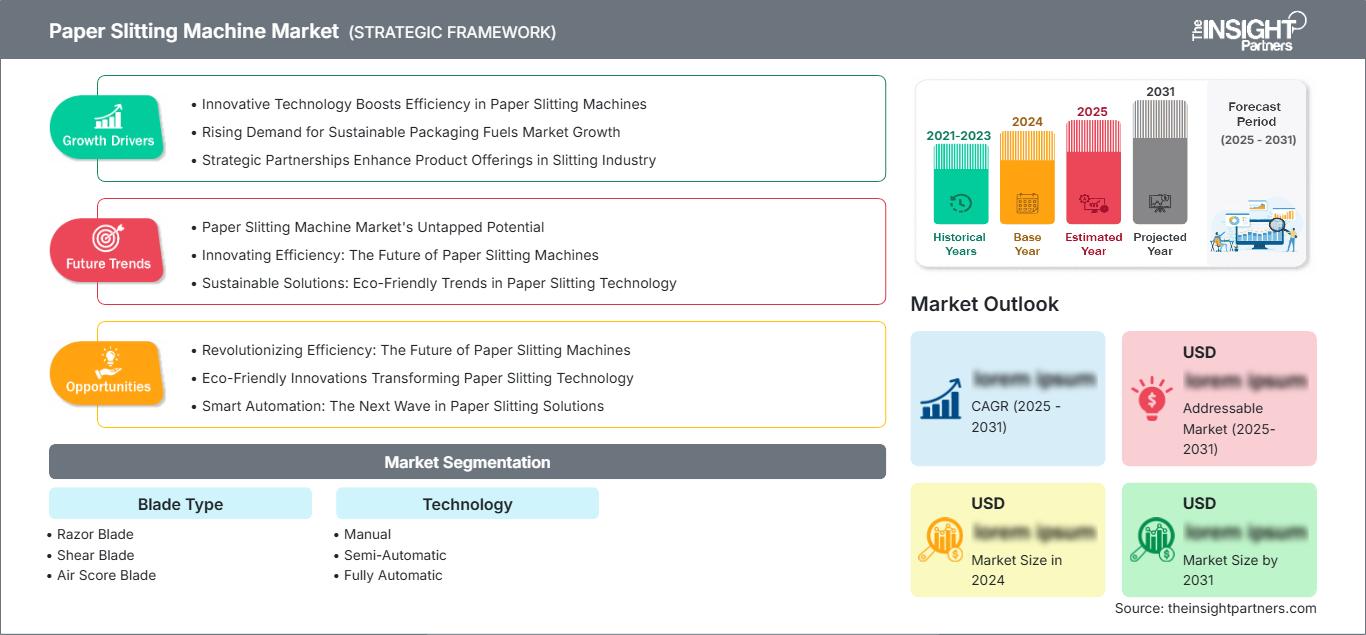
Paper Slitting Machine Market: Strategic Insights
Regional Insights
North America Paper Slitting Machine Market
In North America, the Paper Slitting Machine market share was pegged at 28–31% in 2025 and expected to grow at a CAGR of 3.9–4.3% between 2026 and 2034. The major demand comes from paperboard converters, label producers, hygiene roll processors, and packaging printers looking for slit consistency in recycled and lightweight papers.
The key structural factors driving this include the presence of domestic packaging plants, food-grade paper formats, and automation initiatives designed to minimize operator involvement. PMMI’s tracking of packaging machinery deliveries indicates further North American spending on such equipment, as sustainability practices promote substitution of plastic packaging by paper packaging.
U.S. Paper Slitting Machine Market
The U.S. represented 74–78% of North America in 2025 and is growing at a CAGR of 3.8–4.2% during 2026–2034. Converters in corrugated, label stock, tissue, and specialty paper applications continue to modernize slitting lines to improve uptime, reduce edge defects, and support variable-width production.
Company presence is shaped by North American sales and service networks rather than only domestic manufacturing. ASHE Converting Equipment Limited, SOMA spol. s r.o., and Universal Converting Equipment Limited support regional customers through machinery installations, spare parts, and retrofits. Applications are shifting toward recyclable flexible packaging, release liners, and digitally printed packaging rolls.
Europe Paper Slitting Machine Market
Europe accounted for 24–27% share in 2025 and is advancing at a CAGR of 3.6–4.0% during 2026–2034. Germany remains the leading country because of engineering depth, converting automation, and proximity to premium machinery suppliers, including Kampf Schneid- und Wickeltechnik GmbH and Co. KG.
The UK and Italy sustain demand through flexible packaging, labels, and specialty paper conversion, while France, Spain, and Benelux countries prioritize sustainability-led packaging upgrades. European converters often specify high automation, noise reduction, guarding, and energy efficiency, making the market less price-driven than many emerging regions.
APAC Paper Slitting Machine Market
In APAC, the share in 2025 was 32–35%, and the region is growing with a CAGR of 5.0–5.5% from 2026 to 2034. The major market players are China driven by export of packaging, paperboard manufacturing, and converters. Japan and South Korea are focused on high-precision equipment, whereas India is developing cost-efficient machines usage.
Industrials policies, local manufacturing of packaging and e-commerce logistics encourage the converters to install the automated slitting lines. Australia is still small and stable market with the drivers being food packaging and labeling.
Middle East & Africa Paper Slitting Machine Market
The demand from Middle East and Africa will increase with a CAGR of 4.2-4.7%, driven primarily by Saudi Arabia and the United Arab Emirates. Demand for machinery investments is dependent on food processing activities, retail development, and logistics growth, and South Africa represents demand from an advanced converting segment.
The increasing diversification of industry due to energy production investments and infrastructure development drives demand in packaging and paper processing machines. The demand in Rest of MEA is project-based with preference to strong semi-automatic machinery where service support is difficult.
Segmentation Analysis
Blade Type
Blade Type is growing at a CAGR of 4.1–4.6% during 2026–2034. Blade selection defines cut cleanliness, dust generation, substrate compatibility, and maintenance cost. This segment frames the Paper Slitting Machine Market scope because converters match blade systems with material thickness, coating sensitivity, tensile strength, and required slit width.
- Razor Blade systems are preferred for thin paper, light films, and delicate laminates where low-cost tooling and fine slits are required, but blade wear monitoring remains important.
- Shear Blade systems lead demand in heavier paperboard and coated grades because paired knives produce cleaner edges, lower dust, and better repeatability across industrial converting operations.
- Air Score Blade systems serve specialized applications that need non-contact or reduced-pressure scoring, supporting controlled separation of sensitive substrates and lowering mechanical stress during converting.
Technology
Technology is growing at a CAGR of 4.3–4.8% during 2026–2034. Adoption is moving from manual setup toward semi-automatic and fully automatic platforms as converters seek repeatable recipes, lower labor dependence, and safer operations. Automation depth is becoming a purchase differentiator, especially where multiple roll widths and frequent job changes are common.
- Manual machines remain relevant for smaller converters, maintenance shops, and low-volume applications where capital budgets are limited and operators can manage setup variability.
- Semi-Automatic machines balance cost and productivity through assisted tension control, easier roll handling, and faster changeovers, making them attractive for mid-sized packaging converters.
- Fully Automatic machines are gaining preference in high-throughput facilities because recipe storage, automatic knife positioning, and integrated diagnostics reduce downtime and improve repeatability.
Opportunity Snapshot
| Technology | Revenue Contribution | Trend Tag | Adoption Stage |
| Manual | Medium | Budget Lines | Mature |
| Semi-Automatic | High | Assisted Setup | Scaling |
| Fully Automatic | High | Smart Slitting | Scaling |
Paper Slitting Machine Market Growth Drivers and Impact Analysis
Shift Toward Paper-Based Packaging Formats
Limitations on single-use plastics, along with brands' commitments to sustainable packaging solutions, create demand for paper roll conversion. Wrapping paper, pouches, labels, bags, and board inserts all need proper slitting prior to being printed, coated, folded, or laminated. This demand trend influences sales and retrofits, as it forces converters to work with greater variety of materials but not compromise on slit quality. It hits the hardest when packaging lines switch from large, repetitive batches to smaller and diverse ones, which necessitates slitting machines capable of quick width adjustment.
Automation Need in High-Mix Converting Lines
Converting machines are under increasing demand for delivering lead time reductions, waste minimization, and consistent slitting regardless of paper grades. Knife setting automation, recipes, tension control, and diagnostics decrease reliance on operators and increase the productivity in first passes. This is manifested commercially in converting plants producing products such as food, labels, packaging, and hygiene rolls because downtime directly impacts their ability to deliver timely. Automation further ensures safety through the reduction of manual blade adjustments and minimizing setup errors in frequent changeovers.
Expansion of Emerging Converting Capacity
India, Southeast Asia, the Gulf, and parts of Africa are adding packaging and paper-processing capacity as organized retail, food manufacturing, and export logistics mature. Buyers in these regions often start with semi-automatic platforms but gradually shift to higher automation as volumes stabilize. This creates a multi-tier opportunity for global and regional suppliers. Vendors that combine robust machines, local service partnerships, and blade support can capture repeat orders because converters value uptime and spare-part availability as much as purchase price.
Paper Slitting Machine Market Future Trends
Connected Slitting Cells with Predictive Service
Paper Slitting Machine Market trends are shifting toward connected cells that monitor vibration, blade wear, tension deviations, and roll build quality in real time. Future systems will use production data to schedule maintenance before defects appear, helping converters protect yield during high-speed operation. Digital dashboards will also support benchmarking across multiple machines and plants. Suppliers with cloud-enabled service, secure data handling, and retrofit packages are expected to gain an advantage as buyers seek measurable uptime improvement rather than isolated mechanical upgrades.
Energy-Efficient Platforms for Sustainable Converting
Energy efficiency will become a stronger procurement criterion as converters track electricity use, compressed air consumption, and material loss per finished roll. Servo drives, optimized braking, lighter roll handling systems, and reduced trim waste will shape machine specifications. The trend aligns with customer sustainability audits and packaging producer targets for lower operational emissions. Vendors that can document savings through operating data, not only design claims, will improve their position in replacement cycles and multinational supplier approvals.
Paper Slitting Machine Market Opportunities
Retrofit Packages for Installed Slitter Bases
Large installed bases of manual and semi-automatic equipment create an actionable service opportunity. Suppliers can offer automatic knife positioning, tension-control upgrades, guarding, remote support modules, and blade optimization kits without requiring full machine replacement. This route fits converters that need productivity gains but face capital constraints. Paper Slitting Machine Market Forecasts indicate that service-led revenue can become more resilient than cyclical equipment sales, especially where buyers are extending asset life while improving safety, accuracy, and setup speed.
Localized Manufacturing and Service Networks
Regional assembly, spare-part stocking, and technician training can help machinery suppliers win buyers in India, the Gulf, Latin America, and Africa. Many converters delay automation purchases when service response times are uncertain or imported components carry long lead times. Partnerships with local engineering firms, blade suppliers, and automation integrators can reduce risk and improve lifecycle economics. This opportunity is particularly relevant for mid-market suppliers seeking differentiation beyond machine price and basic technical specifications.
Recent Developments
- July 2026: Binbao Machinery will participate in LOUPE Americas 2026, formerly known as Labelexpo Americas. At the exhibition, the company will focus on presenting its latest SLD Series Automatic Unloading Slitter Rewinder, a machine developed specifically for large-scale pressure-sensitive adhesive material coating plants and labelstock converting companies.
- September 2025: Qingdao New Richuan Precision Machine Co.,Ltd provide paper slitting rewinding machine from NRCMACHINE.COM. The machine is designed for precise cutting and rewinding of large paper rolls into smaller, customer-specific widths. It is engineered for efficiency and accuracy in packaging, printing, and paper processing industries.
- December 2024: IMS TECHNOLOGIES S.p.A. through GOEBEL IMS, introduced an automatic knife positioning system for the RAPID slitter rewinder, developed with DIENES. The upgrade supports paper and light board applications with automated upper knife adjustment, 20 mm minimum slitting width, and speeds up to 1,000 m/min.
Frequently Asked Questions

- Comprehensive Market Sizing and Forecast Analysis
- Detailed Segmentation Analysis
- In-Depth Market Dynamics Assessment
- Regional and Country-Level Insights
- Competitive Landscape and Company Benchmarking
- Strategic Business Intelligence
Recent Reports
Testimonials

The Insight Partners' SCADA System Market report is comprehensive, with valuable insights on current trends and future forecasts. The team was highly professional, responsive, and supportive throughout. We are very satisfied and highly recommend their services.
RAN KEDEM Partner, Reali Technologies LTDs
I requested a report on a very specific software market and the team produced the report in a few days. The information was very relevant and well presented. I then requested some changes and additions to the report. The team was again very responsive and I got the final report in less than a week.
JEAN-HERVE JENN Chairman, Future Analytica
We worked with The Insight Partners for an important market study and forecast. They gave us clear insights into opportunities and risks, which helped shape our plans. Their research was easy to use and based on solid data. It helped us make smart, confident decisions. We highly recommend them.
PIYUSH NAGPAL Sr. Vice President, High Beam Global
The Insight Partners delivered insightful, well-structured market research with strong domain expertise. Their team was professional and responsive throughout. The user-friendly website made accessing industry reports seamless. We highly recommend them for reliable, high-quality research services
YUKIHIKO ADACHI CEO, Deep Blue, LLC.
This is the first time I have purchased a market report from The Insight Partners.While I was unsure at first, I visited their web site and felt more comfortable to take the risk and purchase a market report.I am completely satisfied with the quality of the report and customer service. I had several questions and comments with the initial report, but after a couple of dialogs over email with their analyst I believe I have a report that I can use as input to our strategic planning process.Thank you so much for taking the extra time and making this a positive experience.I will definitely recommend your service to others and you will be my first call when we need further market data.
JOHN SUZUKI President and Chief Executive Officer, Board Director, BK Technologies
I wish to appreciate your support and the professionalism you displayed in the course of attending to my request for information regarding to infectious disease IVD market in Nigeria. I appreciate your patience, your guidance, and the fact that you were willing to offer a discount, which eventually made it possible for us to close a deal. I look forward to engaging The Insight Partners in the future, all thanks to the impression you have created in me as a result of this first encounter.
DR CHIJIOKE ONYIA MANAGING DIRECTOR, PineCrest Healthcare Ltd.Reason to Buy
- Informed Decision-Making
- Understanding Market Dynamics
- Competitive Analysis
- Identifying Emerging Markets
- Customer Insights
- Market Forecasts
- Risk Mitigation
- Boosting Operational Efficiency
- Strategic Planning
- Investment Justification
- Tracking Industry Innovations
- Aligning with Regulatory Trends





 Get Free Sample for