
Partially Hydrogenated Oil Market Size, Trends & Demand by 2034
Coverage: by Nature (Organic, Conventional); Grade (Food Grade, Feed Grade, Pharmaceutical Grade); End Use (Food and Beverages, Bakery, Dairy, Biodiesel, Plastics, Others); Distribution Channel (Hypermarkets/Supermarkets, Specialty Stores, Online Stores, Others), and Geography (North America, Europe, Asia Pacific, and South and Central America)
- Status : Data Released
- Report Code : TIPRE00013059
- Category : Chemicals and Materials
- No. of Pages : 150
- Available Report Formats :


- Last update date : October 22, 2026


2025 Market Size
US$ 857.00 Mn
Base year value
2034 Forecast
US$ 1,367.65 Mn
Projected by 2034
CAGR 2026-2034
5.33 %
Growth rate
Addressable Market
US$ 10,089.75 Mn
(2026-2034)
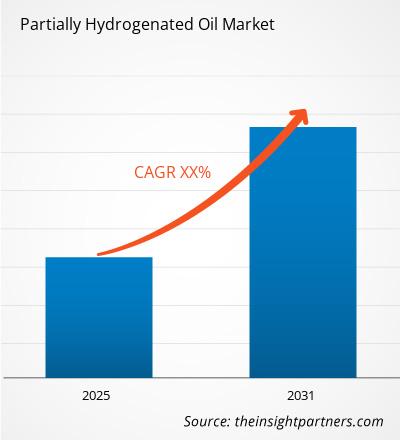
The Partially Hydrogenated Oil Market size was valued at US$ 857.00 Million in 2025 and is projected to reach US$ 1,367.65 Million by 2034, expanding at a CAGR of 5.33% during 2026–2034. Demand is shaped by functional fat requirements, specialty processing capabilities, and continued use in selected food, industrial, and technical applications. Market development is also influenced by trans-fat regulations, reformulation strategies, raw-material availability, and the performance requirements of downstream manufacturers.
North America remains an important market focus because manufacturers continue to require structured fats with controlled melting behavior, oxidation stability, and processing consistency. The regional outlook reflects a modeled CAGR of 4.7–5.1% through 2034. Bakery reformulation, specialty fat innovation, food-service requirements, and established edible-oil processing infrastructure are expected to support demand, while regulatory restrictions encourage suppliers to emphasize controlled formulations and alternatives.
Partially Hydrogenated Oil Market Assessment and Insights
- North America: North America accounted for a modeled 29–33% Partially Hydrogenated Oil Market share in 2025 and is expected to expand at a 4.7–5.1% CAGR during 2026–2034, supported by bakery, food processing, and specialty-fat applications.
- U.S.: The U.S. represented approximately 72–76% of North American demand in 2025 and is projected to grow at a 4.8–5.2% CAGR through 2034, led by food reformulation and specialty applications.
- Europe: Europe held an estimated 24–28% share in 2025 and is expected to register a 4.6–5.0% CAGR during 2026–2034. Germany, France, Italy, Spain, and the UK remain significant processing markets.
- Asia Pacific: Asia Pacific represented approximately 34–38% of global demand in 2025 and is forecast to grow at a 5.8–6.2% CAGR. China, India, Japan, South Korea, and Australia support regional consumption.
- Largest Segment: Conventional products represented an estimated 78–82% market share in 2025 and are projected to expand at a 4.8–5.2% CAGR during 2026–2034.
- High Growth Segment: Organic products held an estimated 8–12% market share in 2025 and are expected to grow at an 8.0–9.0% CAGR during 2026–2034.
- Key companies analyzed in detail: Berhad Group of Companies, Bunge Global SA, Golden Agri-Resources Ltd, Mectech Process Engineers Private Limited, Mewah International Inc., Sarawak Oil Palms Berhad, SD Guthrie Berhad, Wilmar International Limited, AAK AB (publ), and IOI Corporation Berhad.
Source: The Insight Partners' analysis based on proprietary research, government publications, company annual reports, investor presentations, industry databases, and expert interviews.
Changes in production processes arise due to the ability of processors to utilize production facilities where refining, fractionation, hydrogenation, and interesterification takes place to produce fats with certain melting and stability properties. More production facilities are incorporating feedstock chains that involve planting, crushing, refining, specialized fat production, and distribution facilities. Such an approach can help to evade issues relating to the availability of intermediates and enhance traceability. This development implies that investments will be directed to flexible processing plants that can produce different fat specifications.
Going into the future, investments in capacity optimization and formulation may focus on tapping new markets in Asia where there is growth in the bakery, processed foods, and food services sectors. Regulations on trans fat will continue to influence product positioning, and suppliers will have to distinguish partially hydrogenated formulations from products with low levels of trans fat and non-hydrogenated products.
Partially Hydrogenated Oil Market Report Scope
| Report Attribute | Details |
|---|---|
| Market size in 2025 | US$ 857.00 Million |
| Market Size by 2034 | US$ 1,367.65 Million |
| Global CAGR (2026 - 2034) | 5.33% |
| Historical Data | 2021-2024 |
| Forecast period | 2026-2034 |
Partially Hydrogenated Oil Market Analysis
The Partially Hydrogenated Oil Market growth prospects are driven by the functional needs of the fats in terms of their use in texture, spreadability, aeration, frying characteristics, and shelf life. The value chain is comprised of feedstock cultivation and crushing, followed by the refinement process, fractionation, hydrogenation, mixing, and packaging. Feedstock comes from palm, soybean, and other vegetable oils; further functionality is provided by the controlled modification of oils by producers. Bakery and food manufacturers continue to be key downstream players, since structured fats could ensure product uniformity.
Production costs in the Partially Hydrogenated Oil Market are highly sensitive to the price of vegetable oils, the capacity utilization of refineries, hydrogenation capacities, energy costs, and logistics. Producers who operate in integrated mode benefit in cases where they are able to produce the feedstock themselves and to quickly switch between commodities and specialties. Regulatory issues and changing consumer behavior necessitate flexible production capacity. Suppliers who can easily switch from one kind of the product to another are better placed than those focused on a single formulation group.
Positioning in the Partially Hydrogenated Oil Market report involves integration between integrated palm-oil refiners, specialty-fat refiners, and engineering companies with the capacity to offer processing services. Wilmar International Limited integrates its edible oil and specialty-fat refineries with hydrogenation capacity, while Mewah International Inc. offers processing capacity covering refining and modified fats. The focus of Bunge Global SA continues to be on reformulated fat blends, while that of AAK AB (publ) is specialty fats and partly hydrogenated technology.
Golden Agri-Resources Ltd, Sarawak Oil Palms Berhad, SD Guthrie Berhad, and IOI Corporation Berhad offer regional supply of raw material and processing capacity within Southeast Asia. Mectech Process Engineers Private Limited offers process engineering capacity pertinent to vegetable-oil modifications. Berhad Group of Companies offers regional presence. Competitive investments continue to target more feedstock traceability, process flexibility, quality, and specialty applications as opposed to mere capacity growth.
● REPORT CUSTOMIZATION
Tailor This Report To Align With Your Specific Business Requirements
This report can be customized to align precisely with your business objectives, scope, and target markets. Customization options include tailored segmentation, geography, competitive analysis, and strategic insights to support informed decision-making.
Customize This Report →WHAT YOU CAN ADJUST
- ● Segmentations
- ● Geography
- ● Competitive Analysis
- ● Language Preferences
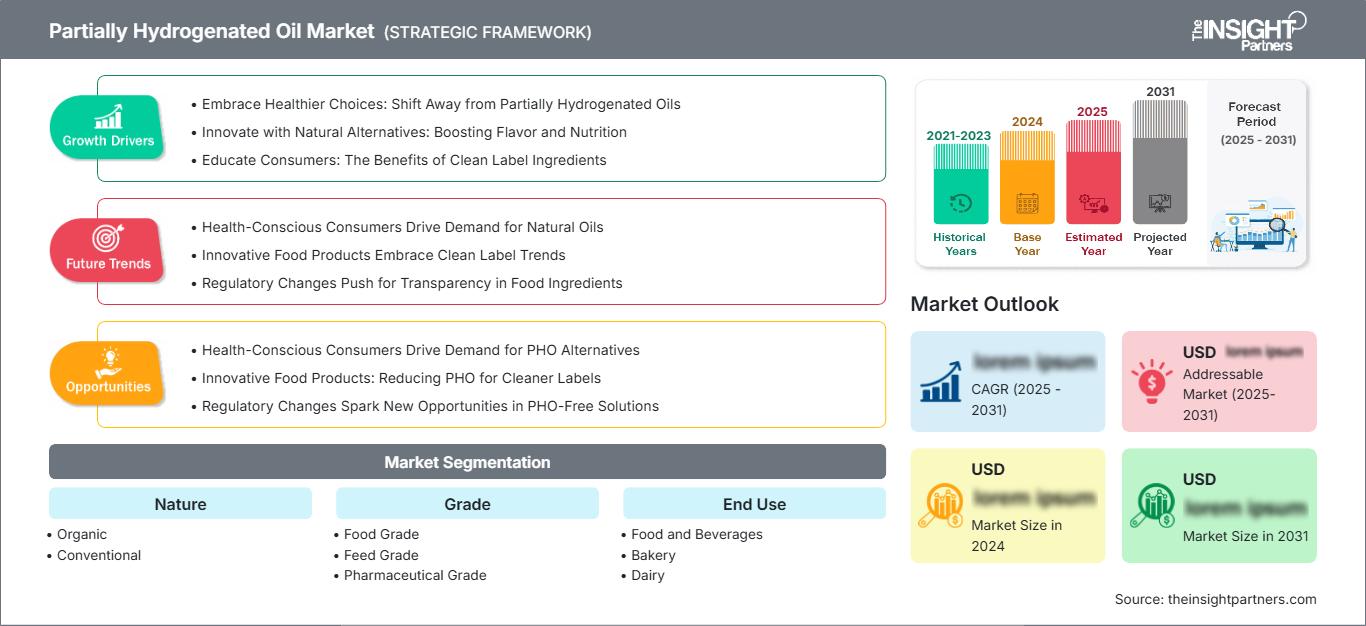
Partially Hydrogenated Oil Market: Strategic Insights
Regional Insights
North America Partially Hydrogenated Oil Market
North America represented an estimated 29–33% Partially Hydrogenated Oil Market share of global demand in 2025 and is projected to expand at a 4.7–5.1% CAGR through 2034. The area boasts of state-of-the-art edible oil refining capabilities, a well-developed bakery industry and the need for structured fats. Industrial trans fats have been regulated, restricting their usage, but special applications and controlled use continue to be applicable in selected industrial and food processing environments.
The U.S. constitutes about 72-76% of North America’s Partially Hydrogenated Oil Market with Canada being a small, yet technically advanced market. Reformulation, foodservice, bakery shortenings, and special fat development drive purchases. The suppliers are focusing on formulation expertise and their capacity to offer low trans or non-hydrogenated products along with their modified fats. The company will maintain its competitiveness in the region by investing in traceable feedstocks, fractionation capability, and customized formulations.
U.S. Partially Hydrogenated Oil Market
The U.S. represented approximately 72–76% of North American Partially Hydrogenated Oil Market in 2025 and is forecast to grow at a 4.8–5.2% CAGR during 2026–2034. Demand will be focused in specialized processing rather than general consumer uses as a result of the regulation on industrial trans fats and ongoing reformulation in packaged goods. Bunge Global SA and AAK AB (publ) possess capabilities in this category of specialty fats, as do regional processors who cater to baking and food manufacturers.
The Partially Hydrogenated Oil Market trends will focus on functionality relating to texture, processing and shelf-life. The manufacturers are providing alternative fat systems which provide similar benefits as hydrogenated fats but without the regulatory risk exposure. In such a case, food manufacturers will assess cost-effectiveness, labeling needs, performance and supply reliability. The importance of the U.S. market will lie in the food processing infrastructure it possesses.
Europe Partially Hydrogenated Oil Market
Europe accounted for an estimated 24–28% share in 2025 and is expected to register a 4.6–5.0% CAGR through 2034. Countries including the UK, Germany, France, Italy, and Spain represent important regions for demand. This is due to the presence of mature food processing industries, bakery manufacture, and specialty fat applications.
The UK region focuses on reformulated products, bakery functions, and clean-label product lines. The German market represents an advanced food-processing market combined with quality management. On the other hand, the French region offers applications in specialty bakery and confectionery. Similarly, Italy and Spain have considerable bases for processed foods and bakery manufacturing. In regional markets, there has been an increase in emphasis on sustainability, traceable feedstocks, and functional products. Demand in Europe is thus becoming specification-oriented.
APAC Partially Hydrogenated Oil Market
Asia Pacific held an estimated 34–38% share in 2025 and is projected to grow at a 5.8–6.2% CAGR through 2034. With China leading the region in terms of demand, other nations following include India, Japan, South Korea, and Australia. Growth is further fueled by an increase in production of processed foods, bakeries, food service structure, and oil extraction facilities.
China gets benefit of the presence of integrated vegetable oil facilities along with a substantial food processing industry, while India sees potential due to its growth in bakeries and packaged foods. Japan and South Korea focus on high quality and custom formulations, while Australia focuses on its mature food processing sector along with strict ingredient control. The regions are seeing formulation changes driven by their policy for trans fats and food safety.
Middle East & Africa Partially Hydrogenated Oil Market
The Middle East and Africa demand is expected to expand at a modeled 5.1–5.6% CAGR through 2034. The Saudi Arabia and the UAE act as key Gulf region processors, while South Africa serves as a key southern Africa food manufacturing market. Regional demand is shaped by bakery, confectionary, food service, and edible oil distribution.
Saudi Arabia enjoys growth in food processing and industrial infrastructure, while the UAE acts as a regional trade and distribution center. South Africa has developed refining and food manufacturing capabilities. Other parts of the MEA markets are relatively fragmented due to import reliance. Refining, storage, logistics, and food-processing investments will improve regional availability, while food safety standards will promote greater control of fat specification and chain of supplies among food manufacturers.
Segmentation Analysis
Nature
Nature segmentation distinguishes Organic and Conventional products according to sourcing and production characteristics. Conventional formulations remain dominant because of established feedstock availability, processing economics, and industrial-scale manufacturing. The segment is expected to expand at a 4.8–5.2% CAGR during 2026–2034 as manufacturers prioritize cost-effective structured fats while adapting portfolios to regulatory requirements.
- Organic: Organic products serve manufacturers seeking certified sourcing and differentiated ingredient positioning. Demand is concentrated in premium food, specialty bakery, and clean-label applications where certification, traceability, and ingredient transparency justify higher procurement complexity.
- Conventional: Conventional products remain the principal commercial category because established refining and modification infrastructure provides a consistent supply, broad formulation flexibility, and competitive production economics across food, industrial, and specialty applications.
Grade
Grade includes Food Grade, Feed Grade, and Pharmaceutical Grade products. The segment is projected to grow at a 4.9–5.3% CAGR during 2026–2034. Food applications dominate because modified fats provide functional properties required for bakery, confectionery, processed foods, and frying. Quality controls, purity requirements, and application-specific specifications determine grade selection.
- Food Grade: Food-grade material represents the largest demand pool, supported by bakery, processed foods, confectionery, and food-service manufacturing. Producers compete on functionality, consistency, documentation, and compatibility with evolving formulation requirements.
- Feed Grade: Feed-grade products are used where energy density, stability, and formulation economics are priorities. Demand is linked to livestock and animal nutrition production, with purchasing decisions emphasizing consistent composition and dependable bulk availability.
- Pharmaceutical Grade: Pharmaceutical-grade products serve highly controlled applications requiring stringent purity, quality documentation, and reproducible characteristics. Demand is smaller but strategically valuable because qualification requirements can create longer-term supplier relationships and higher technical barriers.
End Use
End Use comprises Food and Beverages, Bakery, Dairy, Biodiesel, and Plastics. The segment is forecast to grow at a 5.1–5.5% CAGR during 2026–2034. Food and bakery applications remain the principal demand centers, while technical uses diversify the addressable customer base.
- Food and Beverages: Food and beverage manufacturers use modified fats for texture, stability, mouthfeel, and processing performance. Demand is supported by packaged foods, prepared products, and specialized formulations requiring predictable fat functionality.
- Bakery: Bakery applications rely on structured fats for aeration, dough handling, laminating, frying, and texture control. Demand remains significant because manufacturers require consistent processing performance across high-volume production environments.
- Dairy: Dairy applications use modified fats in selected formulations where melting characteristics, texture, and stability are important. Plant-based and blended formulations create additional opportunities for tailored fat systems.
- Biodiesel: Biodiesel applications provide a technical outlet for modified vegetable-oil derivatives. Adoption depends on feedstock economics, processing specifications, fuel regulations, and the relative competitiveness of alternative lipid feedstocks.
- Plastics: Plastics applications use selected hydrogenated or modified fatty derivatives as processing aids, lubricants, and formulation components. Demand is linked to polymer processing volumes and requirements for consistent thermal and physical performance.
Distribution Channel
Distribution Channel includes Hypermarkets/Supermarkets, Specialty Stores, and Online Stores. The segment is expected to expand at a 4.6–5.0% CAGR during 2026–2034. Institutional and industrial procurement remains more important than retail channels because commercial users purchase oils and fats according to technical specifications and volume requirements.
- Hypermarkets/Supermarkets: Hypermarkets and supermarkets provide access to packaged oils, specialty fats, and consumer-oriented formulations. Their strategic relevance is strongest for standardized products where packaging, brand visibility, and household purchasing patterns influence distribution.
- Specialty Stores: Specialty stores support premium, organic, technical, and application-specific fat products. They are particularly relevant where customers require differentiated sourcing credentials, specialty formulations, or knowledgeable product selection.
- Online Stores: Online channels are gaining importance for smaller-volume procurement, specialty products, and business-to-business sampling. Digital ordering improves product discovery and can reduce transaction friction for fragmented customers seeking specialized specifications.
Opportunity Snapshot
| End Use | Revenue Contribution | Trend Tag | Adoption Stage |
| Food and Beverages | High | Reformulation | Mature |
| Bakery | High | Structured Fats | Mature |
| Dairy | Medium | Fat Blending | Scaling |
| Biodiesel | Low | Feedstock Flexibility | Emerging |
| Plastics | Medium | Processing Aids | Scaling |
Partially Hydrogenated Oil Market Growth Drivers and Impact Analysis
Demand for Functional Structured Fats in Processed Foods
Food processors still need fats that offer particular melting properties, textures, aerating ability, frying stability, and shelf life capabilities. Such needs ensure a continuous market for modified vegetable fat formulations despite increasing regulation reducing the use of conventional partially hydrogenated fats. Bakery foods are especially responsive to fat functionality in that dough handling, layering, shortening functions, and final textures are determined by appropriate solid fat content. The practical effect of this trend is that there will be increased formulation specificity instead of generic oils in commerce. Those processors who are capable of blending hydrogenation, fractionation, and interesterification would be able to fulfill various customer needs using the same oil feedstock basis.
Expansion of Processed Food and Bakery Manufacturing
The development of packaged food industry, industrial baking, confectioneries, and food service manufacturing drives the need for fats that can ensure reliable processing properties. Producers of automated production lines give much attention to dough machinability, frying performance, storability, and melting properties. Urbanization and changing consumption habits in the Asia Pacific, Middle East, and select Latin American countries are creating a new potential customer base. The effect is experienced across the whole value chain because higher downstream production volumes prompt refineries to enhance their fractionation, storage, quality control, and distribution processes. The structure of the industry allows integrated producers to gain added value through transitioning from simple oils to blends and functional fats.
Integrated Vegetable-Oil Processing and Feedstock Availability
The integration of palm, soybean, and other vegetable oil refining operations gives processors better control over feedstock availability and scheduling. Processors who have plantations, crushing plants, refineries, fractionation plants, and specialty fat operations will be able to handle variability better compared to those that operate standalone plants. This is especially the case if the price of vegetable oil changes or there are disruptions in the supply of imports. Producers can allocate various fractions depending on market trends in order to use them in food, feed, oleochemicals, or technical purposes. Such flexibility helps with margin management and enhances supply reliability. For example, in Southeast Asia, the integrated value chain for palm oil makes a solid basis for manufacturing. In North America and Europe, processors have well-diversified sources of oilseeds.
Partially Hydrogenated Oil Market Future Trends
Transition Toward Low-Trans and Non-Hydrogenated Functional Alternatives
Current Partially Hydrogenated Oil Market trends are focused on substituting regular formulations for low trans, non-hydrogenated, and interesterified products while retaining the necessary functionalities. Companies are developing methods such as fractionation, blending, and enzymatic/chemical interesterification to achieve necessary characteristics of melting and structure without using the usual hydrogenation process. This change occurs inconsistently since technical needs vary in bakery, confectionery, frying, dairy, and industrial applications. Companies with a wide variety of specialty fat products can address the transition through providing several formulations based on one common base. The trend also promotes a closer interaction of ingredient manufacturers and food producers in the process of creating new products. In the future, competitive advantage is expected to shift from availability to formulation, regulatory compliance, label friendliness, and traceability.
Traceable and Sustainable Modified Vegetable-Fat Systems
The Partially Hydrogenated Oil Market forecast shows that future demand will be increasingly aligned with the procurement of modified fats and their traceability, responsible sourcing, and supply chain visibility. The palm oil based raw materials are expected to come under close observation because of the growing demand for information about the plantation origins, deforestation issues, certification, and chain of custody systems. Therefore, producers have started to increase investments in digital traceability, segregated supply chains, mass balance systems, and suppliers assessments. The sustainability criteria are expected to be increasingly built into purchasing criteria rather than being independent corporate initiatives. In the case of manufacturers, traceable raw materials would help in minimizing reputation risks and building claims regarding products when feasible. Suppliers that provide both technical functionalities along with sustainable sourcing systems would have better access to multinationals engaged in food manufacturing.
Partially Hydrogenated Oil Market Opportunities
Specialty Fat Reformulation in Emerging Asian Markets
Asia Pacific offers an investment opportunity because food processing, bakery, confectionery, and food-service industries continue to expand while manufacturers adapt formulations to evolving food-safety requirements. Suppliers can develop regional specialty-fat portfolios designed around local processing conditions, climate, consumer preferences, and regulatory expectations. India and Southeast Asia are particularly attractive for localized production because they combine large food-processing bases with strong vegetable oil availability. Investment priorities include flexible hydrogenation and interesterification assets, fractionation technology, application laboratories, and technical support centers. Companies can also strengthen competitiveness by integrating certified and traceable feedstocks into product development. The opportunity is therefore broader than selling conventional modified oils. It involves establishing regional formulation capabilities that enable customers to transition between traditional, low-trans, and non-hydrogenated systems while preserving product quality and manufacturing efficiency.
Value-Added Technical Applications Beyond Conventional Food Uses
Diversification into plastics, oleochemicals, animal nutrition, pharmaceutical ingredients, and selected technical applications can reduce dependence on regulated food uses. Modified fatty materials can provide controlled physical characteristics that are valuable in processing aids, specialty chemicals, coatings, and other industrial formulations. Investment can target purification, fractionation, hydrogenation, and downstream conversion capabilities that create higher-value derivatives from vegetable-oil feedstocks. Such applications generally require technical qualifications and consistent specifications, creating higher barriers to entry than commodity oil trading. Producers with integrated processing systems can allocate feedstocks according to relative margins across food and technical markets. This strategy also creates a pathway for utilizing fractions that may have a lower value in conventional edible oil applications. As regulatory pressure continues to reshape food formulations, technical diversification can improve asset utilization and strengthen long-term portfolio resilience.
Recent Developments
- November 2025: Natural Grocers by Vitamin Cottage, Inc. — Natural Grocers expanded its private-label portfolio with five new organic cooking oils, including organic avocado oil, olive oil spray, and an avocado and olive oil blend. The retailer states that products sold under its grocery standards may not contain partially hydrogenated or hydrogenated oils, reinforcing the shift toward organic and non-hydrogenated alternatives.
- May 2025: Access to Nutrition initiative — Access to Nutrition initiative launched its Edible Oil Supplier Index through the virtual event “Towards Zero Tolerance: Eliminating Trans Fats from the Edible Oil Industry,” held in partnership with Resolve to Save Lives. The initiative examined systems used by edible-oil suppliers to eliminate industrially produced trans fats and partially hydrogenated oils from commodity supply chains.
Frequently Asked Questions

- Comprehensive Market Sizing and Forecast Analysis
- Detailed Segmentation Analysis
- In-Depth Market Dynamics Assessment
- Regional and Country-Level Insights
- Competitive Landscape and Company Benchmarking
- Strategic Business Intelligence
Recent Reports
Testimonials

The Insight Partners provided valuable market intelligence that supported our global go-to-market strategy. Their team was professional, responsive, and attentive to our feedback, providing thoughtful analysis and helpful methodological clarifications throughout the project.
Junmo Kim Chief Financial Officer (CFO), Enertech Co., Ltd.
The Insight Partners' SCADA System Market report is comprehensive, with valuable insights on current trends and future forecasts. The team was highly professional, responsive, and supportive throughout. We are very satisfied and highly recommend their services.
RAN KEDEM Partner, Reali Technologies LTDs
I requested a report on a very specific software market and the team produced the report in a few days. The information was very relevant and well presented. I then requested some changes and additions to the report. The team was again very responsive and I got the final report in less than a week.
JEAN-HERVE JENN Chairman, Future Analytica
We worked with The Insight Partners for an important market study and forecast. They gave us clear insights into opportunities and risks, which helped shape our plans. Their research was easy to use and based on solid data. It helped us make smart, confident decisions. We highly recommend them.
PIYUSH NAGPAL Sr. Vice President, High Beam Global
The Insight Partners delivered insightful, well-structured market research with strong domain expertise. Their team was professional and responsive throughout. The user-friendly website made accessing industry reports seamless. We highly recommend them for reliable, high-quality research services
YUKIHIKO ADACHI CEO, Deep Blue, LLC.
This is the first time I have purchased a market report from The Insight Partners.While I was unsure at first, I visited their web site and felt more comfortable to take the risk and purchase a market report.I am completely satisfied with the quality of the report and customer service. I had several questions and comments with the initial report, but after a couple of dialogs over email with their analyst I believe I have a report that I can use as input to our strategic planning process.Thank you so much for taking the extra time and making this a positive experience.I will definitely recommend your service to others and you will be my first call when we need further market data.
JOHN SUZUKI President and Chief Executive Officer, Board Director, BK Technologies
I wish to appreciate your support and the professionalism you displayed in the course of attending to my request for information regarding to infectious disease IVD market in Nigeria. I appreciate your patience, your guidance, and the fact that you were willing to offer a discount, which eventually made it possible for us to close a deal. I look forward to engaging The Insight Partners in the future, all thanks to the impression you have created in me as a result of this first encounter.
DR CHIJIOKE ONYIA MANAGING DIRECTOR, PineCrest Healthcare Ltd.Reason to Buy
- Informed Decision-Making
- Understanding Market Dynamics
- Competitive Analysis
- Identifying Emerging Markets
- Customer Insights
- Market Forecasts
- Risk Mitigation
- Boosting Operational Efficiency
- Strategic Planning
- Investment Justification
- Tracking Industry Innovations
- Aligning with Regulatory Trends





 Get Free Sample for