
Personal Care Ingredients Market Growth, Share & Trends by 2034
Coverage: By Ingredient Type (Synthetic Ingredients, Natural/Herbal Ingredients, Specialty Ingredients); End Use (Fragrance, Hair Care, Skin Care, Oral Care, Facial Makeup, Others.) , and Geography (North America, Europe, Asia Pacific, and South and Central America)
- Status : Data Released
- Report Code : TIPRE00023099
- Category : Chemicals and Materials
- No. of Pages : 150
- Available Report Formats :


- Last update date : July 08, 2026


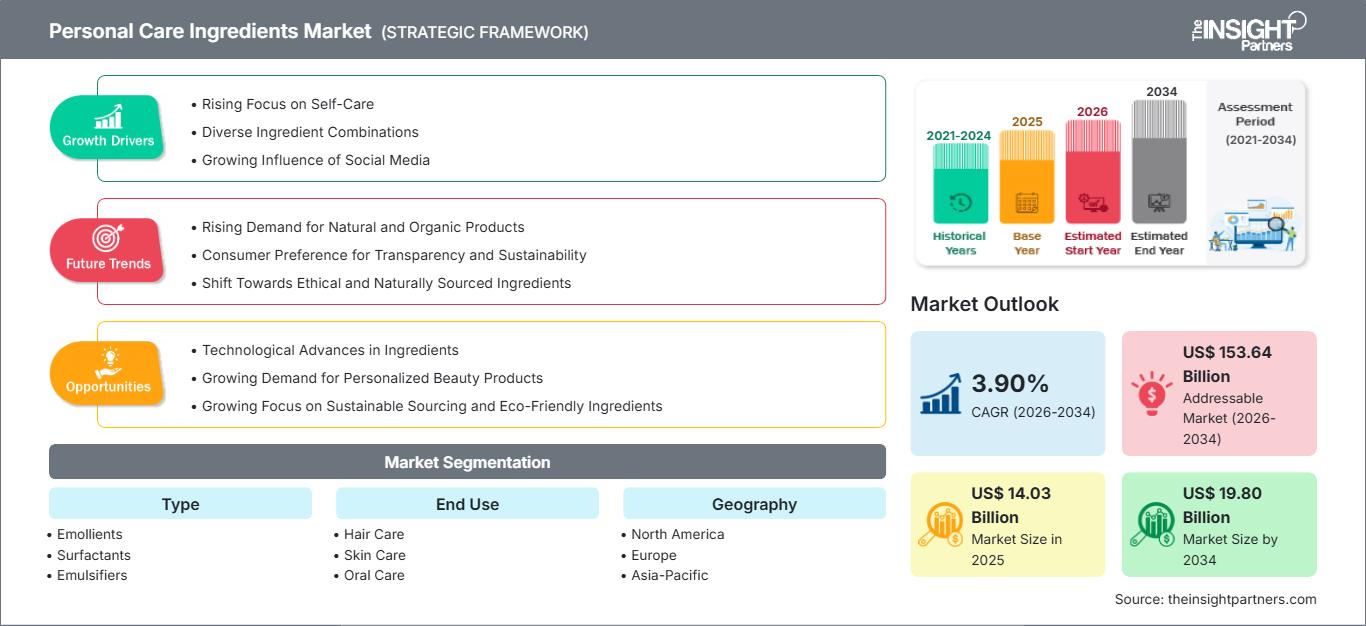
2025 Market Size
US$ 14.03 Bn
Base year value
2034 Forecast
US$ 19.80 Bn
Projected by 2034
CAGR 2026-2034
3.90 %
Growth rate
Addressable Market
US$ 153.64 Bn
(2026-2034)
The Personal Care Ingredients market is positioned for steady expansion as beauty, hygiene, and wellness products increasingly rely on advanced formulation technologies and performance-enhancing raw materials. The market is valued at US$ 14.03 Billion in 2025 and is projected to reach US$ 19.80 Billion by 2034, registering a CAGR of 3.90% during 2026–2034. Growth is being supported by rising demand for multifunctional ingredients, clean-label formulations, and premium personal care products that deliver superior sensory and functional performance.
North America remains a critical innovation hub for the Personal Care Ingredients market and is anticipated to expand at an estimated CAGR of 3.6% through 2034. The region benefits from strong consumer spending on premium beauty products, growing adoption of sustainable ingredients, and continuous product innovation by major formulators. Demand for bio-based surfactants, high-performance emollients, and advanced conditioning polymers continues to accelerate across skincare, haircare, and cosmetic applications.
Personal Care Ingredients Market Assessment and Insights
- North America: North America accounted for 34–38% share in 2025 and is anticipated to expand at a CAGR of 3.6%–4.0% during 2026–2034. Premium cosmetic innovation, biotechnology-based formulations, and strong consumer demand for sustainable ingredients continue to support regional market leadership.
- U.S.: The U.S. represented 80–84% of the North American market in 2025 and is projected to register a CAGR of 3.7%–4.1% during 2026–2034, supported by increasing adoption of high-performance cosmetic ingredients, robust personal care product innovation, and strong consumer spending on premium beauty products.
- Europe: Europe held 28–32% market share in 2025 and is expected to grow at a CAGR of 3.4%–3.8% during 2026–2034. Germany, France, and the United Kingdom remain the leading regional markets due to established cosmetic manufacturing capabilities and stringent formulation standards.
- Asia Pacific: Asia Pacific accounted for 25–29% share in 2025 and is forecast to expand at a CAGR of 4.8%–5.2% during 2026–2034. China, Japan, and India continue to drive regional growth through expanding beauty industries, rising disposable incomes, and increasing demand for premium personal care products.
- Largest Segment: End Use – Skin Care represented the largest market segment and is expected to record a CAGR of 4.5%–4.9% during 2026–2034, reflecting sustained demand for premium formulations and multifunctional active ingredients.
- High Growth Segment: Product Type – Conditioning Polymers is projected to grow at a CAGR of 4.6%–5.0% during 2026–2034, driven by increasing demand for advanced hair care formulations and enhanced conditioning performance.
- Key companies analyzed in detail: BASF SE; Ashland Inc.; Solvay SA; Dow Inc.; Clariant AG; Croda International Plc; Evonik Industries AG; Nouryon Holding B.V.; Lonza Group AG; and J.M. Huber Corporation.
Source: The Insight Partners' analysis based on proprietary research, government publications, company annual reports, investor presentations, industry databases, and expert interviews.
The Personal Care Ingredients market has evolved from a commodity-driven supply environment into a highly specialized ecosystem centered on formulation science, sustainability, and product differentiation. Ingredient manufacturers increasingly focus on multifunctional solutions that improve product texture, stability, efficacy, and environmental performance while helping brands streamline formulations and reduce ingredient complexity.
There are opportunities for market growth due to the premium nature of beauty products, increased attention to ingredient transparency, and the focus on safety in product regulations. The companies have been focusing on biotechnology, green chemistry, and renewable raw materials to develop differentiated product lines.
Personal Care Ingredients Market Report Scope
| Report Attribute | Details |
|---|---|
| Market size in 2025 | US$ 14.03 Billion |
| Market Size by 2034 | US$ 19.80 Billion |
| Global CAGR (2026 - 2034) | 3.90% |
| Historical Data | 2021-2024 |
| Forecast period | 2026-2034 |
Personal Care Ingredients Market Analysis
Consumer demand for efficacy-based cosmetic ingredients is influencing the development of new ingredients in global markets. Emollients, surfactants, emulsifiers, rheology modifiers, and conditioning polymers are necessary in creating textures, stability, cleansing, moisturization, and consumer acceptance. There is an increasing demand for premium skin care, specialty hair care, and functional cosmetics.
The market ecosystem includes raw material suppliers, specialty chemical producers, biotechnology companies, contract formulators, cosmetic brands, and retail distribution channels. The Personal Care Ingredients Market share is increasingly shaped by sustainability considerations, which influence purchasing decisions and drive the adoption of biodegradable ingredients, renewable feedstocks, and manufacturing processes with reduced environmental footprints.
Competition includes extensive research skills, regulatory know-how, global marketing channels, and application development assistance. The industry players such as BASF SE, Ashland, Solvay, Dow, Clariant, Croda International Plc., Evonik Industries AG, Nouryon, Lonza, and J.M. Huber Corporation are enhancing their portfolios via innovation and strategic alliances.
Investments are being made in the direction of biotechnology ingredients, actives through fermentation process, sustainable surfactants and eco-friendly emulsifying systems. Companies are developing regional innovation hubs and technical services facilities in order to develop products according to the changing preferences of consumers in different parts of the world.
● REPORT CUSTOMIZATION
Tailor This Report To Align With Your Specific Business Requirements
This report can be customized to align precisely with your business objectives, scope, and target markets. Customization options include tailored segmentation, geography, competitive analysis, and strategic insights to support informed decision-making.
Customize This Report →WHAT YOU CAN ADJUST
- ● Segmentations
- ● Geography
- ● Competitive Analysis
- ● Language Preferences
Personal Care Ingredients Market: Strategic Insights
Regional Insights
North America Personal Care Ingredients Market
North America represents the largest regional market, supported by strong beauty and personal care consumption, advanced cosmetic manufacturing infrastructure, and high adoption of premium products. The regional market is projected to grow at approximately 3.6% CAGR through 2034. Demand is particularly strong for specialty ingredients that improve product efficacy while meeting increasingly stringent sustainability requirements.
The development of naturally occurring emulsifiers, biodegradable surfactants, and multifunctional polymers that serve both functional and environmental goals remains a major focus for manufacturers. Collaborations between ingredient producers, cosmetics companies, and R&D centers are speeding up the launch of new-generation personal care products in skincare and haircare categories.
U.S. Personal Care Ingredients Market
The United States accounts for approximately 75–80% of North American demand and is anticipated to expand at a CAGR of around 3.5% through the forecast period. The country benefits from a large consumer base, a strong premium beauty segment, and extensive innovation activity among both multinational and emerging cosmetic brands.
The major ingredient providers have a significant amount of research facilities and production facilities, in addition to the development of applications within the entire nation. There is an increasing demand for clean beauty formulations, products that are favorable for the microflora of the skin, anti-aging solutions, and multifunctional ingredients.
Europe Personal Care Ingredients Market
Europe accounts for an estimated 28–32% share of the global Personal Care Ingredients market and remains a major center for ingredient innovation. Regional growth is expected at approximately 3.4% CAGR, supported by sophisticated cosmetic manufacturing capabilities and stringent sustainability standards. Germany remains the leading country market due to its strong specialty chemicals industry and advanced formulation expertise.
The UK continues to demonstrate healthy demand for premium skincare and specialized cosmetic formulations. Growing consumer interest in ingredient transparency, ethical sourcing, and sustainable products is encouraging manufacturers to develop naturally derived alternatives to conventional formulation components.
Germany benefits from the presence of major ingredient manufacturers, advanced research infrastructure, and strong export-oriented production capabilities. Continuous investment in biotechnology and green chemistry solutions strengthens the country's leadership position within the European personal care ingredient ecosystem.
France, Italy, and Spain play an important role with their well-established cosmetic industries and great demand for high-end cosmetics. Luxury beauty products and growing dermocosmetics markets drive demand for novel emollients, conditioning agents, and emulsifiers.
APAC Personal Care Ingredients Market
Asia Pacific is the fastest-growing regional market and is expected to register a CAGR of approximately 5.0% through 2034. The region accounts for roughly 30–35% of global demand and contributes significantly to the Personal Care Ingredients Market size, benefiting from rising disposable incomes, urbanization, expanding middle-class populations, and increasing beauty consciousness. China remains the largest country market within the region.
China continues to drive substantial ingredient demand through its extensive cosmetics manufacturing base and rapidly evolving consumer preferences. Domestic and international beauty brands increasingly seek advanced ingredients that support premium positioning and differentiated product performance.
Japan, South Korea, India, and Australia contribute to regional expansion through innovation-focused beauty sectors and increasing demand for specialized formulations. Government support for advanced manufacturing, growing investments in biotechnology, and rising consumer interest in sustainable beauty products create favorable conditions for long-term market development.
Middle East & Africa Personal Care Ingredients Market
The Middle East & Africa market is expected to expand at a CAGR of approximately 4.2% through the forecast period. Rising urban populations, increasing beauty product consumption, and expanding retail infrastructure are contributing to ingredient demand. Saudi Arabia represents the leading country market, supported by growing consumer spending and economic diversification initiatives.
The UAE continues to serve as a regional distribution and innovation hub, facilitating access to international beauty brands and advanced ingredient technologies. Premium skincare and haircare categories are experiencing notable growth, particularly among younger consumer demographics.
South Africa and the broader regional market benefit from expanding personal care manufacturing activities and increasing awareness of specialized beauty products. Ongoing infrastructure investments, economic diversification efforts, and growing consumer preference for premium formulations support the Personal Care Ingredients Market forecast and continued development of the regional ingredient supply chain.
Segmentation Analysis
Type
- Emollients: Essential moisturizing ingredients that improve skin feel, barrier protection, and sensory performance. Widely utilized in premium skincare, sun care, and cosmetic formulations requiring enhanced spreadability and conditioning characteristics.
- Surfactants: Critical cleansing and foaming agents used extensively in shampoos, body washes, facial cleansers, and oral care products. Growing demand centers on mild, sulfate-free, and biodegradable alternatives.
- Emulsifiers: Enable stable oil-and-water formulations while improving texture and product consistency. Increasingly adopted in advanced skincare and cosmetic products emphasizing performance, stability, and sensory appeal.
- Rheology Modifiers: Improve viscosity control, suspension stability, and application characteristics. Their role is becoming increasingly important in premium formulations requiring superior texture and long-term product stability.
- Conditioning Polymers: Deliver softness, manageability, and protective benefits in hair care and skin care applications. Demand is rising for multifunctional polymers that combine performance with sustainability attributes.
End Use
- Hair Care: Strong demand for conditioning polymers, mild surfactants, and specialized emulsifiers supports product differentiation across shampoos, conditioners, styling products, and scalp treatment formulations.
- Skin Care: The largest application segment, driven by premium moisturizers, anti-aging products, sunscreens, and dermocosmetics requiring advanced emollients, emulsifiers, and multifunctional active ingredient delivery systems.
- Oral Care: Utilizes specialty surfactants, rheology modifiers, and formulation stabilizers that enhance texture, cleansing efficiency, sensory performance, and product consistency in oral hygiene applications.
- Cosmetics: Requires sophisticated ingredient combinations that improve aesthetics, stability, texture, and application performance while supporting trends toward multifunctional, sustainable, and premium beauty formulations.
Opportunity Snapshot
| End Use | Revenue Contribution | Trend Tag | Adoption Stage |
| Hair Care | High | Scalp Health | Mature |
| Skin Care | High | Active Beauty | Mature |
| Oral Care | Medium | Gentle Cleansing | Scaling |
| Cosmetics | High | Sensory Design | Mature |
Personal Care Ingredients Market Growth Drivers and Impact Analysis
Growing Consumer Preference for Premium and Functional Beauty Products
Consumers increasingly seek products that deliver measurable benefits beyond basic cleansing and moisturization. This shift has elevated demand for specialized ingredients that enhance hydration, sensory attributes, anti-aging performance, scalp health, and overall formulation effectiveness. Premium beauty categories continue to outperform many mass-market segments, creating opportunities for ingredient suppliers capable of delivering scientifically validated performance.
The impact extends across the value chain, encouraging greater investment in formulation science and application testing. Personal Care Ingredients Market trends indicate that ingredient manufacturers are expanding portfolios to address emerging consumer concerns such as skin barrier protection, microbiome support, and healthy aging. This trend strengthens demand for advanced emollients, conditioning polymers, and multifunctional ingredient systems that enable brands to differentiate products in highly competitive markets.
Expansion of Sustainable and Bio-Based Ingredient Development
It is important to note that sustainability has emerged as a core purchase criterion for consumers and brands alike. Personal care product developers are now looking at ingredients made using renewable resources that are sourced in an environmentally friendly manner, and that can be used in products that decompose easily.
In this regard, the implications on the market have been that there has been substantial investment in biotechnology, green chemistry, and sustainable sourcing systems, positively influencing the Personal Care Ingredients Market. New ingredients that are alternatives to traditional synthetics have been developed, while simultaneously meeting the performance criteria required by formulators.
Increasing Innovation in Multifunctional Formulation Technologies
Ingredient formulators face the challenge of reducing the number of ingredients in formulations while improving their effectiveness. Multifunctional ingredients have become more appealing since they offer several advantages in formulation, including increasing efficiency, reducing complexity, and facilitating clean-label positioning.
The trend has been affecting research focus across the industry. Ingredients that combine conditioning, stabilization, emulsification, and sensory properties into one material are being developed by various companies. This leads to increased efficiency for manufacturing companies and helps produce more advanced consumer products.
Personal Care Ingredients Market Future Trends
Biotechnology-Derived Ingredients Moving into Mainstream Formulations
The biotechnology domain is gradually becoming a revolutionary factor in the Personal Care Ingredients Market. Materials generated by fermentation processes, bioengineered polymers, and nature-inspired material platforms are becoming substitutes for chemically synthesized materials. The development in biotechnology is helping suppliers achieve high levels of consistency in materials while minimizing dependency on conventional raw materials.
It can be anticipated that future development in the market would be marked by the incorporation of biotechnology in all types of ingredients. With improved scalability of manufacturing and decreasing costs of production, biotechnological ingredients will not be confined to premium segments only but will make their way into other markets as well.
Data-Driven Personalization Influencing Ingredient Selection
The rise of personalized beauty products will put more demands on the ingredient companies. More brands will be looking for the ingredients that can be used as the basis for flexible formulation options that are able to meet the needs of consumers based on their skin type, environment, age, and lifestyle.
Looking ahead, ingredient suppliers will increasingly develop modular and customizable ingredient systems that support targeted product formulations. It seems likely that this trend will lead to improved cooperation between suppliers and brands as well as to more specialized products.
Personal Care Ingredients Market Opportunities
Emerging Market Premiumization Creating New Ingredient Demand
Increasing income levels and changing consumer attitudes in developing countries are helping drive growth in premium beauty and personal care segments. Consumers now have a greater preference for products that provide enhanced performance, superior texture, and unique sensorial effects, thereby creating a need for value-added ingredients.
There are business development opportunities for firms that are strengthening their technical, formulation, and innovation capabilities in fast-growing markets within the Personal Care Ingredients Market. Developing regional alliances and application development centers will enable ingredient suppliers to address regional needs and capture growth opportunities through premium beauty products.
Expansion of Clean Beauty and Transparency-Oriented Formulations
Consumer awareness is growing regarding ingredient content and sourcing, driving increased demand for formulations that deliver efficacy, safety, and sustainability within the Personal Care Ingredients Market. Companies are adopting new product formulations and seeking ingredients that can support the development of their clean beauty strategies. This is a perfect opportunity for suppliers who provide natural, sustainable ingredients that have a traceable supply chain and clear sustainability attributes. Such companies will benefit from closer collaboration with major beauty brands in future product development projects.
Recent Developments
- April 2025: BASF SE introduced new natural-based personal care ingredients at in-cosmetics Global 2025, including Verdessence Maize, Lamesoft OP Plus, and Dehyton PK45 GA/RA. The launch emphasized biodegradable alternatives, renewable feedstocks, and sustainable formulation strategies designed to support evolving consumer demand for environmentally responsible beauty products.
- April 2025: BASF SE announced a strategic U.S. distribution agreement with Azelis for its Personal Care business, effective July 2025. The arrangement aims to strengthen customer access, streamline distribution operations, and enhance support for innovation and sustainability-focused ingredient solutions across the U.S. personal care industry.
- April 2025: Evonik Industries AG showcased new biosolutions and sustainable personal care technologies at in-cosmetics Global 2025, highlighting biotechnology-derived ingredients, biosurfactants, biopolymers, vegan collagen, and low-carbon emollient production technologies designed to address growing demand for eco-friendly, high-performance beauty formulations.
Frequently Asked Questions

- Comprehensive Market Sizing and Forecast Analysis
- Detailed Segmentation Analysis
- In-Depth Market Dynamics Assessment
- Regional and Country-Level Insights
- Competitive Landscape and Company Benchmarking
- Strategic Business Intelligence
Recent Reports
Testimonials

The Insight Partners provided valuable market intelligence that supported our global go-to-market strategy. Their team was professional, responsive, and attentive to our feedback, providing thoughtful analysis and helpful methodological clarifications throughout the project.
Junmo Kim Chief Financial Officer (CFO), Enertech Co., Ltd.
The Insight Partners' SCADA System Market report is comprehensive, with valuable insights on current trends and future forecasts. The team was highly professional, responsive, and supportive throughout. We are very satisfied and highly recommend their services.
RAN KEDEM Partner, Reali Technologies LTDs
I requested a report on a very specific software market and the team produced the report in a few days. The information was very relevant and well presented. I then requested some changes and additions to the report. The team was again very responsive and I got the final report in less than a week.
JEAN-HERVE JENN Chairman, Future Analytica
We worked with The Insight Partners for an important market study and forecast. They gave us clear insights into opportunities and risks, which helped shape our plans. Their research was easy to use and based on solid data. It helped us make smart, confident decisions. We highly recommend them.
PIYUSH NAGPAL Sr. Vice President, High Beam Global
The Insight Partners delivered insightful, well-structured market research with strong domain expertise. Their team was professional and responsive throughout. The user-friendly website made accessing industry reports seamless. We highly recommend them for reliable, high-quality research services
YUKIHIKO ADACHI CEO, Deep Blue, LLC.
This is the first time I have purchased a market report from The Insight Partners.While I was unsure at first, I visited their web site and felt more comfortable to take the risk and purchase a market report.I am completely satisfied with the quality of the report and customer service. I had several questions and comments with the initial report, but after a couple of dialogs over email with their analyst I believe I have a report that I can use as input to our strategic planning process.Thank you so much for taking the extra time and making this a positive experience.I will definitely recommend your service to others and you will be my first call when we need further market data.
JOHN SUZUKI President and Chief Executive Officer, Board Director, BK Technologies
I wish to appreciate your support and the professionalism you displayed in the course of attending to my request for information regarding to infectious disease IVD market in Nigeria. I appreciate your patience, your guidance, and the fact that you were willing to offer a discount, which eventually made it possible for us to close a deal. I look forward to engaging The Insight Partners in the future, all thanks to the impression you have created in me as a result of this first encounter.
DR CHIJIOKE ONYIA MANAGING DIRECTOR, PineCrest Healthcare Ltd.Reason to Buy
- Informed Decision-Making
- Understanding Market Dynamics
- Competitive Analysis
- Identifying Emerging Markets
- Customer Insights
- Market Forecasts
- Risk Mitigation
- Boosting Operational Efficiency
- Strategic Planning
- Investment Justification
- Tracking Industry Innovations
- Aligning with Regulatory Trends





 Get Free Sample for