
Pet Food Processing Market Trends, Demand & Growth by 2034
Coverage: by Form (Dry, Wet); Type (Mixing and Blending Equipment, Forming Equipment, Baking and Drying Equipment, Cooling Equipment, Coating Equipment, Others); Application (Dog Food, Cat Food, Fish Food, Others) , and Geography (North America, Europe, Asia Pacific, and South and Central America)
- Status : Data Released
- Report Code : TIPRE00010705
- Category : Manufacturing and Construction
- No. of Pages : 150
- Available Report Formats :


- Last update date : August 07, 2026


2025 Market Size
US$ 6.08 Bn
Base year value
2034 Forecast
US$ 9.91 Bn
Projected by 2034
CAGR 2026-2034
5.58 %
Growth rate
Addressable Market
US$ 72.50 Bn
(2026-2034)
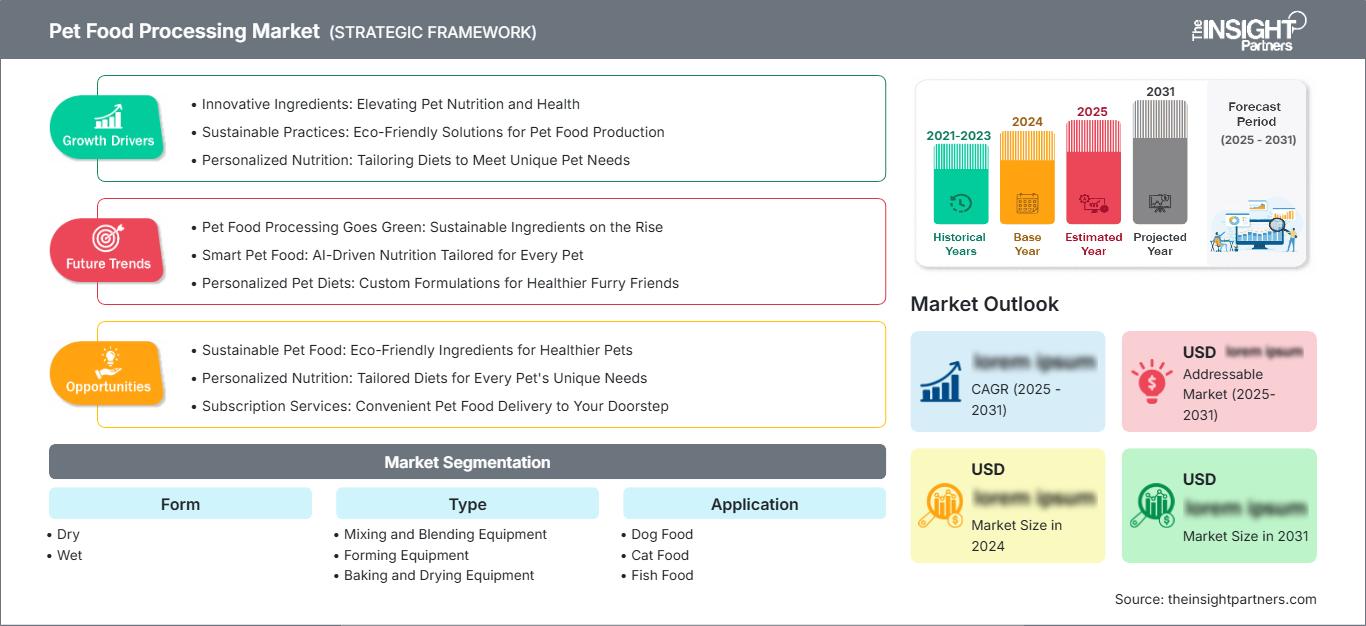
The Pet Food Processing Market is projected to expand from US$ 6.08 Billion in 2025 to US$ 9.91 Billion by 2034, registering a CAGR of 5.58% during 2026–2034. Growth is supported by rising demand for consistent, safe, and automated production of dry, wet, and application-specific pet food across dog food, cat food, and fish food manufacturing environments.
Across North America, investment in automated extrusion, hygienic mixing, and precision coating lines is expected to support a 4.8–5.4% CAGR through 2034. The Pet Food Processing Market size in the region benefits from mature pet ownership, premium formulations, and high-capacity plants serving private-label and branded nutrition programs.
Pet Food Processing Market Assessment and Insights
- North America held 32–35% share in 2025 and is growing at a CAGR of 4.8–5.4% during 2026–2034, supported by pet food premiumization, high automation penetration, and strict food safety expectations.
- US represented 74–78% of North America in 2025 and is growing at a CAGR of 4.7–5.3% during 2026–2034 as large brands modernize dry and wet lines.
- Europe accounted for 24–27% share in 2025 and is growing at a CAGR of 4.9–5.5% during 2026–2034, led by Germany, the UK, France, Italy, and Spain.
- Asia Pacific captured 22–25% share in 2025 and is growing at a CAGR of 6.3–7.0% during 2026–2034, with China, India, Japan, South Korea, and Australia driving capacity additions.
- Largest Segment dry form held 62–66% market share in 2025, with a CAGR of 5.1–5.7% during 2026–2034 because kibble remains scalable, shelf-stable, and cost-efficient.
- High Growth Segment wet form held 34–38% market share in 2025, with a CAGR of 6.0–6.7% during 2026–2034 as premium, high-moisture, and portioned diets expand.
- Key companies analyzed in detail: ANDRITZ AG, Baker Perkins Ltd., Bühler Holding AG, Clextral SAS, Coperion GmbH, F.N. Smith Corporation, GEA Group Aktiengesellschaft, Mepaco, Precision Food Innovations, and The Middleby Corporation.
Source: The Insight Partners' analysis based on proprietary research, government publications, company annual reports, investor presentations, industry databases, and expert interviews.
Pet Food Processing Market forecast indicates that manufacturing priorities have shifted from basic throughput expansion to integrated recipe control, hygienic zoning, and lower energy consumption. Current extrusion, baking, drying, cooling, and coating equipment lines must now be able to work with changing protein content, additives, and textures while maintaining the integrity of the process. The result is that the pet food industry is becoming increasingly equipment-oriented, since manufacturers want flexible production lines to accommodate premium dry kibble, wet meals, and specialized pet foods. Increased demand for grain-free, protein-rich, and veterinarian-approved formulas is driving the adoption of advanced equipment lines capable of increasing product uniformity and production efficiency.
Future investment is anticipated to go to Asia Pacific, Latin America, and certain Middle Eastern facilities where pet ownership, disposable income, and retailing are growing. Attention from regulators on feed hygiene, traceability, and contamination control is also encouraging automation. Equipment suppliers who offer process engineering, digital monitoring, and full lifecycle service are well-placed to capitalize on upgrading opportunities in multinational and contract manufacturing operations.
Pet Food Processing Market Report Scope
| Report Attribute | Details |
|---|---|
| Market size in 2025 | US$ 6.08 Billion |
| Market Size by 2034 | US$ 9.91 Billion |
| Global CAGR (2026 - 2034) | 5.58% |
| Historical Data | 2021-2024 |
| Forecast period | 2026-2034 |
Pet Food Processing Market Analysis
The Pet Food Processing Market growth is tied to pet humanization, higher protein inclusion, and rising demand for portion-controlled nutrition. Producers require equipment that preserves palatability while managing fat application, density, and texture. Suppliers of ingredients, machine builders, automation specialists, and branding companies make up an inter-related system where the intricacy of formulations influences the design of the lines and the capital invested.
The dynamics of supply still depend on the capacity for manufacturing in stainless steel, availability of components, and commissioning expertise. Large producers tend to opt for turnkey systems to minimize risks, while regional producers favor modular systems which could later be scaled-up depending on the demand.
This market is characterized by stiff competition among international engineering firms and specialized equipment manufacturers. ANDRITZ AG, Bühler Holding AG, Clextral SAS, Coperion GmbH, and GEA Group Aktiengesellschaft battle for leadership on extrusion capability, mixing capacity, drying and automation capability, while Baker Perkins Ltd., Mepaco, Precision Food Innovations, F.N. Smith Corporation, and The Middleby Corporation focus on special needs for forming, heating, and handling.
Positioning within this market space is increasingly driven by application labs, after-sales services, and recipe testing prior to commercial use. Manufacturers with facilities to conduct tests in specific regions lower risks for customers, while digital controls differentiate through machine uptime, sanitization logs, and maintenance schedules. This makes capital allocation increasingly favor companies who sell machines as well as processes.
● REPORT CUSTOMIZATION
Tailor This Report To Align With Your Specific Business Requirements
This report can be customized to align precisely with your business objectives, scope, and target markets. Customization options include tailored segmentation, geography, competitive analysis, and strategic insights to support informed decision-making.
Customize This Report →WHAT YOU CAN ADJUST
- ● Segmentations
- ● Geography
- ● Competitive Analysis
- ● Language Preferences
Pet Food Processing Market: Strategic Insights
Regional Insights
North America Pet Food Processing Market
North America held 32–35% of the Pet Food Processing Market share in 2025 and is projected to record a 4.8–5.4% CAGR during 2026–2034. The region's market position reflects established dry food production capacity, private-label expansion, and strict quality and food-safety standards that favor automated mixing, extrusion, drying, and coating systems. Large-scale production volumes and growing investment in processing efficiency continue to support demand for advanced manufacturing equipment across the U.S. and Canada.
Demand is reinforced by premium diets, functional additives, and high-volume dog and cat food production. Equipment upgrades are increasingly focused on energy-efficient dryers, hygienic wet food processing systems, automated ingredient handling, and digital recipe management platforms that improve consistency and traceability. Contract manufacturers are also increasing line flexibility to serve brands launching grain-free, high-protein, limited-ingredient, and veterinary-positioned products. As product portfolios become more specialized, processors are investing in equipment that enables faster changeovers, reduced waste, and reliable production across multiple formulations and package formats.
U.S. Pet Food Processing Market
The U.S. represented 74–78% of North America in 2025 and is expected to grow at a 4.7–5.3% CAGR during 2026–2034. Big installed capacity, extensive retail reach, and robust pet food consumption will drive future modernizations of dry, wet, and treats production facilities.
The company operates in areas associated with extrusion machinery, thermal processing equipment, and sanitary handling equipment companies serving multi-national manufacturers and contract packagers. The largest application category is dog food, although cat food lines have received more investments in wet formats.
Europe Pet Food Processing Market
Europe accounted for 24–27% share in 2025 and is forecast to grow at a 4.9–5.5% CAGR during 2026–2034. Germany is the most advanced country due to its engineering skills, the high number of pets and development of energy efficient processes such as drying, baking, and extruding.
The United Kingdom focuses on the development of premium pet treats and private label products, while Germany relies on equipment through industrialization. Other countries that make contributions are France, Italy, and Spain through wet pet food and fish-based formulations.
APAC Pet Food Processing Market
APAC captured 22–25% share in 2025 and is expected to post a 6.3–7.0% CAGR during 2026–2034. China is the top consumer, while Japan, South Korea, India, and Australia follow as pet ownership and organized retailing continue to grow.
In terms of production, there are emerging capacities for contract manufacturing, localization of premium products, and the regulatory focus on food safety. Manufacturers are now adopting extrusion technology, wet retort process for preparation, and automatic coating equipment for regional formulas and fish diets.
Middle East & Africa Pet Food Processing Market
Middle East & Africa is projected to grow at a 5.6–6.2% CAGR during 2026–2034, with Saudi Arabia leading regional demand. Growth in imports of premium pet food is taking place in the UAE, South Africa, and RoMEA (Rest of Middle East and Africa).
There are favorable conditions in terms of energy, logistics and increase in modern retail for processing investments in the region. The equipment needs will be selective, comprising small scale mixers, formers and heating systems enabling local sourcing of ingredients.
Segmentation Analysis
Form
Form is expected to grow at a 5.4–6.0% CAGR during 2026–2034 as manufacturers balance shelf-stable dry products with premium wet formats. The market scope across form is shaped by texture control, moisture management, packaging compatibility, and the need to serve both mass-market kibble and higher-value refrigerated or retorted diets.
- Dry remains the dominant form because extrusion-based kibble offers long shelf life, efficient logistics, and scalable production economics for dog, cat, and fish food manufacturers.
- Wet gains strategic importance as brands expand premium, high-moisture, and palatability-led diets requiring controlled cooking, filling, sealing, and sanitation-intensive processing environments.
Type
Type is projected to grow at a 5.5–6.1% CAGR during 2026–2034, reflecting coordinated demand for upstream preparation and downstream finishing systems. Equipment selection depends on formulation complexity, thermal profile, moisture removal, density control, coating accuracy, and sanitation requirements across dry, wet, and specialty pet food production lines.
- Mixing and Blending Equipment supports consistent ingredient distribution, especially where vitamins, minerals, protein meals, and functional additives must be uniformly incorporated before forming or extrusion.
- Forming Equipment is important for treats, shaped products, and portion-controlled formats where visual consistency, dimensional accuracy, and repeatable texture influence consumer acceptance.
- Baking and Drying Equipment remains critical because moisture control determines shelf stability, energy cost, product safety, and final texture in high-volume dry food lines.
- Cooling Equipment protects product structure after thermal processing and enables stable downstream coating, packaging, and storage by reducing condensation and temperature-related quality variation.
- Coating Equipment adds fats, flavors, palatants, and functional oils, making it strategically important for premium products where aroma, nutrient delivery, and batch consistency are key.
Application
Application is anticipated to grow at a 5.6–6.2% CAGR during 2026–2034 as manufacturers align equipment with species-specific nutrition, palatability, and product formats. Dog food drives throughput, cat food requires palatability and wet processing expertise, and fish food production depends on density, water stability, and precise extrusion parameters.
- Dog Food is the largest application because dogs represent the broadest volume base, supporting investment in high-capacity extrusion, drying, coating, and treat-forming systems.
- Cat Food is strategically attractive due to premium wet diets, palatability requirements, and smaller serving formats that increase demand for controlled cooking and packaging integration.
- Fish Food relies on specialized extrusion and drying parameters, where pellet density, water stability, and nutrient retention determine performance across ornamental and aquaculture-linked products.
Opportunity Snapshot
| Application | Revenue Contribution | Trend Tag | Adoption Stage |
| Dog Food | High | Kibble Scale | Mature |
| Cat Food | Medium | Wet Premium | Scaling |
| Fish Food | Low | Pellet Stability | Emerging |
Pet Food Processing Market Growth Drivers and Impact Analysis
Premium Nutrition Requires Tighter Process Control
Premium pet nutrition adds to the technological demands on the processor because the recipes use greater amounts of meat, functional oils, probiotics, fiber, and novel proteins. These ingredients need proper mixing, cooking, and coating after extrusion in order to maintain the integrity of nutritional and sensory claims. From a practical point of view, this driver drives processors to develop automation for recipes, vacuum coating, and improved drying technologies. This implies increased cost per line, but also more consistent batches and faster development of premium offerings.
Automation Addresses Labor, Hygiene, and Uptime Constraints
The use of automation in processors is now being considered due to factors such as availability of skilled labor, sanitation practices, and performance reliability. Through automation of feeding, cleaning validation, temperature tracking, and batch recording, the need for manual handling is minimized, and more importantly, tracking of processes is enhanced. In the market place, equipment consumers are moving from fragmented machines to integrated lines that link the stages of mixing, forming, baking, drying, cooling, and coating.
Emerging Markets Are Localizing Pet Food Production
Pet ownership is growing in Asia Pacific, the Middle East, and some parts of Latin America, which is leading to an increased desire for localized manufacturing over importation. Localized manufacturing ensures safety from freight dangers, better shelf life, and tailoring of recipes to fit regional tastes and prices. The effect this has on the market is that it demands the availability of modular extrusion, wet food production, and flexible coating equipment.
Pet Food Processing Market Future Trends
Digital Recipe Intelligence Across Processing Lines
The next phase of Pet Food Processing Market trends will involve recipe intelligence that links formulation data with equipment settings, quality records, and maintenance alerts. Rather than using the memory of the operators, the producers will apply digital parameters in terms of moisture, temperature, density, and coating uptake per batch. It will facilitate faster market launches, less waste, and better audit preparedness. Suppliers who can incorporate sensors and controls into their processes will be influential since the customer needs repeatability in plant, format, and region.
Lower-Impact Thermal and Drying Systems
Energy-efficient drying, heat recovery, and lower-emission thermal processing will become procurement priorities as plants face rising utility costs and sustainability targets. Drying is one of the most energy-sensitive stages in dry pet food production, so incremental efficiency gains can materially affect operating margins. The Pet Food Processing Market will see stronger demand for systems that balance product safety, moisture uniformity, and lower energy intensity. Vendors able to document lifecycle savings will be favored in both mature replacement projects and new greenfield facilities.
Pet Food Processing Market Opportunities
Modular Lines for Regional Contract Manufacturers
Regional contract manufacturers need equipment that supports multiple brands, frequent recipe changes, and variable batch sizes without excessive downtime. Modular mixing, forming, drying, and coating systems can help them enter premium categories while preserving capital flexibility. In the Pet Food Processing Market, suppliers can target this opportunity by offering scalable layouts, test-center validation, and service packages that reduce commissioning risk. The investment case is strongest where retailers are expanding private-label pet food and regional brands require local production partners with credible food safety systems.
Wet Food Capacity for Premium Cat Nutrition
Premium cat nutrition presents a distinct investment opening because wet diets depend on palatability, portion control, and high sanitation standards. Manufacturers that expand wet food preparation, filling, and thermal systems can address consumer demand for texture variety and higher moisture intake. The Pet Food Processing Market can capture this opportunity through equipment packages that combine gentle handling, hygienic design, and automated changeover. This is particularly relevant for brands moving from imported wet food toward localized production in Asia Pacific, Europe, and selected Middle East markets.
Recent Developments
- July 2026: Nestlé Purina plans to make significant capacity investment with a new CHF 520 million plant in Mantova, Italy, to meet continued demand growth for pet food. The facility will combine a wet pet food plant with a highly efficient logistics platform serving Purina as well as other Nestlé brands. The plant will produce super-premium wet pet food for cats and dogs, for key Purina brands. The investment will bring the number of Purina production sites in Europe to 15, serving a total population of around 111 million cats and around 91 million dogs across Europe.
- September 2025: ANDRITZ AG launched the ExMax S1021 single-screw extruder at VICTAM LATAM in São Paulo for pet food and aqua feed production, emphasizing hygienic stainless-steel design, DensiFlex density control, automation, reduced downtime, and lower operating costs for safer and more efficient production. The new extruder responds to the growing demand for safer, more sustainable pet food and aqua feed by helping producers achieve consistently high-quality nutrition, improved food safety, and greater efficiency, while reducing operating costs and unplanned downtime.
- March 2025: CPM Holdings, Inc. introduced pet food processing solutions at VIV Asia 2025. CPM’s pet food processing equipment line includes twin-screw extruders, advanced dryers, precision coating systems, hammermills and more, designed to deliver consistent quality, efficiency, and scalability for pet food manufacturers.
Frequently Asked Questions

- Comprehensive Market Sizing and Forecast Analysis
- Detailed Segmentation Analysis
- In-Depth Market Dynamics Assessment
- Regional and Country-Level Insights
- Competitive Landscape and Company Benchmarking
- Strategic Business Intelligence
Recent Reports
Testimonials

The Insight Partners' SCADA System Market report is comprehensive, with valuable insights on current trends and future forecasts. The team was highly professional, responsive, and supportive throughout. We are very satisfied and highly recommend their services.
RAN KEDEM Partner, Reali Technologies LTDs
I requested a report on a very specific software market and the team produced the report in a few days. The information was very relevant and well presented. I then requested some changes and additions to the report. The team was again very responsive and I got the final report in less than a week.
JEAN-HERVE JENN Chairman, Future Analytica
We worked with The Insight Partners for an important market study and forecast. They gave us clear insights into opportunities and risks, which helped shape our plans. Their research was easy to use and based on solid data. It helped us make smart, confident decisions. We highly recommend them.
PIYUSH NAGPAL Sr. Vice President, High Beam Global
The Insight Partners delivered insightful, well-structured market research with strong domain expertise. Their team was professional and responsive throughout. The user-friendly website made accessing industry reports seamless. We highly recommend them for reliable, high-quality research services
YUKIHIKO ADACHI CEO, Deep Blue, LLC.
This is the first time I have purchased a market report from The Insight Partners.While I was unsure at first, I visited their web site and felt more comfortable to take the risk and purchase a market report.I am completely satisfied with the quality of the report and customer service. I had several questions and comments with the initial report, but after a couple of dialogs over email with their analyst I believe I have a report that I can use as input to our strategic planning process.Thank you so much for taking the extra time and making this a positive experience.I will definitely recommend your service to others and you will be my first call when we need further market data.
JOHN SUZUKI President and Chief Executive Officer, Board Director, BK Technologies
I wish to appreciate your support and the professionalism you displayed in the course of attending to my request for information regarding to infectious disease IVD market in Nigeria. I appreciate your patience, your guidance, and the fact that you were willing to offer a discount, which eventually made it possible for us to close a deal. I look forward to engaging The Insight Partners in the future, all thanks to the impression you have created in me as a result of this first encounter.
DR CHIJIOKE ONYIA MANAGING DIRECTOR, PineCrest Healthcare Ltd.Reason to Buy
- Informed Decision-Making
- Understanding Market Dynamics
- Competitive Analysis
- Identifying Emerging Markets
- Customer Insights
- Market Forecasts
- Risk Mitigation
- Boosting Operational Efficiency
- Strategic Planning
- Investment Justification
- Tracking Industry Innovations
- Aligning with Regulatory Trends





 Get Free Sample for