
PET Packaging Market Size, Growth & Demand by 2034
Coverage: By Product Type (Bottles and Jars, Bags and Pouches, Trays, Lids/Caps and Closures, Others); Packaging (Rigid, Flexible); End-Use Industry (Food and Beverages, Pharmaceuticals, Personal Care and Cosmetics, Industrial Goods, Household Products, Others), and Geography (North America, Europe, Asia Pacific, and South and Central America)
- Status : Data Released
- Report Code : TIPRE00017874
- Category : Chemicals and Materials
- No. of Pages : 150
- Available Report Formats :


- Last update date : July 15, 2026


2025 Market Size
US$ 43.56 Bn
Base year value
2034 Forecast
US$ 76.64 Bn
Projected by 2034
CAGR 2026-2034
6.48 %
Growth rate
Addressable Market
US$ 543.70 Bn
(2026-2034)
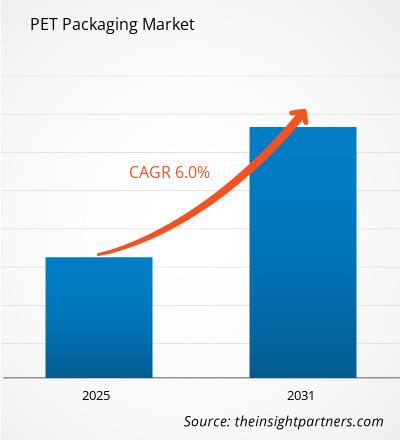
The PET Packaging market is undergoing a notable transformation driven by evolving consumer preferences, sustainability mandates, and product innovation. Valued at US$ 43.56 Billion in 2025, the market is projected to reach US$ 76.64 Billion by 2034, expanding at a CAGR of 6.48% during 2026–2034. Increasing demand for lightweight, durable, and recyclable packaging materials across industries such as food, beverages, and personal care is significantly influencing market dynamics and long-term growth patterns.
North America represents a mature yet technology-intensive region within the PET Packaging market, advancing at an estimated CAGR of approximately 6.2%. Growth in this region is primarily fueled by strong regulatory pressure toward sustainable packaging and rising demand for packaged food and beverages. Additionally, innovations in recycling technologies and widespread adoption of rPET (recycled polyethylene terephthalate) are shaping the region's packaging landscape and reinforcing its market position.
PET Packaging Market Assessment and Insights
- North America: North America accounted for 33–37% market share in 2025 and is projected to expand at a CAGR of 6.0%–6.4% during 2026–2034. Growth is supported by strong beverage consumption, advanced recycling infrastructure, and continued sustainability investments across the packaging value chain.
- U.S.: The U.S. represented 81–85% of the North American market in 2025 and is anticipated to register a CAGR of 6.1%–6.5% during 2026–2034, driven by rising demand for sustainable packaging solutions and expansion of high-efficiency recycling systems.
- Europe: Europe held 27–31% market share in 2025 and is expected to grow at a CAGR of 5.8%–6.2% during 2026–2034. Germany, France, and the United Kingdom remain key markets, supported by strict recycling mandates and strong demand for premium packaging formats.
- Asia Pacific: Asia Pacific accounted for 25–29% share in 2025 and is forecast to register a CAGR of 7.2%–7.6% during 2026–2034. China, India, and Japan continue to drive regional expansion through manufacturing growth, urbanization, and increasing consumption of packaged goods.
- Largest Segment: Product Type – Rigid Packaging represented the largest market segment and is projected to grow at a CAGR of 6.3%–6.7% during 2026–2034, supported by widespread use in beverage, pharmaceutical, and food packaging applications.
- High Growth Segment: Product Type – Bags and Pouches is expected to register the fastest growth with a CAGR of 7.4%–7.8% during 2026–2034, driven by increasing adoption of lightweight, flexible, and transport-efficient packaging solutions.
- Key companies analyzed in detail: Amcor plc; Berry Global Group, Inc.; DUNMORE Corporation; DuPont Teijin Films; Gerresheimer AG; Graham Packaging Company; Resilux NV; Robinson Packaging Innovation Ltd.; Silgan Holdings Inc.; and Smurfit Westrock plc.
Source: The Insight Partners' analysis based on proprietary research, government publications, company annual reports, investor presentations, industry databases, and expert interviews.
The PET Packaging market has evolved with increasing emphasis on material efficiency and environmental responsibility. Manufacturers have transitioned toward lightweight packaging designs that reduce material consumption while maintaining strength and clarity. The emergence of advanced barrier coatings and enhanced recycling capabilities has improved the performance profile of PET packaging, supporting its growing integration across multiple end-use industries.
The market outlook suggests that there is great momentum towards developing circular economy strategies, with manufacturers trying to use more recycled material in their packaging. Manufacturers are developing innovative solutions that make recycling easier without impacting product safety. The demand for flexible and bespoke packaging is becoming increasingly important.
PET Packaging Market Report Scope
| Report Attribute | Details |
|---|---|
| Market size in 2025 | US$ 43.56 Billion |
| Market Size by 2034 | US$ 76.64 Billion |
| Global CAGR (2026 - 2034) | 6.48% |
| Historical Data | 2021-2024 |
| Forecast period | 2026-2034 |
PET Packaging Market Analysis
The PET Packaging market is shaped by multiple demand drivers, including rising consumption of packaged food and beverages, increased preference for convenience packaging, and growing awareness of environmental impact. PET's lightweight nature, durability, and recyclability make it an essential material within modern packaging ecosystems. The shift toward sustainable alternatives is pushing manufacturers to adopt recycled materials and optimize production processes.
The value chain includes the raw material suppliers, PET resin makers, converters, packagers, and customers. The major companies that take center stage in adding value through converting the raw PET into packaging solutions include Amcor plc and Berry Global Inc. At the same time, there is a need for downstream companies to distribute the materials where a steady supply of packaging is needed.
Competition within the PET Packaging market is characterized by product differentiation and sustainability-focused innovation. Leading players such as Smurfit Kappa and RESILUX NV focus on enhancing packaging design and reducing environmental impact through lightweighting and improvements in recyclability. Strategic collaborations between packaging manufacturers and consumer goods companies are also shaping comPETitive positioning.
More investments are being channeled into recycling technologies and building the necessary infrastructure. There is more capacity creation in the production of rPET and closed-loop systems to ensure a steady supply of materials. The comPETitive environment forces companies to adopt environmental regulations and changing customer preferences.
● REPORT CUSTOMIZATION
Tailor This Report To Align With Your Specific Business Requirements
This report can be customized to align precisely with your business objectives, scope, and target markets. Customization options include tailored segmentation, geography, competitive analysis, and strategic insights to support informed decision-making.
Customize This Report →WHAT YOU CAN ADJUST
- ● Segmentations
- ● Geography
- ● Competitive Analysis
- ● Language Preferences
PET Packaging Market: Strategic Insights

Regional Insights
North America PET Packaging Market
North America remains a dominant market, supported by advanced manufacturing ecosystems and established recycling infrastructure. The region is projected to expand at around 6.2% CAGR, driven by high consumption of packaged goods and stringent environmental regulations encouraging sustainable packaging solutions. Strong innovation capabilities further support continuous product development.
The focus on circular economy projects is changing the approach to packaging in various industries. The use of recycled PET material is becoming common, along with sustainability in design. Good coordination between regulatory authorities and the private sector will ensure constant progress and development in the region.
U.S. PET Packaging Market
The U.S. accounts for approximately 70% to 75% of the North American PET Packaging market and is anticipated to grow at a CAGR close to 6.3%. The presence of key companies such as Silgan Holdings Inc. and Graham Packaging supports continuous innovation and large-scale production capabilities. The demand for beverages and ready-to-eat food products significantly contributes to packaging consumption.
The market is witnessing increased demand for eco-friendly packaging solutions, with brands focusing on reducing plastic waste and enhancing recyclability. Advances in lightweight bottle design and integration of recycled materials are driving application trends, ensuring sustained demand across multiple industries.
Europe PET Packaging Market
Europe holds an estimated 25% to 30% share of the global PET Packaging market and is projected to grow at a CAGR of about 6.0%. The region is defined by strict environmental regulations and ambitious recycling targets, encouraging the adoption of sustainable packaging solutions. Germany emerges as a leading country due to its advanced recycling infrastructure.
The UK market is driven by strong consumer awareness and regulatory initiatives promoting waste reduction. Increasing adoption of rPET and sustainable packaging designs is enhancing market growth and influencing product innovation.
Germany demonstrates leadership with its efficient recycling systems and high utilization of recycled materials. Packaging manufacturers in Germany focus on technological advancements and sustainability-oriented innovations, strengthening the PET packaging market share and the region's position.
France, Italy, and Spain collectively show steady progress, supported by regulatory compliance and growing emphasis on eco-friendly packaging. Rising packaging demand in the food and cosmetics sectors supports market growth across these countries.
APAC PET Packaging Market
Asia-Pacific is the fastest-growing region, accounting for roughly 30% to 35% of the global market and expanding at a CAGR exceeding 7.2%. Rapid industrialization, urbanization, and an expanding middle-class population are driving demand for packaged products, contributing to the growth of the PET packaging market. Increased investments in manufacturing infrastructure further support regional growth.
China is dominating the market as it possesses a big manufacturing industry and a high demand for the food and beverage sector. Market evolution is taking place as there are various government policies focusing on increasing the recycling rate and minimizing the use of plastics.
Both Japan and South Korea concentrate on advanced packaging technology. India and Australia are experiencing increased adoption of PET packaging owing to higher consumer demand and larger retail sectors.
Middle East & Africa PET Packaging Market
The Middle East & Africa region is gradually expanding, with a CAGR of around 5.8%, supported by increasing urbanization and infrastructure development. According to the PET packaging market report, demand for packaged goods is rising as consumer lifestyles evolve, creating opportunities for PET packaging adoption.
Saudi Arabia leads the region due to its strong economic base and investments in packaging infrastructure. The UAE follows with advanced logistics systems and a growing demand for high-quality packaging solutions.
South Africa serves as a key market in Africa, supported by growing industrial activity and expanding retail sectors. Other regions are developing gradually, with energy-driven economies investing in packaging capabilities to support domestic production and consumption.
Segmentation Analysis
Packaging
- Rigid: Rigid PET packaging dominates due to its structural strength, clarity, and wide application in beverages and personal care products. It supports product safety and shelf visibility while enabling efficient storage and transportation.
- Flexible: Flexible PET packaging is gaining traction for its lightweight and cost-efficiency benefits. It is widely used in food packaging, offering convenience, reduced material usage, and improved logistics efficiency for manufacturers.
Product Type
- Bottles and Jars: This segment leads due to extensive use in beverages, pharmaceuticals, and personal care. High durability, transparency, and compatibility with recycling systems make these formats essential in PET packaging.
- Bags and Pouches: Increasing demand for convenience packaging drives this segment. Lightweight nature and ease of handling make these formats suitable for snacks, frozen foods, and other consumer goods.
- Trays and Clamshells: Widely used in food packaging, these formats ensure product protection and extend shelf life. Retail-ready presentation and improved product visibility contribute to segment growth.
- Caps and Closures: Essential for ensuring product integrity and ease of use, caps and closures play a critical role across beverage and personal care packaging applications.
End-User
- Food: PET packaging is extensively used in food applications for preserving freshness and extending shelf life. Demand is driven by the growth of packaged and ready-to-eat food segments globally.
- Beverages: This segment represents the largest share, driven by extensive use of PET bottles in soft drinks, water, and juices. Lightweight and recyclable properties enhance its suitability.
- Pharmaceutical: PET packaging supports safe storage and transportation of pharmaceutical products. Increasing demand for durable and contamination-resistant packaging solutions strengthens growth.
- Personal Care and Cosmetics: Rising demand for visually appealing and durable packaging solutions drives adoption in cosmetics and skincare products. PET offers design flexibility and product protection.
- Household products: Packaging demand is driven by cleaning and home care products requiring durable and safe storage solutions. PET's chemical resistance enhances its application in this segment.
Opportunity Snapshot
| End-User | Revenue Contribution | Trend Tag | Adoption Stage |
| Food | High | Fresh preservation | Mature |
| Beverages | High | Lightweight bottles | Mature |
| Pharmaceutical | Medium | Safe storage | Scaling |
| Personal Care and Cosmetics | Medium | Premium design | Scaling |
| Household products | Medium | Chemical safety | Scaling |
| Others | Low | Niche uses | Emerging |
PET Packaging Market Growth Drivers and Impact Analysis
Increasing demand for sustainable and recyclable packaging solutions
Environmental concerns surrounding plastic waste have significantly influenced packaging strategies, driving the adoption of recyclable materials such as PET. Governments worldwide are implementing stricter regulations to limit single-use plastics and encourage recycling initiatives. As a result, manufacturers are focusing on increasing the recycled content in PET packaging and adopting eco-friendly production methods, supporting a positive PET packaging market forecast.
The development of rPET has been a critical step in reducing environmental impact while maintaining material performance. Brands are increasingly incorporating recycled content into their packaging to align with sustainability goals and consumer expectations. This shift also supports circular economy principles by promoting material reuse.
The market impact is substantial, with companies such as Amcor plc and Berry Global Inc. investing in recycling technologies and sustainable packaging solutions. This driver is reshaping the comPETitive landscape, pushing innovation and encouraging collaboration across the value chain, ultimately strengthening the long-term sustainability of the PET Packaging market.
Rapid growth in food and beverage consumption globally
The expansion of the global food and beverage industry is a major driver for PET packaging demand. Changing lifestyles, urbanization, and increasing disposable incomes are leading to higher consumption of packaged food and beverages. PET packaging offers advantages such as durability, transparency, and convenience, making it a preferred choice across these applications.
The rise of ready-to-eat and on-the-go products further accelerates the need for reliable packaging solutions. PET's lightweight nature reduces transportation costs and enhances logistics efficiency, making it suitable for large-scale distribution. Beverage companies, in particular, rely heavily on PET bottles for cost-effective and scalable packaging.
This growth trend has led to increased production capacity and continuous innovation in packaging design. Companies like Graham Packaging and Silgan Holdings Inc. are focusing on optimizing production processes and developing advanced packaging formats, reflecting key PET packaging market trends to meet evolving industry needs.
Technological advancements in packaging design and materials
Technological innovation is playing a crucial role in enhancing PET packaging capabilities. Advances in barrier technologies, lightweighting techniques, and material enhancement are improving packaging performance while reducing resource consumption. These developments enable manufacturers to produce high-quality packaging that meets stringent safety and durability requirements.
Use of intelligent packaging technology and digital printing has also been growing, helping companies produce unique packaging that stands out through its aesthetics. It adds to differentiation and engages customers better.
This creates increased competition and diversified products in the market. Firms such as DuPont Teijin Films and DUNMORE have helped advance material science for improved performance and sustainability. These developments will continue to propel the market growth.
PET Packaging Market Future Trends
Expansion of circular economy models in plastic packaging
The transition toward circular economy models is becoming a defining trend in the PET Packaging market. Companies are focusing on reducing waste by designing packaging that can be reused, recycled, or repurposed. This shift is supported by regulatory frameworks encouraging higher recycling rates and the use of recycled materials.
Closed-loop systems are gaining prominence, where PET packaging is collected, recycled, and reintroduced into the production cycle. This reduces dependence on virgin materials and minimizes environmental impact. Collaboration between manufacturers, recyclers, and governments is essential to establishing efficient recycling systems.
Looking ahead, advancements in chemical recycling and sorting technologies are expected to enhance recycling efficiency within the PET packaging market. Companies investing in circular solutions are likely to gain a competitive edge, as sustainability continues to be a critical factor influencing consumer preferences and regulatory compliance.
Rising adoption of lightweight and flexible packaging formats
Growing demand for lightweight and flexible packaging from industries seeking cost-effective and efficient alternatives, flexible PET packaging has benefits including less material used, lower transport costs, and greater product convenience, especially in food and household products.
The change in lifestyles of consumers is leading to an increased preference for easy-to-carry and convenient packaging systems, which can be achieved using flexible PET material.
In the future, the direction of innovation will be towards recycling suitability and performance of flexible packaging technology. The increasing use of lighter materials will help enhance supply chain efficiencies.
PET Packaging Market Opportunities
Growing investments in recycling infrastructure and rPET production
Expansion of recycling infrastructure represents an important growth avenue for the PET Packaging industry. Growing demand for recycled products is fueling investments in collection, sorting, and processing infrastructure, increasing the availability of high-quality rPET and contributing to the expansion of the pet packaging market size.
Governments and the private industry are cooperating in creating effective recycling processes, particularly in places where recycling efficiency is currently low. This presents an opportunity for companies to participate in the recycling value chain and ensure sustainable sources of materials.
Investment in high-level recycling technology, such as chemical recycling, will increase recovery efficiency and material quality. Companies engaged in the production of rPET and the use of the product in packaging are well-positioned to capitalize on this opportunity.
Expansion into emerging markets with increasing consumption patterns
Emerging markets provide significant growth prospects for the PET packaging market due to escalating populations and growing consumption of packaged products. Urbanization and improvements in retail infrastructure are stimulating demand for convenient and durable packaging solutions.
Companies can capitalize on this chance by opening up factories in those areas and setting up logistical centers. Tweaking packing solutions according to local tastes and regulations improves their presence and comPETitiveness.
Investment in affordable manufacturing methods and supply chain management helps ensure long-term success in these markets. With demand set to increase, firms concentrating on these geographies stand to gain from greater earnings and extended footprints.
Recent Developments
- February, 2025: Berry Global Group, Inc. (NYSE: BERY) collaborated with snacks and treats leader Mars to transition its pantry jars for M&M'S, SKITTLES, and STARBURST brands to 100% recycled plastic packaging, exclusive of jar lids. This achievement advances the ongoing collaboration between Berry and Mars to develop packaging made with recycled content and builds on a previous launch of the pantry jars with 15% recycled plastic in 2022.
- May, 2024: ALPLA launched a recyclable wine bottle made of PET, which weighs approximately only an eighth of a glass bottle, reduces the carbon footprint by up to 50%, and allows for price savings of up to 30 per cent. It can be made entirely of recycled PET (rPET). The packaging solution is available now in 0.75-liter and 1-litre bottle sizes and is already being used in Austria by the pilot customer and development partner Wegenstein.
- April, 2024: Amcor launched a one-liter polyethylene terephthalate (PET) bottle for carbonated soft drink (CSD) use that is made from 100% post-consumer recycled (PCR) content. This first-of-its-kind stock option will support customers as they strive to meet sustainability commitments and requirements.
Frequently Asked Questions

- Comprehensive Market Sizing and Forecast Analysis
- Detailed Segmentation Analysis
- In-Depth Market Dynamics Assessment
- Regional and Country-Level Insights
- Competitive Landscape and Company Benchmarking
- Strategic Business Intelligence
Recent Reports
Testimonials

The Insight Partners' SCADA System Market report is comprehensive, with valuable insights on current trends and future forecasts. The team was highly professional, responsive, and supportive throughout. We are very satisfied and highly recommend their services.
RAN KEDEM Partner, Reali Technologies LTDs
I requested a report on a very specific software market and the team produced the report in a few days. The information was very relevant and well presented. I then requested some changes and additions to the report. The team was again very responsive and I got the final report in less than a week.
JEAN-HERVE JENN Chairman, Future Analytica
We worked with The Insight Partners for an important market study and forecast. They gave us clear insights into opportunities and risks, which helped shape our plans. Their research was easy to use and based on solid data. It helped us make smart, confident decisions. We highly recommend them.
PIYUSH NAGPAL Sr. Vice President, High Beam Global
The Insight Partners delivered insightful, well-structured market research with strong domain expertise. Their team was professional and responsive throughout. The user-friendly website made accessing industry reports seamless. We highly recommend them for reliable, high-quality research services
YUKIHIKO ADACHI CEO, Deep Blue, LLC.
This is the first time I have purchased a market report from The Insight Partners.While I was unsure at first, I visited their web site and felt more comfortable to take the risk and purchase a market report.I am completely satisfied with the quality of the report and customer service. I had several questions and comments with the initial report, but after a couple of dialogs over email with their analyst I believe I have a report that I can use as input to our strategic planning process.Thank you so much for taking the extra time and making this a positive experience.I will definitely recommend your service to others and you will be my first call when we need further market data.
JOHN SUZUKI President and Chief Executive Officer, Board Director, BK Technologies
I wish to appreciate your support and the professionalism you displayed in the course of attending to my request for information regarding to infectious disease IVD market in Nigeria. I appreciate your patience, your guidance, and the fact that you were willing to offer a discount, which eventually made it possible for us to close a deal. I look forward to engaging The Insight Partners in the future, all thanks to the impression you have created in me as a result of this first encounter.
DR CHIJIOKE ONYIA MANAGING DIRECTOR, PineCrest Healthcare Ltd.Reason to Buy
- Informed Decision-Making
- Understanding Market Dynamics
- Competitive Analysis
- Identifying Emerging Markets
- Customer Insights
- Market Forecasts
- Risk Mitigation
- Boosting Operational Efficiency
- Strategic Planning
- Investment Justification
- Tracking Industry Innovations
- Aligning with Regulatory Trends





 Get Free Sample for