
Piezoceramics Market Size, Trends & Demand by 2034
Coverage: by Material (Piezo Crystals, Piezo-Ceramics, Piezo Polymer, Piezo Composites); Product (Sensors, Actuators, Transducers, Generators, Motors); Application (Industrial, Automotive, Medical Devices, Electronics and Telecommunication, Others) , and Geography (North America, Europe, Asia Pacific, and South and Central America)
- Status : Data Released
- Report Code : TIPRE00010187
- Category : Chemicals and Materials
- No. of Pages : 150
- Available Report Formats :


- Last update date : June 24, 2026


2025 Market Size
US$ 113.62 Bn
Base year value
2034 Forecast
US$ 193.81 Bn
Projected by 2034
CAGR 2026-2034
6.11 %
Growth rate
Addressable Market
US$ 1,391.74 Bn
(2026-2034)
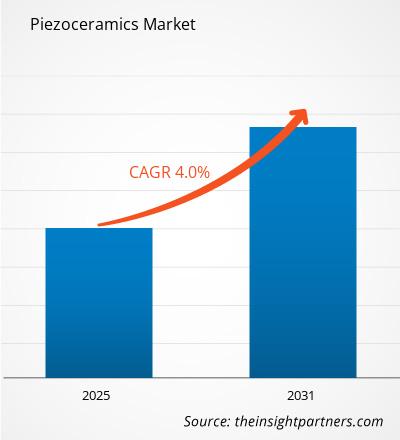
The piezoceramics market was valued at US$ 113.62 Billion in 2025 and is projected to reach US$ 193.81 Billion by 2034, expanding at a CAGR of 6.11% during 2026–2034. Growing adoption of smart electronic systems, advanced sensing technologies, and precision actuation solutions is strengthening demand across multiple industries. Piezoceramic materials have become critical components in automotive systems, industrial automation, telecommunications equipment, and medical devices due to their ability to convert mechanical energy into electrical energy and vice versa.
North America remains an important market for piezoceramics and is anticipated to record a CAGR of approximately 5.8% through 2034. Growth is supported by rising investments in industrial automation, increasing deployment of advanced medical equipment, and strong demand for aerospace and defense electronics. The region's established semiconductor ecosystem and emphasis on next-generation sensing technologies continue to create favorable conditions for piezoceramic component manufacturers.
Piezoceramics Market Assessment and Insights
- Global market for Piezoceramics was valued at US$ 113.62 Billion in 2025
- Annual market size is expected to reach US$ 193.81 Billion by 2034
- Total addressable market (TAM) during 2026-2034 is projected to reach approximately US$ 1,391.74 Billion
- Market is anticipated to register a CAGR of 6.11% during the forecast period
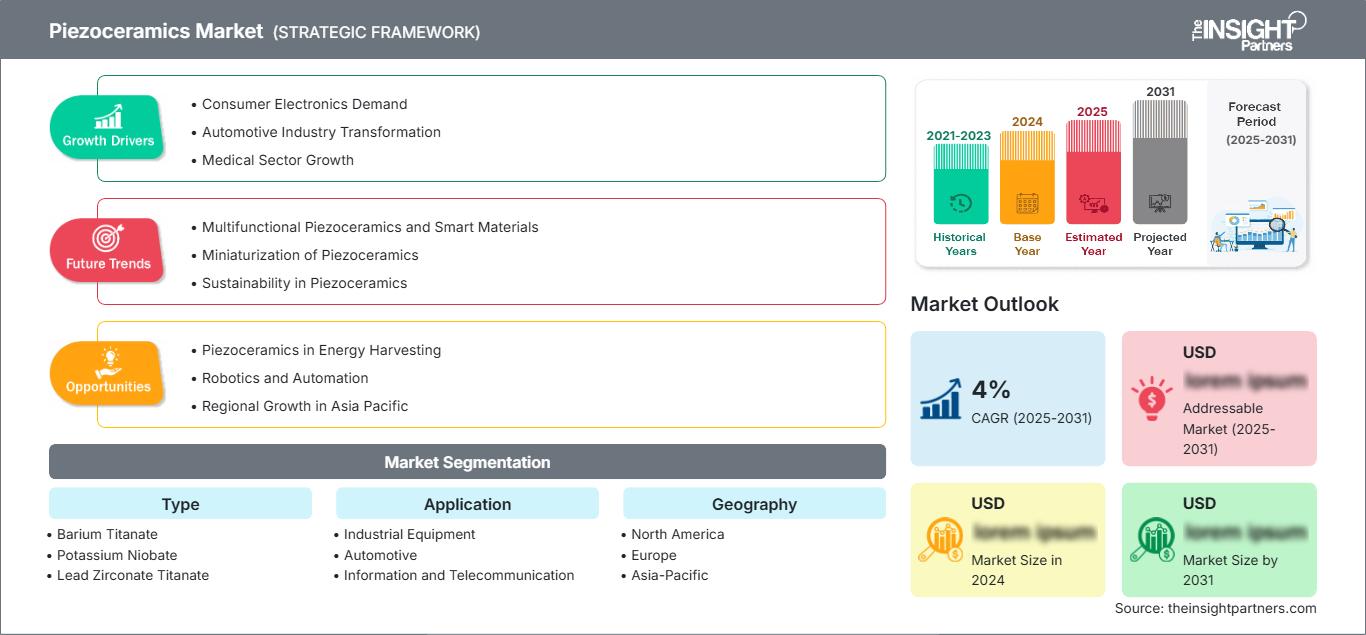
- The United States represents a key market, supported by Consumer Electronics Demand, Automotive Industry Transformation, Medical Sector Growth, as well as evolving industry dynamics
- Market analysis covers North America, Europe, Asia-Pacific, South and Central America, Middle East and Africa, with growth evaluated across the forecast period
- Market opportunities such as Piezoceramics in Energy Harvesting, Robotics and Automation, Regional Growth in Asia Pacific are expected to influence market dynamics and addressable market
- Report profiles industry participants, including CeramTec GmbH, CTS Corporation, H.C. Starck GmbH, Harris Corporation, Kyocera Corporation, Morgan Advanced Materials, Navion Electronics Private Limited, Piezosystem Jena GmbH, Sparkler Ceramics Pvt. Ltd., The NGK Spark Plug Co., Ltd., while analyzing competitive strategies and innovation developments
Source: The Insight Partners' analysis based on proprietary research, government publications, company annual reports, investor presentations, industry databases, and expert interviews.
Piezoceramic materials have become increasingly important as industries adopt intelligent systems requiring accurate sensing, vibration control, and precision motion capabilities. Technological advances in electronics, industrial machinery, and healthcare equipment have expanded application possibilities. Manufacturers continue to improve material performance, reliability, and operational efficiency to address evolving requirements across both consumer and industrial environments.
The market outlook remains favorable as automation, electrification, and digitalization initiatives accelerate globally. Growing investments in advanced manufacturing, medical diagnostics, telecommunications infrastructure, and automotive electronics are creating sustained demand. Continued material innovation and increased focus on lead-free alternatives are expected to shape future development while opening new opportunities for suppliers and technology developers.
Piezoceramics Market Report Scope
| Report Attribute | Details |
|---|---|
| Market size in 2025 | US$ 113.62 Billion |
| Market Size by 2034 | US$ 193.81 Billion |
| Global CAGR (2026 - 2034) | 6.11% |
| Historical Data | 2021-2024 |
| Forecast period | 2026-2034 |
Piezoceramics Market Analysis
The piezoceramics market is influenced by increasing demand for sensors, actuators, transducers, and ultrasonic devices across diverse industries. Rising adoption of Industry 4.0 technologies and smart manufacturing systems has significantly increased the need for highly responsive piezoelectric components. The automotive industry's transition toward advanced driver assistance systems and electrified vehicles is also creating new application opportunities for piezoceramic materials.
The market ecosystem includes raw material suppliers, ceramic powder manufacturers, component producers, electronics assemblers, equipment manufacturers, and end-use industries. Material engineering plays a crucial role in determining performance characteristics such as sensitivity, durability, frequency response, and operational stability. Strong collaboration between material developers and system manufacturers continues to support innovation throughout the value chain.
Competition remains intense among established manufacturers and specialized piezoelectric technology providers. Companies including CeramTec GmbH, Kyocera Corporation, CTS Corporation, Morgan Advanced Materials, and Piezosystem Jena GmbH focus on product differentiation through material innovation, application expertise, and advanced manufacturing capabilities. Strategic investments in research and development remain essential for maintaining competitive positioning.
Investment activity is increasingly directed toward miniaturized components, medical technology applications, advanced sensing systems, and industrial automation solutions. Growing demand for high-performance electronic devices is encouraging capacity expansion and technology upgrades. Partnerships between component manufacturers and original equipment manufacturers are becoming more common as industries seek customized piezoelectric solutions capable of meeting complex performance requirements.
● REPORT CUSTOMIZATION
Tailor This Report To Align With Your Specific Business Requirements
This report can be customized to align precisely with your business objectives, scope, and target markets. Customization options include tailored segmentation, geography, competitive analysis, and strategic insights to support informed decision-making.
Customize This Report →WHAT YOU CAN ADJUST
- ● Segmentations
- ● Geography
- ● Competitive Analysis
- ● Language Preferences
Piezoceramics Market: Strategic Insights
Regional Insights
North America Piezoceramics Market
North America is expected to register a CAGR of approximately 5.8% throughout the forecast period. Strong demand from aerospace, defense, healthcare, and industrial automation sectors continues to support market growth. Increasing deployment of advanced sensors and precision control systems has strengthened demand for piezoceramic materials across multiple high-value applications.
The region benefits from a mature technology ecosystem, extensive research capabilities, and strong investment in advanced manufacturing technologies. Adoption of robotics, smart factories, and sophisticated diagnostic equipment is driving demand for high-performance piezoelectric components. Ongoing innovation in medical imaging and ultrasonic technologies is expected to reinforce regional market expansion.
U.S. Piezoceramics Market
The United States accounts for approximately 75–80% of the North American piezoceramics market and is projected to achieve a CAGR of around 5.9% through 2034. Strong demand from defense electronics, healthcare equipment, industrial automation systems, and telecommunications infrastructure contributes significantly to market development. Continued investment in semiconductor technologies and advanced sensing solutions further strengthens industry prospects.
Several major component manufacturers and technology developers maintain a strong presence in the country. Medical ultrasound systems, industrial monitoring equipment, and precision motion control applications remain important demand centers. The increasing integration of piezoelectric technologies into smart devices and advanced manufacturing systems is expected to support sustained growth throughout the forecast period.
Europe Piezoceramics Market
Europe accounts for approximately 25–30% of global piezoceramics demand and is expected to expand at a CAGR of nearly 5.7% during the forecast period. The region benefits from a strong industrial base, advanced automotive manufacturing capabilities, and growing adoption of smart production technologies. Demand for precision sensing and control systems remains a key market driver.
Germany represents the leading country market due to its dominant manufacturing sector, extensive automation infrastructure, and strong engineering expertise. Industrial robotics, automotive electronics, and advanced machinery applications continue to generate substantial demand for piezoceramic components. The country's emphasis on smart manufacturing further supports market growth.
The United Kingdom, France, Italy, and Spain contribute to regional expansion through investments in medical technologies, telecommunications infrastructure, and industrial modernization initiatives. The United Kingdom demonstrates increasing adoption of advanced healthcare equipment, while France supports innovation in aerospace and defense technologies. Italy and Spain continue to strengthen demand through manufacturing upgrades and industrial automation projects.
APAC Piezoceramics Market
Asia Pacific dominates the global piezoceramics market with an estimated 40–45% market share and is projected to achieve a CAGR of approximately 6.8% through 2034. Strong manufacturing capabilities, extensive electronics production, and growing industrial automation investments continue to support regional leadership. Government initiatives promoting semiconductor development, smart manufacturing, and advanced electronics production further strengthen demand for piezoelectric materials and components.
China represents the largest country market due to its massive electronics manufacturing ecosystem, growing electric vehicle industry, and expanding industrial automation sector. Significant investments in advanced manufacturing technologies and telecommunications infrastructure continue to generate demand for sensors, actuators, and transducers. The country's strategic focus on high-tech industries further enhances growth prospects.
Japan, South Korea, India, and Australia also play important roles in regional development. Japan benefits from its longstanding expertise in advanced ceramics and precision electronics. South Korea's semiconductor and consumer electronics industries remain significant demand generators. India is witnessing increased adoption driven by industrial modernization and telecommunications expansion, while Australia supports market growth through medical technology and industrial automation investments.
Middle East & Africa Piezoceramics Market
The Middle East & Africa piezoceramics market is gradually expanding as industrial diversification and infrastructure modernization initiatives gain momentum. The region is expected to register a CAGR of approximately 5.5% through the forecast period. Growing investment in industrial automation, energy infrastructure, and advanced healthcare systems is creating opportunities for piezoelectric component adoption across multiple sectors.
Saudi Arabia leads the regional market due to ongoing industrial development programs, smart manufacturing initiatives, and investments in advanced infrastructure projects. The country's economic diversification strategy encourages adoption of modern industrial technologies, including automation systems that rely on piezoceramic sensors and actuators. These developments continue to strengthen long-term demand potential.
The United Arab Emirates is increasing deployment of advanced technologies across healthcare, transportation, and industrial sectors. South Africa remains an important market for industrial equipment and mining-related applications, while the rest of the region continues to invest in infrastructure modernization and energy sector upgrades. Increasing awareness of operational efficiency and automation benefits is expected to support future market growth.
Segmentation Analysis
Type
- Barium Titanate: Barium titanate is widely utilized in capacitors, sensors, and electronic components due to its excellent dielectric properties, environmental compatibility, and suitability for lead-free piezoelectric applications.
- Potassium Niobate: Potassium niobate is gaining attention as a lead-free piezoelectric material offering favorable electromechanical properties, making it attractive for environmentally conscious industrial and electronic applications.
- Lead Zirconate Titanate: Lead zirconate titanate remains the dominant material segment because of its superior piezoelectric performance, high sensitivity, reliability, and extensive use in actuators, transducers, and precision sensing systems.
Application
- Industrial Equipment: Industrial equipment represents a major application segment as piezoceramics enable precise sensing, vibration monitoring, positioning control, and automation functions within advanced manufacturing environments.
- Automotive: Automotive applications are expanding through integration of piezoelectric components into fuel injection systems, sensors, driver assistance technologies, and electric vehicle subsystems requiring accurate control mechanisms.
- Information and Telecommunication: Information and telecommunication systems utilize piezoceramics in frequency control devices, signal processing components, filters, and communication equipment supporting high-performance network operations.
- Medical Devices: Medical devices depend on piezoceramic materials for ultrasound imaging, diagnostic equipment, surgical instruments, and therapeutic technologies requiring precise energy conversion characteristics.
Opportunity Snapshot
| Application | Revenue Contribution | Trend Tag | Adoption Stage |
| Industrial Equipment | High | Smart Factory | Mature |
| Automotive | High | Vehicle Electronics | Scaling |
| Information and Telecommunication | Medium | Network Expansion | Mature |
| Medical Devices | High | Ultrasound Imaging | Mature |
| Others | Low | Emerging Sensors | Emerging |
Piezoceramics Market Growth Drivers and Impact Analysis
Industrial Automation and Smart Manufacturing Expansion
Industrial automation continues to be one of the strongest growth drivers for the piezoceramics market. Manufacturing facilities across developed and emerging economies are increasingly adopting smart production systems designed to improve operational efficiency, reduce downtime, and enhance product quality. These systems rely heavily on sensors, actuators, transducers, and vibration monitoring devices, all of which frequently incorporate piezoceramic materials because of their accuracy and reliability.
As factories become more interconnected through Industry 4.0 initiatives, demand for real-time monitoring and precision control technologies continues to increase. Piezoceramic components play a critical role in machine condition monitoring, robotic positioning systems, automated inspection equipment, and advanced production processes. Their ability to deliver precise motion and sensing capabilities makes them indispensable in modern manufacturing environments.
The market impact extends across the entire value chain, encouraging investments in material innovation, advanced component manufacturing, and application-specific product development. Companies that align their product portfolios with automation requirements are likely to benefit from sustained industrial modernization trends. The growing adoption of robotics and intelligent manufacturing systems is expected to support long-term demand across global markets.
Rising Adoption of Advanced Medical Diagnostic Technologies
The healthcare industry's increasing dependence on sophisticated diagnostic and therapeutic equipment is significantly supporting piezoceramics demand. Medical imaging technologies, particularly ultrasound systems, rely extensively on piezoelectric materials for accurate signal generation and detection. Growing healthcare investments and increasing demand for non-invasive diagnostic procedures continue to create favorable market conditions.
Piezoceramic materials offer the precision, responsiveness, and reliability required in modern medical devices. They are widely used in diagnostic imaging systems, therapeutic ultrasound equipment, surgical tools, and specialized monitoring instruments. As healthcare providers seek improved diagnostic accuracy and patient outcomes, the demand for advanced piezoelectric components continues to strengthen.
The broader impact of this driver includes increased collaboration between medical device manufacturers and material suppliers, greater investment in high-performance piezoelectric technologies, and expanded research into next-generation healthcare applications. Continued advancements in medical imaging and minimally invasive procedures are expected to support sustained market expansion.
Growth of Automotive Electronics and Vehicle Electrification
The automotive industry's transformation toward electrification, connectivity, and intelligent mobility is creating substantial opportunities for piezoceramic technologies. Modern vehicles incorporate a growing number of sensors, actuators, and electronic control systems designed to improve safety, efficiency, and performance. Piezoceramic materials are increasingly utilized in these applications because of their responsiveness and durability.
Advanced driver assistance systems, fuel injection system technology, tire pressure monitoring systems, and vibration sensing systems also add to the rising demand. The introduction of electric vehicles opens up new possibilities, as electric vehicles need advanced electronic platforms and precision control systems. Automakers have continued to focus on technologies that help increase efficiency and also comply with regulations.
The effects of this market include investment in high-quality automotive piezoelectric devices, partnerships between suppliers and carmakers, and rapid development of sensor technologies. As cars continue to evolve technologically, piezoceramic devices are set to become an integral part of future transportation systems.
Piezoceramics Market Future Trends
Accelerated Development of Lead-Free Piezoceramic Materials
Environmental regulations and sustainability objectives are encouraging manufacturers to reduce dependence on lead-based piezoelectric materials, particularly lead zirconate titanate (PZT). As a result, research efforts are increasingly focused on alternatives such as potassium niobate and advanced barium titanate formulations. Material developers are working to improve electromechanical performance while maintaining environmental compatibility and regulatory compliance.
Some of the industries, such as the healthcare sector, consumer electronics, and automation systems, are increasingly showing interest in lead-free piezoceramics because of the need for sustainability in procurement. Technology is progressively minimizing the performance difference between conventional lead-based piezoceramics and other alternatives on the market. There are significant investments in research and composition, microstructure, and processing technology.
In terms of future trends, it appears that lead-free materials will have a bigger market share among the innovations being developed. Their adoption rate is likely to increase as performance continues to get better while regulations change. Firms that have the capacity to develop high-performing lead-free piezoceramics could have an edge in the future market environment.
Miniaturization of Piezoelectric Components for Smart Electronics
The continued evolution of smart devices, connected systems, and compact electronic equipment is driving demand for smaller and more efficient piezoelectric components. Manufacturers are increasingly designing miniaturized sensors, actuators, resonators, and transducers that can deliver high performance within limited space constraints. This trend is particularly important in telecommunications, wearable electronics, healthcare devices, and automotive electronics.
Improvements in the technology of ceramics manufacturing and engineering enable the development of smaller piezoceramic elements without any loss of functionality. The development fits well into general trends in digitalization, where there is a need for quick-acting and energy-saving electronic devices. Demand for miniature elements in the future, when industries will strive for higher integration.
Future trends in the sector may include the development of multi-functional piezoelectric elements that combine features of sensing, energy harvesting, and communication systems. This will allow creating new applications for these elements in consumer electronics, industry, and next-generation transport systems. Manufacturers who invest in miniaturization technology will gain a competitive advantage in the future.
Piezoceramics Market Opportunities
Expansion of Medical Ultrasound and Precision Healthcare Devices
Healthcare remains one of the most promising opportunity areas for piezoceramic manufacturers. Medical imaging systems, therapeutic ultrasound devices, minimally invasive surgical equipment, and diagnostic instruments all depend heavily on piezoelectric technologies. Rising healthcare expenditures, aging populations, and increasing demand for early disease detection continue to support investment in advanced medical equipment worldwide.
Piezoceramic materials have the level of accuracy, reactivity, and durability needed for the harsh medical environment. Improvements in imaging resolution and performance levels are creating openings for more sophisticated piezoelectric materials with higher sensitivity levels. Companies capable of maintaining high standards of medical quality will be able to take advantage of future growth in the medical industry.
A business partnership with manufacturers of medical devices and research organizations working on healthcare technologies will help boost growth even further. Investments in special medical-quality piezoceramic materials will provide access to lucrative markets with stringent technical requirements and relatively stable demand.
Emerging Demand from Energy Harvesting and Smart Infrastructure
Energy harvesting technologies represent an increasingly attractive opportunity within the piezoceramics market. Piezoelectric materials can convert mechanical vibrations, pressure fluctuations, and movement into electrical energy, making them suitable for self-powered sensors and monitoring systems. Growing interest in sustainable energy solutions is encouraging research and commercialization efforts in this area.
Smart infrastructure development is generating new opportunities for piezoelectric devices. Real-time monitoring systems are becoming an integral part of transport networks, industrial complexes, and urban infrastructure developments that need minimal maintenance. Energy harvesting using piezoceramic technology could provide a means to energize the distributed sensor network and decrease reliance on the external power source.
New investment opportunities exist not only in electronic devices but also in the fields of smart cities, industrial internet of things, transportation infrastructure, and environment monitoring. Those organizations that successfully integrate piezoelectric technology with the latest sensing and connectivity capabilities might generate substantial revenue.
Recent Developments
- April, 2025: CeramTec GmbH showcased its latest CeramSense® ultrasonic sensor platform and advanced piezoceramic technologies at SENSOR+TEST 2025 in Nuremberg. The company highlighted next-generation ultrasonic flow measurement solutions designed for smart metering and industrial sensing applications. The development reflects increasing industry focus on high-precision piezoelectric technologies supporting automation, resource monitoring, and intelligent infrastructure.
- July, 2025: Kyocera Corporation presented advanced ceramics, semiconductor components, and automotive technologies at The Advanced Ceramics Show 2025 in the United Kingdom. The company emphasized continued innovation in fine ceramics and electronic components supporting telecommunications, automotive electronics, and industrial applications. The announcement highlights ongoing investment in high-performance ceramic technologies relevant to piezoceramic-enabled systems.
- June, 2025: Niterra Co., Ltd. (formerly NGK Spark Plug Co., Ltd.) completed the acquisition and integration of Toshiba Materials, establishing Niterra Materials Co., Ltd. The transaction expands the group's advanced ceramics and materials capabilities, particularly in high-performance ceramic technologies used in mobility and electronics applications. The development strengthens expertise in advanced ceramic materials that support future piezoelectric and electronic component innovation.
Frequently Asked Questions

- Comprehensive Market Sizing and Forecast Analysis
- Detailed Segmentation Analysis
- In-Depth Market Dynamics Assessment
- Regional and Country-Level Insights
- Competitive Landscape and Company Benchmarking
- Strategic Business Intelligence
Recent Reports
Testimonials

The Insight Partners provided valuable market intelligence that supported our global go-to-market strategy. Their team was professional, responsive, and attentive to our feedback, providing thoughtful analysis and helpful methodological clarifications throughout the project.
Junmo Kim Chief Financial Officer (CFO), Enertech Co., Ltd.
The Insight Partners' SCADA System Market report is comprehensive, with valuable insights on current trends and future forecasts. The team was highly professional, responsive, and supportive throughout. We are very satisfied and highly recommend their services.
RAN KEDEM Partner, Reali Technologies LTDs
I requested a report on a very specific software market and the team produced the report in a few days. The information was very relevant and well presented. I then requested some changes and additions to the report. The team was again very responsive and I got the final report in less than a week.
JEAN-HERVE JENN Chairman, Future Analytica
We worked with The Insight Partners for an important market study and forecast. They gave us clear insights into opportunities and risks, which helped shape our plans. Their research was easy to use and based on solid data. It helped us make smart, confident decisions. We highly recommend them.
PIYUSH NAGPAL Sr. Vice President, High Beam Global
The Insight Partners delivered insightful, well-structured market research with strong domain expertise. Their team was professional and responsive throughout. The user-friendly website made accessing industry reports seamless. We highly recommend them for reliable, high-quality research services
YUKIHIKO ADACHI CEO, Deep Blue, LLC.
This is the first time I have purchased a market report from The Insight Partners.While I was unsure at first, I visited their web site and felt more comfortable to take the risk and purchase a market report.I am completely satisfied with the quality of the report and customer service. I had several questions and comments with the initial report, but after a couple of dialogs over email with their analyst I believe I have a report that I can use as input to our strategic planning process.Thank you so much for taking the extra time and making this a positive experience.I will definitely recommend your service to others and you will be my first call when we need further market data.
JOHN SUZUKI President and Chief Executive Officer, Board Director, BK Technologies
I wish to appreciate your support and the professionalism you displayed in the course of attending to my request for information regarding to infectious disease IVD market in Nigeria. I appreciate your patience, your guidance, and the fact that you were willing to offer a discount, which eventually made it possible for us to close a deal. I look forward to engaging The Insight Partners in the future, all thanks to the impression you have created in me as a result of this first encounter.
DR CHIJIOKE ONYIA MANAGING DIRECTOR, PineCrest Healthcare Ltd.Reason to Buy
- Informed Decision-Making
- Understanding Market Dynamics
- Competitive Analysis
- Identifying Emerging Markets
- Customer Insights
- Market Forecasts
- Risk Mitigation
- Boosting Operational Efficiency
- Strategic Planning
- Investment Justification
- Tracking Industry Innovations
- Aligning with Regulatory Trends





 Get Free Sample for