
Pipe Conveyor Belt Market Growth, Trends & Forecast by 2034
Coverage: By Type (Heavy weight Conveyor Belt, Light Weight Conveyor Belt); Application (Mining, Industrial, Food Production Industry, Agriculture, Logistics/warehousing) , and Geography (North America, Europe, Asia Pacific, and South and Central America)
- Status : Data Released
- Report Code : TIPRE00020776
- Category : Manufacturing and Construction
- No. of Pages : 150
- Available Report Formats :


- Last update date : August 06, 2026


2025 Market Size
US$ 6.03 Bn
Base year value
2034 Forecast
US$ 9.93 Bn
Projected by 2034
CAGR 2026-2034
5.69 %
Growth rate
Addressable Market
US$ 72.30 Bn
(2026-2034)
The Pipe Conveyor Belt Market is projected to grow from US$ 6.03 Billion in 2025 to US$ 9.93 Billion by 2034, registering a CAGR of 5.69% during 2026–2034. Demand is being shaped by enclosed conveying requirements in mining, industrial processing, food production, agriculture, and logistics/warehousing, where operators need safer routing, lower material loss, and reduced exposure to dust, weather, and product contamination.
Across North America, the Pipe Conveyor Belt Market size is supported by mine modernization, warehouse automation, and stricter dust-control expectations in bulk handling corridors. The region is estimated to expand at a 4.9–5.4% CAGR during 2026–2034, with the US anchoring demand through replacement of aging conveyors, higher throughput requirements in aggregates and minerals, and automation investments across distribution facilities.
Pipe Conveyor Belt Market Assessment and Insights
- North America accounted for 24–27% share in 2025 and is growing at a CAGR between 2026–2034 of 4.9–5.4%, driven by mine automation, aggregates handling, and enclosed logistics systems.
- US represented 72–76% of North America in 2025 and is growing at a CAGR between 2026–2034 of 5.0–5.5%, led by mining, warehousing, and industrial retrofits.
- Europe held 19–22% share in 2025 and is growing at a CAGR between 2026–2034 of 4.5–5.0%, with Germany, the UK, France, Italy, and Spain leading modernization.
- Asia Pacific captured 39–43% share in 2025 and is growing at a CAGR between 2026–2034 of 6.2–6.8%, supported by China, India, Japan, South Korea, and Australia.
- Largest Segment Heavy weight Conveyor Belt held 61–65% market share in 2025 and is growing at a CAGR range 2026–2034 of 5.3–5.8% on bulk handling demand.
- High Growth Segment Logistics/warehousing held 11–14% market share in 2025 and is growing at a CAGR range 2026–2034 of 6.6–7.2% through automation adoption.
- Key companies analyzed in detail: Bando Chemical Industries, Ltd.; Baoding Huayue Rubber Belts Co., Ltd.; Bridgestone Corporation; Continental AG; Shandong Phoebus Rubber Co., Ltd.; Somi Conveyor Beltings Ltd.; Wuxi Boton Belt Co., Ltd.; YongLi Belting; Zhangjiagang Huashen Industrial Rubber and Plastic Products Co., Ltd.; and Zhejiang Double Arrow Rubber Co., Ltd.
Source: The Insight Partners' analysis based on proprietary research, government publications, company annual reports, investor presentations, industry databases, and expert interviews.
Technology migration in the Pipe Conveyor Belt Market has moved from basic enclosed transport toward engineered belt compounds, anti-tear structures, flame-retardant steel-cord designs, and lower rolling-resistance materials. Producers are gearing manufacturing towards larger belts, greater overland distances, and smaller radius curves, thus enabling the operator to substitute truck traffic, minimize transfers, and operate more smoothly within mines, cement mills, ports, and industrial sites.
Going forward, demand will be increasingly focused on Asia-Pacific resources clusters, aggregates networks in North America, and brownfield upgrades in Europe. Environmental permitting, dust control, and efficiency programs are all driving a quantifiable demand for enclosed conveyors. Investment decisions are also being made in favor of predictive maintenance, real-time belt monitoring via sensors, and custom-built belt manufacturing, boosting long-term replacement demand while limiting exposure for large volume operators.
Pipe Conveyor Belt Market Report Scope
| Report Attribute | Details |
|---|---|
| Market size in 2025 | US$ 6.03 Billion |
| Market Size by 2034 | US$ 9.93 Billion |
| Global CAGR (2026 - 2034) | 5.69% |
| Historical Data | 2021-2024 |
| Forecast period | 2026-2034 |
Pipe Conveyor Belt Market Analysis
Pipe Conveyor Belt Market growth is linked to the shift from open bulk transfer to enclosed, route-flexible material handling. Pipe conveyors are preferred for long-distance transportations and steep angles, as well as curved paths where spillage cannot be high. The supply chain involves rubber compounders, steel cord producers, fabric reinforcement producers, belt producers, system integrators, idler producers, and service suppliers.
Supply dynamics are still dependent on the price of rubber, carbon black, steel cord, and polymers. Lifecycle costs become a critical component of evaluation in the process of making decisions about purchase. Heavy-weight belts rule in bulk transportation, while light-weight belts become relevant for logistics and food processing industries.
Competitive positioning in the Pipe Conveyor Belt Market analysis is shaped by global engineering capability and regional production responsiveness. Competing through high-performance compounding and system expertise are Continental AG and Bridgestone Corporation, whereas Zhejiang Double Arrow Rubber Co., Ltd., Baoding Huayue Rubber Belts Co., Ltd., and Shandong Phoebus Rubber Co., Ltd. provide increased capacity for long-distance projects in Asia.
Specific belt technologies, fabrication, and services include those offered by Bando Chemical Industries, Ltd., Somi Conveyor Beltings Ltd., Wuxi Boton Belt Co., Ltd., YongLi Belting, and Zhangjiagang Huashen Industrial Rubber and Plastic Products Co., Ltd. Capital investment is now being directed to flame retardancy, abrasion-resistant surfaces, low-energy belts, and monitoring agreements that enable operators to justify their capital spending by increased reliability.
● REPORT CUSTOMIZATION
Tailor This Report To Align With Your Specific Business Requirements
This report can be customized to align precisely with your business objectives, scope, and target markets. Customization options include tailored segmentation, geography, competitive analysis, and strategic insights to support informed decision-making.
Customize This Report →WHAT YOU CAN ADJUST
- ● Segmentations
- ● Geography
- ● Competitive Analysis
- ● Language Preferences
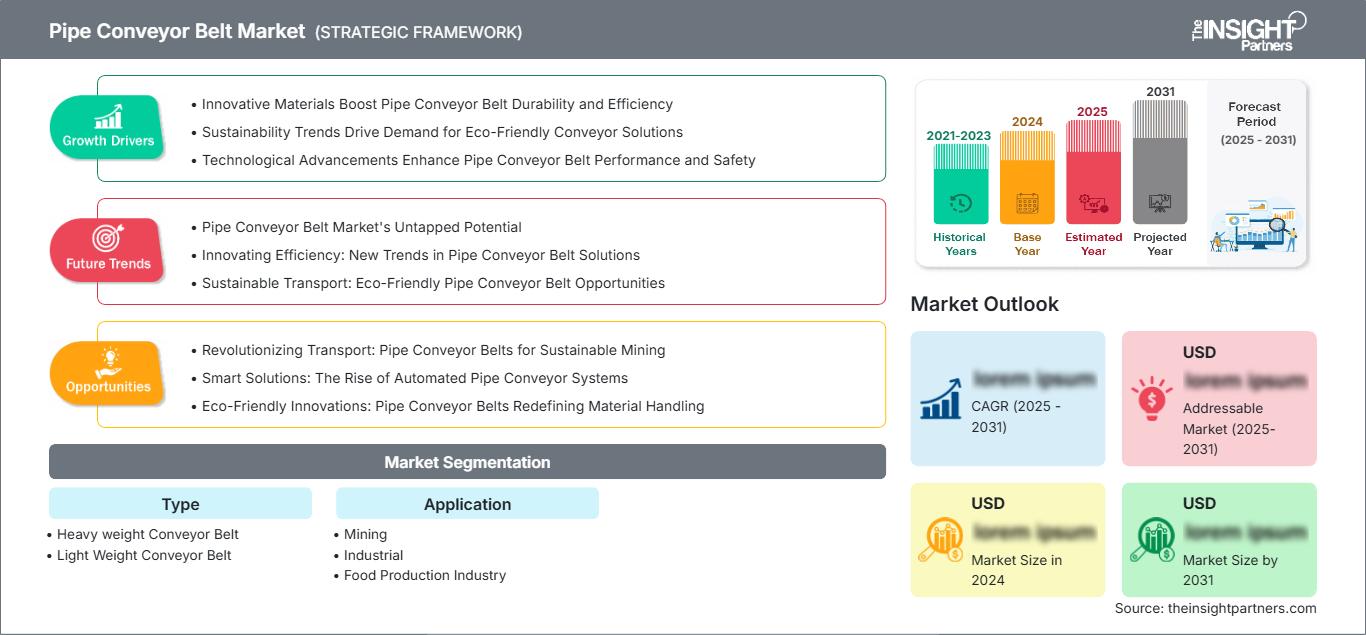
Pipe Conveyor Belt Market: Strategic Insights
Regional Insights
North America Pipe Conveyor Belt Market
North America accounted for 24–27% share in 2025, and the Pipe Conveyor Belt Market share is anchored by mining, aggregates, grain handling, and industrial modernization. Regional CAGR is estimated at 4.9–5.4% during 2026–2034 as users replace open conveyors with enclosed systems to reduce dust, spillage, and road-haul dependence.
Capital spending is concentrated in US minerals, Canadian resource corridors, and Mexican manufacturing clusters. Enclosed pipe belts are especially relevant where routing must pass near communities, rail crossings, or protected operating zones. Replacement cycles also favor higher-strength rubber and steel-cord designs that support longer runs and lower maintenance frequency.
U.S. Pipe Conveyor Belt Market
The U.S. Conveyor Belt Market represented 72–76% of North America in 2025 and is estimated to grow at a 5.0–5.5% CAGR through 2034. Demand is tied to aggregates, coal handling replacement, cement feedstock movement, parcel automation, and food-grade conveying, where enclosed routing limits contamination and improves housekeeping. Continued investment in bulk material handling infrastructure and warehouse automation is further supporting equipment replacement and system upgrades across key industries.
Company presence is strongest through global suppliers, distributors, and maintenance partners supporting mines, terminals, and factories. U.S. operators prioritize belt life, fire resistance, and sensor-based inspection because unplanned stoppages quickly affect throughput and operating costs. Logistics and warehousing demand adds a second growth layer as automated sortation expands across fulfillment networks. Growing use of predictive maintenance, condition monitoring, and conveyor automation technologies is also encouraging adoption of higher-performance belt systems that improve reliability, efficiency, and asset utilization.
Europe Pipe Conveyor Belt Market
Europe held 19–22% of the Conveyor Belt Market share in 2025 and is projected to expand at a 4.5–5.0% CAGR. Germany leads through cement, mining services, ports, and engineered industrial handling, while the UK emphasizes aggregates, recycling, and logistics upgrades. Demand in France, Italy, and Spain is underpinned by construction materials, food processing, and bulk movement by ports. Further development and modernization of production and logistics facilities are contributing to the continuation of replacement and upgrade programs.
Regulation of dust emissions, occupational health, and urban industrial route traffic encourages investments in enclosed conveying technology. European customers tend to take into account not only the performance of equipment, but also its energy efficiency, recyclability of conveyor belts, noise, and ease of maintenance. Such trends offer potential for specialized high-quality belts, lightweight conveyors for processing plants, and sophisticated monitoring technologies capable of proving the compliance of operations and improving productivity while reducing inspection efforts.
APAC Pipe Conveyor Belt Market
APAC captured 39–43% of the Conveyor Belt Market share in 2025 and is expected to grow at a 6.2–6.8% CAGR, making it the leading regional base. The demand in China is supported by logistics using coal, steel, cement, and industrial zones, while in India, demand is spurred by applications in mining, port terminals, and bulk handling infrastructure-related applications. The increase in production from the industry and investments in infrastructure will continue to drive high growth in the use of conveyor belts in the region.
Japan and South Korea focus on engineered belts for their manufacturing facilities, while Australia will be important for mining and the overland transport of ore. Policies supporting green transport systems and fewer trucks and automated industrial systems will further spur APAC demand. Manufacturing capacity within the country makes the projects economically feasible for pipe belts and other specialized conveyor belts. Furthermore, the use of smart monitoring systems is gaining prominence in the region.
Middle East & Africa Pipe Conveyor Belt Market
Middle East & Africa is estimated to grow at a 5.6–6.2% CAGR through 2034. Saudi Arabia and the UAE lead demand through mining diversification, ports, cement, and infrastructure megaprojects, while South Africa remains relevant for mineral handling and industrial replacement cycles.
Energy projects, phosphate movement, and construction material corridors support enclosed conveying because dust and heat exposure increase operating risk. The rest of MEA demand is project-based, but rising investment in bulk terminals and resource processing creates selective opportunities for durable, high-temperature, and abrasion-resistant pipe belt solutions.
Segmentation Analysis
Type
Type is projected to grow at a 5.4–5.9% CAGR during 2026–2034, with Pipe Conveyor Belt Market scope shaped by load intensity, route complexity, and operating environment. Heavy-weight belts dominate bulk material movement, while light-weight belts expand in facilities needing cleaner, compact, and faster conveying across packaged goods, food handling, and automated logistics.
- Heavy weight Conveyor Belt supports mining, cement, power, and bulk terminals where abrasion resistance, high tensile strength, and long operating life determine purchase decisions.
- Lightweight conveyor belts serve cleaner handling environments, including logistics and food production, where flexibility, hygiene, speed, and lower energy consumption are key selection criteria.
Application
Application is expected to advance at a 5.7–6.3% CAGR during 2026–2034 as end users shift from fragmented material transfer toward continuous enclosed movement. Mining remains the largest demand base, but industrial production, food processing, agriculture, and logistics/warehousing widen the addressable base by using pipe belts for cleaner routing and controlled throughput.
- Mining remains the core application because ores, coal, limestone, and aggregates require enclosed, high-capacity transport across difficult terrain with limited spillage.
- Industrial demand comes from cement, steel, chemicals, and utilities seeking continuous movement between crushers, storage areas, kilns, and processing lines.
- The food production industry uses lighter belt designs where hygiene, product containment, washability, and controlled transfer support safer and more consistent processing.
- Agriculture adoption is linked to grain, fertilizer, and feed movement, particularly where weather protection and dust reduction matter during storage and loading.
- Logistics/warehousing is the high-growth application as fulfillment centers and parcel hubs require compact enclosed routing, automation compatibility, and lower maintenance interruptions.
Opportunity Snapshot
| Application | Revenue Contribution | Trend Tag | Adoption Stage |
| Mining | High | Ore Routing | Mature |
| Industrial | High | Plant Retrofit | Scaling |
| Food Production Industry | Medium | Hygienic Flow | Scaling |
| Agriculture | Medium | Grain Shielding | Emerging |
| Logistics/warehousing | Medium | Parcel Automation | Scaling |
Pipe Conveyor Belt Market Growth Drivers and Impact Analysis
Dust-Control Regulations Accelerate Enclosed Bulk Handling
Industrial operators are under increasing pressure to limit fugitive dust, spillage, and worker exposure in mining, cement, ports, and agricultural terminals. Pipe belts provide a practical engineering response because the material is enclosed after loading and remains protected across curves, inclines, and long distances. The impact is strongest where truck haulage creates emissions, road maintenance costs, and community complaints. For the Pipe Conveyor Belt Market, this driver shifts procurement from conventional flat belts toward systems that support compliance, reduce cleanup labor, and improve permit acceptance for new or expanded material corridors.
Long-Distance Mining Routes Require Higher Reliability
Increasing haul distances has become necessary due to deepening, remoteness, or dispersion of deposits. Pipelike conveyor belts enable bulk material transportation through terrain that otherwise would necessitate construction of further towers, haul roads, or an open conveyor layout. It leads to better interconnection of pits, crushers, stockpiles, and rail load points. The business implication is an increased need for heavy-duty conveyor belts reinforced with steel cords, wear-resistant and flame-retardant. Those suppliers that can substantiate belt life in high-tension applications enjoy better positioning in major investment programs.
Automation Expands Demand Beyond Heavy Industry
The automation of logistics, food processing, and industrial production increases the customer base to include not only mining and cement customers. Conveyed belt paths allow facilities to transport materials or products in small spaces with reduced contamination and human handling. Factories are increasingly using conveyors with sensors, controls, and predictive maintenance software, making conveyor belt quality critical to system reliability. This creates increased demand for light-weight Conveyor Belts and specialized compounds. This allows for greater flexibility in revenue generation as replacement cycles occur in both heavy-duty and fast environments.
Pipe Conveyor Belt Market Future Trends
Sensor-Enabled Belt Health Monitoring
Pipe Conveyor Belt Market trends will increasingly center on embedded sensors, belt scanners, and condition-monitoring platforms that detect cord damage, cover wear, misalignment, and thermal risk before failure. These systems are expected to become part of procurement specifications for mines, ports, and large industrial plants because unplanned belt stoppage can interrupt entire production chains. Suppliers that combine durable belts with diagnostics and service analytics will create defensible value. The trend also supports outcome-based maintenance contracts, where buyers pay for reliability improvement rather than belt supply alone.
Lower-Energy Compounds and Recyclable Belt Structures
Energy efficiency will be increasingly highlighted with conveyor paths becoming longer and companies quantifying energy consumption throughout their material handling equipment. Low resistance covering materials, improved carcass design and recycle-friendly belts could lower operational expenses while helping meet the sustainability objectives of firms. The adoption is expected to start in areas where the cost of electricity is relatively higher and companies have more strict requirements on environmental reporting. Manufacturers who will be able to prove the energy-saving capabilities of their products via real data will have an advantage during tenders for ports, cement and mines-to-plant conveyor lines.
Pipe Conveyor Belt Market Opportunities
Mine-to-Port and Rail Yard Conveyor Corridors
Large resource economies are seeking alternatives to truck-intensive bulk movement between mines, stockyards, ports, and rail terminals. Pipe Conveyor Belt Market Forecasts indicate that enclosed corridors can capture investment where communities, fuel cost, land constraints, and emissions targets limit haul-road expansion. Suppliers should prioritize project developers, EPC contractors, and mining operators at early route-design stages, because belt diameter, curve radius, and cover compound decisions influence system economics. Strategic opportunities include bundled belt supply, installation supervision, splicing services, and long-term maintenance agreements tied to corridor uptime.
Food and Logistics Retrofit Programs
There is a trend in food processing and logistics companies towards modernization of their infrastructure in order to enhance sanitation, traceability, and efficiency without enlarging the square footage of buildings. Enclosed conveyors in smaller sizes allow movement of products along complicated routes without contamination and without manual transfers. Manufacturers of belt systems can exploit this trend by designing their products as washable, lightweight, modularly spliced, and services that ensure minimal downtime for the installation of new belts during scheduled downtimes. Cooperation with automation system integration partners is highly desirable due to the increased role of belt selection in automation system design.
Recent Developments
- April 2025: Zhejiang Double Arrow Rubber Co., Ltd. reported that its anti-tear flame-retardant steel cord pipe conveyor belt entered heavy-load testing for a Zouping City closed transportation project, covering 30 kilometers, 8 conveyor lines, a 600 millimeter diameter, and daily capacity of 43,000 tons.
- 2023: SIG successfully started an iconic steel cord pipe conveyor supply . It dealt with a 9km length item, with a tube diameter of 500mm, delivered to an important quarry in the Middle East.
- February 2022: Continental is taking another step towards predictive maintenance and condition monitoring in conveyor belt technology by launching the new Conti Load Sense monitoring system. The system is based on 2D radar technology and measures the material flow on the conveyor belt. It can be used in almost all industries where conveyor belt systems are in operation – for example as is currently the case in gravel extraction.
Frequently Asked Questions

- Comprehensive Market Sizing and Forecast Analysis
- Detailed Segmentation Analysis
- In-Depth Market Dynamics Assessment
- Regional and Country-Level Insights
- Competitive Landscape and Company Benchmarking
- Strategic Business Intelligence
Recent Reports
Testimonials

The Insight Partners' SCADA System Market report is comprehensive, with valuable insights on current trends and future forecasts. The team was highly professional, responsive, and supportive throughout. We are very satisfied and highly recommend their services.
RAN KEDEM Partner, Reali Technologies LTDs
I requested a report on a very specific software market and the team produced the report in a few days. The information was very relevant and well presented. I then requested some changes and additions to the report. The team was again very responsive and I got the final report in less than a week.
JEAN-HERVE JENN Chairman, Future Analytica
We worked with The Insight Partners for an important market study and forecast. They gave us clear insights into opportunities and risks, which helped shape our plans. Their research was easy to use and based on solid data. It helped us make smart, confident decisions. We highly recommend them.
PIYUSH NAGPAL Sr. Vice President, High Beam Global
The Insight Partners delivered insightful, well-structured market research with strong domain expertise. Their team was professional and responsive throughout. The user-friendly website made accessing industry reports seamless. We highly recommend them for reliable, high-quality research services
YUKIHIKO ADACHI CEO, Deep Blue, LLC.
This is the first time I have purchased a market report from The Insight Partners.While I was unsure at first, I visited their web site and felt more comfortable to take the risk and purchase a market report.I am completely satisfied with the quality of the report and customer service. I had several questions and comments with the initial report, but after a couple of dialogs over email with their analyst I believe I have a report that I can use as input to our strategic planning process.Thank you so much for taking the extra time and making this a positive experience.I will definitely recommend your service to others and you will be my first call when we need further market data.
JOHN SUZUKI President and Chief Executive Officer, Board Director, BK Technologies
I wish to appreciate your support and the professionalism you displayed in the course of attending to my request for information regarding to infectious disease IVD market in Nigeria. I appreciate your patience, your guidance, and the fact that you were willing to offer a discount, which eventually made it possible for us to close a deal. I look forward to engaging The Insight Partners in the future, all thanks to the impression you have created in me as a result of this first encounter.
DR CHIJIOKE ONYIA MANAGING DIRECTOR, PineCrest Healthcare Ltd.Reason to Buy
- Informed Decision-Making
- Understanding Market Dynamics
- Competitive Analysis
- Identifying Emerging Markets
- Customer Insights
- Market Forecasts
- Risk Mitigation
- Boosting Operational Efficiency
- Strategic Planning
- Investment Justification
- Tracking Industry Innovations
- Aligning with Regulatory Trends





 Get Free Sample for