
Pipeline Monitoring System Market Size, Growth & Trends by 2034
Coverage: by Technology (Ultrasonic Testing, PIGs, Smart Ball, and Others), and End-users (Oil & Gas, Manufacturing, Public Utilities, and Others), and Geography (North America, Europe, Asia Pacific, and South and Central America)
- Status : Data Released
- Report Code : TIPMC00002759
- Category : Manufacturing and Construction
- No. of Pages : 150
- Available Report Formats :


- Last update date : August 07, 2026


2025 Market Size
US$ 3.68 Bn
Base year value
2034 Forecast
US$ 6.78 Bn
Projected by 2034
CAGR 2026-2034
7.03 %
Growth rate
Addressable Market
US$ 47.24 Bn
(2026-2034)
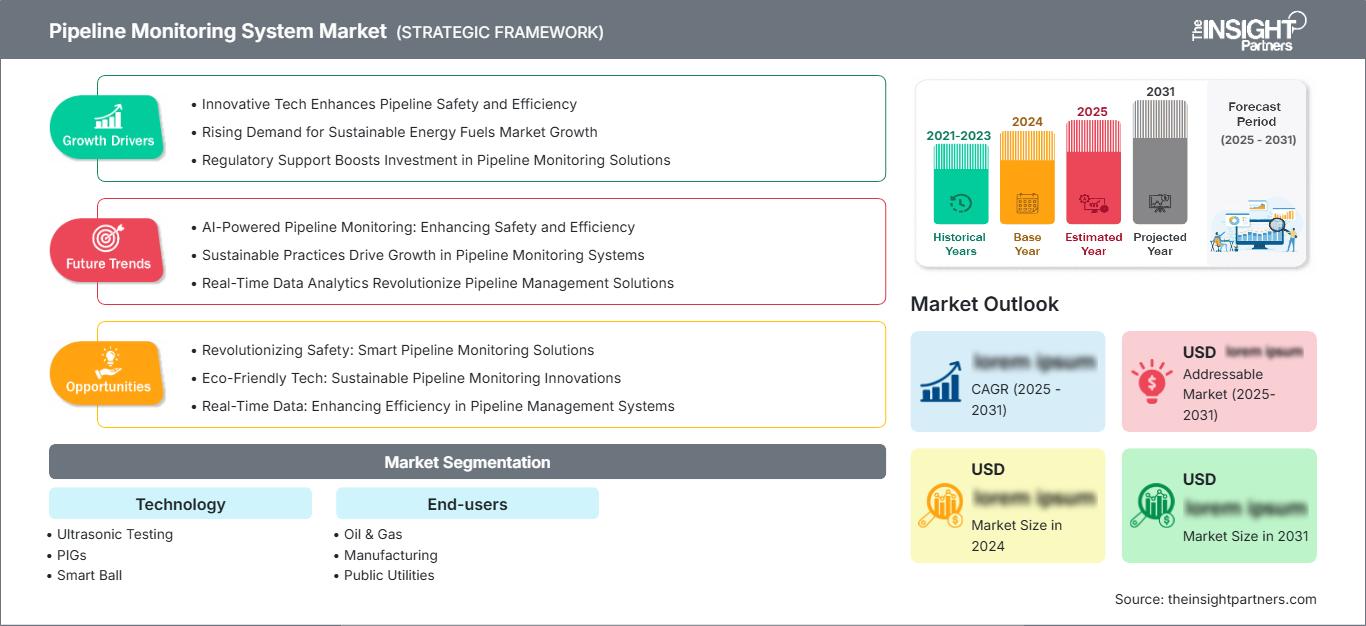
The Pipeline Monitoring System Market is projected to grow from US$ 3.68 Billion in 2025 to US$ 6.78 Billion by 2034, registering a CAGR of 7.03% during 2026–2034. Demand is being shaped by pipeline integrity mandates, real-time leak detection needs, and digital inspection adoption across oil and gas, manufacturing, and public utility networks.
Across North America, operators are prioritizing modernization of aging transmission assets, methane reduction programs, and compliance-led integrity management. The Pipeline Monitoring System Market size in the region is expected to expand at a 6.4–6.9% CAGR through 2034, supported by U.S. pipeline safety enforcement and Canadian long-distance energy transportation upgrades.
Pipeline Monitoring System Market Assessment and Insights
- North America accounted for 31–34% share in 2025 and is growing at a CAGR between 6.4–6.9% during 2026–2034, led by oil and gas integrity spending and utility leak control.
- US represented 78–82% of North America in 2025 and is growing at a CAGR between 6.5–7.0% during 2026–2034, supported by PHMSA compliance activity.
- Europe held 24–27% share in 2025 and is growing at a CAGR between 5.9–6.5% during 2026–2034, with Germany, the UK, France, Italy, and Spain leading deployments.
- Asia Pacific captured 26–29% share in 2025 and is growing at a CAGR between 7.6–8.4% during 2026–2034, driven by China, India, Japan, South Korea, and Australia.
- Largest Segment Oil & Gas held 57–61% market share in 2025, with a CAGR range of 6.7–7.3% during 2026–2034, reflecting long-haul transmission needs.
- High Growth Segment Public Utilities held 18–22% market share in 2025, with a CAGR range of 7.8–8.6% during 2026–2034, supported by water-loss reduction.
- Key companies analyzed in detail: BAE Systems plc, Huawei Technologies Co., Ltd., Pentair plc, ORBCOMM Inc., TC Energy Corporation, PSI Software SE, Pure Technologies Ltd., Honeywell International Inc., Perma-Pipe International Holdings, Inc., and Siemens AG.
Source: The Insight Partners' analysis based on proprietary research, government publications, company annual reports, investor presentations, industry databases, and expert interviews.
Pipeline integrity programs are shifting from inspection-based models towards continuous connectivity-based models. Ultrasonic testing has been key for verifying corrosion and pipe wall thickness, while PIGs help in conducting inspections in long transmission pipelines. The use of smart ball technology is increasing in instances where water utilities and pipelines with challenging accessibility requirements benefit from mobile acoustic leak detection. Hence, growth in this industry is tied to sensing efficiency, software integration, and reduced unplanned downtimes.
The future demand will largely depend on instances where expansion in the infrastructure coincides with stringent environmental oversight. Expansion of energy corridors will be seen in the Asia Pacific and the Middle East, while upgrading of aged assets will be seen in North America and Europe. Utilities will become even more significant customers with the onset of drought-related challenges, non-revenue water reduction initiatives, and urban resiliency budgets.
Pipeline Monitoring System Market Report Scope
| Report Attribute | Details |
|---|---|
| Market size in 2025 | US$ 3.68 Billion |
| Market Size by 2034 | US$ 6.78 Billion |
| Global CAGR (2026 - 2034) | 7.03% |
| Historical Data | 2021-2024 |
| Forecast period | 2026-2034 |
Pipeline Monitoring System Market Analysis
Demand will be driven by operators requiring advance notice of leakage, corrosion, third-party intervention, and pressure abnormalities. Growth in the market will be supplemented by higher environmental risks, increased reporting, and the cost of system downtime. The buyer requirements will increasingly be in terms of detection accuracy, false alarms, integration with SCADA and service during the life cycle.
The ecosystem consists of suppliers of sensors, inspection tools, communications tools, software for analytics, and engineering services companies. There will be a shift in supply due to demand for an integrated platform where operators can get inspection, alarms, mapping, and compliance all within the same system.
The competitive field remains mixed, with automation leaders, telecom suppliers, defense technology groups, and specialist inspection companies competing for brownfield upgrades and new pipeline projects. Honeywell International Inc., Siemens AG, Huawei Technologies Co., Ltd., and PSI Software SE are positioned around integrated control and analytics, while ORBCOMM Inc. supports remote asset connectivity.
Investment is moving toward predictive diagnostics and lower-maintenance field equipment. The market analysis indicates that procurement decisions increasingly depend on total cost of ownership, data ownership, response workflow, and compatibility with legacy assets. TC Energy Corporation, Pure Technologies Ltd., Perma-Pipe International Holdings, Inc., Pentair plc, and BAE Systems plc illustrate how operators and technology providers shape specialized deployment models.
● REPORT CUSTOMIZATION
Tailor This Report To Align With Your Specific Business Requirements
This report can be customized to align precisely with your business objectives, scope, and target markets. Customization options include tailored segmentation, geography, competitive analysis, and strategic insights to support informed decision-making.
Customize This Report →WHAT YOU CAN ADJUST
- ● Segmentations
- ● Geography
- ● Competitive Analysis
- ● Language Preferences
Pipeline Monitoring System Market: Strategic Insights
Regional Insights
North America Pipeline Monitoring System Market
North America held 31–34% share in 2025 and is projected to grow at a 6.4–6.9% CAGR during 2026–2034. The regional base is supported by mature oil and gas transmission networks, stringent pipeline safety enforcement, and rising investment in methane monitoring. The Pipeline Monitoring System Market share is also supported by utility modernization programs.
Operators are replacing manual inspection intervals with connected sensing and analytics across high-consequence areas. Canada contributes through long-distance energy infrastructure, while the U.S. remains the anchor for compliance-driven deployment. Demand is strongest for ultrasonic testing, in-line inspection, and remote monitoring platforms that shorten response times.
U.S. Pipeline Monitoring System Market
The U.S. represented 78–82% of the North American market in 2025 and is projected to register a CAGR of 6.5–7.0% during 2026–2034. Continuous robust spending on the modernization of the aging pipeline system, regulation adherence, and digital infrastructure will keep fueling market growth. A large number of crude oil pipelines, pipelines carrying other refined products, natural gas, and utility pipelines form a regular demand base for integrity management. The industry players provide a diverse set of technologies, including automation systems, satellite communications, IoT sensors, inspection services, and sophisticated leak detection software. These technologies are used in various fields like high-consequence area management, real-time pressure and flow monitoring, corrosion evaluation, predictive maintenance, and water loss management. Notable players of this market include Honeywell International Inc., Siemens AG, ORBCOMM Inc., and Pure Technologies Ltd.
Europe Pipeline Monitoring System Market
Europe accounted for 24–27% of the market in 2025 and is projected to expand at a CAGR of 5.9–6.5% during 2026–2034. Germany remains the leading national market, supported by extensive industrial pipeline networks, strong manufacturing activity, and investments tied to energy transition initiatives. Asset monitoring remains a key priority in the UK for offshore assets and gas pipelines. France, on its part, places focus on utility and industrial safety, as well as environmental risk minimization initiatives. Italy and Spain add their share of demand for services related to refining products, transportation, gas pipelines and ongoing water infrastructure improvement. European end users attach considerable value to environmental compliance, transparency of operations, asset inventory and reliability of the service provider. IoT-based pipeline monitoring, predictive analytics and the use of digital twins make the processes more efficient.
APAC Pipeline Monitoring System Market
APAC held 26–29% of the market in 2025 and is expected to grow at a robust CAGR of 7.6–8.4% during 2026–2034. China leads regional demand, driven by major natural gas pipeline expansion projects, rising petrochemical production capacity, and large-scale water transmission infrastructure investments. India, Japan, South Korea, and Australia are also ramping up investment in safety surveillance equipment, industrial automation solutions, and utility infrastructure strengthening. Energy security goals, urban water loss reduction goals, environmental protections, and industrial safety requirements are just some of the important policies that are fueling this market. This market is gaining traction as utilities embrace scalable solutions that combine field sensors, SCADA systems, cloud-based integration, and analytics for asset visibility in real time. The greatest growth potential exists in those markets that offer opportunities to deploy these solutions from the design phase of new pipeline constructions.
Middle East & Africa Pipeline Monitoring System Market
The Middle East & Africa is projected to grow at a CAGR of 6.8–7.5% during 2026–2034, supported by ongoing investments in energy transportation, utility infrastructure, and industrial modernization. Saudi Arabia is at the forefront of regional deployment with respect to its elaborate network of oil, gas, and petrochemical pipelines, while the UAE concentrates more on developing infrastructure reliability and predictive maintenance. The role of South Africa, together with other MEA nations, is demand-led via fuel pipeline transport, water utilities, and industrial infrastructure. The requirements for long-haul exports of energy, the harshness of desert terrain, and remote operations make automation, leakage detection, and remote asset management solutions increasingly important in the region. There is also the benefit of major water transportation initiatives, desalination infrastructure projects, and industrial zone development that requires pipeline integrity management. The increasing adoption of IoT technologies, satellite communication, and analytics technologies helps with improving visibility and minimize downtime. The key for vendors will be ruggedized solutions, regional technical expertise, and partnerships.
Segmentation Analysis
Technology
Technology is projected to grow at a 6.9–7.6% CAGR during 2026–2034 as buyers combine inspection hardware with analytics and field communications. The market scope is widening from standalone leak detection to integrated integrity workflows covering corrosion, pressure events, and predictive maintenance.
- Ultrasonic Testing remains important for wall-thickness measurement, corrosion detection, and weld inspection, especially where operators need high-resolution condition assessment without disrupting continuous pipeline operations.
- PIGs support internal inspection across long pipeline routes, helping operators identify geometry changes, metal loss, cracks, and debris accumulation before failures affect throughput or safety.
- Smart Ball systems are suited to water and difficult-access pipelines because they provide mobile acoustic leak detection with limited shutdown requirements and flexible deployment across complex networks.
End-users
End-users are projected to grow at a 7.0–7.7% CAGR during 2026–2034, led by energy operators but increasingly supported by utilities and manufacturing sites. Adoption is strongest where pipeline failure affects safety, regulatory exposure, environmental costs, and production continuity. The Pipeline Monitoring System Market forecast reflects rising adoption across sectors requiring continuous asset visibility and risk mitigation.
- Oil & Gas remains the dominant end-user group because transmission, gathering, refinery, and distribution assets require continuous integrity assurance across high-pressure and high-value operating environments.
- Manufacturing uses monitoring for process pipelines carrying chemicals, fuels, gases, and water, with demand tied to safety compliance, uptime protection, and plant automation programs.
- Public Utilities are increasing adoption to reduce non-revenue water, detect hidden leaks, prioritize repairs, and protect service continuity across aging municipal distribution networks.
Opportunity Snapshot
| End-users | Revenue Contribution | Trend Tag | Adoption Stage |
| Oil & Gas | High | Methane Control | Mature |
| Manufacturing | Medium | Plant Safety | Scaling |
| Public Utilities | Medium | Water Loss | Scaling |
Pipeline Monitoring System Market Growth Drivers and Impact Analysis
Regulatory Pressure on Pipeline Integrity
Reporting requirements have become stricter for pipeline operators in regard to leak response, integrity management, and environmental protection. In North America and Europe, regulations call for risk-based inspection, documentation, and rapid remediation of pipeline defects in high-consequence areas. The result is that pipeline monitoring becomes an obligation, not an optional expenditure on capital infrastructure. The advantage for the market is that pipeline operators now require auditability, automated notification, and reliable inspection procedures. The practical significance is seen through greater demand for ultrasonic testing, PIG inspection, and remote monitoring equipment.
Aging Infrastructure and Rising Failure Costs
Previous pipeline systems are more vulnerable to corrosion, soil movement, unauthorized tapping, pressure fluctuations, and fatigue. Given that failure consequences will be higher due to loss of materials, labor to fix the problem, clean-up cost, penalty, and reputational damage, the industry is opting to inspect pipelines more often and move toward predictive maintenance. The growth opportunities for the market benefit from this business rationale since detecting issues early on is cheaper than reacting to an emergency situation.
Digital Integration Across Remote Assets
Pipeline systems often operate across remote terrain, offshore routes, industrial zones, and urban corridors where manual inspection is costly or slow. Integration of field sensors, satellite communication, SCADA, and analytics improves event visibility and decision-making. Vendors that combine secure communications with inspection intelligence can shorten alarm-to-action cycles. The Pipeline Monitoring System Market is therefore being shaped by connected platforms rather than isolated devices. This driver is especially important for gas transmission, water utilities, and cross-border energy corridors requiring continuous asset awareness.
Pipeline Monitoring System Market Future Trends
Predictive Integrity Platforms
The next phase of the Pipeline Monitoring System Market trends will center on predictive integrity platforms that combine inspection data, operating history, weather exposure, and geospatial risk. Instead of treating leak detection as an alarm function, operators will use analytics to rank assets, schedule inspections, and prioritize repairs. This will favor suppliers with software depth, data governance capability, and domain-specific algorithms that reduce false alarms while improving confidence in maintenance planning.
Monitoring for Hydrogen and Carbon Networks
Hydrogen transport and carbon capture networks will create new inspection requirements because material compatibility, pressure behavior, and leak characteristics differ from conventional hydrocarbons. Operators will need monitoring systems calibrated for new molecules, dense-phase carbon dioxide, and repurposed pipeline corridors. The Pipeline Monitoring System Market will benefit where energy transition infrastructure moves from the pilot stage to commercial networks, especially in Europe, North America, and selected Middle Eastern industrial clusters.
Pipeline Monitoring System Market Opportunities
Utility Network Modernization
Water and wastewater utilities present a practical growth opportunity as cities confront leakage, service interruptions, and constrained capital budgets. Monitoring systems that locate leaks precisely can help utilities prioritize repairs and reduce non-revenue water without replacing entire networks. Vendors can win by offering modular deployments, subscription analytics, and field services suitable for municipal procurement. The Pipeline Monitoring System Market is positioned to expand as utility resilience becomes tied to climate adaptation and infrastructure funding programs.
Integrated Inspection-as-a-Service Models
Many operators lack specialized teams to interpret inspection signals, maintain field equipment, and integrate monitoring outputs with maintenance planning. This creates room for service-led models that bundle sensors, analytics, reporting, and periodic integrity reviews. Suppliers can reduce customer adoption barriers by converting large capital purchases into phased operating contracts. The Pipeline Monitoring System Market can gain from this approach in mid-sized utilities, industrial sites, and regional oil and gas operators that need expertise without building internal monitoring centers.
Recent Developments
- July 2026: KROHNE introduces PipePatrol NEO, a new comprehensive solution for leak detection, theft detection and pipeline monitoring. At the core of the system is NEPM (Neural Engine Pipeline Monitoring), KROHNE’s next-generation technology for continuous internal pipeline monitoring. The system combines artificial intelligence with proven physical models, providing an effective way to manage the complex risks of modern pipelines – from corrosion and equipment failure to third-party interference, illegal tapping, and environmental impacts.
- April 2025: ABB India Ltd has successfully delivered an integrated scope of advanced automation and digital solutions for Indian Oil Corporation Ltd.’s (IndianOil) countrywide oil and gas pipeline network. ABB’s solutions will be at the core of supporting IndianOil’s Centralized Pipeline Information Management System (CPIMS). The project involved the design, engineering, supply and commissioning of the ABB Ability SCADAvantage digital platform, which features robust cyber security and disaster recovery systems hosted on the cloud.
- February 2024: GPT Industries has announced the launch of its remote pipeline monitoring system, Iso-Smart. Iso-Smart is an all-in-one solution developed based on customer feedback for checking Cathodic Protection (on and instant off potentials), Isolation, Bond currents, AC vs. DC on the line, and more from remote locations. It incorporates True RMS technology to provide reliable data, helping pipeline owners make informed decisions and comply with DOT pipeline integrity regulations.
Frequently Asked Questions

- Comprehensive Market Sizing and Forecast Analysis
- Detailed Segmentation Analysis
- In-Depth Market Dynamics Assessment
- Regional and Country-Level Insights
- Competitive Landscape and Company Benchmarking
- Strategic Business Intelligence
Recent Reports
Testimonials

The Insight Partners' SCADA System Market report is comprehensive, with valuable insights on current trends and future forecasts. The team was highly professional, responsive, and supportive throughout. We are very satisfied and highly recommend their services.
RAN KEDEM Partner, Reali Technologies LTDs
I requested a report on a very specific software market and the team produced the report in a few days. The information was very relevant and well presented. I then requested some changes and additions to the report. The team was again very responsive and I got the final report in less than a week.
JEAN-HERVE JENN Chairman, Future Analytica
We worked with The Insight Partners for an important market study and forecast. They gave us clear insights into opportunities and risks, which helped shape our plans. Their research was easy to use and based on solid data. It helped us make smart, confident decisions. We highly recommend them.
PIYUSH NAGPAL Sr. Vice President, High Beam Global
The Insight Partners delivered insightful, well-structured market research with strong domain expertise. Their team was professional and responsive throughout. The user-friendly website made accessing industry reports seamless. We highly recommend them for reliable, high-quality research services
YUKIHIKO ADACHI CEO, Deep Blue, LLC.
This is the first time I have purchased a market report from The Insight Partners.While I was unsure at first, I visited their web site and felt more comfortable to take the risk and purchase a market report.I am completely satisfied with the quality of the report and customer service. I had several questions and comments with the initial report, but after a couple of dialogs over email with their analyst I believe I have a report that I can use as input to our strategic planning process.Thank you so much for taking the extra time and making this a positive experience.I will definitely recommend your service to others and you will be my first call when we need further market data.
JOHN SUZUKI President and Chief Executive Officer, Board Director, BK Technologies
I wish to appreciate your support and the professionalism you displayed in the course of attending to my request for information regarding to infectious disease IVD market in Nigeria. I appreciate your patience, your guidance, and the fact that you were willing to offer a discount, which eventually made it possible for us to close a deal. I look forward to engaging The Insight Partners in the future, all thanks to the impression you have created in me as a result of this first encounter.
DR CHIJIOKE ONYIA MANAGING DIRECTOR, PineCrest Healthcare Ltd.Reason to Buy
- Informed Decision-Making
- Understanding Market Dynamics
- Competitive Analysis
- Identifying Emerging Markets
- Customer Insights
- Market Forecasts
- Risk Mitigation
- Boosting Operational Efficiency
- Strategic Planning
- Investment Justification
- Tracking Industry Innovations
- Aligning with Regulatory Trends





 Get Free Sample for