
Planetary Mixers Market Size, Growth & Trends by 2034
Coverage: by Type (Single Planetary Mixers, Double Planetary Mixers); End-user (Chemicals, Food, Pharmaceuticals, Others) , and Geography (North America, Europe, Asia Pacific, and South and Central America)
- Status : Data Released
- Report Code : TIPRE00010146
- Category : Manufacturing and Construction
- No. of Pages : 150
- Available Report Formats :


- Last update date : September 29, 2026


2025 Market Size
US$ 255.99 Bn
Base year value
2034 Forecast
US$ 343.74 Bn
Projected by 2034
CAGR 2026-2034
3.33 %
Growth rate
Addressable Market
US$ 2,723.64 Bn
(2026-2034)
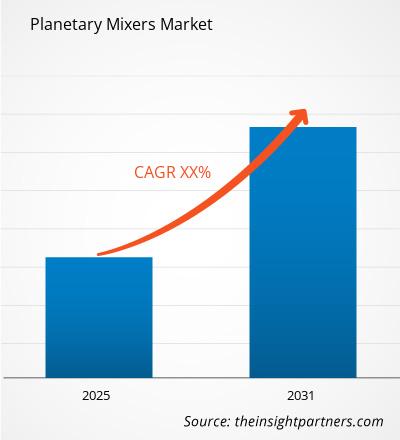
The planetary mixers market size was valued at US$ 255.99 Billion in 2025 and is projected to reach US$ 343.74 Billion by 2034, registering a CAGR of 3.33% during 2026-2034. The market covers equipment that uses planetary motion for controlled mixing, blending, kneading, and processing of viscous or complex formulations, with the scope segmented by Type into Single Planetary Mixers and Double Planetary Mixers and by End-user into Chemicals, Food, and Pharmaceuticals.
North America accounted for an estimated 31.8% of the global planetary mixers market in 2025 and is expected to expand at a 3.05% CAGR through 2034. Demand is supported by established pharmaceutical manufacturing, processed-food production, and specialty chemical processing, where batch consistency, hygienic construction, recipe repeatability, and increasingly automated process control influence equipment procurement.
Planetary Mixers Market Assessment and Insights
- North America: An estimated 31.8% global planetary mixers market share in 2025 and 3.05% CAGR reflect mature pharmaceutical, food, and chemical processing infrastructure; established equipment replacement and automation demand support sustained adoption despite slower expansion than emerging manufacturing regions.
- U.S.: The U.S. represented an estimated 78.0% of North America's market in 2025 and is expected to grow at 2.92% CAGR, supported by pharmaceutical formulation, specialty chemicals, bakery processing, and automated batch production.
- Europe: Europe held an estimated 27.4% global share in 2025 and is projected to grow at 2.76% CAGR, led by Germany, France, Italy, the UK, and Spain, with hygienic engineering, process efficiency, and established equipment manufacturing differentiating demand.
- Asia Pacific: Asia Pacific represented an estimated 28.9% global share in 2025 and is projected to grow at 4.12% CAGR, led by China, with pharmaceutical, food processing, specialty chemicals, and manufacturing localization providing the principal demand base.
- Largest Segment: Double Planetary Mixers are the largest Type segment and are estimated to grow at a 3.15% CAGR from 2026-2034 because their multi-tool configuration supports intensive processing of high-viscosity and demanding formulations.
- High Growth Segment: Single Planetary Mixers are estimated to register a 3.58% CAGR from 2026-2034 as manufacturers seek flexible equipment for smaller batches, recipe changes, food processing, and applications requiring comparatively straightforward mixing configurations.
- Key companies analyzed in detail: Charles Ross & Son Company; Custom Milling & Consulting, Inc.; Electrolux Professional AB; Ferneto S.A.; Li Yuan Machine Industrial Pte. Ltd.; Moffat Group Pty Ltd; Sammic S.L.; Starmix S.r.l.; Univex Corporation; VMI, a LINXIS Group company.
Source: The Insight Partners' analysis based on proprietary research, government publications, company annual reports, investor presentations, industry databases, and expert interviews.
planetary mixers market continue to evolve from mechanically operated batch equipment to become more controllable, sanitary, and application-specific processing units. Variable speed control, programmable recipes, changeable tools, scraper enhancements, stainless steel construction, and vacuum or temperature control features are increasingly being developed to meet demands for process repeatability and formulation complexity. Within pharmaceutical and chemical processing, the capacity of managing high viscosity and powdery formulations becomes very important, while food processors tend to favor sanitation, ergonomic design, and consistent characteristics of the dough or cream. Modern equipment design is therefore increasingly aimed at combining good mechanical mixing capabilities with digital recipes and process integration.
Future demand trends in the planetary mixers market are increasingly expected to depend on investments into local pharmaceutical, food, and specialty chemical manufacturing capacities. Incremental capacity growth in the region will ensure the development of equipment demand in Asia Pacific, while replacement, automation, energy savings, and hygiene improvement will be main drivers of North America and Europe markets. Increasing regulatory pressure related to product consistency, cleaning and contamination prevention, and traceability is expected to drive equipment specifications with recipes documentation and process repeatability. Local production and servicing capacity will reduce lead-time and maintenance obstacles for batch processing facilities.
Planetary Mixers Market Report Scope
| Report Attribute | Details |
|---|---|
| Market size in 2025 | US$ 255.99 Billion |
| Market Size by 2034 | US$ 343.74 Billion |
| Global CAGR (2026 - 2034) | 3.33% |
| Historical Data | 2021-2024 |
| Forecast period | 2026-2034 |
Planetary Mixers Market Analysis
Planetary mixers’ demand is strongly associated with the necessity of processing such products that are viscous, shear-sensitive, filled with powder or have complex formulation. In pharmaceutical or specialty chemicals production industries there is a need for controlled processing of pastes, creams and compounds, while in the food industry – planetary mixing is used for doughs, creams, fillings, sauces and confections. This way the demand chain is formed from the complexity of the product formulation to equipment choice, where factors such as viscosity, size of the batches, sanitation, configuration of the tools and automation affect purchasing criteria. Equipment manufactures, motors and drives producers, bowls and tools makers, automation companies and services impact delivery economics.
The conditions for supply in the planetary mixers market are dependent upon the fabrication of stainless steel, precision gear, motors, drives, control, mixers, lifters, and seal components. There is a growing preference among buyers for suppliers who can tailor these components to fit into a particular process as opposed to just providing a general-purpose machine. Manufacturers that are able to test their machines through application and have access to various tool kits will gain the upper hand. The inclusion of vacuum, heat, cold, and scraper in the case of viscous applications could significantly affect the specification of equipment used.
Competitive environment in the planetary mixers market includes industrial mixers specialists and food equipment companies with planetary mixers for professional and production kitchen applications. Charles Ross & Son Company and VMI specialize in high tech solutions when viscous processing, vacuum operations, formulation, and integration capabilities matter. Custom Milling & Consulting supplements the competitive environment through processing knowledge, whereas Electrolux Professional and Sammic have positions closer to professional food preparation and commercial processing needs. This generates competition not only based on equipment features but also on engineering tailored to particular application instead of mere machine cost.
The planetary mixers market trends show that capital investment is shifting towards automation, hygiene, modularity, process control, and manufacturing flexibility. Those suppliers who are able to offer programmable cycles, different types of tools, sanitary design, and scalability will be able to cover more customer needs. Geographical positioning is important since pharmaceutical and food producers pay much attention to local service availability and spare parts support. Such companies like Ferneto, Moffat Group, Univex, and VMI could be distinguished due to their specialization in applications and geographic channels of distribution. On the other hand, industrial specialists could compete with the help of customization and process engineering.
● REPORT CUSTOMIZATION
Tailor This Report To Align With Your Specific Business Requirements
This report can be customized to align precisely with your business objectives, scope, and target markets. Customization options include tailored segmentation, geography, competitive analysis, and strategic insights to support informed decision-making.
Customize This Report →WHAT YOU CAN ADJUST
- ● Segmentations
- ● Geography
- ● Competitive Analysis
- ● Language Preferences
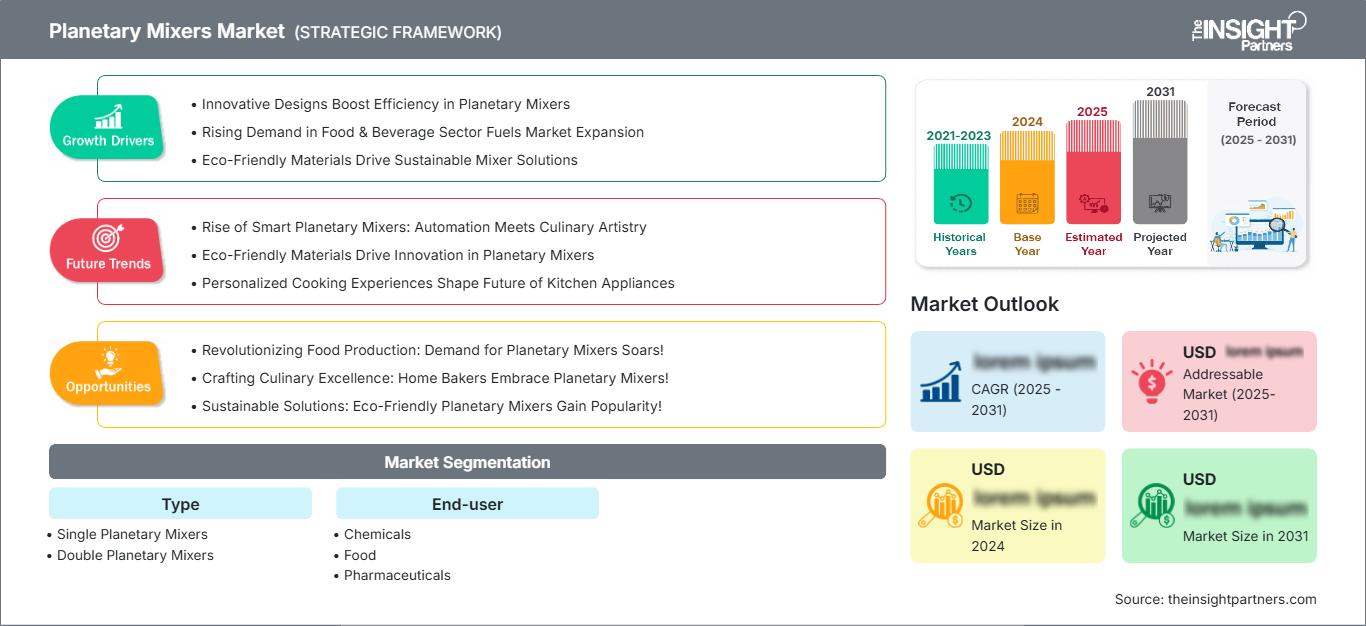
Planetary Mixers Market: Strategic Insights
Regional Insights
North America Planetary Mixers Market
North America held an estimated 31.8% of the global planetary mixers market in 2025 and is projected to grow at a 3.05% CAGR through 2034. There is an existing presence of manufacturing activities in pharmaceuticals, foods, baked goods, specialty chemicals, and formulated materials. Buyers now assess mixers on the basis of sanitation, reproducibility of batches, automation of recipes, maintenance, and ability to integrate into the current control systems of production.
The United States is the leader in the regional market as a result of being the largest manufacturer of pharmaceuticals and processed food, in addition to the largest supplier of specialized equipment. Canada is responsible for increasing demand due to food processing and industrial manufacturing, whereas Mexico profits from increased manufacturing capacity and food processing capability. The supply environment consists of industrial manufacturers and application-focused suppliers that serve food and pharmaceutical customers.
U.S. Planetary Mixers Market
The U.S. represented an estimated 78.0% of North America's planetary mixers market in 2025 and is expected to grow at a 2.92% CAGR. Diversification in pharmaceutical formulations, specialty chemicals, bakery products, confectionery, sauces, and processed foods makes for a varied end-user base. Equipment that provides repeatable batch runs, cleanability, flexibility in tooling, and interfacing with automation is favored.
The American market is characterized by technical process engineering along with a need for equipment replacement. Charles Ross & Son Company and Custom Milling & Consulting provide their services in technologically sophisticated applications of mixing and processing, while Univex Corporation caters to food equipment applications. The investment emphasis shifts from expansion of capacity to productivity, safety, repeatability, and reduced operator involvement.
Europe Planetary Mixers Market
Europe accounted for an estimated 27.4% global share in 2025 and is projected to grow at a 2.76% CAGR. Germany provides a strong industrial and engineering base, while France, Italy, the UK, and Spain contribute through food processing, pharmaceuticals, chemicals, bakery production, and specialized machinery manufacturing. Germany is the leading country within the region because of its concentration of industrial equipment expertise and process-manufacturing customers.
In the UK and France, there is a concentration on pharma and specialty formulations as well as food applications. In the cases of Italy and Spain, there is an important bakery, confectionary, and food processing market for our products. Hygiene, energy savings, safety, repeatability, and documentation of equipment are key aspects considered by our European customers. Both Ferneto and Starmix cater to food applications, whereas VMI brings the industrial and pharmaceutical aspects to the table.
APAC Planetary Mixers Market
Asia Pacific represented an estimated 28.9% of the global planetary mixers market in 2025 and is projected to register a 4.12% CAGR. China is the regional leader, supported by extensive food, pharmaceutical, chemical, and manufacturing capacity. Japan and South Korea add demand from high-quality industrial and pharmaceutical production, while India benefits from expanding food and pharmaceutical processing.
Australia represents a smaller but established demand center focused on food processing and commercial production. Regional growth is linked to manufacturing localization, rising processed-food output, pharmaceutical capacity additions, and modernization of batch-processing equipment. Li Yuan Machine Industrial and other Asian equipment suppliers benefit from proximity to regional customers, while international suppliers compete through specialized technology and application engineering.
Middle East & Africa Planetary Mixers Market
The planetary mixers market report shows that Middle East and Africa represented an estimated 6.6% of the global market in 2025 and is projected to grow at a 4.05% CAGR. Saudi Arabia and the UAE are important demand centers because food manufacturing, pharmaceutical localization, industrial diversification, and new processing facilities are increasing the requirement for modern mixing equipment. South Africa provides an established food and pharmaceutical processing base.
Across the rest of the region, investment in local food production and manufacturing infrastructure supports gradual equipment adoption. Buyers remain sensitive to equipment reliability, service availability, import lead times, and spare-parts access. Regional localization initiatives can favor suppliers that establish distributor, service, or manufacturing relationships close to customers.
South & Central America Planetary Mixers Market
South and Central America accounted for an estimated 5.3% of the global planetary mixers market in 2025 and is projected to grow at a 3.88% CAGR. Brazil leads regional demand through its large food-processing, pharmaceutical, and chemical industries, while Argentina contributes through food manufacturing and industrial processing.
The region's adoption remains influenced by equipment import dependence, currency conditions, financing availability, and local technical support. Suppliers with regional distributors and service capabilities can reduce procurement barriers. Food processing remains an important application base, while pharmaceutical and specialty chemical investments create demand for more controlled and hygienic mixing configurations.
Segmentation Analysis
Single Planetary Mixers
Single Planetary Mixers are estimated to register a 3.58% CAGR from 2026-2034. Their simpler configuration supports flexible batch processing across food preparation, bakery, pharmaceutical, and selected chemical applications. Demand is reinforced by buyers seeking equipment that accommodates recipe changes and moderate production requirements without the complexity of multi-tool systems. Future adoption should benefit from programmable controls, hygienic construction, interchangeable attachments, and improved operator ergonomics.
- Single Planetary Mixers: Their single planetary motion provides adaptable mixing and kneading for food formulations and selected industrial products, with flexibility and comparatively straightforward operation supporting adoption among varied batch processors.
- Single Planetary Mixers: Food and bakery users value interchangeable tools and controllable speeds, while pharmaceutical and specialty users prioritize cleanability, repeatable recipes, and compatibility with smaller or variable production batches.
Double Planetary Mixers
Double Planetary Mixers are estimated to grow at a 3.15% CAGR from 2026-2034 and represent the largest Type segment. Their multiple-tool configuration is suited to intensive processing of high-viscosity, filled, pasty, or difficult-to-mix materials. Pharmaceutical, chemical, adhesive, and specialized food processors value their ability to combine mixing actions within controlled batches. Demand should remain supported by application-specific tooling and vacuum, heating, or cooling integration.
- Double Planetary Mixers: Multiple mixing elements intensify material turnover and improve processing of viscous formulations, making the configuration important for specialty chemicals, pharmaceutical products, and demanding food applications.
- Double Planetary Mixers: Industrial buyers often prioritize vacuum capability, temperature management, scraper integration, and customized tooling when processing products whose viscosity or solids loading limits conventional agitation.
Chemicals
Chemicals is estimated to register a 3.20% CAGR from 2026-2034. The segment includes specialty and formulated chemical products requiring controlled dispersion, blending, kneading, and processing of viscous materials. Demand is influenced by formulation complexity, filler loading, temperature control, and batch reproducibility. Equipment suppliers with engineered tooling, vacuum capability, and robust construction are positioned to address demanding chemical applications.
- Chemicals: Specialty chemical formulations create demand for mixers capable of handling high viscosity, mineral fillers, pigments, pastes, and other difficult materials while maintaining batch consistency.
- Chemicals: Buyers emphasize abrasion resistance, process control, thermal management, and equipment durability where aggressive formulations and extended production cycles increase mechanical requirements.
Food
Food is estimated to grow at a 3.48% CAGR from 2026-2034 and remains a major application base for planetary mixers. Bakery, confectionery, sauces, creams, fillings, and prepared foods require repeatable texture and ingredient distribution. Hygiene, easy cleaning, operator safety, interchangeable tools, and recipe control influence purchasing decisions. Demand is also supported by modernization of commercial and industrial food-processing facilities.
- Food: Bakery and prepared-food producers use planetary motion for doughs, creams, fillings, sauces, and confectionery products where texture consistency and controlled batch preparation are essential.
- Food: Commercial users favor compact, ergonomic systems, while larger processors prioritize stainless-steel hygiene, programmable cycles, tooling flexibility, and integration into broader food-production workflows.
Pharmaceuticals
Pharmaceuticals is estimated to register a 3.31% CAGR from 2026-2034. The segment requires controlled processing, repeatable formulations, hygienic surfaces, and equipment configurations that support contamination control. Planetary mixers are relevant to creams, ointments, pastes, and other formulation stages where high viscosity can constrain conventional mixing. Adoption should increasingly favor systems offering recipe management, cleanability, controlled environments, and process documentation.
- Pharmaceuticals: Formulation manufacturers require consistent blending and kneading of viscous products, with hygienic design and controlled processing supporting repeatability across production batches.
- Pharmaceuticals: Equipment selection is strongly influenced by cleanability, material compatibility, containment requirements, validated process parameters, and integration with pharmaceutical manufacturing controls.
Opportunity Snapshot
| End-user | Revenue Contribution | Trend Tag | Adoption Stage |
|---|---|---|---|
| Chemicals | High | Viscosity Processing | Mature |
| Food | High | Recipe Control | Mature |
| Pharmaceuticals | Medium | Hygienic Processing | Scaling |
Planetary Mixers Market Growth Drivers and Impact Analysis
Rising demand for controlled high-viscosity processing
Demand for planetary mixers is strengthened by applications in which conventional agitators struggle to achieve uniform processing of viscous, pasty, powder-rich, or filled formulations. Chemical producers, pharmaceutical formulators, and specialty food processors increasingly require controlled batch conditions because viscosity, solids loading, and temperature can materially affect product quality. Planetary motion addresses this requirement by combining orbital movement with tool rotation, improving material turnover within the vessel. As formulation complexity rises, buyers are more likely to specify interchangeable tools, scraper systems, vacuum capability, and programmable operating cycles. The strategic implication is increased value per installation for suppliers able to engineer mixers around specific rheology, tooling, thermal, and sanitation requirements rather than offering standardized equipment alone.
Automation and recipe repeatability in batch manufacturing
Automation is becoming a more important purchasing criterion as food, pharmaceutical, and chemical manufacturers seek consistent batches with lower dependence on manual operator intervention. Programmable speeds, recipe storage, automated ingredient handling, controlled mixing durations, and integration with plant-level systems can reduce variation between production runs. The mechanism is straightforward: greater process repeatability improves product consistency, simplifies operator training, and creates more predictable production cycles. Planetary mixer suppliers that combine mechanical performance with digital controls can therefore participate in modernization projects rather than only replacement purchases. The implication extends across both mature and emerging regions because manufacturers can use automation to compensate for labor constraints while improving traceability and process control.
Hygiene, product quality, and equipment modernization
Food and pharmaceutical manufacturers are placing greater emphasis on hygienic equipment construction, accessible cleaning, controlled surfaces, and repeatable processing conditions. Stainless-steel contact components, removable or optimized tooling, enclosed operating areas, and recipe-controlled cycles reduce contamination and process-variation risks. These requirements influence equipment replacement decisions even when existing mixers remain mechanically functional because older machines may lack modern control, sanitation, or operator-safety features. The resulting market mechanism is a shift from capacity-only purchasing toward total process suitability. Suppliers capable of combining hygienic design with efficient tooling, monitoring, and maintenance access can benefit from modernization programs across established processing clusters in North America, Europe, and Asia Pacific.
Planetary Mixers Market Future Trends
Digital recipe control becomes integral to mixer design
The planetary mixers market forecast shows that planetary mixers are increasingly incorporating digital interfaces, programmable cycles, recipe storage, variable-speed operation, and automated process sequences. The shift is occurring because food and pharmaceutical manufacturers need repeatable batches while managing more formulations and shorter production changeovers. Operators benefit from standardized processing parameters, while plant managers gain greater control over production consistency and equipment utilization. The change affects equipment manufacturers because controls and software are becoming part of the competitive specification alongside motor power and mechanical construction. Over time, planetary mixers are likely to become more tightly integrated with upstream ingredient handling and downstream filling or packaging systems, creating greater demand for interoperable controls and process-data connectivity.
Application-specific tooling reshapes equipment competition
Competition is moving toward application-specific configurations as manufacturers process increasingly diverse materials with different viscosity, solids content, temperature sensitivity, and mixing requirements. Rather than relying on one generic tool, users can select interchangeable mixing elements, scrapers, emulsifying devices, or specialized attachments according to the formulation. This trend is particularly relevant to contract processors and manufacturers producing multiple product families in the same facility. Equipment suppliers are affected because broader tooling portfolios and application testing can strengthen customer retention and expand addressable use cases. The likely implication is greater differentiation around process engineering, tooling design, and technical support, with machine architecture becoming more modular to accommodate changing formulations.
Planetary Mixers Market Opportunities
Localized equipment and service ecosystems in Asia Pacific
Asia Pacific offers an opportunity for suppliers to establish stronger local manufacturing, application-engineering, and service networks around pharmaceutical, food, and specialty chemical production. China and India provide large processing ecosystems, while Japan and South Korea offer sophisticated manufacturing environments requiring precision equipment. The principal barrier is not only equipment cost but also installation support, spare-parts availability, process validation, and technical response times. Suppliers can address this gap through regional service centers, distributor partnerships, local component sourcing, and application laboratories. The beneficiaries are equipment manufacturers able to shorten delivery cycles and tailor planetary mixers to local processing requirements while reducing the operational risk associated with imported machinery.
Integrated hygienic mixing systems for pharmaceutical production
Pharmaceutical manufacturers represent an opportunity for suppliers that can provide planetary mixers as integrated hygienic processing systems rather than standalone machines. Target applications include creams, ointments, pastes, and other high-viscosity formulations where controlled mixing and contamination management are important. Customers need equipment that combines appropriate contact materials, cleanable geometry, controlled recipes, containment, and repeatable operating parameters. The unmet requirement is the integration of mechanical mixing performance with documented process control and plant automation. Suppliers can capture this opportunity by offering application-specific tooling, recipe management, temperature or vacuum functions, and service support designed around pharmaceutical production workflows.
Frequently Asked Questions

- Comprehensive Market Sizing and Forecast Analysis
- Detailed Segmentation Analysis
- In-Depth Market Dynamics Assessment
- Regional and Country-Level Insights
- Competitive Landscape and Company Benchmarking
- Strategic Business Intelligence
Recent Reports
Testimonials

The Insight Partners provided valuable market intelligence that supported our global go-to-market strategy. Their team was professional, responsive, and attentive to our feedback, providing thoughtful analysis and helpful methodological clarifications throughout the project.
Junmo Kim Chief Financial Officer (CFO), Enertech Co., Ltd.
The Insight Partners' SCADA System Market report is comprehensive, with valuable insights on current trends and future forecasts. The team was highly professional, responsive, and supportive throughout. We are very satisfied and highly recommend their services.
RAN KEDEM Partner, Reali Technologies LTDs
I requested a report on a very specific software market and the team produced the report in a few days. The information was very relevant and well presented. I then requested some changes and additions to the report. The team was again very responsive and I got the final report in less than a week.
JEAN-HERVE JENN Chairman, Future Analytica
We worked with The Insight Partners for an important market study and forecast. They gave us clear insights into opportunities and risks, which helped shape our plans. Their research was easy to use and based on solid data. It helped us make smart, confident decisions. We highly recommend them.
PIYUSH NAGPAL Sr. Vice President, High Beam Global
The Insight Partners delivered insightful, well-structured market research with strong domain expertise. Their team was professional and responsive throughout. The user-friendly website made accessing industry reports seamless. We highly recommend them for reliable, high-quality research services
YUKIHIKO ADACHI CEO, Deep Blue, LLC.
This is the first time I have purchased a market report from The Insight Partners.While I was unsure at first, I visited their web site and felt more comfortable to take the risk and purchase a market report.I am completely satisfied with the quality of the report and customer service. I had several questions and comments with the initial report, but after a couple of dialogs over email with their analyst I believe I have a report that I can use as input to our strategic planning process.Thank you so much for taking the extra time and making this a positive experience.I will definitely recommend your service to others and you will be my first call when we need further market data.
JOHN SUZUKI President and Chief Executive Officer, Board Director, BK Technologies
I wish to appreciate your support and the professionalism you displayed in the course of attending to my request for information regarding to infectious disease IVD market in Nigeria. I appreciate your patience, your guidance, and the fact that you were willing to offer a discount, which eventually made it possible for us to close a deal. I look forward to engaging The Insight Partners in the future, all thanks to the impression you have created in me as a result of this first encounter.
DR CHIJIOKE ONYIA MANAGING DIRECTOR, PineCrest Healthcare Ltd.Reason to Buy
- Informed Decision-Making
- Understanding Market Dynamics
- Competitive Analysis
- Identifying Emerging Markets
- Customer Insights
- Market Forecasts
- Risk Mitigation
- Boosting Operational Efficiency
- Strategic Planning
- Investment Justification
- Tracking Industry Innovations
- Aligning with Regulatory Trends





 Get Free Sample for