
Plastic Cosmetic Packaging Market Growth, Share & Trends by 2034
Coverage: By Type (Bottles, Tubes, Jars, Others); Application (Skin Care, Hair Care, Sun Care, Others) , and Geography (North America, Europe, Asia Pacific, and South and Central America)
- Status : Data Released
- Report Code : TIPRE00025669
- Category : Chemicals and Materials
- No. of Pages : 150
- Available Report Formats :


- Last update date : July 15, 2026


2025 Market Size
US$ 22.22 Bn
Base year value
2034 Forecast
US$ 31.45 Bn
Projected by 2034
CAGR 2026-2034
3.94 %
Growth rate
Addressable Market
US$ 243.81 Bn
(2026-2034)
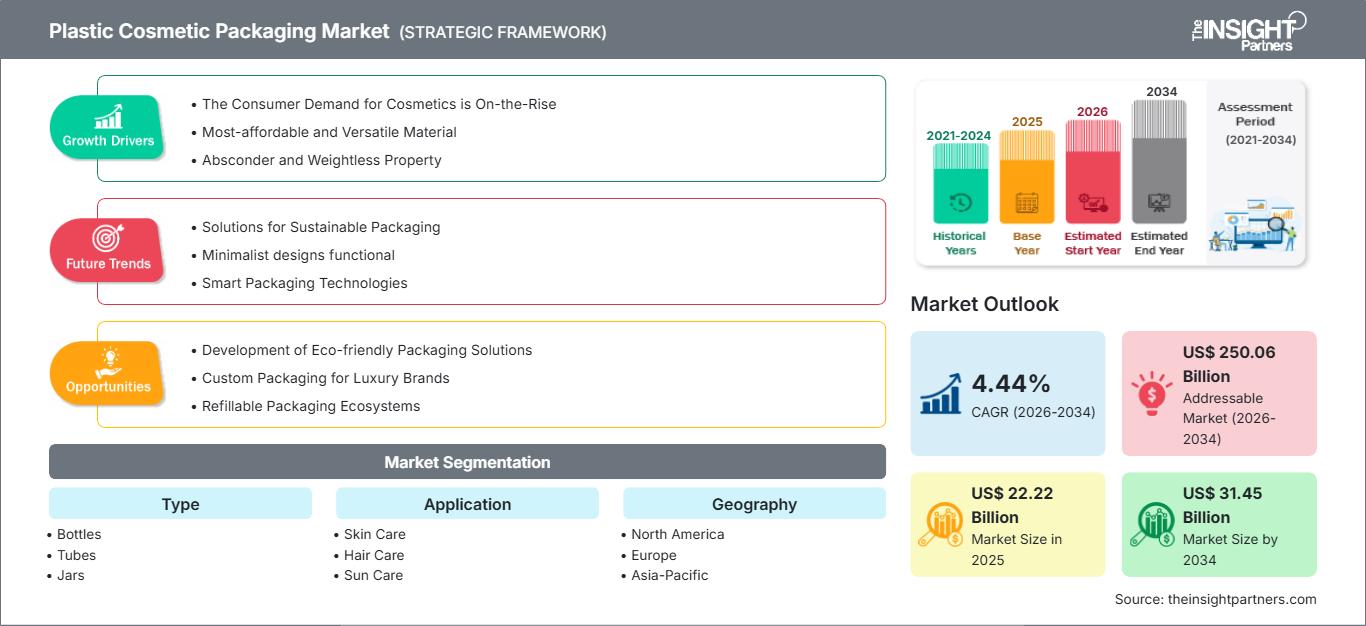
The Plastic Cosmetic Packaging market was valued at US$ 22.22 billion in 2025 and is expected to reach US$ 31.45 billion by 2034; it is estimated to record a CAGR of 3.94% during 2026-2034.
Plastic Cosmetic Packaging Market Assessment and Insights
- North America: North America accounted for 34–38% market share in 2025 and is projected to expand at a CAGR of 4.1%–4.7% during 2026–2034. Growth is driven by increasing demand for premium beauty products, sustainable packaging innovations, and advanced cosmetic packaging solutions.
- U.S.: The U.S. represented 84–88% of the North American market in 2025 and is anticipated to register a CAGR of 4.2%–4.8% during 2026–2034, supported by strong consumption of premium cosmetics, growing investments in sustainable packaging, and continued product innovation.
- Europe: Europe held 27–31% market share in 2025 and is expected to grow at a CAGR of 3.9%–4.5% during 2026–2034. Germany, France, and the United Kingdom remain the leading regional markets, supported by circular packaging initiatives and strong premium cosmetics manufacturing.
- Asia Pacific: Asia Pacific accounted for 28–32% market share in 2025 and is forecast to expand at a CAGR of 5.2%–5.8% during 2026–2034. China, Japan, and South Korea drive regional growth through expanding beauty and personal care industries, rising consumer spending, and increasing demand for innovative cosmetic packaging.
- Largest Segment – Skin Care: The skin care segment represented the largest market segment and is expected to grow at a CAGR of 4.6%–5.2% during 2026–2034, driven by increasing consumption of premium skincare products and rising demand for functional packaging solutions.
- High Growth Segment – Tubes: The tubes segment is projected to register the fastest growth with a CAGR of 5.1%–5.7% during 2026–2034, supported by their convenience, portability, enhanced product protection, and improved dispensing technologies.
- Key companies analyzed in detail: Amcor plc; Berry Global Group, Inc.; Sonoco Products Company; Albéa Group; HCP Packaging; AptarGroup, Inc.; Huhtamäki Oyj; TriMas Corporation; DS Smith Plc; and World Wide Packaging LLC
Source: The Insight Partners' analysis based on proprietary research, government publications, company annual reports, investor presentations, industry databases, and expert interviews.
Plastic cosmetic packaging has evolved significantly as beauty brands increasingly view packaging as both a functional necessity and a strategic product differentiator. Material advancements have enabled the development of lightweight, durable, aesthetically appealing, and customizable packaging solutions. The growing importance of branding, consumer experience, and sustainability has transformed packaging from a protective component into an essential element of product positioning.
Future market development throughout the plastic cosmetic packaging market forecast period will be influenced by evolving consumer expectations, sustainability commitments, and innovations in packaging design. Companies are focusing on refillable systems, recyclable materials, and premium packaging aesthetics while maintaining cost efficiency. These factors are expected to shape purchasing decisions and competitive strategies throughout the forecast period.
Plastic Cosmetic Packaging Market Report Scope
| Report Attribute | Details |
|---|---|
| Market size in 2025 | US$ 22.22 Billion |
| Market Size by 2034 | US$ 31.45 Billion |
| Global CAGR (2026 - 2034) | 3.94% |
| Historical Data | 2021-2024 |
| Forecast period | 2026-2034 |
Plastic Cosmetic Packaging Market Analysis
The plastic cosmetic packaging market is influenced by changing consumer lifestyles, expanding beauty product portfolios, and increasing demand for convenient packaging formats. Packaging plays a critical role in product preservation, brand recognition, and customer engagement. Cosmetic manufacturers increasingly require packaging solutions that combine functionality, visual appeal, durability, and sustainability while supporting efficient production and distribution processes.
The value chain encompasses resin suppliers, packaging component manufacturers, decoration specialists, cosmetic brands, contract fillers, distributors, and retailers. Demand patterns are closely tied to skincare, haircare, and sun care product consumption trends. Technological advancements in molding, decoration, dispensing systems, and sustainable materials continue to influence market dynamics and purchasing preferences.
Competition within the Plastic Cosmetic Packaging market remains intense as packaging suppliers seek to differentiate through innovation, sustainability, and design capabilities. Companies such as Amcor PLC, Berry Global Inc, Sonoco, Albea SA, HCP Packaging, AptarGroup, Inc., Huhtamaki Oyj, TriMas Corporation, DS Smith PLC, and World Wide Packaging LLC continue investing in advanced packaging technologies and customer-focused product development.
Investment activity increasingly targets recyclable materials, refillable packaging systems, and post-consumer recycled content integration. Beauty brands are collaborating closely with packaging suppliers to develop solutions that align with sustainability goals while maintaining premium aesthetics. Strategic positioning increasingly depends on the ability to balance environmental performance, consumer appeal, and manufacturing efficiency.
● REPORT CUSTOMIZATION
Tailor This Report To Align With Your Specific Business Requirements
This report can be customized to align precisely with your business objectives, scope, and target markets. Customization options include tailored segmentation, geography, competitive analysis, and strategic insights to support informed decision-making.
Customize This Report →WHAT YOU CAN ADJUST
- ● Segmentations
- ● Geography
- ● Competitive Analysis
- ● Language Preferences
Plastic Cosmetic Packaging Market: Strategic Insights
Regional Insights
North America Plastic Cosmetic Packaging Market
North America is expected to expand at a CAGR of approximately 4.1% through 2034, supported by strong consumer spending on beauty and personal care products. The region benefits from a highly developed cosmetics industry, frequent product innovation, and growing consumer awareness regarding sustainable packaging practices.
Demand is particularly strong for premium packaging solutions incorporating advanced dispensing systems, customized designs, and environmentally responsible materials. The increasing popularity of skincare products, direct-to-consumer beauty brands, and clean beauty concepts continues to create opportunities for packaging manufacturers serving the North American market.
U.S. Plastic Cosmetic Packaging Market
The United States accounts for approximately 72–77% of the North American plastic cosmetic packaging market and is anticipated to register a CAGR of around 4.2% through 2034. High consumption of skincare, haircare, and premium beauty products supports sustained demand for innovative packaging formats. Product differentiation through packaging design remains a key competitive strategy among cosmetic brands.
Major packaging suppliers maintain strong manufacturing and design capabilities throughout the country, enabling close collaboration with beauty companies. Rising adoption of refillable packaging systems, recyclable plastics, and premium dispensing technologies is reshaping packaging requirements. Demand from independent beauty brands and multinational cosmetic companies continues to drive innovation across the sector.
Europe Plastic Cosmetic Packaging Market
Europe accounts for approximately 25–30% plastic cosmetic packaging market share and is expected to grow at a CAGR of around 4.0% through 2034. Sustainability regulations, circular economy initiatives, and strong consumer preference for environmentally responsible packaging solutions continue to shape market development. Premium cosmetics and skincare products remain major contributors to packaging demand.
The United Kingdom benefits from a dynamic beauty industry and increasing adoption of sustainable packaging solutions. Beauty brands are actively incorporating recyclable materials and refillable formats to align with consumer expectations and environmental targets. E-commerce growth is also influencing packaging design and functionality requirements.
Germany remains the leading country within the European plastic cosmetic packaging market due to its strong manufacturing capabilities, advanced packaging technologies, and significant cosmetics sector. Demand is supported by premium skincare products, sustainable packaging initiatives, and ongoing investment in innovative materials and production processes.
France, Italy, and Spain collectively represent a substantial market for cosmetic packaging. France's luxury beauty sector, Italy's packaging design expertise, and Spain's expanding personal care market contribute to regional growth. Increasing focus on circular packaging systems and sustainable material sourcing is expected to support future development.
APAC Plastic Cosmetic Packaging Market
Asia Pacific holds approximately 40–45% of global market demand and is projected to achieve a CAGR of nearly 5.3% through 2034, making it the largest and fastest-growing regional market. Rising disposable incomes, growing beauty consciousness, and expanding cosmetics production are supporting substantial demand for packaging solutions.
China remains the dominant market due to its large consumer base, extensive cosmetics manufacturing sector, and rapidly evolving beauty industry. Demand is driven by skincare products, premium beauty brands, and e-commerce-driven product sales. The country's strong manufacturing infrastructure further supports packaging production and innovation.
Japan, South Korea, India, and Australia contribute significantly to regional expansion. South Korea and Japan remain influential centers for beauty innovation and packaging design, while India offers strong growth potential due to increasing personal care spending and urbanization. Government support for manufacturing and packaging industries further reinforces regional opportunities.
Middle East & Africa Plastic Cosmetic Packaging Market
The Middle East & Africa plastic cosmetic packaging market is anticipated to expand at a CAGR of approximately 4.6% through 2034. Rising beauty product consumption, urbanization, and retail sector development are supporting packaging demand across the region. Expanding middle-class populations and increasing brand penetration are creating favorable market conditions.
Saudi Arabia remains the leading Plastic Cosmetic Packaging market due to strong demand for premium beauty products and growing investments in consumer goods sectors. The country's evolving retail landscape and increasing focus on personal grooming products continue to support packaging requirements across multiple cosmetic categories.
The United Arab Emirates, South Africa, and the Rest of MEA are experiencing increasing demand for innovative cosmetic packaging solutions. Growth in e-commerce, premium beauty products, and international brand presence is encouraging adoption of advanced packaging formats that combine functionality, aesthetics, and sustainability.
Segmentation Analysis
Type
- Bottles: Bottles represent the largest packaging format due to their widespread use across skincare, haircare, and sun care products. Their versatility, design flexibility, dispensing compatibility, and branding potential make them highly preferred by cosmetic manufacturers.
- Tubes: Tubes are widely utilized for creams, gels, lotions, and treatment products. They offer convenience, portability, product protection, and controlled dispensing while supporting attractive branding and premium product positioning.
- Jars: Jars remain important for skincare applications, particularly face creams, masks, and specialty treatments. Their premium appearance, ease of product access, and compatibility with luxury formulations support continued Plastic Cosmetic Packaging market demand.
Application
- Skin Care: Skin care constitutes the leading application segment due to growing consumer focus on facial care, anti-aging products, moisturizers, serums, and specialty treatments. Packaging innovation plays a critical role in product differentiation and user experience.
- Hair Care: Hair care products require durable and functional packaging formats that support efficient dispensing, storage, and transportation. Rising demand for premium shampoos, conditioners, and treatment products continues to drive packaging consumption.
- Sun Care: Sun care packaging demand is increasing as consumer awareness regarding UV protection grows globally. Manufacturers emphasize portable, durable, and user-friendly packaging designs suitable for outdoor and travel-related applications.
Opportunity Snapshot
| Application | Revenue Contribution | Trend Tag | Adoption Stage |
| Skin Care | High | Premium Beauty | Mature |
| Hair Care | Medium | Scalp Wellness | Scaling |
| Sun Care | Medium | UV Protection | Scaling |
Plastic Cosmetic Packaging Market Growth Drivers and Impact Analysis
Expansion of Global Skin Care and Beauty Product Consumption
The increasing popularity of skincare and personal beauty products remains one of the most influential drivers of growth in the plastic cosmetic packaging market. Consumers in both developed and emerging economies are allocating a larger share of their disposable income to skincare routines, anti-aging products, facial treatments, and specialized cosmetic formulations. Social media influence, beauty influencers, and growing awareness of self-care practices continue to sustain product demand.
Packaging serves a crucial function beyond product containment. Cosmetic brands rely on packaging to communicate quality, reinforce brand identity, and create memorable customer experiences. As beauty companies expand product portfolios, the demand for innovative bottles, tubes, and jars increases correspondingly. Packaging customization, visual differentiation, and premium aesthetics have become essential competitive tools.
The impact on the market is substantial because rising skincare consumption directly translates into higher packaging requirements, supporting long-term plastic cosmetic packaging market size expansion. Manufacturers are investing in advanced molding, decoration, and dispensing technologies to support evolving brand expectations. The continued expansion of global beauty markets is expected to provide long-term opportunities for packaging suppliers and component manufacturers.
Growing Adoption of Sustainable and Recyclable Packaging Materials
Environmental concerns are reshaping packaging strategies throughout the cosmetics industry. Consumers increasingly prefer products packaged in recyclable, reusable, or environmentally responsible materials. Beauty brands are responding by setting sustainability targets focused on reducing virgin plastic usage, increasing recycled content, and improving packaging recyclability.
Plastic cosmetic packaging manufacturers are introducing solutions that incorporate post-consumer recycled materials, mono-material structures, and refillable systems. These innovations help brands align with regulatory requirements while addressing consumer expectations regarding environmental responsibility. Sustainable packaging is increasingly viewed as a source of competitive advantage rather than simply a compliance requirement.
Market impact can be seen throughout the value chain. Companies that supply packaging offering an environmentally friendly solution will work more closely with cosmetic brands worldwide. Investment in eco-friendly materials and recycling will grow due to changing regulations and rising awareness.
Growth of E-Commerce Beauty Retail Channels
The rapid expansion of online beauty retail has created new packaging requirements for cosmetic manufacturers. Products sold through e-commerce channels must withstand shipping, handling, and distribution processes while maintaining product quality and visual appeal upon delivery. This has increased demand for durable and protective plastic packaging formats.
Beauty brands increasingly rely on direct-to-consumer business models that emphasize customer experience and packaging presentation. Attractive packaging not only protects products but also contributes to brand perception and customer retention. As online shopping becomes a primary purchasing channel for many consumers, packaging performance gains strategic importance.
The market effects of this phenomenon are evident in increased spending on areas such as packaging strength, lightweighting, tamper evidence, and quality design. Manufacturers are designing packaging solutions specially for e-commerce channels, thus opening up more avenues for innovation and market growth during the forecast period.
Plastic Cosmetic Packaging Market Future Trends
Rise of Refillable and Reusable Cosmetic Packaging Systems
Refillable packaging is emerging as one of the most significant plastic cosmetic packaging market trends, with beauty brands increasingly introducing refill programs that allow consumers to reuse primary packaging components while purchasing replacement product cartridges or refill packs. Beauty brands are increasingly introducing refill programs that allow consumers to reuse primary packaging components while purchasing replacement product cartridges or refill packs. This approach reduces packaging waste and supports sustainability commitments.
Luxury and premium beauty brands are leading adoption due to their ability to integrate refill systems into high-value product offerings. However, mass-market brands are also beginning to embrace refillable concepts as production technologies improve and consumer acceptance increases. Packaging suppliers are responding with designs optimized for durability, aesthetics, and multiple-use cycles.
In the future, refill concepts are expected to become an accepted packaging strategy across the skincare, hair care, and sun care categories. Companies that develop their refill systems and packaging formats for reuse are expected to benefit from such packaging trends.
Integration of Smart and Interactive Packaging Features
Digital technologies are gradually transforming cosmetic packaging from passive containers into interactive tools for consumer engagement. Brands are increasingly incorporating QR codes, near-field communication technologies, authentication systems, and digital storytelling elements into packaging designs to strengthen customer relationships and improve transparency.
Interactive packaging enables consumers to access product, sustainability, and usage information, as well as content, via digital devices. This technology can enrich the customer experience and make it easier for brands to communicate product value. Skincare and luxury beauty brands are among those that are leading the adoption of this technology.
Future implementation is likely to expand as digital engagement becomes increasingly important within the beauty industry. Manufacturers who can integrate interactive packaging into their products without compromising aesthetics and functionality would have an opportunity to develop next-generation cosmetic products.
Plastic Cosmetic Packaging Market Opportunities
Emerging Demand for Premium Beauty Packaging in Developing Economies
Developing economies present substantial opportunities for plastic cosmetic packaging manufacturers, as rising disposable incomes and shifting consumer preferences boost spending on personal care products. Urbanization, the expansion of digital commerce, and growing beauty awareness are driving demand for premium cosmetic brands across Asia, Latin America, the Middle East, and Africa.
Premium packaging has become increasingly important in these areas, perceived as an indicator of high quality and reliability. The cosmetic manufacturers are responding by designing premium packaging that is both functional and attractive. This offers investment opportunities for firms capable of providing affordable premium packaging.
Areas for investment include improving regional production capacity, creating innovative packaging options, and creating relationships with new beauty firms. Businesses that align their products with regional consumer tastes will capitalize on the dynamic nature of developing beauty markets over the next decade.
Expansion of Sustainable Packaging Partnerships Across the Value Chain
Collaboration between cosmetic brands, packaging manufacturers, material suppliers, and recycling organizations is creating new growth opportunities throughout the plastic cosmetic packaging market. Sustainability goals increasingly require coordinated efforts across the value chain to develop effective circular packaging systems and improve material recovery rates.
Packaging suppliers that actively participate in sustainability partnerships can strengthen customer relationships while gaining access to emerging technologies and innovative materials. Joint development programs focused on recyclable packaging, post-consumer recycled content, and refillable systems are becoming increasingly common throughout the industry.
The opportunity extends beyond product development. Businesses that help brands meet their sustainability goals may be rewarded with long-term strategic partnerships. With environmental aspirations becoming more ambitious, innovation through collaboration may have to take center stage.
Recent Developments
- January, 2025: Aptar Beauty launched Nomad Refill, a refillable fragrance packaging solution designed for prestige beauty brands. The product combines a durable outer pack with replaceable fragrance cartridges, helping brands reduce plastic consumption while maintaining premium aesthetics. The launch supports growing demand for sustainable and reusable cosmetic packaging formats.
- February, 2025: Mitsubishi Chemical Group and ALBION announced a collaboration to establish a circular economy model for cosmetic containers. Under the initiative, waste plastics generated from cosmetic container packaging are chemically recycled and converted into polypropylene resin for the production of new cosmetic containers. The partnership supports resource circularity and sustainable plastic cosmetic packaging development.
- July, 2025: Berlin Packaging completed the acquisition of Cosmei, an Italy-based provider of cosmetic packaging solutions for skincare, makeup, and fragrance products. The acquisition expands Berlin Packaging’s cosmetics packaging portfolio and strengthens its design and innovation capabilities within the beauty and personal care sector.
Frequently Asked Questions

- Comprehensive Market Sizing and Forecast Analysis
- Detailed Segmentation Analysis
- In-Depth Market Dynamics Assessment
- Regional and Country-Level Insights
- Competitive Landscape and Company Benchmarking
- Strategic Business Intelligence
Recent Reports
Testimonials

The Insight Partners provided valuable market intelligence that supported our global go-to-market strategy. Their team was professional, responsive, and attentive to our feedback, providing thoughtful analysis and helpful methodological clarifications throughout the project.
Junmo Kim Chief Financial Officer (CFO), Enertech Co., Ltd.
The Insight Partners' SCADA System Market report is comprehensive, with valuable insights on current trends and future forecasts. The team was highly professional, responsive, and supportive throughout. We are very satisfied and highly recommend their services.
RAN KEDEM Partner, Reali Technologies LTDs
I requested a report on a very specific software market and the team produced the report in a few days. The information was very relevant and well presented. I then requested some changes and additions to the report. The team was again very responsive and I got the final report in less than a week.
JEAN-HERVE JENN Chairman, Future Analytica
We worked with The Insight Partners for an important market study and forecast. They gave us clear insights into opportunities and risks, which helped shape our plans. Their research was easy to use and based on solid data. It helped us make smart, confident decisions. We highly recommend them.
PIYUSH NAGPAL Sr. Vice President, High Beam Global
The Insight Partners delivered insightful, well-structured market research with strong domain expertise. Their team was professional and responsive throughout. The user-friendly website made accessing industry reports seamless. We highly recommend them for reliable, high-quality research services
YUKIHIKO ADACHI CEO, Deep Blue, LLC.
This is the first time I have purchased a market report from The Insight Partners.While I was unsure at first, I visited their web site and felt more comfortable to take the risk and purchase a market report.I am completely satisfied with the quality of the report and customer service. I had several questions and comments with the initial report, but after a couple of dialogs over email with their analyst I believe I have a report that I can use as input to our strategic planning process.Thank you so much for taking the extra time and making this a positive experience.I will definitely recommend your service to others and you will be my first call when we need further market data.
JOHN SUZUKI President and Chief Executive Officer, Board Director, BK Technologies
I wish to appreciate your support and the professionalism you displayed in the course of attending to my request for information regarding to infectious disease IVD market in Nigeria. I appreciate your patience, your guidance, and the fact that you were willing to offer a discount, which eventually made it possible for us to close a deal. I look forward to engaging The Insight Partners in the future, all thanks to the impression you have created in me as a result of this first encounter.
DR CHIJIOKE ONYIA MANAGING DIRECTOR, PineCrest Healthcare Ltd.Reason to Buy
- Informed Decision-Making
- Understanding Market Dynamics
- Competitive Analysis
- Identifying Emerging Markets
- Customer Insights
- Market Forecasts
- Risk Mitigation
- Boosting Operational Efficiency
- Strategic Planning
- Investment Justification
- Tracking Industry Innovations
- Aligning with Regulatory Trends





 Get Free Sample for