
Plastic Conduit Market Size, Trends & Growth by 2034
Coverage: by Type (Rigid Conduits, Flexible Conduits); Material (Polyvinyl Chloride (PVC), Polypropylene (PP), High Density Polyethylene (HDPE), Others); Industry Vertical (Manufacturing, Construction, IT and Telecom, Healthcare, Others) , and Geography (North America, Europe, Asia Pacific, and South and Central America)
- Status : Data Released
- Report Code : TIPRE00008040
- Category : Chemicals and Materials
- No. of Pages : 150
- Available Report Formats :


- Last update date : July 13, 2026


2025 Market Size
US$ 18.08 Bn
Base year value
2034 Forecast
US$ 30.73 Bn
Projected by 2034
CAGR 2026-2034
6.07 %
Growth rate
Addressable Market
US$ 221.01 Bn
(2026-2034)
The global plastic conduit market was valued at US$ 18.08 Billion in 2025 and is projected to reach US$ 30.73 Billion by 2034, registering a CAGR of 6.07% during 2026–2034. Plastic conduits are very important in ensuring the safety of electric wiring and communication cables in residential, commercial, and industrial applications. The fact that plastic conduits are resistant to corrosion, are light-weighted, easy to install, and inexpensive has enabled their continued use in today’s infrastructural construction projects.
North America is an important market for plastic pipes and is projected to grow at a 5.5% CAGR through 2034. Key factors behind the growth include increasing investment in power distribution systems, broadband networks, and commercial building upgrades. The increasing use of underground cable installations and the importance of long-lasting electrical protection systems are among the other reasons behind the growth.
Plastic Conduit Market Assessment and Insights
- North America: North America accounted for 34–38% Plastic Conduit market share and is projected to expand at a CAGR of 5.5%–6.1% during 2026–2034. Growth is driven by increasing commercial construction activity, ongoing grid modernization projects, and rising investments in electrical infrastructure.
- U.S.: The U.S. represented 81–85% of the North American market in 2025 and is anticipated to register a CAGR of 5.6%–6.2% during 2026–2034, supported by strong commercial building construction, expanding utility upgrades, and continued investments in power distribution networks.
- Europe: Europe held 25–29% market share in 2025 and is expected to grow at a CAGR of 5.3%–5.9% during 2026–2034. Germany, the United Kingdom, and France remain the leading regional markets, supported by infrastructure modernization, industrial automation investments, and ongoing expansion of energy-efficient electrical systems.
- Asia Pacific: Asia Pacific accounted for 28–32% market share in 2025 and is forecast to expand at a CAGR of 6.9%–7.5% during 2026–2034. China, India, and Japan drive regional growth through rapid urbanization, expanding manufacturing activities, and increasing investments in electrical and telecommunications infrastructure.
- Largest Segment – Rigid Conduits: The Rigid Conduits segment represented the largest market segment and is expected to grow at a CAGR of 5.8%–6.4% during 2026–2034, driven by its widespread use in commercial and industrial electrical installations, superior mechanical protection, and long-term durability.
- High Growth Segment – High Density Polyethylene: The High Density Polyethylene (HDPE) segment is projected to register the fastest growth with a CAGR of 6.8%–7.4% during 2026–2034, supported by increasing deployment in underground utility networks, expanding telecommunications infrastructure, and rising investments in modern cable protection systems.
- Key companies analyzed in detail: ABB Ltd.; AKG Group; Allied Tube & Conduit Corporation; Atkore Inc.; CANTEX Inc.; Dura-Line Holdings, Inc.; Hubbell Incorporated; Precision Pipe and Products, Inc.; Prime Conduit, Inc.; and Schneider Electric SE.
Source: The Insight Partners' analysis based on proprietary research, government publications, company annual reports, investor presentations, industry databases, and expert interviews.
Plastic conduit systems have become increasingly important as governments and private organizations invest in resilient electrical and communication infrastructure. Improvements in material technology have enabled manufacturers to develop conduit products with enhanced durability, flexibility, flame resistance, and environmental performance. These advancements have expanded their application scope across industrial facilities, commercial developments, data centers, transportation networks, and utility projects.
Market prospects remain favorable due to rising urbanization, digital transformation initiatives, and infrastructure modernization programs worldwide. Demand is expected to be supported by renewable energy installations, smart city developments, fiber-optic network deployment, and industrial automation projects. Manufacturers are focusing on product innovation and operational efficiency to address evolving performance requirements while maintaining competitive pricing structures.
Plastic Conduit Market Report Scope
| Report Attribute | Details |
|---|---|
| Market size in 2025 | US$ 18.08 Billion |
| Market Size by 2034 | US$ 30.73 Billion |
| Global CAGR (2026 - 2034) | 6.07% |
| Historical Data | 2021-2024 |
| Forecast period | 2026-2034 |
Plastic Conduit Market Analysis
Demand for plastic conduits continues to increase as electrical systems become more complex, supporting sustained Plastic Conduit market size expansion. The market experiences positive influences from rising demands for cable protection, electricity safety, and proper installation. There are certain benefits associated with plastic conduits, including corrosion prevention, easy transportation, moisture prevention, and decreased maintenance needs.
The market's value chain consists of raw material providers, conduit producers, distributors, contractors, engineering companies, utilities, and end-users. Infrastructure investments, construction works, industry growth, and telecoms network installations are expected to affect purchase decisions in all of these segments. There are also certain regulatory requirements concerning electrical safety and building standards.
Competition in the plastic conduit industry is marked by companies which are existing players in the electrical infrastructure business and those which manufacture conduit pipes. These include companies like ABB, AKG Group, Allied Tube & Conduit, Atkore International, Cantex Inc., Dura-Line, Hubbell, Precision, Prime Conduit, Inc., and Schneider Electric.
Investment activity is increasingly focused on advanced conduit systems designed for telecommunications, renewable energy, industrial automation, and smart infrastructure projects. Manufacturers are introducing products with enhanced durability, environmental resistance, and installation efficiency. Regional production expansion and distribution network optimization are also becoming important strategies for improving responsiveness to infrastructure-related demand growth.
● REPORT CUSTOMIZATION
Tailor This Report To Align With Your Specific Business Requirements
This report can be customized to align precisely with your business objectives, scope, and target markets. Customization options include tailored segmentation, geography, competitive analysis, and strategic insights to support informed decision-making.
Customize This Report →WHAT YOU CAN ADJUST
- ● Segmentations
- ● Geography
- ● Competitive Analysis
- ● Language Preferences
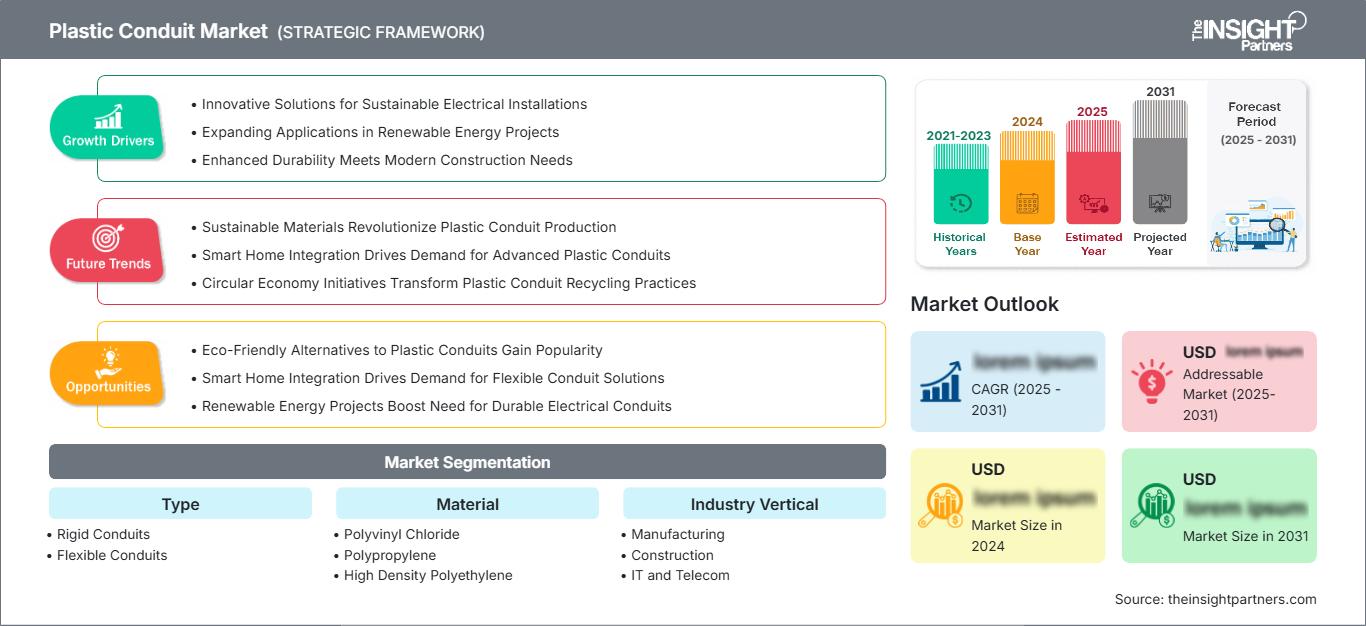
Plastic Conduit Market: Strategic Insights
Regional Insights
North America Plastic Conduit Market
It is anticipated that North America will have a CAGR of about 5.5% until 2034. This growth can be attributed to massive investments in the development of the electrical grid, telecommunication infrastructure, and building construction. The initiatives by the government towards upgrading aged infrastructure have led to an increased demand for conduits.
The region benefits from stringent electrical safety regulations and widespread adoption of underground utility installations. Expansions in data centers, renewable energy, and broadband infrastructure are providing further avenues for conduit makers. Further investments in transportation and industrial infrastructure can be anticipated to maintain market growth.
U.S. Plastic Conduit Market
The United States accounts for approximately 70–75% of the North American market and is projected to achieve a CAGR of around 5.7% through 2034. Demand is driven by commercial construction projects, utility upgrades, industrial automation initiatives, and large-scale telecommunications investments. The growing deployment of fiber-optic networks and renewable energy facilities is also supporting conduit consumption.
Key players in the industry possess efficient manufacturing and distribution systems that are spread across the country. The usage of products in hospitals, schools, factories, and data centers is increasing owing to the growing focus on the dependability of the infrastructure and safety from electric hazards. The adoption of modern conduits for intelligent buildings is increasing market demand.
Europe Plastic Conduit Market
Europe represents approximately 24–28% of global Plastic Conduit market share and is anticipated to expand at a CAGR of around 5.4% through 2034. Infrastructure modernization programs, renewable energy investments, and stringent building regulations support market development throughout the region. Demand remains strong across commercial construction, industrial facilities, transportation infrastructure, and utility projects.
The United Kingdom continues to benefit from investments in broadband connectivity, commercial construction, and public infrastructure upgrades. Increasing adoption of smart building technologies and energy-efficient construction practices is contributing to higher demand for advanced conduit systems across residential and commercial developments.
Germany remains the leading country in the European market due to its extensive industrial base, advanced manufacturing sector, and strong infrastructure investment activity. The country's focus on industrial automation, renewable energy integration, and smart manufacturing initiatives supports sustained demand for conduit products designed for high-performance electrical installations.
France, Italy, and Spain collectively contribute significant demand through transportation projects, utility modernization programs, and commercial construction activity. Increasing investments in digital infrastructure and renewable energy facilities are encouraging the adoption of durable conduit systems capable of supporting long-term operational requirements.
APAC Plastic Conduit Market
Asia Pacific accounts for approximately 42–47% of global Plastic Conduit market forecast demand and is expected to achieve a CAGR of nearly 6.8% through 2034, making it both the largest and fastest-growing regional market. Rapid urbanization, industrialization, and infrastructure expansion continue to generate substantial demand for electrical and communication conduit systems.
China remains the dominant market due to large-scale investments in urban infrastructure, power transmission networks, industrial facilities, and telecommunications systems. Government initiatives focused on smart cities, renewable energy deployment, and advanced manufacturing are creating sustained demand for conduit products across multiple sectors.
Japan, South Korea, India, and Australia are also contributing to regional growth through infrastructure upgrades, telecommunications investments, and industrial development programs. India stands out as a rapidly expanding market due to extensive construction activity, power distribution projects, and digital connectivity initiatives. Regional policy support for infrastructure modernization is expected to reinforce long-term market expansion.
Middle East & Africa Plastic Conduit Market
The Middle East & Africa plastic conduit market is projected to grow at a CAGR of approximately 6.0% through 2034. Demand is supported by investments in urban development, utility infrastructure, transportation networks, and industrial diversification projects. Expanding construction activity across commercial and residential sectors is creating favorable conditions for conduit manufacturers.
Saudi Arabia leads the regional market due to major infrastructure initiatives, industrial development programs, and large-scale urban transformation projects. Continued investments in energy, transportation, and smart city developments are increasing requirements for reliable electrical protection systems and cable management solutions.
The United Arab Emirates, South Africa, and the Rest of MEA continue to experience rising demand for conduit products across commercial construction, telecommunications infrastructure, and industrial facilities. Growing adoption of renewable energy systems and modernization of public infrastructure are expected to create additional opportunities for market participants across the region.
Segmentation Analysis
Type
- Rigid Conduits: Rigid plastic conduits are extensively used in permanent electrical installations where high mechanical protection, durability, and long service life are required. They are commonly deployed in commercial buildings, industrial facilities, and utility infrastructure projects.
- Flexible Conduits: Flexible plastic conduits provide superior routing versatility in confined spaces and dynamic environments. Their growing adoption across telecommunications, healthcare facilities, and industrial automation systems is supported by ease of installation and maintenance advantages.
Material
- Polyvinyl Chloride: PVC remains the most widely used conduit material due to its affordability, corrosion resistance, electrical insulation properties, and compatibility with diverse construction and infrastructure applications across residential, commercial, and industrial sectors.
- Polypropylene: Polypropylene conduits are gaining traction in specialized applications requiring chemical resistance, lightweight characteristics, and operational reliability. They are increasingly utilized in industrial facilities, manufacturing environments, and utility installations.
- High Density Polyethylene: HDPE conduits are widely adopted for underground cable protection, fiber-optic networks, and utility infrastructure projects. Their flexibility, impact resistance, and long-term durability make them suitable for demanding outdoor environments.
Industry Vertical
- Manufacturing: Manufacturing facilities utilize plastic conduit systems to protect power cables, automation wiring, and communication networks. Increasing industrial automation and smart factory deployment continue to strengthen demand within this segment.
- Construction: Construction represents the largest industry vertical due to extensive conduit usage in residential, commercial, institutional, and infrastructure projects requiring safe and durable electrical distribution systems.
- IT and Telecom: IT and telecom applications rely heavily on conduit systems for fiber-optic deployment, data center infrastructure, broadband expansion, and communication network protection across urban and rural environments.
- Healthcare: Healthcare facilities require specialized conduit solutions that support reliable electrical distribution, medical equipment connectivity, safety compliance, and uninterrupted operation of critical infrastructure systems.
Opportunity Snapshot
| Industry Vertical | Revenue Contribution | Trend Tag | Adoption Stage |
| Manufacturing | Medium | Automation | Scaling |
| Construction | High | Urbanization | Mature |
| IT and Telecom | High | Fiber Expansion | Scaling |
| Healthcare | Medium | Facility Upgrades | Mature |
Plastic Conduit Market Growth Drivers and Impact Analysis
Expansion of Power Distribution and Grid Modernization Projects
Electricity infrastructure modernization has become a strategic priority for governments and utility operators worldwide. Aging transmission and distribution networks require substantial upgrades to improve reliability, integrate renewable energy resources, and accommodate rising electricity consumption. Plastic conduit systems play an essential role in protecting electrical wiring, underground cables, and distribution networks from environmental damage and operational risks.
The development of more renewable energy installations, especially solar and wind power plants, increases the demand for systems that ensure the safety of cable distribution and the long-term performance of infrastructure. At the same time, utility companies tend to prefer plastic conduits for their durability, ease of transportation, and lower installation costs compared to traditional solutions.
Market effects span the residential, commercial, industrial, and utility sectors. Conduit manufacturers are increasingly offering a wider range of products to meet changing infrastructure needs. In contrast, the emphasis on providing tough yet economical conduits remains high among contractors and engineering companies. Continued development of power grids worldwide is likely to drive market growth throughout the forecast period.
Rapid Growth of Telecommunications and Fiber-Optic Networks
The acceleration of digital connectivity initiatives is creating substantial opportunities for the plastic conduit market. Governments and telecommunications providers are investing heavily in fiber-optic infrastructure, broadband expansion programs, 5G deployment, and data center connectivity projects. These developments require reliable conduit systems capable of protecting communication cables in both underground and above-ground environments.
Plastic conduits have become a preferred solution for telecommunications infrastructure because they offer flexibility, moisture resistance, and simplified installation. High-density polyethylene conduits, in particular, are widely utilized for fiber deployment due to their ability to support long-distance cable installations while minimizing maintenance requirements. As connectivity becomes increasingly important to economic development, telecommunications infrastructure spending continues to rise across multiple regions.
The resulting market impact is evident in growing demand from network operators, utility companies, municipalities, and private infrastructure developers. The expansion of digital services, cloud computing, and smart city initiatives is expected to generate long-term demand for conduit systems that support secure, scalable communication networks.
Increasing Construction and Urban Infrastructure Development
Urbanization continues to drive substantial investments in residential, commercial, institutional, and transportation infrastructure. Contemporary construction requires sophisticated installations of electrical and communications systems, resulting in high demands for conduit systems that are reliable, safe, and comply with regulations. One of the materials that is now extensively used for conduit applications is plastic.
Large-scale infrastructure developments, including airports, rail networks, hospitals, educational facilities, and commercial complexes, depend on conduit systems to protect critical wiring and communication networks. The growing adoption of smart building technologies is also increasing the complexity of electrical installations, further supporting demand for conduit. Building owners and developers are prioritizing infrastructure solutions that provide long-term durability and operational flexibility.
The influence of this driver extends across both mature and emerging economies. As governments continue investing in infrastructure development and urban expansion programs, conduit manufacturers are positioned to benefit from sustained demand across multiple end-use sectors and project categories.
Plastic Conduit Market Future Trends
Adoption of Smart Infrastructure-Compatible Conduit Systems
Current Plastic Conduit market trends show that smart city initiatives and intelligent infrastructure projects are influencing the evolution of conduit technologies. Modern urban developments increasingly incorporate connected systems for transportation management, energy distribution, public safety, and digital communications. These applications require advanced cable protection solutions that can accommodate increasing network complexity and future upgrades.
Manufacturers are addressing the issue by designing conduits that enable the installation, maintenance, and scaling of communications infrastructure. Increased durability, ability to accommodate more cables, and compatibility with advanced monitoring systems are among the attributes that differentiate products in the market. There is increased focus on scalability and efficiency.
Looking ahead, intelligent infrastructure investments are anticipated to increase in both developed and emerging economies. Product design for conduit makers that accounts for digital infrastructure needs will see increased opportunities in transport, utilities, telecommunications, and urban development.
Growing Preference for Underground Utility Installations
The shift towards implementing underground electrical and communication networks is gaining popularity as cities strive to ensure reliability, safety, and aesthetic standards. Such networks are usually not very susceptible to disruption from natural and environmental conditions.
Plastic conduits play a key role in underground construction, providing protection for cables and simplifying installation. Utility companies and cities are considering underground construction to make their networks more resilient to future damage. Large amounts of conduit piping are needed for such projects.
The ongoing development of underground utilities will drive future growth in the market. With climate resilience and reliable infrastructure becoming priorities in the planning process, demand for state-of-the-art conduit systems will grow across many markets worldwide.
Plastic Conduit Market Opportunities
Rising Investment in Data Centers and Digital Infrastructure
The rapid growth of cloud computing, artificial intelligence, and digital services is generating significant investment in data centers worldwide. These facilities require extensive electrical and communication infrastructure, supported by reliable conduit systems that protect high-density cabling networks. The increasing scale and complexity of modern data centers create substantial opportunities for conduit manufacturers.
Data center managers focus on factors such as reliability, efficiency, and scalability. There are several benefits of plastic conduits, including their corrosion resistance, ease of installation, and adaptability to changing network demands. Organizations will have to continue making investments in digital transformation projects, which will increase the need for cable management systems.
Manufacturers that provide customized data center solutions have an opportunity to benefit from a growing market segment. Cooperation with engineering firms, contractors, and technology providers could be even more beneficial in this fast-growing application space.
Expansion of Renewable Energy and Utility Infrastructure
Emerging Plastic Conduit market trends indicate that renewable energy projects represent a growing opportunity for the plastic conduit market. Solar farms, wind power installations, battery storage facilities, and transmission infrastructure require extensive cable protection systems that can operate in challenging environmental conditions. Plastic conduits are increasingly utilized because of their durability, lightweight construction, and resistance to corrosion.
Governments across multiple regions are implementing policies to support the use of renewable energy and energy infrastructure. Such policies will ensure sustained demand for conduit systems used in electricity generation, transmission, and distribution. There is also an investment in grid resiliency.
Companies that expand product offerings for renewable energy applications can benefit from favorable market conditions and sustained infrastructure investment. The integration of renewable energy resources into modern power systems is expected to remain an important growth opportunity throughout the forecast period.
Recent Developments
- June, 2026: Hubbell Incorporated completed its acquisition of NSI Industries, a leading supplier of electrical fittings, connectors, components, and wire-management products. The acquisition enhances Hubbell’s Electrical Solutions portfolio by expanding its offering of electrical infrastructure products that complement conduit and cable-management systems used in commercial, industrial, and infrastructure projects.
- April, 2025: SOLAR STACK® expanded its product portfolio with the launch of the SS-C4 and SS-C8 Conduit Mounts, designed for securing electrical conduit, PVC conduit, and HVAC lines without roof penetrations. The new products provide an adhesive-based mounting solution that eliminates drilling and supports faster installation across electrical and construction applications. This launch reflects ongoing innovation in conduit support systems and infrastructure installation technologies.
- August, 2025: Supreme Industries Ltd. completed the acquisition of Orbia Wavin’s pipes and fittings business in India and simultaneously initiated a long-term technology licensing collaboration with Orbia Wavin. The agreement provides Supreme access to Orbia Wavin’s advanced pipe and conduit-related technologies, strengthening product development capabilities and expanding technology-driven solutions across infrastructure applications.
Frequently Asked Questions

- Comprehensive Market Sizing and Forecast Analysis
- Detailed Segmentation Analysis
- In-Depth Market Dynamics Assessment
- Regional and Country-Level Insights
- Competitive Landscape and Company Benchmarking
- Strategic Business Intelligence
Recent Reports
Testimonials

The Insight Partners' SCADA System Market report is comprehensive, with valuable insights on current trends and future forecasts. The team was highly professional, responsive, and supportive throughout. We are very satisfied and highly recommend their services.
RAN KEDEM Partner, Reali Technologies LTDs
I requested a report on a very specific software market and the team produced the report in a few days. The information was very relevant and well presented. I then requested some changes and additions to the report. The team was again very responsive and I got the final report in less than a week.
JEAN-HERVE JENN Chairman, Future Analytica
We worked with The Insight Partners for an important market study and forecast. They gave us clear insights into opportunities and risks, which helped shape our plans. Their research was easy to use and based on solid data. It helped us make smart, confident decisions. We highly recommend them.
PIYUSH NAGPAL Sr. Vice President, High Beam Global
The Insight Partners delivered insightful, well-structured market research with strong domain expertise. Their team was professional and responsive throughout. The user-friendly website made accessing industry reports seamless. We highly recommend them for reliable, high-quality research services
YUKIHIKO ADACHI CEO, Deep Blue, LLC.
This is the first time I have purchased a market report from The Insight Partners.While I was unsure at first, I visited their web site and felt more comfortable to take the risk and purchase a market report.I am completely satisfied with the quality of the report and customer service. I had several questions and comments with the initial report, but after a couple of dialogs over email with their analyst I believe I have a report that I can use as input to our strategic planning process.Thank you so much for taking the extra time and making this a positive experience.I will definitely recommend your service to others and you will be my first call when we need further market data.
JOHN SUZUKI President and Chief Executive Officer, Board Director, BK Technologies
I wish to appreciate your support and the professionalism you displayed in the course of attending to my request for information regarding to infectious disease IVD market in Nigeria. I appreciate your patience, your guidance, and the fact that you were willing to offer a discount, which eventually made it possible for us to close a deal. I look forward to engaging The Insight Partners in the future, all thanks to the impression you have created in me as a result of this first encounter.
DR CHIJIOKE ONYIA MANAGING DIRECTOR, PineCrest Healthcare Ltd.Reason to Buy
- Informed Decision-Making
- Understanding Market Dynamics
- Competitive Analysis
- Identifying Emerging Markets
- Customer Insights
- Market Forecasts
- Risk Mitigation
- Boosting Operational Efficiency
- Strategic Planning
- Investment Justification
- Tracking Industry Innovations
- Aligning with Regulatory Trends





 Get Free Sample for