
Plastic Pallets Market Size, Trends & Growth by 2034
Plastic Pallets Market Size and Forecasts (2021–2034), Global and Regional Growth Opportunity Analysis, and Geography (North America, Europe, Asia Pacific, and South and Central America)
- Status : Data Released
- Report Code : TIPRE00016553
- Category : Chemicals and Materials
- No. of Pages : 150
- Available Report Formats :


- Last update date : July 15, 2026


2025 Market Size
US$ 15.16 Bn
Base year value
2034 Forecast
US$ 31.82 Bn
Projected by 2034
CAGR 2026-2034
8.59 %
Growth rate
Addressable Market
US$ 210.71 Bn
(2026-2034)
The plastic pallets market was valued at US$ 15.16 Billion in 2025 and is projected to reach US$ 31.82 Billion by 2034, expanding at a CAGR of 8.59% during 2026–2034. The market is experiencing robust growth as industries increasingly adopt durable, hygienic, and reusable material handling solutions. Plastic pallets are gaining preference over traditional wooden alternatives due to their longer service life, lower maintenance requirements, and compatibility with automated logistics systems used across modern supply chains.
North America remains a major contributor to the plastic pallets market growth, supported by an estimated CAGR of around 8.1% during the forecast period. Growth is driven by widespread warehouse automation, stringent hygiene standards in the food and pharmaceutical industries, and increasing investment in sustainable logistics infrastructure. The region's strong emphasis on reusable packaging systems and supply chain efficiency continues to support market expansion.
Plastic Pallets Market Assessment and Insights
- North America: North America accounted for 31–35% market share in 2025 and is projected to expand at a CAGR of 8.1%–8.7% during 2026–2034. Growth is driven by increasing warehouse automation, rising adoption of reusable packaging solutions, and expanding logistics operations, supporting sustained demand for plastic pallets.
- U.S.: The U.S. represented 78–82% of the North American market in 2025 and is anticipated to register a CAGR of 8.3%–8.9% during 2026–2034, supported by strong warehouse modernization, widespread pallet pooling practices, and increasing investment in supply chain automation.
- Europe: Europe held 25–29% of the Plastic pallets market share in 2025 and is expected to grow at a CAGR of 7.8%–8.4% during 2026–2034. Germany, France, and the United Kingdom remain the leading regional markets, supported by logistics modernization initiatives and expanding pallet pooling activities.
- Asia Pacific: Asia Pacific accounted for 28–32% market share in 2025 and is forecast to expand at a CAGR of 9.3%–9.9% during 2026–2034. China, India, and Japan drive regional growth through industrial expansion, increasing logistics investments, and strengthening manufacturing supply chains.
- Largest Segment – Polyethylene: Polyethylene represented the largest market segment and is expected to grow at a CAGR of 8.7%–9.3% during 2026–2034, driven by its high durability, impact resistance, and broad applicability across industrial and logistics operations.
- High Growth Segment – Pharmaceuticals: The pharmaceuticals segment is projected to register the fastest growth with a CAGR of 10.1%–10.7% during 2026–2034, supported by stringent hygiene requirements, expanding cold-chain logistics, and increasing pharmaceutical distribution activities.
- Key companies analyzed in detail: OMNIPAK s.r.o.; LOSCAM International Holdings Co., Ltd.; ORBIS Corporation; Bekuplast GmbH; Meridian Group d.o.o.; Rehrig Pacific Company; Schoeller Allibert Group B.V.; Craemer Holding GmbH; Falkenhahn AG; Kamps Pallets, Inc.
Source: The Insight Partners' analysis based on proprietary research, government publications, company annual reports, investor presentations, industry databases, and expert interviews.
The plastic pallets market has evolved from a niche logistics solution into a critical component of global material handling operations. Rising emphasis on hygiene, durability, and lifecycle cost reduction has accelerated adoption across industries such as food processing, pharmaceuticals, and retail distribution. Technological advancements in polymer engineering have also enhanced load-bearing capacity and operational performance, enabling broader use in demanding industrial environments.
Market expansion is expected to remain closely linked to digital supply chain transformation and sustainable logistics practices. Companies are increasingly replacing single-use transport solutions with reusable pallet systems to improve operational efficiency and reduce waste generation. Investments in automation-compatible pallet designs and circular economy initiatives are likely to shape competitive strategies throughout the Plastic Pallets market forecast period.
Plastic Pallets Market Report Scope
| Report Attribute | Details |
|---|---|
| Market size in 2025 | US$ 15.16 Billion |
| Market Size by 2034 | US$ 31.82 Billion |
| Global CAGR (2026 - 2034) | 8.59% |
| Historical Data | 2021-2024 |
| Forecast period | 2026-2034 |
Plastic Pallets Market Analysis
Structural changes are influencing demand for plastic pallets in warehousing, transportation, and inventory management practices. The rapid adoption of automated storage and retrieval systems requires standardized pallet dimensions and consistent structural integrity, making plastic pallets an attractive alternative to wood. Their resistance to moisture, chemicals, and contamination further enhances their suitability for regulated industries where hygiene and product safety are essential.
The value chain encompasses polymer suppliers, pallet manufacturers, logistics providers, distribution operators, and end-use industries. Polyethylene and polypropylene remain the primary raw materials due to their balance of strength, durability, and recyclability. Increasing use of recycled plastics in manufacturing is helping companies improve sustainability profiles while controlling raw material costs and supporting circular economy objectives.
Product innovation, sustainability initiatives, and strategic partnerships with logistics operators characterize competition within the market. Companies such as ORBIS Corporation, Schoeller Allibert, LOSCAM, and Rehrig Pacific are expanding product portfolios focused on lightweight yet high-strength pallet systems. Market participants are also investing in RFID-enabled pallet tracking technologies and regional production expansion to improve responsiveness to customer requirements.
The increasing importance of closed-loop logistics systems is prompting pallet pool systems that will ensure optimum utilization and lower transportation costs, supporting long-term Plastic Pallets market size expansion. Customization, superior material development, and lifecycle management are some of the ways that manufacturers differentiate themselves in order to achieve sustainable customer loyalty.
● REPORT CUSTOMIZATION
Tailor This Report To Align With Your Specific Business Requirements
This report can be customized to align precisely with your business objectives, scope, and target markets. Customization options include tailored segmentation, geography, competitive analysis, and strategic insights to support informed decision-making.
Customize This Report →WHAT YOU CAN ADJUST
- ● Segmentations
- ● Geography
- ● Competitive Analysis
- ● Language Preferences
Plastic Pallets Market: Strategic Insights
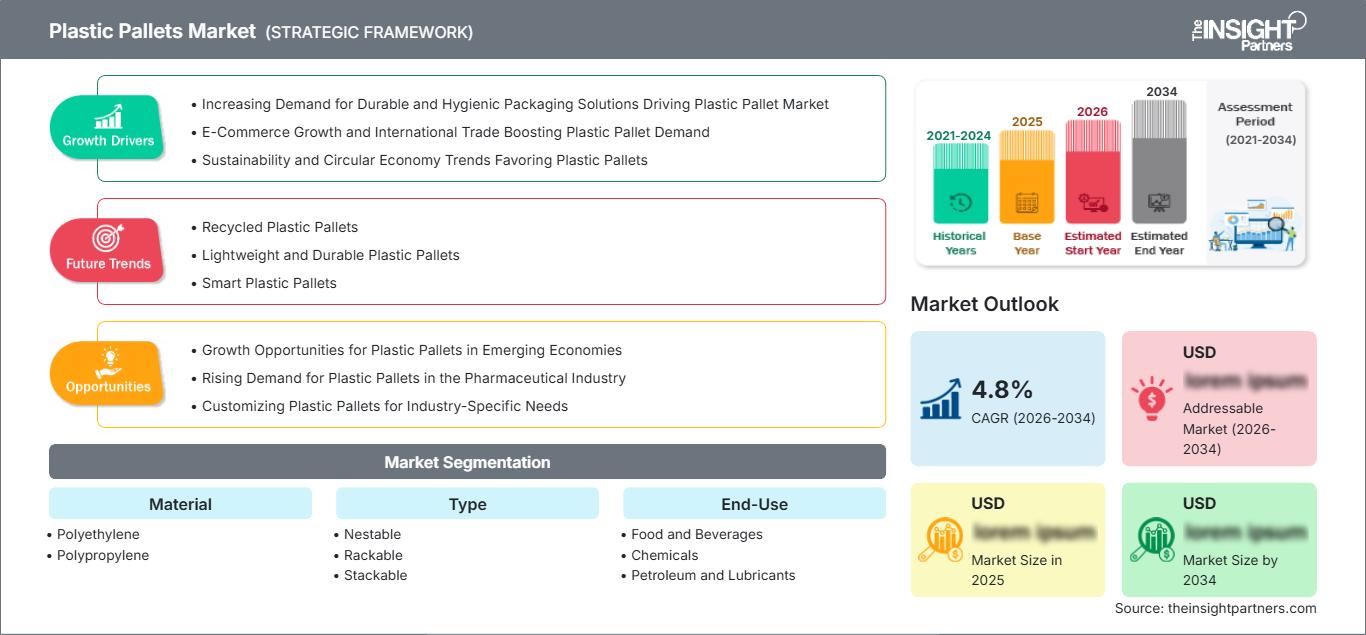
Regional Insights
North America Plastic Pallets Market
North America represents one of the most mature markets for plastic pallets, supported by an estimated CAGR of approximately 8.1%. Strong demand from food processing, pharmaceutical distribution, and organized retail sectors continues to create opportunities for reusable pallet systems. Regulatory requirements related to hygiene and contamination control further strengthen adoption across critical supply chains.
Warehouse automation is a major structural driver across the region, with companies investing in robotic material handling systems that require standardized and durable pallet platforms. Growing sustainability initiatives and corporate commitments to waste reduction are encouraging the transition from traditional wooden pallets to recyclable plastic alternatives, particularly among large logistics operators and multinational manufacturers.
U.S. Plastic Pallets Market
The U.S. accounts for roughly 75%–80% of the North American plastic pallets market and is projected to expand at a CAGR of around 8.2% through 2034. Strong industrial output, advanced distribution networks, and widespread implementation of automated warehouse technologies continue to support market growth. The country remains a major hub for reusable transport packaging solutions.
Companies such as ORBIS Corporation, Rehrig Pacific, and Kamps Pallets maintain significant Plastic pallets market presence through extensive product portfolios and logistics partnerships. Demand is particularly strong in food and beverage distribution, pharmaceutical logistics, and large retail supply chains where hygiene, durability, and traceability requirements are becoming increasingly important. RFID-enabled pallet management solutions are also gaining traction across U.S. distribution networks.
Europe Plastic Pallets Market
Europe accounts for approximately 25%–28% Plastic Pallets market share and is expected to grow at a CAGR of nearly 8.0%. Regulatory focus on sustainability, waste reduction, and circular economy principles continues to encourage adoption of reusable pallet systems. The region benefits from highly developed logistics infrastructure and strong participation from manufacturing and retail industries.
The UK market is supported by expanding e-commerce fulfillment operations and increasing investment in warehouse automation. Demand for hygienic pallet solutions is particularly strong in food processing and pharmaceutical supply chains, where compliance requirements favor durable plastic alternatives over conventional wooden platforms.
Germany remains the leading country within Europe due to its advanced manufacturing sector, extensive logistics network, and strong automation capabilities. Industrial users increasingly favor rackable and stackable plastic pallets that improve warehouse efficiency while supporting sustainability objectives.
France, Italy, and Spain collectively contribute substantial demand through food exports, retail distribution, and industrial manufacturing activities. Growing adoption of recyclable transport packaging and increasing focus on operational efficiency continue to support market penetration across these countries.
APAC Plastic Pallets Market
Asia Pacific is the fastest-growing regional market, accounting for approximately 30%–35% of global demand and registering a CAGR of around 9.5%. Rapid industrialization, expanding manufacturing output, and growing investment in logistics infrastructure are driving significant adoption of plastic pallet solutions across the region.
China leads the regional market due to its extensive manufacturing base, export-oriented economy, and large-scale warehouse development projects. Government initiatives focused on logistics modernization and supply chain efficiency continue to accelerate deployment of reusable transport platforms across industrial sectors.
India is emerging as a high-growth Plastic pallets market supported by expanding organized retail, pharmaceutical manufacturing, and cold chain logistics investments. Japan and South Korea remain important markets for automation-compatible pallet systems, while Australia benefits from strong demand in food exports, agriculture, and retail distribution networks.
Middle East & Africa Plastic Pallets Market
The Middle East & Africa plastic pallets market is expanding at a CAGR of approximately 7.3%, supported by infrastructure development, industrial diversification, and logistics modernization initiatives. Demand is increasing as regional industries seek durable and reusable material handling solutions that improve operational efficiency and reduce transportation losses.
Saudi Arabia leads regional adoption due to ongoing industrial expansion and major logistics investments associated with economic diversification programs. The development of manufacturing clusters and distribution hubs is creating sustained demand for high-performance pallet systems across multiple sectors.
The UAE continues to strengthen its role as a logistics and re-export center, supporting pallet demand within warehousing and transportation operations. South Africa remains an important market for industrial logistics and retail distribution, while the broader MEA region benefits from gradual improvements in supply chain infrastructure and warehouse capabilities.
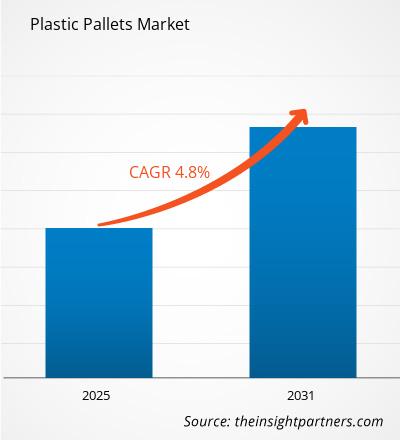
Segmentation Analysis
Material (Polyethylene, Polypropylene)
- Polyethylene: Dominates the plastic pallets market due to its excellent impact resistance, durability, and ability to withstand harsh environmental conditions. It is widely used in food processing, retail logistics, and pharmaceutical distribution where hygiene and long service life are essential.
- Polypropylene: Preferred for applications requiring higher rigidity and load-bearing performance. Polypropylene pallets are commonly utilized in automated warehousing systems and industrial supply chains where dimensional stability and resistance to repeated handling are critical.
Type (Nestable, Rackable, Stackable)
- Nestable: Designed to reduce storage and transportation costs by allowing empty pallets to fit within one another. These pallets are widely adopted in retail and export logistics where return transport efficiency is important.
- Rackable: Engineered for use in warehouse racking systems, providing superior load support and structural strength. Their compatibility with automated storage systems makes them increasingly popular in modern logistics facilities.
- Stackable: Offers enhanced load stability during storage and transportation. These pallets are extensively used in manufacturing and distribution environments where vertical space optimization is a priority.
End-Use (Food and Beverages, Chemicals, Petroleum and Lubricants, Pharmaceuticals, Automotive, Construction, Retail)
- Food and Beverages: Represents one of the largest demand segments due to stringent hygiene regulations, contamination prevention requirements, and growing adoption of reusable transport packaging across food supply chains.
- Chemicals: Utilizes plastic pallets for safe handling and transportation of hazardous and non-hazardous materials, benefiting from chemical resistance and structural durability under demanding operating conditions.
- Petroleum and Lubricants: Requires robust pallet systems capable of handling heavy loads and exposure to industrial environments, supporting storage and distribution operations throughout the value chain.
- Pharmaceuticals: Drives demand for contamination-free, washable, and traceable pallet solutions that comply with strict regulatory standards governing pharmaceutical manufacturing and distribution.
- Automotive: Uses plastic pallets for component handling and just-in-time manufacturing operations where consistency, durability, and automation compatibility improve supply chain efficiency.
- Construction: Employs heavy-duty pallet systems for transporting building materials and industrial products while minimizing damage during handling and storage activities.
- Retail: Relies on plastic pallets for distribution center operations, store replenishment programs, and e-commerce logistics where durability and repeat usability support cost-effective operations.
Opportunity Snapshot
| End-Use | Revenue Contribution | Trend Tag | Adoption Stage |
| Food and Beverages | High | Hygiene Logistics | Mature |
| Chemicals | Medium | Safe Handling | Scaling |
| Petroleum and Lubricants | Medium | Heavy Loads | Scaling |
| Pharmaceuticals | High | Compliance Focus | Mature |
| Automotive | Medium | Factory Automation | Scaling |
| Construction | Low | Material Transport | Emerging |
| Retail | High | E-commerce | Mature |
Plastic Pallets Market Growth Drivers and Impact Analysis
Expansion of warehouse automation and smart logistics systems
The increasing deployment of automated warehouses and intelligent logistics infrastructure is a major growth driver for the plastic pallets market. Modern distribution centers depend on standardized material-handling equipment that can operate seamlessly with robotic systems, conveyors, and automated storage and retrieval technologies. Plastic pallets offer consistent dimensions and structural integrity, making them particularly suitable for these environments.
Unlike wooden alternatives, plastic pallets are less prone to deformation, splintering, or moisture-related damage, ensuring smooth operation in highly automated facilities. Industries including retail, food processing, and e-commerce logistics are investing heavily in automation to improve efficiency and reduce labor costs. As automation adoption expands globally, demand for rackable and automation-compatible pallet designs continues to accelerate.
The real-world impact is evident across distribution networks, where companies are reducing downtime, improving inventory accuracy, and enhancing throughput. Manufacturers that develop pallets optimized for automated systems are gaining strategic advantages as digital supply chains become increasingly prevalent.
Growing emphasis on reusable and sustainable transport packaging
Sustainability initiatives are transforming material handling practices and encouraging the replacement of disposable transport solutions with reusable plastic pallets. Organizations are increasingly evaluating lifecycle costs rather than upfront purchase prices, recognizing the long-term economic benefits of durable reusable assets.
Plastic pallets typically offer longer service lives, lower maintenance requirements, and greater resistance to environmental exposure than traditional alternatives. Their recyclability further supports corporate sustainability objectives and compliance with environmental regulations. Many multinational companies are implementing circular logistics programs that utilize reusable pallet pools to reduce waste generation and transportation inefficiencies.
This trend is having a measurable impact on procurement decisions across industries such as retail, food and beverages, and manufacturing. Companies are seeking suppliers who can help them meet their sustainability goals by using recycled-content pallets and participating in end-of-life recycling programs. As environmental policies continue to change, the use of reusable plastic pallets is likely to increase further.
Rising demand from food, pharmaceutical, and retail sectors
The food and beverage, pharmaceutical, and retail industries are among the largest consumers of plastic pallets due to stringent hygiene, safety, and operational requirements. Plastic pallets offer non-porous surfaces that are easier to clean and sanitize, making them suitable for applications where contamination control is critical.
Growth in pharmaceutical production and cold chain logistics is increasing the demand for hygienic pallets. Likewise, food processing companies are moving towards plastic pallets owing to regulatory compliance and improved product protection during transport.
The impact extends beyond compliance requirements. Companies are experiencing reduced product damage, enhanced inventory management, and increased supply chain reliability. Such advantages are making the need for durable pallets more permanent in high-quality industries.
Plastic Pallets Market Future Trends
Integration of RFID and digital tracking technologies
A significant trend shaping the plastic pallets market is the integration of RFID tags, IoT sensors, and digital asset tracking technologies into pallet systems. Organizations are increasingly seeking greater visibility across supply chains to improve inventory accuracy, reduce asset loss, and optimize logistics performance.
Smart pallets enable real-time monitoring of location, utilization rates, and movement patterns throughout transportation networks. Such real-time tracking becomes especially helpful for industries such as pharmaceuticals, food, and retail, which are becoming stricter about traceability.
Looking ahead, smart pallets will see increased adoption as firms seek end-to-end visibility into their supply chains. With the integration of digital logistics platforms and the use of reusable transportation equipment, there will be new opportunities in business services logistics.
Increased adoption of recycled plastic pallet manufacturing
The use of recycled polymers in pallet production is emerging as a key trend across global markets. Manufacturers are investing in advanced recycling technologies that enable high-quality pallet production while reducing dependence on virgin plastic materials.
This trend is consistent with the goals of the circular economy and with increasing consumer preference for green products. Recycled plastic pallets will enable businesses to reduce their carbon footprint while still achieving their desired performance levels across various industries. Developments in materials manufacturing have made these types of products more resilient than ever.
Adoption is forecast to increase as the regulatory environment favors the use of recycled materials and sustainability reports continue to gain importance. Firms that can achieve a balance between performance, longevity, and environmental advantages will be in a better competitive position.
Plastic Pallets Market Opportunities
Expansion of pallet pooling and rental service networks
Emerging Plastic Pallets market trends indicate that the growing adoption of pallet pooling and rental models presents a substantial opportunity for market participants. Businesses across the food and beverage, retail, and pharmaceutical sectors are increasingly seeking asset-light logistics solutions that reduce capital expenditure while improving operational efficiency. Plastic pallets are particularly well-suited to pooling systems because of their durability, standardized dimensions, and extended lifecycle performance.
Pooling networks allow companies to collaborate to share their reusable pallets across various phases of the supply chain, thereby avoiding transportation inefficiencies and minimizing costs. Pooling is increasingly adopted by multinational corporations and logistics providers for its flexibility and sustainability.
The investment potential is even higher in emerging economies where there is a fast-growing network of logistical infrastructure. The ability to integrate pooling with digital monitoring, predictive maintenance, and pallet lifecycle management will allow companies to increase customer retention and stand out from their competitors.
Growth of cold chain and pharmaceutical logistics infrastructure
The accelerated growth of temperature-controlled logistics networks presents immense possibilities for plastic pallet makers. Drugs, vaccines, biological substances, and fresh food products demand logistical support systems that maintain high levels of hygiene and efficiency. The benefits of plastic pallets include their resistance to moisture, ease of sanitization, and uniform size.
Governments and private-sector organizations are making large investments in cold storage, refrigerated transport systems, and infrastructure for the distribution of pharmaceutical products. Emerging countries are taking an active role in enhancing their logistics infrastructure for the healthcare industry due to population growth and rising pharmaceutical consumption. There is a huge demand for efficient pallets that can preserve product quality during transportation.
Manufacturers that invest in developing specific pallets for cold environments, automation, and other special requirements will be able to capitalize on this demand. Collaborations with logistics firms, pharmaceutical companies, and cold chain logistics players may help to improve the Plastic pallets market positioning.
Recent Developments
- March, 2025: ORBIS Corporation introduced expanded reusable packaging and pallet solutions focused on enhancing automation compatibility and sustainability performance for industrial and retail supply chains. The initiative supports increasing demand for durable transport assets designed for automated warehouse operations and circular logistics programs.
- June, 2024: LOSCAM continued expansion of its returnable transport packaging and pallet pooling services across Asia-Pacific markets, strengthening logistics support for food, retail, and manufacturing customers seeking efficient reusable asset management solutions.
- September, 2024: Schoeller Allibert announced developments in recycled plastic material utilization across its reusable packaging portfolio, including pallet products. The company emphasized circular economy objectives and efforts to reduce environmental impact while maintaining performance standards for logistics applications.
Frequently Asked Questions

- Comprehensive Market Sizing and Forecast Analysis
- Detailed Segmentation Analysis
- In-Depth Market Dynamics Assessment
- Regional and Country-Level Insights
- Competitive Landscape and Company Benchmarking
- Strategic Business Intelligence
Recent Reports
Testimonials

The Insight Partners provided valuable market intelligence that supported our global go-to-market strategy. Their team was professional, responsive, and attentive to our feedback, providing thoughtful analysis and helpful methodological clarifications throughout the project.
Junmo Kim Chief Financial Officer (CFO), Enertech Co., Ltd.
The Insight Partners' SCADA System Market report is comprehensive, with valuable insights on current trends and future forecasts. The team was highly professional, responsive, and supportive throughout. We are very satisfied and highly recommend their services.
RAN KEDEM Partner, Reali Technologies LTDs
I requested a report on a very specific software market and the team produced the report in a few days. The information was very relevant and well presented. I then requested some changes and additions to the report. The team was again very responsive and I got the final report in less than a week.
JEAN-HERVE JENN Chairman, Future Analytica
We worked with The Insight Partners for an important market study and forecast. They gave us clear insights into opportunities and risks, which helped shape our plans. Their research was easy to use and based on solid data. It helped us make smart, confident decisions. We highly recommend them.
PIYUSH NAGPAL Sr. Vice President, High Beam Global
The Insight Partners delivered insightful, well-structured market research with strong domain expertise. Their team was professional and responsive throughout. The user-friendly website made accessing industry reports seamless. We highly recommend them for reliable, high-quality research services
YUKIHIKO ADACHI CEO, Deep Blue, LLC.
This is the first time I have purchased a market report from The Insight Partners.While I was unsure at first, I visited their web site and felt more comfortable to take the risk and purchase a market report.I am completely satisfied with the quality of the report and customer service. I had several questions and comments with the initial report, but after a couple of dialogs over email with their analyst I believe I have a report that I can use as input to our strategic planning process.Thank you so much for taking the extra time and making this a positive experience.I will definitely recommend your service to others and you will be my first call when we need further market data.
JOHN SUZUKI President and Chief Executive Officer, Board Director, BK Technologies
I wish to appreciate your support and the professionalism you displayed in the course of attending to my request for information regarding to infectious disease IVD market in Nigeria. I appreciate your patience, your guidance, and the fact that you were willing to offer a discount, which eventually made it possible for us to close a deal. I look forward to engaging The Insight Partners in the future, all thanks to the impression you have created in me as a result of this first encounter.
DR CHIJIOKE ONYIA MANAGING DIRECTOR, PineCrest Healthcare Ltd.Reason to Buy
- Informed Decision-Making
- Understanding Market Dynamics
- Competitive Analysis
- Identifying Emerging Markets
- Customer Insights
- Market Forecasts
- Risk Mitigation
- Boosting Operational Efficiency
- Strategic Planning
- Investment Justification
- Tracking Industry Innovations
- Aligning with Regulatory Trends





 Get Free Sample for