Polymeric Sand Market Trends, Share & Demand by 2034

Coverage: by Applications (Patios, Pool Deck, Pavement and Auxiliary Spaces, Others); End-User (Residential, Commercial, Municipal, Industrial) , and Geography (North America, Europe, Asia Pacific, and South and Central America)

Historic Data: 2021-2024 | Base Year: 2025 | Forecast Period: 2026-2034
  • Status : Data Released
  • Report Code : TIPRE00011734
  • Category : Chemicals and Materials
  • No. of Pages : 150
  • Available Report Formats : pdf-format excel-format
  • Last update date : July 16, 2026
Polymeric Sand Market Trends, Share & Demand by 2034
Report Date: July 16, 2026   |   Report Code: TIPRE00011734 Email: sales@theinsightpartners.com

2025 Market Size

US$ 183.3 Mn

Base year value

2034 Forecast

US$ 247.36 Mn

Projected by 2034

CAGR 2026-2034

3.82 %

Growth rate

Addressable Market

US$ 1,999.14 Mn

(2026-2034)

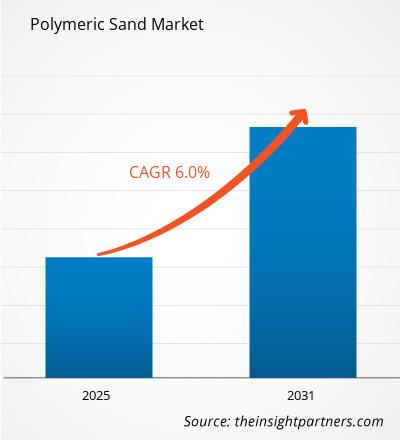
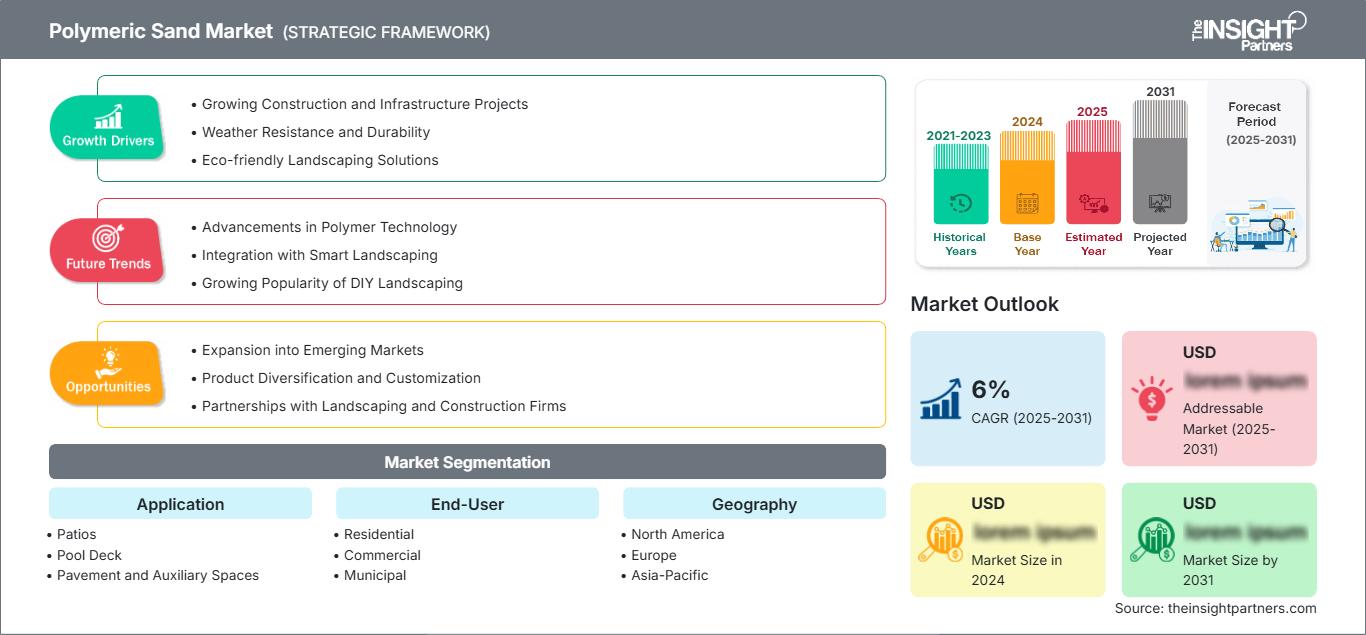
The polymeric sand market size was valued at US$ 183.3 million in 2025 and is projected to reach US$ 247.36 million by 2034, registering a CAGR of 3.82% during 2026–2034. The market size expansion is supported by sustained demand for durable jointing materials in hardscape construction, increasing investments in residential landscaping, and rising adoption of low-maintenance paving solutions across developed and emerging economies. Product innovations focused on weather resistance and installation efficiency continue to strengthen long-term market prospects.

Regionally, North America is predicted to dominate in terms of the market for the foreseeable future, growing at a CAGR of around 3.4-3.8% between 2026-2034. Home renovations, increasing popularity of high-end outdoor living spaces, and urban initiatives to invest in walking facilities are among the factors driving demand for polymeric sand. Moreover, the presence of experienced hardscape contractors along with the increasing popularity of durable and low-maintenance pavement are contributing to the polymeric sand market trends.

Polymeric Sand Market Assessment and Insights

  • North America: North America accounted for 38–42% of the polymeric sand market share in 2025 and is anticipated to expand at a CAGR of 3.4–3.8% during 2026–2034. Residential remodeling, municipal hardscape upgrades, and increasing investments in premium landscaping projects continue to support steady regional market growth.
  • U.S.: The U.S. represented 84–88% of the North American market in 2025 and is projected to register a CAGR of 3.5–3.9% during 2026–2034, driven by growing demand for outdoor living spaces, home improvement projects, and durable hardscape maintenance solutions.
  • Europe: Europe held 26–30% polymeric sand market share in 2025 and is expected to grow at a CAGR of 3.2–3.6% during 2026–2034. Germany, France, and the United Kingdom remain leading markets, supported by mature landscaping industries, public-space renovation initiatives, and increasing adoption of durable paving solutions.
  • Asia Pacific: Asia Pacific accounted for 22–26% of the market in 2025 and is forecast to expand at a CAGR of 4.5–4.9% during 2026–2034. China, Japan, and India continue to lead regional demand, driven by expanding urban infrastructure, rising residential construction, and increasing installation of hardscape and outdoor living areas.
  • Largest Segment: Residential represented the largest segment in the polymeric sand market and is expected to record a CAGR of 3.6–4.0% during 2026–2034, reflecting strong homeowner investment in patios, driveways, walkways, and outdoor living space enhancements.
  • High Growth Segment: Pool Deck is projected to grow at a CAGR of 4.6–5.0% during 2026–2034, driven by rising demand for premium outdoor recreational spaces and increasing adoption of moisture-resistant, durable paving systems.
  • Key companies analyzed in detail: Alliance Designer Products Inc.; Ash Grove Packaging; Covia Holdings LLC; Promasonry Inc.; Sakrete; SEK-Surebond, Inc.; Silpro LLC; SRW Products; TCC Materials; Techniseal.

Source: The Insight Partners' analysis based on proprietary research, government publications, company annual reports, investor presentations, industry databases, and expert interviews.

The demand for polymeric sand has been shaped by the rising popularity of professional outdoor design concepts and improved hardscaping materials. The quality of products has been improved by advancements in polymer mix, improved particle size, and dust control, making the installation easier and increasing weed resistance, joint erosion, and washout. The distribution channels have been expanded with additional presence in home improvement retailers, landscape specialists, and contractor-oriented channels in both developed and developing construction markets.

Moving forward, there will be additional opportunities for market growth with continued investment in infrastructure and focus on more durable construction projects. There is an increase in decorative paving system usage in emerging economies, leading to the rise in demand for joint stabilization products. Initiatives related to sustainability and using more durable construction materials along with innovations in eco-friendly polymers and contractor training are likely to boost competition in the polymeric sand market during the forecast period until 2034.

Polymeric Sand Market Report Scope

Report Attribute Details
Market size in 2025 US$ 183.3 Million
Market Size by 2034 US$ 247.36 Million
Global CAGR (2026 - 2034)3.82%
Historical Data 2021-2024
Forecast period 2026-2034
Inquire More about this report.
Inquire More

Polymeric Sand Market Analysis

With rising investment in residential landscaping projects, commercial hardscape structures and municipal public spaces, demand for polymeric sand is expected to grow further across the globe. This is due to the preference of polymeric sand over traditional jointing sand since it offers reduced weed growth, insect infestation and joint deterioration along with increased stability of pavements. Rising application of decorative pavers in patios, pathways, plazas, pool deck surfaces and pedestrian pathways has led manufacturers to develop new generation products with improved moisture resistance, fast curing and improved color stability.

Market ecosystem comprises silica sand producers, polymer additive producers, blending companies, packers and distributors, landscape contractors, retailers and customers. Availability of high-quality raw materials and efficient logistics are vital to ensure product quality and timely deliveries. Manufacturers are focusing on optimizing production processes by incorporating advanced blending equipment and sustainable packaging systems. Positive business relationship with contractors and retail distributors helps manufacturers increase market share along with catering to customers' needs and regional construction activities.

According to the polymeric sand market report, the competitive landscape is characterized by product innovation, brand positioning, and extensive distribution capabilities rather than price competition alone. Companies including Alliance Designer Products Inc., Techniseal, SEK-Surebond, Inc., SRW Products, TCC Materials, Silpro LLC, Promasonry Inc., Sakrete, Ash Grove Packaging, and Covia Holdings LLC continue to strengthen their portfolios through enhanced formulations, contractor education programs, and expanded regional availability. Premium-performance products offering superior bond strength and weather resistance increasingly differentiate suppliers in mature markets.

Efforts have been centered on improving efficiency in manufacturing processes, advancing new polymer technologies, and developing distribution networks that serve contractors. The producers are now focusing on developing environmentally friendly formulas that generate less dust and perform better during installation, in response to changing customer demands. Collaboration between producers, building materials distributors, and home improvement stores has improved the availability of their products, while online marketing and installation training programs have helped ensure customer loyalty. Competitive strategies will help in maintaining market growth.

● REPORT CUSTOMIZATION

Tailor This Report To Align With Your Specific Business Requirements

This report can be customized to align precisely with your business objectives, scope, and target markets. Customization options include tailored segmentation, geography, competitive analysis, and strategic insights to support informed decision-making.

Customize This Report →

WHAT YOU CAN ADJUST

  • Segmentations
  • Geography
  • Competitive Analysis
  • Language Preferences

Polymeric Sand Market: Strategic Insights
polymeric-sand-market
Download Free sample to check more details about report.
This FREE sample will include data analysis, ranging from market trends to estimates and forecasts.
Download Free Sample

Regional Insights

North America Polymeric Sand Market

North America accounted for 38–42% of the global polymeric sand market in 2025 and is projected to register a CAGR of 3.4–3.8% during 2026–2034. Strong residential remodeling activity and sustained investment in outdoor living spaces continue to support market expansion across the region.

Municipal sidewalk rehabilitation, commercial landscape development, and widespread use of interlocking pavers are encouraging contractors to adopt premium polymeric sand products that offer enhanced joint stability, reduced maintenance, and improved resistance to erosion and weather exposure.

U.S. Polymeric Sand Market

The United States represented 84–88% of North American market revenue in 2025 and is anticipated to expand at a CAGR of 3.5–3.9% through 2034. Demand remains supported by a mature landscaping industry and consistent investment in residential exterior improvement projects.

Leading manufacturers in the polymeric sand market maintain strong distribution partnerships with home improvement retailers and contractor supply networks throughout the country. Growing installations of patios, pool decks, driveways, and walkways continue to increase consumption of high-performance polymeric sand formulations that deliver long-term durability and lower maintenance requirements.

Europe Polymeric Sand Market

Europe captured 26–30% of the global polymeric sand market in 2025 and is forecast to record a CAGR of 3.2–3.6% during the forecast period. Germany remains the leading country, supported by established construction standards and extensive hardscape applications.

The United Kingdom continues to reap the benefits of high investment by homeowners in premium-quality gardens, patios, and outdoor entertaining facilities. The demand is also driven by improvements in public paths and a growing preference for paving systems that require minimal maintenance while extending pavement life.

Germany leads because of its well-established construction materials industry, widespread use of decorative paving materials, and ongoing improvements in urban infrastructure. Landscape professionals tend to use advanced polymeric sand in order to enhance the performance of pavements in different climatic conditions.

France, Italy, and Spain account for significant regional demand due to urban reconstruction, tourism infrastructure development, and landscaping improvements. Awareness of durable paving materials, coupled with growing renovation activity, continues to provide stable demand prospects in Southern and Western Europe.

APAC Polymeric Sand Market

Asia Pacific accounted for 22–26% of global revenue in 2025 and is expected to achieve the fastest regional expansion with a CAGR of 4.5–4.9% through 2034. China leads regional demand owing to extensive urban development and large-scale infrastructure investment.

Japan consistently uses high-quality hardscape materials for residential and commercial landscaping applications, whereas South Korea capitalizes on growing urban beautification efforts. Both countries are emphasizing the use of paving systems that offer durability and minimum maintenance over their lifecycle.

The need for polymeric sand in India and Australia is increasing due to residential and commercial construction projects and public infrastructure modernization projects. The construction of smart cities, recreational areas, and pedestrian-friendly infrastructure would drive regional consumption of polymeric sand during the forecast period.

Middle East & Africa Polymeric Sand Market

The Middle East & Africa market is projected to expand at a CAGR of 3.7–4.1% during 2026–2034. Saudi Arabia remains the leading country, supported by large-scale urban development programs and investments in commercial, hospitality, and public infrastructure projects.

The United Arab Emirates continues to generate demand through premium residential communities, tourism infrastructure, and mixed-use developments requiring durable hardscape installations. Contractors increasingly favor polymeric sand for projects exposed to demanding climatic conditions.

South Africa and the Rest of the Middle East & Africa are experiencing gradual market development as municipalities improve pedestrian infrastructure and recreational spaces. Continued diversification beyond energy sectors and rising investments in public amenities are expected to support long-term regional demand for advanced jointing materials.

polymeric-sand-market-cagr-image
Get a regional analysis of this market.
Download Free Sample Brochure

Segmentation Analysis

Application

The Application segment represents a fundamental demand pillar for the polymeric sand market, with product selection largely influenced by project scale, traffic exposure, and long-term maintenance expectations. Increasing adoption of decorative paving solutions across residential and commercial developments continues to support segment expansion. The application segment is anticipated to register a CAGR of 3.8–4.2% during 2026–2034, driven by growing investments in durable outdoor infrastructure and aesthetically appealing hardscape installations.

  • Patios: Patios account for a substantial share of polymeric sand consumption as homeowners increasingly invest in outdoor living spaces. Contractors favor polymeric sand because it improves paver stability, minimizes weed growth, and enhances the long-term appearance of decorative hardscape installations.
  • Pool Deck: Pool deck applications are expected to experience robust demand owing to rising construction of residential and hospitality leisure facilities. Moisture resistance, reduced joint erosion, and enhanced durability make polymeric sand a preferred solution for these demanding environments.
  • Pavement and Auxiliary Spaces: Public walkways, pedestrian plazas, driveways, sidewalks, courtyards, and other auxiliary paved areas continue to generate steady demand. Municipal infrastructure upgrades and commercial landscape development encourage the adoption of premium joint stabilization materials that improve pavement longevity and reduce maintenance costs.

End-User

Residential construction remains the dominant end-user category, supported by consistent spending on landscaping, home renovation, and outdoor recreation areas. Commercial, municipal, and industrial users are also expanding their adoption of polymeric sand as infrastructure owners increasingly prioritize durable paving systems that lower maintenance requirements and extend service life.

  • Residential: Residential applications generate the largest revenue contribution due to widespread installation of patios, walkways, driveways, and backyard entertainment spaces. Homeowners increasingly prefer polymeric sand because it delivers attractive finishes while reducing weed intrusion, insect activity, and joint displacement.
  • Commercial: Commercial properties, including retail centers, office complexes, hotels, and mixed-use developments, utilize polymeric sand to maintain aesthetically appealing paved surfaces capable of withstanding continuous pedestrian traffic and minimizing maintenance interruptions throughout their operating life.
  • Municipal: Municipal agencies increasingly specify polymeric sand for sidewalks, parks, plazas, recreational facilities, and streetscape improvement projects. Long-term durability, reduced erosion, and lower maintenance frequency support cost-effective management of public infrastructure assets.
  • Industrial: Industrial facilities adopt polymeric sand for paved logistics yards, warehouse surroundings, and operational pathways where stable paver joints contribute to improved surface integrity, reduced maintenance interventions, and reliable performance under moderate service conditions.

Opportunity Snapshot

Segment Name

Revenue Contribution

Trend Tag

Adoption Stage

Residential

High

Outdoor Living

Mature

Commercial

Medium

Urban Landscaping

Scaling

Municipal

Medium

Streetscape Renewal

Scaling

Industrial

Low

Facility Paving

Emerging

Request for Customization for extensive market insights.
Customize This Report

Polymeric Sand Market Growth Drivers and Impact Analysis

Expansion of Residential Landscaping and Outdoor Living Projects

The increased interest among homeowners in outdoor living spaces is a significant driver of the polymeric sand market. Construction and renovation efforts have included patios, walkways, driveways, pool decks, and even decorative paving that would need stable joint material. There has been an emphasis on aesthetic, low-maintenance landscaping that provides structural strength. As disposable incomes improve and outdoor spaces become extensions of residential living areas, contractors are specifying premium polymeric sand products that reduce weed growth, resist washout, and improve paver stability.

Increasing Infrastructure Modernization and Public Space Development

The increase in spending on pedestrian infrastructure, urban redevelopment, parks, plazas, and recreational facilities is creating a constant demand for high-quality paving material. Polymeric sand enhances the longevity of paved surfaces by reinforcing the joints between pavers and preventing erosion caused by rain, traffic, and environmental exposure. There is increased awareness among public organizations regarding the benefits of using high-quality jointing materials for long-term maintenance. As cities take steps toward urban beautification and infrastructure modernization, demand for polymeric sand will rise.

Continuous Product Innovation Enhancing Installation Performance

Research and development are underway to improve polymer technology and make the installation process easier and more effective. The new technology provides greater joint strength, shorter curing time, reduced dust formation, improved coloring, and improved freeze-thaw tolerance and rain resistance. This leads to greater productivity for the installer and reduced maintenance for the end user. Improved product effectiveness can increase use in commercial development, hospitality projects, and public works projects, as product performance over its lifespan is considered when making a purchase.

Polymeric Sand Market Future Trends

Growing Adoption of Sustainable and Low-Emission Product Formulations

Environmental considerations are increasingly influencing product development across the polymeric sand market. Manufacturers are focusing on formulations that reduce dust emissions during installation, optimize polymer utilization, and incorporate environmentally responsible packaging materials. Customers, particularly municipalities and commercial developers, are evaluating construction materials based on lifecycle performance and sustainability objectives alongside traditional cost considerations. As green building practices become more widely adopted, suppliers are expected to accelerate investments in eco-conscious manufacturing processes and product innovation. These developments will strengthen market competitiveness while helping contractors meet evolving environmental standards without compromising installation quality or long-term pavement performance.

Expansion of Digital Contractor Support and Value-Added Services

Manufacturers are moving beyond product supply by offering digital tools, technical guidance, and installer training programs that improve project execution and customer satisfaction. Mobile application guides, online installation resources, and certification initiatives are enabling contractors to achieve more consistent results while reducing installation errors. These value-added services are strengthening brand loyalty and supporting premium product positioning in competitive markets. The polymeric sand market forecast indicates that companies are expected to integrate digital engagement strategies with distributor networks, creating stronger relationships with professional installers and expanding market penetration through enhanced technical expertise and after-sales support.

Polymeric Sand Market Opportunities

Expansion into High-Growth Urban Infrastructure Projects

Urbanization in the emerging countries provides opportunities for polymer sand producers to expand their presence in large-scale infrastructure developments. Investment is being made in the construction of walkways, plazas, parks, transport terminals, and multipurpose complexes that require robust pavements with long service lives. By collaborating with contractors, architects, and municipalities, providers could create stable project pipelines and showcase the benefits of high-tech joint materials. The establishment of regional plants and distribution networks will increase production efficiency and allow producers to respond quickly to rising demand.

Development of Premium Solutions for Professional Contractors

The professional contractor segment offers substantial growth potential as customers increasingly seek products that improve installation efficiency and deliver reliable long-term performance. Manufacturers can benefit from developing high-quality polymeric sand blends with quick-curing properties, weather-resistance, color stability, and high-strength joints for tough environments. Supplementing these solutions with certification courses for contractors, technical training, on-site assistance, and installation software tools will be an effective way to promote brand loyalty and foster repeated sales. The proposed approach allows companies to stand out from the crowd of cheaper products and capture a larger market share.

Recent Developments

  • February 2026: Alliance Designer Products Inc. introduced the GATOR NITRO-X Fine Joint Sand, featuring a proprietary resin formulation with Rapid Flow Technology designed for low-permeability, fine-joint paver applications. The launch expands the company's premium polymeric sand portfolio by improving installation efficiency, joint strength, and performance in demanding hardscape environments.
  • February 2025: Techniseal announced that its SMARTSAND, HP NextGel, and NOCO polymeric sand products are being manufactured in Colorado through a regional production partnership, improving product availability, shortening delivery times, and strengthening supply chain responsiveness for distributors and contractors across the western United States.
  • April 2024: Techniseal expanded its North American manufacturing footprint by introducing locally manufactured jointing products in Northern California, including new Southern Granite and Cali Tan colors for HP NextGel™ and SMARTSAND. The initiative improves regional supply efficiency while broadening color options for professional hardscape contractors and distributors.

Frequently Asked Questions

The residential segment represents the largest revenue opportunity because of sustained investments in patios, driveways, walkways, pool decks, and backyard renovation projects. Rising homeowner preference for premium landscaping materials continues to reinforce the segment's market leadership.

Manufacturers are investing in advanced polymer formulations, expanding regional manufacturing capacity, strengthening distribution partnerships, introducing contractor training programs, and improving digital technical support. These initiatives enhance customer loyalty while differentiating premium products in an increasingly competitive marketplace.

The polymeric sand market is expected to experience steady growth through 2034, supported by urban infrastructure development, increasing hardscape construction, sustainability-focused product innovation, and rising demand for durable paving materials across residential, commercial, municipal, and industrial end-user segments.

North America benefits from a well-established hardscape industry, high residential renovation spending, advanced contractor networks, and strong consumer demand for premium outdoor spaces. These structural advantages encourage widespread adoption of high-performance polymeric sand products across residential and commercial applications.

Demand is primarily driven by increasing residential landscaping activities, expansion of outdoor living spaces, municipal infrastructure modernization, and growing preference for durable, low-maintenance paving solutions. Continuous product innovation and wider adoption of decorative hardscapes also support long-term market growth.
Vrushali Bothare
Manager,
Market Research & Consulting
Vrushali is a senior consultant with over 7 years of experience in the Chemicals & Materials industry, with deep domain expertise across specialty chemicals. She holds a Bachelor's degree in Chemistry and a Master's degree in Management, enabling her to combine strong technical acumen with strategic business insight. Her experience spans multiple sectors, including chemicals, food & beverage, and consumer goods, with expertise in functional ingredients, renewable chemicals, feed, and agrochemicals. She has successfully supported clients through market expansion, business growth, and operational transformation initiatives. Vrushali is recognized for her strong capabilities in client conversion, stakeholder management, and leading high-performing teams. She has consistently driven operational efficiency and productivity improvements through a structured, results-oriented approach. Her ability to bridge technical expertise with commercial strategy enables her to deliver impactful solutions tailored to client needs across complex and evolving markets.
  • Comprehensive Market Sizing and Forecast Analysis
  • Detailed Segmentation Analysis
  • In-Depth Market Dynamics Assessment
  • Regional and Country-Level Insights
  • Competitive Landscape and Company Benchmarking
  • Strategic Business Intelligence

Testimonials

Reason to Buy

  • Informed Decision-Making
  • Understanding Market Dynamics
  • Competitive Analysis
  • Identifying Emerging Markets
  • Customer Insights
  • Market Forecasts
  • Risk Mitigation
  • Boosting Operational Efficiency
  • Strategic Planning
  • Investment Justification
  • Tracking Industry Innovations
  • Aligning with Regulatory Trends

Sales Assistance
US: +1-646-491-9876
UK: +44-20-8125-4005
DUNS Logo
ISO Certified Logo
GDPR
CCPA