
Polypropylene Waxes Market Size, Share & Forecast by 2034
Coverage: by Type (Normal PP Wax, Modified PP Wax); Form (Granule, Powder, Emulsion); Applications (Plastics and Polymer, Hot Melt Adhesive, Inks and Paints, Release Agent), and Geography (North America, Europe, Asia Pacific, and South and Central America)
- Status : Data Released
- Report Code : TIPRE00013061
- Category : Chemicals and Materials
- No. of Pages : 150
- Available Report Formats :


- Last update date : July 03, 2026


2025 Market Size
US$ 976.89 Mn
Base year value
2034 Forecast
US$ 1,194.89 Mn
Projected by 2034
CAGR 2026-2034
2.26 %
Growth rate
Addressable Market
US$ 9,847.82 Mn
(2026-2034)
Polypropylene waxes market is valued at US$ 976.89 Million in 2025 and is projected to reach US$ 1,194.89 Million by 2034, expanding at a CAGR of 2.26% during 2026–2034. Growth is supported by consistent demand from plastics processing, hot melt adhesive systems, and coatings formulations. Increasing reliance on functional polymer additives in industrial manufacturing continues to reinforce steady consumption across both mature economies and expanding chemical production hubs globally.
In North America, the polypropylene waxes market is expected to grow at a CAGR of 2.0–2.4% during the forecast period. Expansion is driven by advanced polymer processing infrastructure and strong demand from packaging and adhesive industries. Rising emphasis on high-performance materials in automotive and construction sectors further supports adoption, while regulatory compliance in industrial formulations encourages the use of optimized wax-based additives.
Polypropylene Waxes Market Assessment and Insights
- North America: North America accounted for 28–32% of the market share in 2025 and is anticipated to expand at a CAGR of 2.0–2.4% during 2026–2034. Growth is supported by packaging innovation, increasing demand for high-performance adhesives, and expanding applications in plastics processing and industrial formulations.
- U.S.: The U.S. represented 70–75% of the North American market in 2025 and is projected to register a CAGR of 2.4% during 2026–2034, driven by rising demand for advanced packaging materials, high-performance coatings, and adhesive applications.
- Europe: Europe held 22–26% market share in 2025 and is expected to grow at a CAGR of 1.8–2.2% during 2026–2034. Germany, the United Kingdom, and France remain leading markets, supported by established plastics manufacturing, specialty chemical production, and growing demand for sustainable industrial materials.
- Asia Pacific: Asia Pacific accounted for 38–42% market share in 2025 and is forecast to expand at a CAGR of 2.5–3.0% during 2026–2034. China, India, and Japan continue to lead regional demand, driven by expanding plastics processing, packaging manufacturing, and industrial production activities.
- Largest Segment: Normal PP Wax represented the largest market segment and is expected to record a CAGR of 2.0% during 2026–2034, reflecting its cost efficiency and broad compatibility across plastics processing, coatings, inks, and adhesive applications.
- High Growth Segment: Modified PP Wax is projected to grow at a CAGR of 2.7% during 2026–2034, driven by enhanced thermal stability, improved processing characteristics, and superior performance in advanced industrial applications.
- Key companies analyzed in detail: Altana AG; Clariant AG; COSCHEM Co.; Deurex AG; Euroceras GmbH; Honeywell International Inc.; Lion Chemtech Co. Ltd.; The Lubrizol Corporation; Mitsui Chemicals Inc.; Nanjing Tianshi New Materials Co. Ltd.
Source: The Insight Partners' analysis based on proprietary research, government publications, company annual reports, investor presentations, industry databases, and expert interviews.
The polypropylene waxes market is shifting away from the conventional applications in lubrication toward performance additive formulations, which are highly utilized in value-added polymers. Early applications were limited to processing aids in plastics. But developments in polymer chemistry have led to better molecular control. This has enhanced compatibility in coatings, adhesives, and inks, thus increasing the functionality of polypropylene waxes.
In the future, the industry would experience the impact of automation and the growing demand for efficient polymer processing aids. Capacity investments are likely to be witnessed in Asia Pacific, whereas North America will focus on developing formulations. Sustainable and energy-efficient manufacturing would change the competitive scenario, thus driving innovations in next-generation modified waxes.
Polypropylene Waxes Market Report Scope
| Report Attribute | Details |
|---|---|
| Market size in 2025 | US$ 976.89 Million |
| Market Size by 2034 | US$ 1,194.89 Million |
| Global CAGR (2026 - 2034) | 2.26% |
| Historical Data | 2021-2024 |
| Forecast period | 2026-2034 |
Polypropylene Waxes Market Analysis
The demand for polypropylene wax is determined by growth in plastics processing, packaging, and adhesive production industries. These waxes provide slip control, better dispersing ability, and thermal stability for polymers. The value chain includes propylene feedstock suppliers, polymerization facilities, wax manufacturers, and downstream compounders serving industrial end users. Synergy between the petrochemicals and specialties chemicals industries ensures stable supplies and quality.
Supply factors depend on raw materials availability and refinery output dynamics because the production of polypropylene wax is closely connected to propylene derivatives. Production optimization in terms of viscosity and melting point properties is made using catalytic and thermal cracking. Growth in downstream demand from the packaging and automotive industries ensures stable demand trends, and Asia Pacific regional production centers ensure effective global supply chains.
Market consolidation is relatively moderate, with multinationals and specialists competing on formulation efficacy and versatility. Companies such as Clariant AG, The Lubrizol Corporation, and Mitsui Chemicals Inc. concentrate on innovations in modified wax formulations, whereas mid-cap players Deurex AG and Euroceras GmbH specialize in customization and specialization of their products. Competitive strategy in this industry increasingly involves performance differentiation rather than pure pricing strategies.
Investments are focused on capacity expansions and research & development efforts, especially in Asia Pacific. Manufacturers work on increasing production capacity to accommodate increased demand from the region and make their formulations more efficient for high-end applications. Honeywell International Inc. and Altana AG leverage advanced material science expertise to enhance product functionality. Meanwhile, Chinese producers such as Nanjing Tianshi New Materials Co. Ltd. increase their export-oriented capacity.
● REPORT CUSTOMIZATION
Tailor This Report To Align With Your Specific Business Requirements
This report can be customized to align precisely with your business objectives, scope, and target markets. Customization options include tailored segmentation, geography, competitive analysis, and strategic insights to support informed decision-making.
Customize This Report →WHAT YOU CAN ADJUST
- ● Segmentations
- ● Geography
- ● Competitive Analysis
- ● Language Preferences
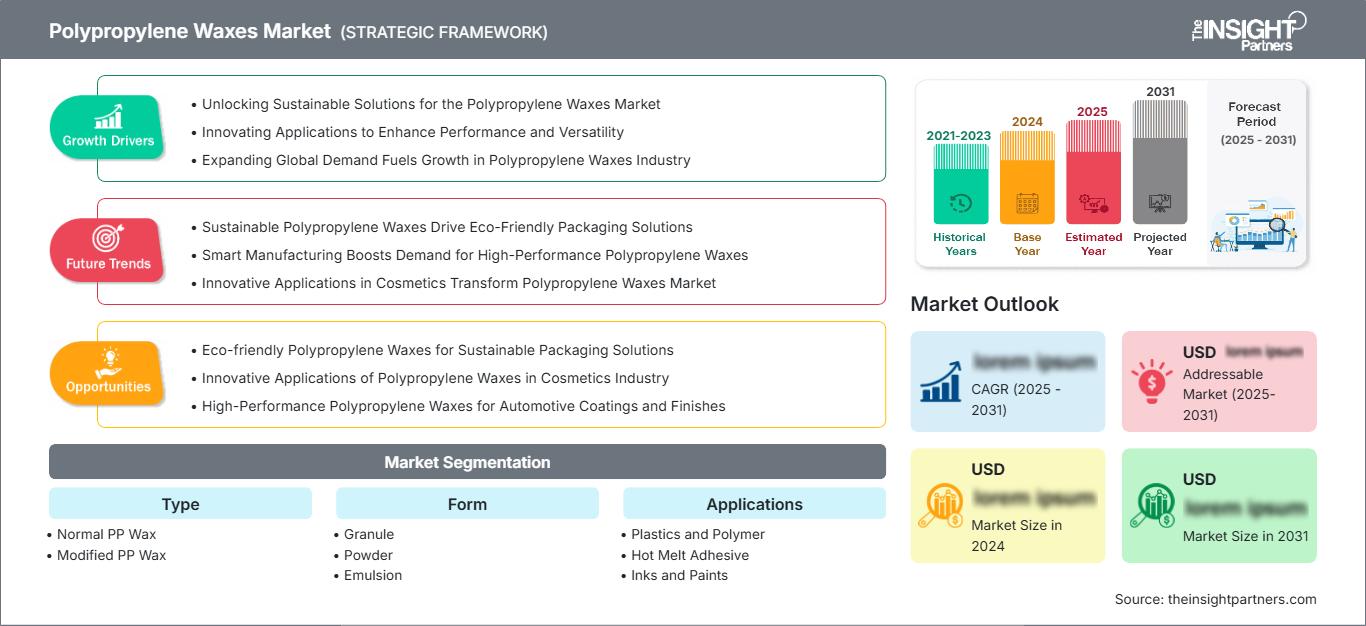
Polypropylene Waxes Market: Strategic Insights
Regional Insights
North America Polypropylene Waxes Market
North America exhibits stable demand for polypropylene waxes, supported by advanced plastics processing and strong industrial manufacturing infrastructure. The region’s market growth is estimated at a CAGR of 2.0–2.4%, driven by increasing adoption in packaging, adhesives, and coatings applications. Strong technological integration within chemical manufacturing further supports consistent product utilization.
Industrial demand is reinforced by automotive lightweighting trends and rising use of hot melt adhesives in packaging systems. The presence of established petrochemical producers ensures stable feedstock supply. Continuous innovation in polymer processing technologies further strengthens regional consumption across diverse industrial end-use sectors.
U.S. Polypropylene Waxes Market
The U.S. accounts for approximately 70–75% of North American demand, reflecting its large-scale polymer production base. The market is projected to grow at a CAGR of 2.4%, driven by expanding applications in adhesives, packaging, and plastic modification industries across industrial manufacturing networks.
Major companies such as Honeywell International Inc. and The Lubrizol Corporation play a significant role in shaping product innovation. Increasing demand for high-performance materials in automotive and construction sectors continues to support steady consumption of polypropylene waxes across industrial applications.
Europe Polypropylene Waxes Market
Europe holds a significant share of global demand, estimated at 22–26%, with a CAGR of 1.8–2.2%. Germany takes the lead in regional consumption, followed by the United Kingdom and France. Italy and Spain contribute through applications in coatings and packaging. Mature industrial structure supports stable demand patterns.
Germany’s chemical industry drives innovation in modified wax formulations. The UK maintains steady demand from packaging and printing applications. France, Italy, and Spain collectively support coatings and adhesives consumption, with regulatory frameworks encouraging efficient and environmentally compliant additive solutions across industrial sectors.
APAC Polypropylene Waxes Market
Asia Pacific emerges as the leading regional cluster for the polypropylene waxes market, capturing 38–42% of the global market. The region is forecasted to grow with a CAGR of 2.5–3.0% on account of the presence of massive polymer-producing facilities along with growing manufacturing processes. In the region, China emerges as the leading consumer, followed by India, Japan, South Korea, and Australia.
China continues to be the major manufacturing and consumption base due to the presence of integrated petrochemical facilities as well as export-oriented manufacturing units. On the other hand, the rapidly growing demand in India is driven by its packaging and adhesives industry. In Japan and South Korea, the focus is on higher performance and specialty applications.
Middle East & Africa Polypropylene Waxes Market
The Middle East & Africa region holds an estimated 6–10% share of the polypropylene waxes market and is projected to grow at a CAGR of 2.3–2.8%. Growth is primarily driven by petrochemical capacity expansion and increasing downstream diversification into specialty chemicals. Saudi Arabia leads regional demand, followed by the UAE, South Africa, and other emerging economies across MEA.
Saudi Arabia benefits from integrated oil-to-chemicals infrastructure, supporting consistent propylene-derived wax production. The UAE focuses on downstream chemical diversification and re-export-oriented trade activities. South Africa contributes moderate demand through packaging and coatings applications. Infrastructure development and industrial expansion projects across the region continue to enhance long-term consumption stability.
Segmentation Analysis
Type
- Normal PP Wax: This segment represents the largest share of demand due to its cost efficiency and broad applicability in standard polymer processing operations. It is widely used as a processing aid in extrusion, compounding, and molding, where it enhances lubrication, improves melt flow, and reduces energy consumption in high-volume plastics manufacturing systems.
- Modified PP Wax: This segment is gaining momentum due to enhanced functional properties such as improved thermal stability, oxidation resistance, and better compatibility with engineered materials. It is increasingly used in high-performance applications including specialty coatings, advanced adhesives, and technical polymer formulations requiring consistent performance under demanding processing conditions.
Form
- Granule: Granule-form polypropylene waxes are widely used in industrial compounding due to their ease of handling, controlled dosing, and reduced dust generation. They provide consistent blending performance in masterbatch production and large-scale plastics manufacturing, ensuring uniform distribution within polymer matrices.
- Powder: Powder-form polypropylene waxes offer high surface area and rapid dispersion characteristics, making them suitable for applications requiring fine integration. They are commonly used in inks, paints, and coatings where quick melting and uniform distribution significantly influence final product performance.
- Emulsion: Emulsion-form polypropylene waxes are increasingly adopted in water-based systems due to their environmental compatibility and stable dispersion behavior. They are widely used in coatings, adhesives, and textile applications where low VOC formulations and aqueous processing are becoming industry standards.
Application
- Plastics and Polymer: This is the dominant application segment, driven by extensive use in improving processing efficiency, surface quality, and flow characteristics of polymers. Polypropylene waxes play a critical role in reducing friction, enhancing dispersion, and optimizing production efficiency in large-scale plastic manufacturing operations.
- Hot Melt Adhesive: This segment is expanding steadily due to strong demand from packaging, labeling, and assembly industries. Polypropylene waxes enhance viscosity control, setting speed, and thermal stability, making adhesive systems more efficient and suitable for high-speed industrial applications.
- Inks and Paints: Polypropylene waxes are widely used in inks and coatings to improve abrasion resistance, control gloss, and enhance rheological stability. These properties are essential in printing, industrial coatings, and specialty surface treatment applications.
- Release Agent: This application involves the use of polypropylene waxes to prevent adhesion between molded products and forming surfaces. It improves demolding efficiency, reduces defects, and enhances surface finish quality in automotive, packaging, and industrial manufacturing processes.
Opportunity Snapshot
| Segment Name | Revenue Contribution | Trend Tag | Adoption Stage |
| Plastics and Polymer | High | Processing Efficiency | Mature |
| Hot Melt Adhesive | High | Packaging Growth | Scaling |
| Inks and Paints | Medium | Surface Control | Scaling |
| Release Agent | Medium | Mold Efficiency | Mature |
Polypropylene Waxes Market Growth Drivers and Impact Analysis
Expansion of Global Plastic Manufacturing Capacity
Rapid expansion of global plastic manufacturing capacity is a major structural driver for polypropylene wax demand across multiple end-use industries. As production of packaging materials, automotive components, consumer goods, and industrial plastics continues to scale, the need for processing aids that improve efficiency and product quality is rising in parallel. Polypropylene wax plays a crucial role in polymer processing by enhancing lubrication, improving flow characteristics, reducing melt viscosity, and enabling more uniform dispersion of additives and fillers within plastic formulations.
With regard to high-volume production, even the tiniest increase in efficiency can be an effective way to save costs and boost productivity. Manufacturers are resorting to polypropylene waxes to reduce friction during extrusion and injection molding, protect equipment from wear, and maintain consistent product quality. This aspect is especially relevant for continuous production lines, since there should be no delays or defects in the manufacturing process.
The packaging industry, which is evolving under the pressure of rapid growth in e-commerce, urbanization, and lifestyle changes, is expected to drive increased consumption of waxes. Furthermore, the growing use of lightweight plastic parts in the automotive industry, which helps reduce emissions and increase vehicle fuel efficiency, also positively impacts future demand.
Rising Adoption of Advanced Adhesive Systems
Increased use of advanced adhesive systems, specifically hot-melt adhesives (HMAs), is a major factor driving demand for polypropylene wax in applications such as packaging, construction, automotive, and industrial assembly. Polypropylene waxes are key ingredients in adhesives that ensure proper viscosity, thermal stability, and optimal setting time across various operating conditions.
In packaging industry applications associated with the expansion of e-commerce and logistics, hot-melt adhesives are extensively used for carton sealing, labeling, and flexible packaging assembly. In this case, the presence of polypropylene waxes ensures good flowability of the adhesive during application and rapid solidification. It increases production efficiency and decreases material waste.
In industrial bonding and automotive assembly, advanced adhesive systems replace mechanical fasteners due to their lightweight, affordability, and design flexibility. In addition, polypropylene waxes increase the heat resistance and structural stability of adhesives.
The growing emphasis on automation in manufacturing and packaging industries is further reinforcing adhesive consumption, as machine-based application systems require consistent and precisely engineered formulations. As a result, polypropylene wax demand continues to rise in tandem with the global shift toward high-performance, fast-curing, and energy-efficient adhesive technologies.
Increasing Demand for High-Performance Coatings
The rising need for high-performance coatings in industries, automobiles, and special applications is one of the factors driving demand for polypropylene wax. The waxes have widespread use as additives to enhance abrasion resistance, increase smoothness, and provide controlled gloss to coatings. Due to their ability to change the surface properties of coatings without affecting film properties, polypropylene waxes are greatly valued as additives in coatings.
In the automobile industry, polypropylene wax is used as an additive in refinishing, primers, and protective coatings that require high durability, scratch resistance, and quality appearance. As automobile manufacturing increases in the global market, there is a growing demand for additives that enhance the performance of such products.
Coatings that protect machinery and equipment used in industry also benefit from the wear resistance provided by polypropylene wax additives. In printing inks for packaging and commercial purposes, additives allow control of rheology, provide better slip, and yield good printing results.
The growing demand for specialty coatings in electronics, packaging, and construction industries is further expanding application scope. Additionally, increasing regulatory emphasis on durability and lifecycle performance is encouraging formulators to incorporate high-performance additives. Overall, polypropylene wax continues to play a vital role in enabling advanced coating technologies across diverse end-use markets.
Polypropylene Waxes Market Future Trends
Transition Toward High-Performance Modified Wax Chemistries
A major future trend in the polypropylene waxes market is the accelerating shift toward modified wax chemistries engineered for specific performance requirements. There is increasing focus among companies on manipulating the molecular composition of their products to improve thermal stability and other properties, including dispersibility and compatibility with polymers.
Integration of Low-Emission and Energy-Efficient Production
Sustainability trends are changing production methodologies along the entire polypropylene waxes value chain. There is a move toward energy-saving catalysis and refining processes, which will help reduce greenhouse gas emissions and solid waste. Regulatory pressures and the growing focus on sustainability have motivated the creation of sustainable production processes. The use of waterborne systems and low-VOC formulations has gained ground, especially in coatings and adhesives, enabling an environmentally sustainable production process for waxes.
Polypropylene Waxes Market Opportunities
Expansion of Value-Added Application Segments
There are considerable opportunities to develop applications that deliver higher added value for polypropylene waxes in specialized industries. There is a growing need for their use in sophisticated adhesives, high-performance coatings, and advanced polymer systems that have improved functional characteristics. It is possible to achieve higher profits by producing customized wax products with a specific melting point and dispersibility.
Growth in Emerging Industrial Manufacturing Hubs
Emerging industrial economies present strong expansion opportunities for polypropylene wax suppliers. Rapid industrialization in Asian countries, the Middle East, and even some regions in Africa is driving increased demand for polymer additives. It results from local manufacturing processes, infrastructure construction, and increased consumption of packaging materials. Companies setting up local production facilities or distribution channels will have an edge over their competitors.
Recent Developments
- September 2025: Clariant AG introduced bio-based wax alternatives for inks, coatings, and plastics applications, expanding its wax additives portfolio with renewable solutions that can also serve polymer processing markets.
- May 2025: Clariant AG reported the expansion of its Licocare™ rice bran wax applications into plastics, alongside European Commission approval for use in food-contact plastics, reinforcing its portfolio of renewable wax-based additives for polymer applications.
- March 2025: Gulbrandsen announced an expansion of its specialty polymer and wax manufacturing capacity at Dahej, India, including additional wax production to meet growing global demand for polymer additives used in plastics, adhesives, inks, and coatings. While focused primarily on polyethylene waxes, the expansion is relevant to the broader polymer wax additives market.
Frequently Asked Questions

- Comprehensive Market Sizing and Forecast Analysis
- Detailed Segmentation Analysis
- In-Depth Market Dynamics Assessment
- Regional and Country-Level Insights
- Competitive Landscape and Company Benchmarking
- Strategic Business Intelligence
Recent Reports
Testimonials

The Insight Partners' SCADA System Market report is comprehensive, with valuable insights on current trends and future forecasts. The team was highly professional, responsive, and supportive throughout. We are very satisfied and highly recommend their services.
RAN KEDEM Partner, Reali Technologies LTDs
I requested a report on a very specific software market and the team produced the report in a few days. The information was very relevant and well presented. I then requested some changes and additions to the report. The team was again very responsive and I got the final report in less than a week.
JEAN-HERVE JENN Chairman, Future Analytica
We worked with The Insight Partners for an important market study and forecast. They gave us clear insights into opportunities and risks, which helped shape our plans. Their research was easy to use and based on solid data. It helped us make smart, confident decisions. We highly recommend them.
PIYUSH NAGPAL Sr. Vice President, High Beam Global
The Insight Partners delivered insightful, well-structured market research with strong domain expertise. Their team was professional and responsive throughout. The user-friendly website made accessing industry reports seamless. We highly recommend them for reliable, high-quality research services
YUKIHIKO ADACHI CEO, Deep Blue, LLC.
This is the first time I have purchased a market report from The Insight Partners.While I was unsure at first, I visited their web site and felt more comfortable to take the risk and purchase a market report.I am completely satisfied with the quality of the report and customer service. I had several questions and comments with the initial report, but after a couple of dialogs over email with their analyst I believe I have a report that I can use as input to our strategic planning process.Thank you so much for taking the extra time and making this a positive experience.I will definitely recommend your service to others and you will be my first call when we need further market data.
JOHN SUZUKI President and Chief Executive Officer, Board Director, BK Technologies
I wish to appreciate your support and the professionalism you displayed in the course of attending to my request for information regarding to infectious disease IVD market in Nigeria. I appreciate your patience, your guidance, and the fact that you were willing to offer a discount, which eventually made it possible for us to close a deal. I look forward to engaging The Insight Partners in the future, all thanks to the impression you have created in me as a result of this first encounter.
DR CHIJIOKE ONYIA MANAGING DIRECTOR, PineCrest Healthcare Ltd.Reason to Buy
- Informed Decision-Making
- Understanding Market Dynamics
- Competitive Analysis
- Identifying Emerging Markets
- Customer Insights
- Market Forecasts
- Risk Mitigation
- Boosting Operational Efficiency
- Strategic Planning
- Investment Justification
- Tracking Industry Innovations
- Aligning with Regulatory Trends





 Get Free Sample for