
Portable Filtration Systems Market Growth, Trends & Forecast by 2034
Coverage: by Technology (Centrifugal Filtration, Pressure Filtration, Vacuum Filtration); Flow rate (0 GPM-10 GPM, 11 GPM-20 GPM, 21 GPM- 60 GPM, 61 GPM- 90 GPM, Above 90 GPM); Industry Vertical (Manufacturing, Oil and Gas, Petrochemicals, Paper and Pulp, Power Generation, Others) , and Geography (North America, Europe, Asia Pacific, and South and Central America)
- Status : Data Released
- Report Code : TIPRE00008855
- Category : Manufacturing and Construction
- No. of Pages : 150
- Available Report Formats :


- Last update date : September 07, 2026


2025 Market Size
US$ 679.66 Mn
Base year value
2034 Forecast
US$ 1,014.24 Mn
Projected by 2034
CAGR 2026-2034
4.55 %
Growth rate
Addressable Market
US$ 7,691.60 Mn
(2026-2034)
The portable filtration systems market is projected to grow from US$ 679.66 Million in 2025 to US$ 1014.24 Million by 2034, registering a CAGR of 4.55% during 2026–2034. The market covers centrifugal filtration, pressure filtration, and vacuum filtration systems across 0 GPM–10 GPM, 11 GPM–20 GPM, 21 GPM–60 GPM, 61 GPM–90 GPM, and above 90 GPM flow-rate categories.
Across North America, the expansion of the portable filtration systems market size is supported by preventive maintenance programs, hydraulic reliability standards, and the rising adoption of offline oil-cleaning carts in manufacturing, oil and gas, power generation, petrochemicals, and pulp-processing plants. The region is expected to grow at a CAGR range of 4.1–4.7% during 2026–2034 as operators reduce unplanned downtime and extend fluid service life.
Portable Filtration Systems Market Assessment and Insights
- North America: The region accounted for 29–32% share in 2025 and is projected to grow at a CAGR range of 4.1–4.7% during 2026–2034, driven by reliability-centered maintenance and hydraulic contamination control.
- US: The U.S. represented 77–81% of North America demand in 2025 and is expected to grow at a CAGR range of 4.2–4.8% through 2034.
- Europe: Europe held 23–26% share in 2025 and is likely to expand at a CAGR range of 4.0–4.5%, led by Germany, the UK, France, Italy, and Spain.
- Asia Pacific: Asia Pacific accounted for 34–38% share in 2025 and is forecast to grow at 4.8–5.4% CAGR, with China, India, Japan, South Korea, and Australia leading adoption.
- Largest Segment: Centrifugal filtration held 38–42% market share in 2025 and is expected to grow at a 4.3–4.9% CAGR because it supports high-volume contaminant removal and efficient oil conditioning.
- High Growth Segment: Vacuum filtration held 18–21% share in 2025 and is projected to grow at 5.0–5.6% CAGR as moisture removal becomes more important in turbine, gearbox, and hydraulic systems.
- Key companies analyzed in detail: Bosch Rexroth AG, Como Filtration Systems, Des-Case Corporation, Donaldson Company, Inc., Eaton Corporation plc, HYDAC International GmbH, MP Filtri S.p.A., Pall Corporation, Parker-Hannifin Corporation, and Trico Corporation.
Source: The Insight Partners' analysis based on proprietary research, government publications, company annual reports, investor presentations, industry databases, and expert interviews.
Technology evolution in the portable filtration systems market is being shaped by stricter cleanliness expectations for hydraulic and lubrication fluids. From filter changes based on response to events, operators are shifting toward mobile filtration systems, kidney loop filters, dehydration systems using vacuums, and contamination monitoring kits. This change is part of an overall trend of increasing emphasis on maintaining the reliability of plant equipment using contamination management, water removal, and fluid cleanliness in addition to regular oil changes.
Future demand will be most pronounced for sites having expensive rotating machinery, mobile hydraulics, and continuous process equipment where downtime represents costly losses. Both Asia-Pacific and North America regions will be favored because of extensive machinery installations due to the growth of manufacturing and the building of energy plants.
Portable Filtration Systems Market Report Scope
| Report Attribute | Details |
|---|---|
| Market size in 2025 | US$ 679.66 Million |
| Market Size by 2034 | US$ 1,014.24 Million |
| Global CAGR (2026 - 2034) | 4.55% |
| Historical Data | 2021-2024 |
| Forecast period | 2026-2034 |
Portable Filtration Systems Market Analysis
Portable filtration systems market growth is driven by industrial operators seeking cleaner fluids, fewer hydraulic failures, and lower maintenance costs. Manufacturing plants, refineries, power stations, and pulp mills use portable units to polish fluids during transfer, storage, and offline recirculation. These systems are especially valuable when permanent filtration is unavailable, when equipment is remote, or when maintenance teams need flexible contamination control across multiple reservoirs.
Supply dynamics depend on filter media availability, pump reliability, flow-rate engineering, certification standards, and service support. The portable filtration systems market analysis shows that buyers increasingly evaluate micron rating, water-removal capability, flow stability, cartridge life, and ease of movement. Suppliers with contamination-monitoring tools and compatible replacement elements gain recurring aftermarket revenue while helping users maintain ISO cleanliness targets.
The competitive environment consists of both global players specializing in filtration and hydraulic applications and lubrication management companies. In the former group can be found Donaldson Company, Inc., Parker-Hannifin Corporation, Pall Corporation, Eaton Corporation plc, HYDAC International GmbH, and Bosch Rexroth AG, whereas Des-Case Corporation, Trico Corporation, Como Filtration Systems, and MP Filtri S.p.A. are included in the latter group.
Strategic focus is becoming more and more connected to the concept of connected maintenance, as companies develop additional capabilities for filter carts, offline panels, duplex filters, fluid analysis kits, and condition monitoring kits. As manufacturing plants become digitalized, the suppliers of portable equipment, consumable items, and cleanliness testing services will gain an advantage in repeat sales.
● REPORT CUSTOMIZATION
Tailor This Report To Align With Your Specific Business Requirements
This report can be customized to align precisely with your business objectives, scope, and target markets. Customization options include tailored segmentation, geography, competitive analysis, and strategic insights to support informed decision-making.
Customize This Report →WHAT YOU CAN ADJUST
- ● Segmentations
- ● Geography
- ● Competitive Analysis
- ● Language Preferences
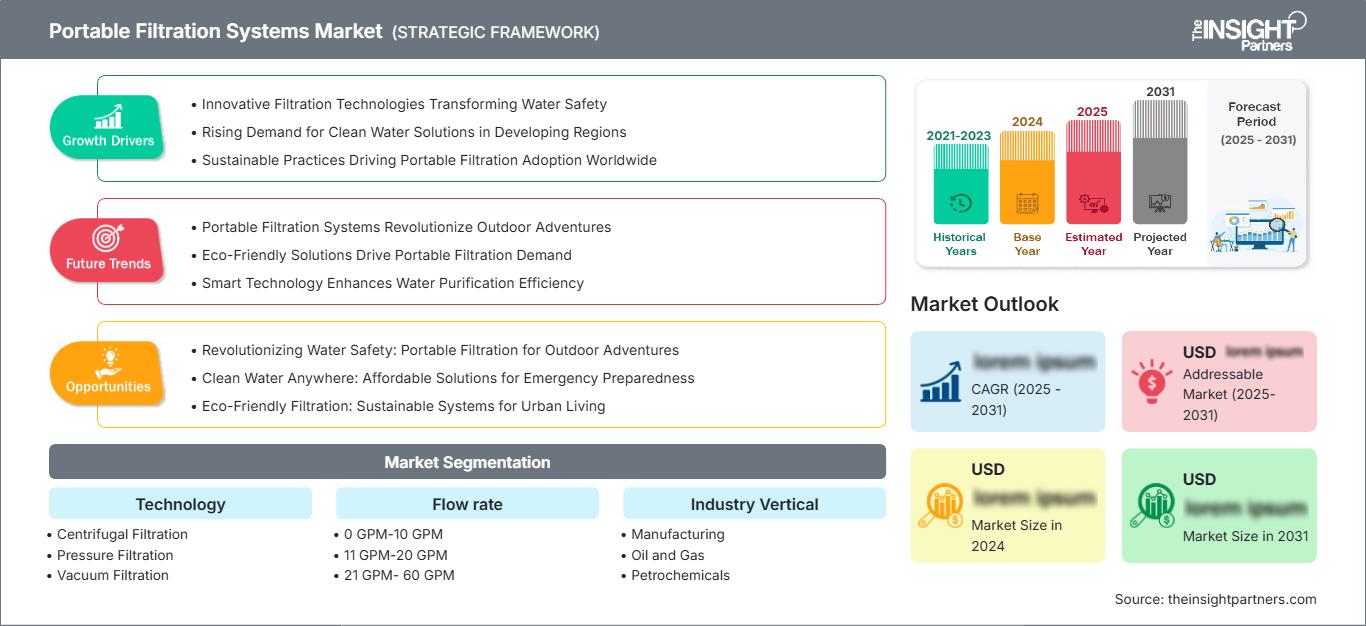
Portable Filtration Systems Market: Strategic Insights
Regional Insights
North America portable filtration systems market
North America accounted for 29–32% share in 2025, with steady demand from manufacturing, power generation, midstream oil and gas, mining, and mobile equipment fleets. The portable filtration systems market share in the region is supported by a strong preventive maintenance culture and widespread use of hydraulic assets that require predictable oil cleanliness.
The region is projected to grow at a CAGR range of 4.1–4.7% during 2026–2034. Adoption is strongest where operators measure downtime cost, fluid replacement frequency, and component wear. Mobile filter carts and offline filtration panels support scheduled maintenance, emergency cleanups, and transfer filtration across plants with multiple reservoirs.
U.S. portable filtration systems Market
The U.S. represented 77–81% of North America demand in 2025 and is expected to grow at a CAGR range of 4.2–4.8% through 2034. Demand is concentrated in manufacturing, power generation, oil and gas services, petrochemicals, and industrial maintenance contractors serving large installed hydraulic bases.
Company presence remains strong through Donaldson Company, Inc., Parker-Hannifin Corporation, Eaton Corporation plc, Pall Corporation, Des-Case Corporation, and Trico Corporation. U.S. buyers prioritize portable units with fast deployment, on-site fluid analysis, water-removal capability, and compatibility with maintenance reliability programs designed to reduce unplanned outages.
Europe portable filtration systems Market
Europe held 23–26% share in 2025 and is forecast to grow at a CAGR range of 4.0–4.5%. Germany leads regional demand because machinery manufacturing, chemicals, automotive production, and industrial hydraulics create large populations of contamination-sensitive equipment. The UK focuses on power, offshore, and industrial services.
France, Italy, and Spain add demand through petrochemicals, pulp and paper, process manufacturing, and energy facilities. European procurement is shaped by sustainability requirements, oil-life extension, worker safety, and documented maintenance practices. HYDAC International GmbH, MP Filtri S.p.A., Bosch Rexroth AG, Eaton Corporation plc, and Pall Corporation maintain strong regional relevance.
APAC portable filtration systems Market
APAC accounted for 34–38% share of the portable filtration systems market in 2025 and is expected to grow at a CAGR range of 4.8–5.4%. China leads regional adoption through large industrial equipment fleets, power generation assets, and manufacturing intensity. India is expanding demand as process industries and refineries strengthen preventive maintenance programs.
Japan and South Korea support premium filtration adoption through high-precision manufacturing, shipbuilding, and power-sector reliability requirements. Australia adds demand from mining, energy, and heavy equipment maintenance. Regional portable filtration systems market trends include faster adoption of higher-flow portable skids, contamination monitoring, and oil-life extension practices.
Middle East & Africa portable filtration systems Market
The Middle East and Africa portable filtration systems market is projected to grow at a CAGR range of 4.3–4.9% during 2026–2034. Saudi Arabia and the UAE lead demand through oil and gas, petrochemicals, utilities, desalination, and industrial infrastructure, where fluid cleanliness protects pumps, turbines, and hydraulic systems.
South Africa and the rest of MEA contribute through mining, power generation, paper, and manufacturing maintenance. Demand is project-led but increasingly supported by reliability programs, mobile service providers, and investments in equipment uptime. Vacuum and pressure filtration units are important where heat, dust, and moisture accelerate oil degradation.
Segmentation Analysis
Technology
Technology is expected to grow at a CAGR range of 4.4–5.0% during 2026–2034. The portable filtration systems market scope includes centrifugal, pressure, and vacuum approaches that address different contamination loads, viscosities, water content, and flow requirements. Buyers select technology based on fluid type, reservoir size, required cleanliness level, and available maintenance windows.
- Centrifugal Filtration: Centrifugal filtration is favored where high-duty separation is required, especially for particulate-heavy oils and process fluids needing continuous contaminant removal without depending only on filter media replacement.
- Pressure Filtration: Pressure filtration supports precise particle removal in hydraulic and lubrication systems, making it important for maintenance teams targeting cleanliness control, component protection, and efficient fluid transfer.
- Vacuum Filtration: Vacuum filtration is strategically important for moisture reduction, varnish control, and oil conditioning in turbines, gearboxes, and systems where water contamination increases corrosion and wear risk.
Flow rate
Flow rate is expected to grow at a CAGR range of 4.3–4.9%. Flow selection determines system portability, service speed, and suitability for reservoir volume. Lower-flow carts serve precision maintenance and smaller machines, while higher-flow units support large reservoirs, storage tanks, transfer operations, and industrial shutdown maintenance.
- 0 GPM-10 GPM: This range is widely used for small reservoirs, mobile equipment, laboratory support, and controlled fluid transfer where portability, safety, and precision are more important than filtration speed.
- 11 GPM-20 GPM: Mid-low flow systems balance mobility and throughput, serving routine hydraulic maintenance, drum-to-reservoir transfer, and contamination control across manufacturing and service workshop environments.
- 21 GPM-60 GPM: This range supports broader plant maintenance because it can condition larger reservoirs efficiently while remaining manageable for multi-asset deployment across industrial facilities.
- 61 GPM-90 GPM: Higher-flow systems are preferred in power, petrochemical, and pulp equipment where large fluid volumes require faster cleaning during maintenance windows or emergency contamination events.
- Above 90 GPM: Above 90 GPM units serve heavy-duty transfer, large storage tanks, and high-volume industrial applications where filtration speed and continuous operation become decisive procurement criteria.
Industry Vertical
Industry Vertical is expected to grow at a CAGR range of 4.5–5.1%. Demand varies by downtime exposure, contamination risk, and fluid cost. Manufacturing remains broad-based, oil and gas and petrochemicals emphasize reliability under harsh conditions, while paper and pulp and power generation require moisture control and stable lubrication performance.
- Manufacturing: Manufacturing facilities use portable units for hydraulic presses, machining lines, injection molding, and general plant maintenance, where fluid cleanliness protects productivity and reduces premature component replacement.
- Oil and Gas: Oil and gas operations rely on rugged portable filtration for remote sites, transfer fluids, hydraulic skids, and equipment exposed to dust, water ingress, and severe operating cycles.
- Petrochemicals: Petrochemical plants prioritize filtration for pumps, turbines, compressors, and lubrication systems where contamination control supports safety, uptime, and process continuity.
- Paper and Pulp: Paper and pulp mills need moisture and particle management in lubrication systems because harsh environments, water exposure, and continuous operation accelerate fluid degradation.
- Power Generation: Power generation facilities use portable filtration to condition turbine oils, hydraulic control fluids, and gearbox lubricants, where failures can create costly forced outages.
Opportunity Snapshot
| Industry Vertical | Revenue Contribution | Trend Tag | Adoption Stage |
| Manufacturing | High | Fluid Reliability | Mature |
| Oil and Gas | High | Remote Filtration | Scaling |
| Petrochemicals | Medium | Process Uptime | Mature |
| Paper and Pulp | Medium | Moisture Control | Scaling |
| Power Generation | High | Turbine Oils | Scaling |
Portable Filtration Systems Market Growth Drivers and Impact Analysis
Rising Focus on Hydraulic Reliability
The operators of industrial machines are now focusing on contamination control as a main indicator of reliability, as opposed to viewing it as something secondary to maintenance. Parts such as hydraulic pumps, valves, servos, bearings, and turbines are vulnerable to contamination by dust particles and water, thereby contributing to unnecessary wear and machine downtime. Portability of the filtration system makes it possible to conduct the cleaning of fluids off-line, during transfer, or when the machines are down, without altering any fixed installation. This provides flexibility, especially in situations where there are mixed fleets of machines.
Pressure to Reduce Oil Waste and Maintenance Cost
Fluid replacement is costly when plants take into account oil buying costs, oil disposal, downtime costs, labor costs, and environmental reporting costs. Mobile filtration systems assist in improving the lifespan of the fluids through the removal of particulates, moisture, sludge, and other products of breakdown from the fluids before they affect machinery. Therefore, fluid filtration can be considered a cost-cutting measure as well as an environmental one. Manufacturers, power producers, and petrochemical facilities have adopted mobile cleaning systems to minimize the need for draining oils and replacement of equipment parts.
Growth in Process Industries and Remote Operations
Where there may not be any existing facilities or where it may not be feasible to have permanent filtration facilities available on-site, oil and gas, mining, utilities, pulp mill, and industrial service facilities will require fluid conditioning at the site where the equipment is located, rather than transporting the contaminated fluid to a central facility. This is very helpful when it comes to far-off reserves, mobile hydraulic equipment, and commissioning operations. As more projects are coming up in emerging areas, there is an increased requirement for tough filters.
Portable Filtration Systems Market Future Trends
Connected Filtration and On-Site Fluid Diagnostics
Future portable filtration systems market trends will increasingly combine filtration hardware with on-site diagnostics, cleanliness sensors, and digital maintenance records. The operators will need to receive information regarding whether filtration processes have reached certain ISO ratings or decreased water pollution in a shorter time. The suppliers providing kits for liquid analysis, particle counters and maintenance information in portable machines will assist maintenance personnel in documenting their interventions. This development will result in changes in the buying process from pumps and filters to reliability results.
Higher-Flow Mobile Skids for Large Industrial Assets
A need for higher flow mobile filtration skids that will purify turbine oils, hydraulic reservoirs, and bulk storage tanks in a relatively short maintenance period will be seen. Big plants do not have much time to use the low-flow carts to process thousands of liters of fluid, particularly in situations where there is an outage or start-up of new equipment. The equipment will be designed with consideration for stable pumping, large housing, dehydrating capabilities, and safe handling.
Portable Filtration Systems Market Opportunities
Aftermarket Cartridges and Service-Based Filtration Programs
The portable filtration systems market Forecasts indicate a strong opportunity in recurring aftermarket sales and service-based filtration programs. Users need replacement elements, hoses, seals, cleanliness testing, and periodic equipment calibration after the initial cart or skid purchase. Suppliers can capture higher lifetime value by bundling portable units with consumables, oil analysis, training, and scheduled service visits. This approach is attractive for plants with limited in-house reliability resources and for distributors serving regional industrial clusters where shared filtration services can reduce customer capital spending.
Vacuum Dehydration for Power and Process Equipment
Moisture contamination creates corrosion, additive depletion, varnish formation, and lubrication failure in turbines, gearboxes, and hydraulic control systems. This creates an opportunity for portable vacuum dehydration units that remove free, emulsified, and dissolved water from critical oils. Power generation, petrochemical, and pulp operations are particularly suitable because equipment downtime is costly and operating environments often introduce water exposure. Vendors that combine moisture removal with particle filtration and fluid testing can position these systems as reliability assets rather than occasional cleanup tools.
Frequently Asked Questions

- Comprehensive Market Sizing and Forecast Analysis
- Detailed Segmentation Analysis
- In-Depth Market Dynamics Assessment
- Regional and Country-Level Insights
- Competitive Landscape and Company Benchmarking
- Strategic Business Intelligence
Recent Reports
Testimonials

The Insight Partners' SCADA System Market report is comprehensive, with valuable insights on current trends and future forecasts. The team was highly professional, responsive, and supportive throughout. We are very satisfied and highly recommend their services.
RAN KEDEM Partner, Reali Technologies LTDs
I requested a report on a very specific software market and the team produced the report in a few days. The information was very relevant and well presented. I then requested some changes and additions to the report. The team was again very responsive and I got the final report in less than a week.
JEAN-HERVE JENN Chairman, Future Analytica
We worked with The Insight Partners for an important market study and forecast. They gave us clear insights into opportunities and risks, which helped shape our plans. Their research was easy to use and based on solid data. It helped us make smart, confident decisions. We highly recommend them.
PIYUSH NAGPAL Sr. Vice President, High Beam Global
The Insight Partners delivered insightful, well-structured market research with strong domain expertise. Their team was professional and responsive throughout. The user-friendly website made accessing industry reports seamless. We highly recommend them for reliable, high-quality research services
YUKIHIKO ADACHI CEO, Deep Blue, LLC.
This is the first time I have purchased a market report from The Insight Partners.While I was unsure at first, I visited their web site and felt more comfortable to take the risk and purchase a market report.I am completely satisfied with the quality of the report and customer service. I had several questions and comments with the initial report, but after a couple of dialogs over email with their analyst I believe I have a report that I can use as input to our strategic planning process.Thank you so much for taking the extra time and making this a positive experience.I will definitely recommend your service to others and you will be my first call when we need further market data.
JOHN SUZUKI President and Chief Executive Officer, Board Director, BK Technologies
I wish to appreciate your support and the professionalism you displayed in the course of attending to my request for information regarding to infectious disease IVD market in Nigeria. I appreciate your patience, your guidance, and the fact that you were willing to offer a discount, which eventually made it possible for us to close a deal. I look forward to engaging The Insight Partners in the future, all thanks to the impression you have created in me as a result of this first encounter.
DR CHIJIOKE ONYIA MANAGING DIRECTOR, PineCrest Healthcare Ltd.Reason to Buy
- Informed Decision-Making
- Understanding Market Dynamics
- Competitive Analysis
- Identifying Emerging Markets
- Customer Insights
- Market Forecasts
- Risk Mitigation
- Boosting Operational Efficiency
- Strategic Planning
- Investment Justification
- Tracking Industry Innovations
- Aligning with Regulatory Trends





 Get Free Sample for