
Reciprocating Pumps Market Demand, Size & Forecast by 2034
Coverage: By Type (Piston, Plunger, Diaphragm); End-user (Oil and Gas, Water and Wastewater Treatment, Chemical and Petrochemical, Power Generation, Mining, Food and Beverages, Pharmaceutical, Others), and Geography (North America, Europe, Asia Pacific, and South and Central America)
- Status : Data Released
- Report Code : TIPRE00014099
- Category : Manufacturing and Construction
- No. of Pages : 150
- Available Report Formats :


- Last update date : September 07, 2026


2025 Market Size
US$ 22.08 Bn
Base year value
2034 Forecast
US$ 32.53 Bn
Projected by 2034
CAGR 2026-2034
4.40 %
Growth rate
Addressable Market
US$ 247.98 Bn
(2026-2034)
The reciprocating pumps market is projected to grow from US$ 22.08 Billion in 2025 to US$ 32.53 Billion by 2034, registering a CAGR of 4.40% during 2026–2034. Demand is supported by high-pressure fluid transfer needs in oil and gas, chemical processing, wastewater treatment, mining, pharmaceutical production, and food and beverages facilities where flow accuracy and durable displacement technology remain critical.
North America continues to shape reciprocating pumps market size through shale operations, refinery maintenance, water infrastructure renewal, and industrial process upgrades. The region is estimated to grow at a CAGR of 3.9–4.5% during 2026–2034 as users prioritize pump reliability, regulatory compliance, and lifecycle service programs for critical chemical injection, boiler feed, sludge handling, and dosing applications.
Reciprocating Pumps Market Assessment and Insights
- North America: North America is estimated to hold 25–29% share in 2025 and grow at a CAGR of 3.9–4.5% between 2026–2034, supported by energy, municipal water, and process industry replacement demand.
- US: The US is estimated to contribute 76–82% of North American demand in 2025 and grow at a CAGR of 4.0–4.6% during 2026–2034.
- Europe: Europe is estimated to hold 21–25% share in 2025 and grow at a CAGR of 3.6–4.2%, led by Germany, the UK, France, Italy, and Spain.
- Asia Pacific: Asia Pacific is estimated to hold 34–38% share in 2025 and grow at a CAGR of 4.8–5.4%, driven by China, India, Japan, South Korea, and Australia.
- Largest Segment: Plunger pumps are estimated to hold 39–43% share in 2025 and grow at a CAGR of 4.2–4.8%, supported by high-pressure oilfield, chemical dosing, and industrial process duties.
- High Growth Segment: Water and wastewater treatment is estimated to hold 18–22% share in 2025 and grow at a CAGR of 5.0–5.7%, reflecting treatment plant modernization and stricter discharge norms.
- Key companies analyzed in detail: Dover Corporation, Flowserve Corporation, Grundfos Holding A/S, ITT Inc., KSB SE & Co. KGaA, LEWA GmbH, Peroni Pompe S.p.A., Ruhrpumpen Group, The Weir Group PLC, and Xylem Inc.
Source: The Insight Partners' analysis based on proprietary research, government publications, company annual reports, investor presentations, industry databases, and expert interviews.
Technology development is moving the reciprocating pumps market from manually maintained pump sets toward engineered packages with digital monitoring, improved seals, corrosion-resistant materials, and more efficient drives. Manufacturers are refining piston, plunger, and diaphragm designs for abrasive, viscous, corrosive, and metered fluids. Production dynamics now emphasize modular skids, easier maintenance access, lower leakage, and customized materials for water treatment, oilfield, petrochemical, pharmaceutical, and food-grade applications.
Forward demand will be strongest in Asia Pacific, the Middle East, and selected North American basins where energy, municipal water, chemicals, and mining programs require reliable high-pressure fluid handling. Investment is shifting toward wastewater reuse, hydrogen and carbon management infrastructure, and automated dosing systems. Regulatory pressure on discharge quality, worker safety, and energy use will support replacement of outdated pump assets.
Reciprocating Pumps Market Report Scope
| Report Attribute | Details |
|---|---|
| Market size in 2025 | US$ 22.08 Billion |
| Market Size by 2034 | US$ 32.53 Billion |
| Global CAGR (2026 - 2034) | 4.40% |
| Historical Data | 2021-2024 |
| Forecast period | 2026-2034 |
Reciprocating Pumps Market Analysis
The reciprocating pumps market growth can be boosted by sectors requiring accurate flow under high pressure conditions unsuitable for centrifugal pumps. Oil field companies require chemical injection and stimulation pumps, whereas utilities require reliable dosing of chemicals. Chemical and pharmaceutical companies are interested in precise metering, and the mining industry requires robust positive displacement pumps to transport slurry fluids.
The ecosystem involves reciprocating pumps original equipment manufacturers (OEM), seals, motors, skids fabrication companies, distributors, engineering companies, and maintenance service providers. reciprocating pumps market analysis reveals rivalry between diversified flow control companies and dedicated metering or high-pressure pumps companies. Flowserve Corporation, Dover Corporation, LEWA GmbH, Peroni Pompe S.p.A., Ruhrpumpen Group, KSB SE & Co. KGaA, Grundfos Holding A/S, ITT Inc., The Weir Group PLC, and Xylem Inc. compete via materials engineering, aftermarket support, and applications know-how.
Investment tendencies tend to lean towards intelligent pump systems monitoring, energy auditing and service agreements that cut down on unplanned downtime. The buying considerations increasingly include life-cycle costs, availability of spare parts, and service support alongside purchase price. The best position to take advantage of this market environment is one where companies can provide solutions both to new projects and upgrades.
● REPORT CUSTOMIZATION
Tailor This Report To Align With Your Specific Business Requirements
This report can be customized to align precisely with your business objectives, scope, and target markets. Customization options include tailored segmentation, geography, competitive analysis, and strategic insights to support informed decision-making.
Customize This Report →WHAT YOU CAN ADJUST
- ● Segmentations
- ● Geography
- ● Competitive Analysis
- ● Language Preferences
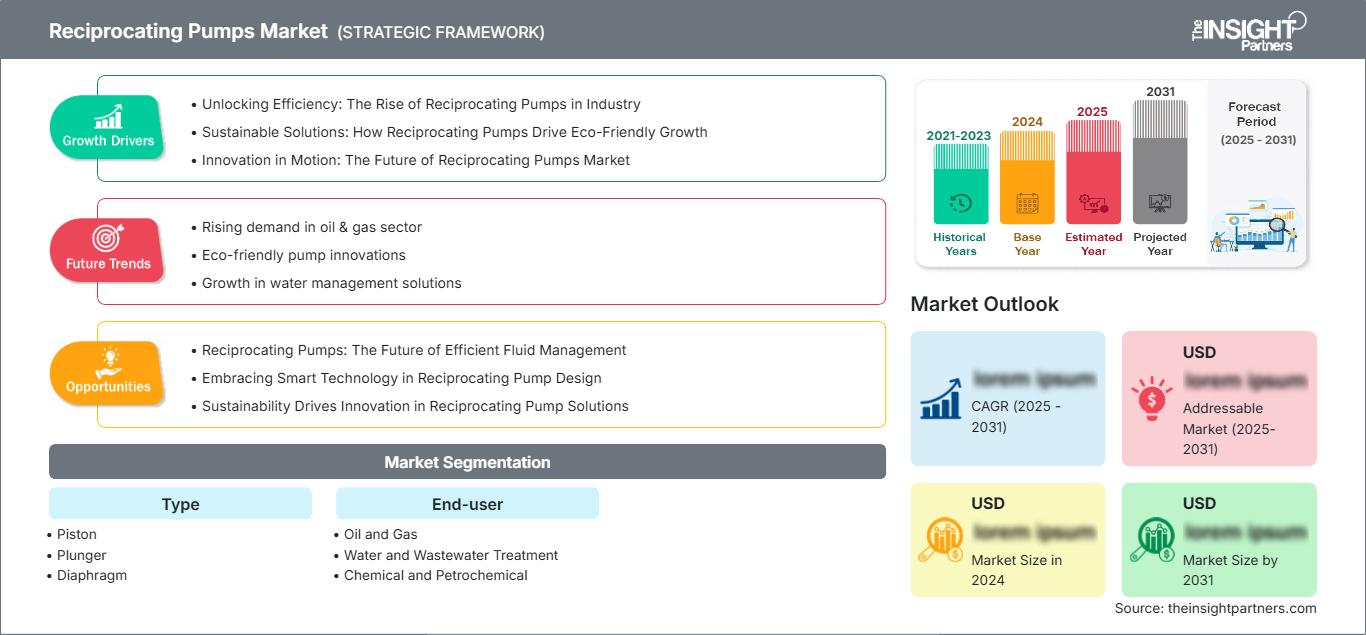
Reciprocating Pumps Market: Strategic Insights
Regional Insights
North America reciprocating pumps market
North America is estimated to account for 25–29% reciprocating pumps market share in 2025 and grow at a CAGR of 3.9–4.5% during 2026–2034. Demand is supported by shale production, refinery turnarounds, municipal wastewater upgrades, and chemical processing facilities that need accurate dosing, chemical injection, high-pressure washdown, and sludge transfer.
There are high levels of existing pumps and good service channels. Utilities and industries have been renewing the old pumps because of cost involved in leakage and maintenance, among other risks. Expansion in the market will be facilitated by projects involving water recycling, mining operations, and greater process reliability requirements in the pharma, food and beverage, and petrochemical industries.
U.S. reciprocating pumps Market
The U.S. is estimated to represent 76–82% of North American demand in 2025 and grow at a CAGR of 4.0–4.6% through 2034. Energy, water treatment, chemicals, and food production remain the principal application base.
Company presence is broad because Dover Corporation, Flowserve Corporation, Xylem Inc., ITT Inc., and LEWA GmbH support U.S. buyers through product portfolios, engineering assistance, and aftermarket networks. Application trends include chemical injection skids, metering pumps for water treatment, refinery process pumping, pharmaceutical dosing, and high-pressure industrial cleaning systems.
Europe reciprocating pumps Market
Europe is estimated to hold 21–25% share in 2025 and grow at a CAGR of 3.6–4.2% during 2026–2034. Germany leads regional demand through chemicals, machinery, water utilities, and pharmaceutical manufacturing, while the UK adds demand from energy infrastructure, wastewater renewal, and food processing.
France, Italy, and Spain have their share in municipal water management, petrochemical properties, mining applications, and industrial dosing. European consumers focus on energy savings, no leakages, safety at workplace, and documentation. Diaphragm and plunger pumps are considered in processes where contamination protection, corrosive fluids, and precise chemical dosing play an important role.
APAC reciprocating pumps Market
Asia Pacific is estimated to hold 34–38% share in 2025 and grow at a CAGR of 4.8–5.4% from 2026–2034. China leads demand through refining, chemicals, municipal water, and manufacturing scale.
Growth is fueled by wastewater treatment, mining, pharmaceuticals, liquefied natural gas, and food processing in India, Japan, South Korea, and Australia. Growth is driven by industrialization, increased water quality standards, and infrastructure projects. Customers are price-conscious but more aware of pump reliability, compatibility, and efficiency.
Middle East & Africa reciprocating pumps Market
The Middle East and Africa market is estimated to grow at a CAGR of 4.1–4.8% during 2026–2034. Saudi Arabia and the UAE lead demand through oil and gas, desalination, petrochemicals, and industrial diversification.
Additional demands from South Africa arise in the areas of mining, power generation, and water treatment; whereas for the Rest of MEA, there are infrastructure and energy development projects that correlate to adoption. Tough operating conditions dictate tough materials, reliable seals, and good service support.
Segmentation Analysis
Type
Type demand is expected to grow at a CAGR of 4.1–4.7% during 2026–2034. The reciprocating pumps market scope covers piston, plunger, and diaphragm designs serving different pressure, fluid, and hygiene requirements. Selection depends on viscosity, abrasiveness, discharge pressure, metering accuracy, chemical compatibility, and maintenance access across process industries.
- Piston: Piston pumps remain attractive for general high-pressure transfer where users need durable operation, straightforward maintenance, and reliable flow handling in water, industrial, and utility applications.
- Plunger: Plunger pumps dominate heavy-duty applications because they handle higher pressures, chemical injection, oilfield service, and challenging industrial duties where strength and precision are essential.
- Diaphragm: Diaphragm pumps are strategically important for corrosive, toxic, hygienic, or leak-sensitive fluids, supporting chemicals, pharmaceuticals, food processing, and water treatment dosing.
End-user
End-user demand is expected to grow at a CAGR of 4.3–4.9% from 2026–2034. Oil and gas remains influential, but water and wastewater treatment, chemicals, mining, food and beverages, power generation, and pharmaceuticals create varied demand patterns. Users prioritize pressure capability, uptime, metering precision, and compatibility with abrasive, corrosive, or regulated fluids.
- Oil and Gas: Oil and gas users require high-pressure pumps for chemical injection, enhanced recovery, produced water handling, refinery operations, and stimulation services where reliability directly affects production continuity.
- Water and Wastewater Treatment: Water utilities use these pumps for chemical dosing, sludge transfer, filtration support, desalination pre-treatment, and wastewater process control where accuracy and compliance are essential.
- Chemical and Petrochemical: Chemical and petrochemical plants rely on corrosion-resistant designs for metering acids, solvents, catalysts, and process additives under controlled pressure and safety requirements.
- Power Generation: Power plants use reciprocating pumps for boiler feed support, chemical dosing, cooling-water treatment, lubrication systems, and auxiliary services that require stable pressure.
- Mining: Mining applications need rugged pumps for slurry handling, dewatering support, reagent dosing, and high-pressure transfer in remote sites with abrasive fluids and difficult service conditions.
- Food and Beverages: Food and beverages users value hygienic fluid handling, accurate dosing, and clean-in-place compatibility for ingredients, additives, flavorings, and process water treatment.
- Pharmaceutical: Pharmaceutical facilities require precise metering, clean designs, validation support, and leak containment for active ingredients, solvents, purified water, and controlled production fluids.
Opportunity Snapshot
| End-user | Revenue Contribution | Trend Tag | Adoption Stage |
| Oil and Gas | High | Chemical Injection | Mature |
| Water and Wastewater Treatment | High | Reuse Dosing | Scaling |
| Chemical and Petrochemical | High | Corrosion Control | Mature |
| Power Generation | Medium | Boiler Support | Mature |
| Mining | Medium | Slurry Duty | Mature |
| Food and Beverages | Medium | Hygienic Dosing | Scaling |
| Pharmaceutical | Medium | Validated Flow | Scaling |
Reciprocating Pumps Market Growth Drivers and Impact Analysis
High-Pressure Fluid Handling Across Energy and Process Industries
The needs for pumps capable of maintaining precision in both pressure and flow in tough conditions still remain high in the oil and gas industry, chemical industry, petrochemical industry, and in power generation. Reciprocating pumps are ideal choices for applications such as injection, metering, boiler services, catalyst injection, and high-pressure transfer because they provide precise fluid displacement despite the difficult nature of the fluids. Market drivers include resilient replacement demand and project demand where any downtime has implications in terms of safety, production, and compliance.
Water Treatment Modernization and Chemical Dosing Growth
In view of increasing significance of water reuse, desalination, effluent management and contamination prevention, there is an increased spending on improved dosing and transfer technologies by municipal and industrial water treatment systems. The reciprocating pump finds application in efficient chemical dosing for the purposes of coagulation, pH adjustment, disinfection, filter aid feeding and sludge handling. This market driver ensures growth of the market beyond conventional energy sectors and demands development of the diaphragm and plunger pump types.
Rising Need for Reliable Pumps in Regulated Manufacturing
The food and beverage industry, pharmaceuticals, and specialty chemicals have been seeing an increasing demand for pumps that not only provide precision and hygiene but also proven track records. Companies require precise doses of ingredients, additives, solvents, and process chemicals without contamination concerns or any variations between batches. Reciprocating pumps can help meet these criteria with precise displacements, hygienic constructions, and materials suitable for the handling of delicate fluids. The impact on the industry will be increased demand for engineered systems, validation, and maintenance contracts.
Reciprocating Pumps Market Future Trends
Smart Monitoring for Predictive Pump Maintenance
Reciprocating pumps market trends point toward the growing use of vibration, pressure, temperature, leak and stroke monitoring of important pumps. Future technologies will enable users to identify wear and tear of seals, valves, cavitations and abnormal behavior of pumps before breakdowns happen. This will be useful in oil field operations, water treatment plants, mining and chemical companies, where maintenance access may be restricted or downtime is costly. The suppliers of sensors that provide service agreements and dashboards can convert hardware into performance contracts.
Materials Innovation for Corrosive and Abrasive Fluids
Pump designs are expected to use improved alloys, coatings, ceramics, elastomers, and engineered polymers to extend service life in corrosive chemicals, abrasive slurries, wastewater streams, and specialty process fluids. This trend will reduce leakage, improve safety, and lower replacement frequency in applications where fluid compatibility is the main failure driver. Demand will be strongest in mining, chemicals, desalination, and pharmaceuticals. Suppliers with testing capabilities and application databases will gain advantage as operating conditions become more specialized.
Reciprocating Pumps Market Opportunities
Aftermarket Service for Aging Industrial Pump Bases
reciprocating pumps market Forecasts indicate opportunity in aftermarket audits, seal upgrades, valve replacements, drive modernization, and monitoring retrofits for older installed assets. Many plants prefer to upgrade proven pump frames rather than replace complete systems, especially when foundations and piping remain adequate. Service-led programs can reduce leakage, improve dosing accuracy, and extend asset life. This creates recurring revenue for OEMs and distributors while helping customers manage downtime, compliance, and energy costs across established industrial sites.
Precision Dosing Packages for Water Reuse and Pharmaceuticals
Water reuse, advanced treatment, and pharmaceutical manufacturing create attractive opportunities for integrated dosing packages. Buyers increasingly need pumps combined with controls, tanks, sensors, skid structures, and validation documentation. Vendors can differentiate by offering compact, pre-engineered packages that reduce installation time and simplify compliance. The opportunity is strongest where chemical accuracy directly affects product quality or discharge performance. Suppliers with diaphragm and plunger expertise can capture premium demand by combining hygienic design, leak containment, and automation readiness.
Frequently Asked Questions

- Comprehensive Market Sizing and Forecast Analysis
- Detailed Segmentation Analysis
- In-Depth Market Dynamics Assessment
- Regional and Country-Level Insights
- Competitive Landscape and Company Benchmarking
- Strategic Business Intelligence
Recent Reports
Testimonials

The Insight Partners' SCADA System Market report is comprehensive, with valuable insights on current trends and future forecasts. The team was highly professional, responsive, and supportive throughout. We are very satisfied and highly recommend their services.
RAN KEDEM Partner, Reali Technologies LTDs
I requested a report on a very specific software market and the team produced the report in a few days. The information was very relevant and well presented. I then requested some changes and additions to the report. The team was again very responsive and I got the final report in less than a week.
JEAN-HERVE JENN Chairman, Future Analytica
We worked with The Insight Partners for an important market study and forecast. They gave us clear insights into opportunities and risks, which helped shape our plans. Their research was easy to use and based on solid data. It helped us make smart, confident decisions. We highly recommend them.
PIYUSH NAGPAL Sr. Vice President, High Beam Global
The Insight Partners delivered insightful, well-structured market research with strong domain expertise. Their team was professional and responsive throughout. The user-friendly website made accessing industry reports seamless. We highly recommend them for reliable, high-quality research services
YUKIHIKO ADACHI CEO, Deep Blue, LLC.
This is the first time I have purchased a market report from The Insight Partners.While I was unsure at first, I visited their web site and felt more comfortable to take the risk and purchase a market report.I am completely satisfied with the quality of the report and customer service. I had several questions and comments with the initial report, but after a couple of dialogs over email with their analyst I believe I have a report that I can use as input to our strategic planning process.Thank you so much for taking the extra time and making this a positive experience.I will definitely recommend your service to others and you will be my first call when we need further market data.
JOHN SUZUKI President and Chief Executive Officer, Board Director, BK Technologies
I wish to appreciate your support and the professionalism you displayed in the course of attending to my request for information regarding to infectious disease IVD market in Nigeria. I appreciate your patience, your guidance, and the fact that you were willing to offer a discount, which eventually made it possible for us to close a deal. I look forward to engaging The Insight Partners in the future, all thanks to the impression you have created in me as a result of this first encounter.
DR CHIJIOKE ONYIA MANAGING DIRECTOR, PineCrest Healthcare Ltd.Reason to Buy
- Informed Decision-Making
- Understanding Market Dynamics
- Competitive Analysis
- Identifying Emerging Markets
- Customer Insights
- Market Forecasts
- Risk Mitigation
- Boosting Operational Efficiency
- Strategic Planning
- Investment Justification
- Tracking Industry Innovations
- Aligning with Regulatory Trends





 Get Free Sample for