
Ride-on Power Trowel Market Growth, Trends & Forecast by 2034
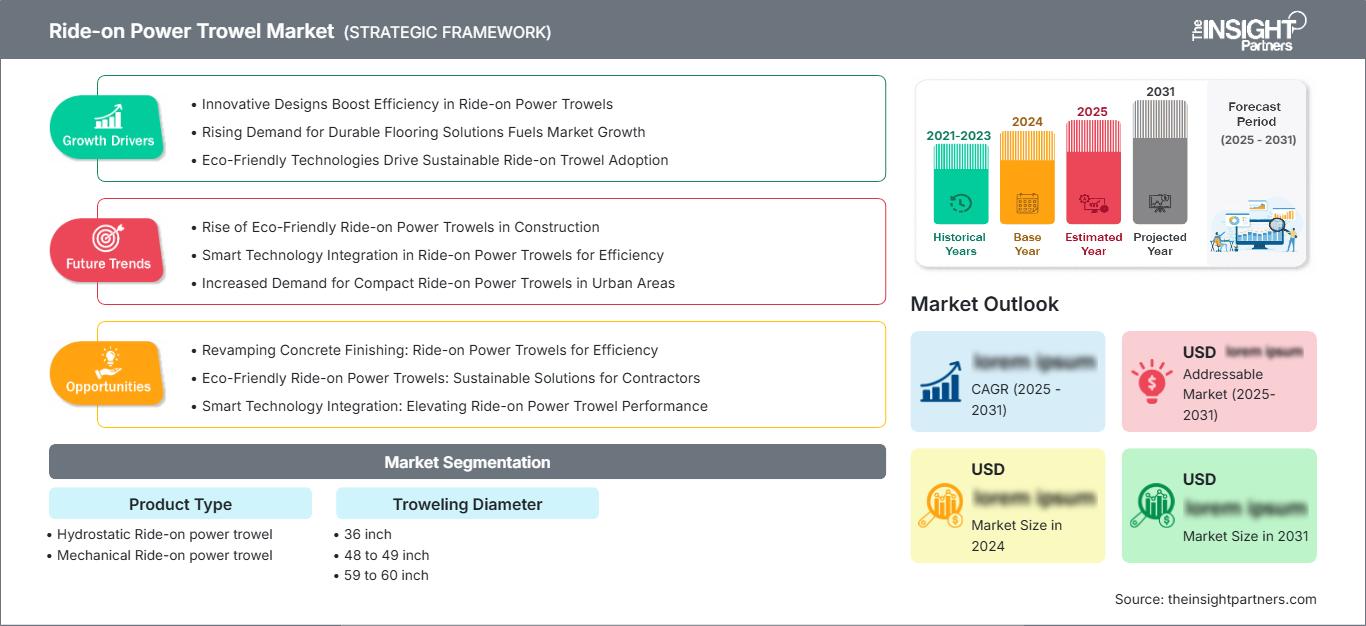
Coverage: By Product Type (Hydrostatic Ride-on power trowel, Mechanical Ride-on power trowel); Troweling Diameter (36 inch, 48 to 49 inch, 59 to 60 inch) , and Geography (North America, Europe, Asia Pacific, and South and Central America)
- Status : Data Released
- Report Code : TIPRE00021343
- Category : Manufacturing and Construction
- No. of Pages : 150
- Available Report Formats :


- Last update date : September 10, 2026


2025 Market Size
US$ 153.5 Mn
Base year value
2034 Forecast
US$ 205.11 Mn
Projected by 2034
CAGR 2026-2034
3.27 %
Growth rate
Addressable Market
US$ 1,628.24 Mn
(2026-2034)
The ride-on power trowel market is positioned for steady expansion as concrete finishing contractors prioritize higher slab productivity, reduced manual finishing, and improved operator control. The market is valued at US$ 153.5 Million in 2025 and is projected to reach US$ 205.11 Million by 2034, advancing at a CAGR of 3.27% during 2026–2034. Demand is shaped by commercial construction, industrial flooring, infrastructure development, equipment rental, and the continued replacement of conventional finishing equipment.
North American demand is supported by large-scale warehouse, logistics, manufacturing, and commercial flooring projects, together with established equipment rental channels. The ride-on power trowel market size is expected to increase at an estimated 3.0–3.8% CAGR through 2034, with adoption benefiting from labor productivity requirements, contractor preference for mechanized finishing, and equipment designs that reduce operator fatigue.
Ride-on Power Trowel Market Assessment and Insights
- North America: North America is expected to account for a 34–38% share in 2025 and expand at a 3.2–3.8% CAGR between 2026–2034, supported by commercial concrete construction, equipment rental penetration, and replacement demand for productivity-oriented finishing machinery.
- US: The US is estimated to represent 27–31% of global demand in 2025 and grow at a 3.3–3.9% CAGR between 2026–2034, supported by warehouses, industrial slabs, and specialized concrete contractors.
- Europe: Europe is projected to hold a 24–28% share in 2025 and grow at a 2.8–3.5% CAGR between 2026–2034, led by Germany, the UK, France, Italy, and construction equipment modernization.
- Asia Pacific: Asia Pacific is estimated at a 25–29% share in 2025 and is expected to grow at a 3.8–4.6% CAGR between 2026–2034, with China, Japan, India, and South Korea driving construction mechanization and industrial flooring demand.
- Largest Segment: Hydrostatic ride-on power trowels are estimated to hold a 58–63% market share in 2025 and grow at a 3.6–4.2% CAGR during 2026–2034, reflecting productivity and control advantages.
- High Growth Segment: Electric configurations within the broader equipment ecosystem are gaining strategic attention, although hydrostatic systems remain dominant; the selected high-growth product segment is hydrostatic ride-on power trowels at 3.6–4.2% CAGR.
- Key companies analyzed in detail: Multiquip Inc., Wacker Neuson SE, Allen Engineering Corporation, Atlas Copco AB, Dragon Construction Equipment, Parchem Construction Supplies Pty Ltd., Bartell Global Inc., Dynamic Construction Machinery Co., Ltd., MBW Inc., Shandong Shenhua Machinery Manufacturing Co., Ltd.
Source: The Insight Partners' analysis based on proprietary research, government publications, company annual reports, investor presentations, industry databases, and expert interviews.
The technology of concrete finishing has moved from mechanically operated systems towards hydrostatic systems that feature better controls for steering, pitch management, diagnostics, lighting and ergonomics. Increasingly, rotor stability, serviceability, fewer maintenance points and balance are among the factors being emphasized by equipment manufacturers. In recent product offerings, there is evidence of a move towards high-output ride-on systems that can enter into the slabs early but still offer good finishing performance.
In the coming forecast years, the usage is expected to increase in the developing construction markets, where contractors will be mechanizing the concrete placement and finishing processes. The role of rental pools is expected to continue as the ride-on systems are major capital investments for smaller contractors. Regulations about the emissions and working indoors will force manufacturers to create lower emission engines and finally battery-operated machines.
Ride-on Power Trowel Market Report Scope
| Report Attribute | Details |
|---|---|
| Market size in 2025 | US$ 153.5 Million |
| Market Size by 2034 | US$ 205.11 Million |
| Global CAGR (2026 - 2034) | 3.27% |
| Historical Data | 2021-2024 |
| Forecast period | 2026-2034 |
Ride-on Power Trowel Market Analysis
Demand for ride-on power trowel growth is closely linked to the size and complexity of concrete slabs requiring rapid, consistent finishing. Large warehouses, distribution centers, manufacturing plants, parking structures, airports, and commercial developments favor ride-on machines because they increase coverage and reduce physical labor. The value chain includes engine and hydraulic suppliers, gearbox and rotor manufacturers, machine assemblers, blade suppliers, dealers, rental companies, contractors, and maintenance providers.
Hydrostatic technology merits notice owing to the ability of hydraulic variable control to deliver efficient steering and rotor speed control in response to changing slabs. The mechanical type still has its relevance when initial cost, simplicity, and maintainability are the important factors to be considered. The supply process is affected by the availability of engines, steel and hydraulic parts cost, dealers' inventory levels, and local servicing networks.
Competitive positioning in ride-on power trowel analysis increasingly depends on machine productivity, operator ergonomics, serviceability, and application flexibility rather than horsepower alone. Multiquip Inc. offers extensive hydrostatic and mechanical ranges, while Wacker Neuson SE maintains a strong concrete-technology portfolio. Allen Engineering Corporation differentiates through mechanical and fully hydraulic riders, while Atlas Copco AB provides construction-equipment expertise and global distribution reach.
Specialists such as Bartell Global Inc., MBW Inc., Dynamic Construction Machinery Co., Ltd., Dragon Construction Equipment, Parchem Construction Supplies Pty Ltd., and Shandong Shenhua Machinery Manufacturing Co., Ltd. compete through product breadth, regional distribution, price positioning, or specialized contractor relationships. As highlighted in the ride-on power trowel market report, investment is increasingly directed toward hydraulic efficiency, operator controls, reduced maintenance, and product configurations suited to rental fleets. This competitive structure creates opportunities for manufacturers able to combine durability with measurable productivity gains.
● REPORT CUSTOMIZATION
Tailor This Report To Align With Your Specific Business Requirements
This report can be customized to align precisely with your business objectives, scope, and target markets. Customization options include tailored segmentation, geography, competitive analysis, and strategic insights to support informed decision-making.
Customize This Report →WHAT YOU CAN ADJUST
- ● Segmentations
- ● Geography
- ● Competitive Analysis
- ● Language Preferences
Ride-on Power Trowel Market: Strategic Insights
Regional Insights
North America ride-on power trowel market
North America is estimated to represent 34–38% of global ride-on power trowel market revenue in 2025, with a projected 3.2–3.8% CAGR through 2034. North America is expected to remain the dominant demand base, supported by industrial constructions, distribution centers, commercial construction, and concrete finishing contractors. Canadian contributions in this regard will be seen through infrastructure and commercial constructions, whereas rental companies will enable access to expensive finishing machinery.
Machinery evaluation by contractors will take into consideration factors such as slab coverage, operator fatigue, maintenance and servicing needs, as well as availability of spare parts. Large pour capacity machines use multi-rotor riders, whereas machines having a smaller machine footprint will serve the limited access sites and multistory buildings. The existence of dealers and rentals will strengthen the replacement market for such machinery. North American usage will remain fairly steady due to the mechanized nature of concrete finishing.
U.S. ride-on power trowel market
The US is estimated to account for 27–31% of the global ride-on power trowel market revenue and approximately 78–82% of North American demand in 2025. Its CAGR is projected at 3.3–3.9% through 2034. Multiquip Inc., Allen Engineering Corporation, MBW Inc., and other established suppliers maintain significant visibility among contractors and rental businesses.
The demand occurs on industrial floors, warehouses, distribution centers, parking garages, commercial buildings, and big residential complexes. Hydrostatic machines are more preferred where precision and productivity matter, whereas mechanical machines still have an edge for those contractors who value simplicity in maintenance. The equipment rental aspect also plays a role in determining the purchase since contractors can fit the machine according to the pour size.
Europe ride-on power trowel market
Europe is projected to hold a 24–28% of the ride-on power trowel market share in 2025 and grow at a 2.8–3.5% CAGR through 2034. A number of markets exist in Germany, the UK, France, Italy, and Spain, in that order. Demand is influenced by the need for new warehouses, industry modernization, development of infrastructure, and focus on machine efficiency and emissions.
In the UK market, there is an opportunity in logistics and commercial construction, where the volume of concrete finish is very high. The German market focuses on industrial building and construction equipment engineering, thus there is demand for powerful hydraulics. In France and Italy, there are possibilities in commercial construction and infrastructural projects, and in Spain, there is logistics, tourist, and industrial construction.
APAC ride-on power trowel market
APAC is estimated to account for 25–29% of 2025 ride-on power trowel market revenue and expand at a 3.8–4.6% CAGR. China leads regional demand, with Japan, South Korea, India, and Australia providing additional growth. Industrial parks, logistics facilities, urban infrastructure, and large commercial developments support equipment mechanization.
China benefits from extensive construction activity and domestic manufacturing capabilities. India is increasingly relevant as industrial and logistics infrastructure expands, while Japan and South Korea emphasize precision and equipment reliability. Australia supports demand through commercial, mining-related, and infrastructure projects. Policy emphasis on construction productivity and cleaner equipment should gradually influence purchasing specifications.
Middle East & Africa ride-on power trowel market
The Middle East and Africa ride-on power trowel market represents a smaller portion of global demand but offers opportunities through major infrastructure, industrial, hospitality, and urban-development projects. Saudi Arabia and the UAE are leading Gulf markets, while South Africa provides the principal sub-Saharan demand base.
The regional CAGR is estimated at 2.8–3.6% through 2034. Large construction programs, logistics facilities, airports, and energy infrastructure require high-productivity concrete finishing. Saudi Arabia benefits from large-scale development programs, while the UAE maintains strong commercial and infrastructure activity. South Africa and the rest of MEA remain more price-sensitive, increasing the relevance of durable mechanical equipment and rental-oriented purchasing.
Segmentation Analysis
Product Type
Product Type remains a central purchasing criterion because contractors balance machine control, acquisition cost, maintenance complexity, and finishing productivity. Hydrostatic platforms are expected to grow at a 3.6–4.2% CAGR during 2026–2034, while mechanical configurations are projected at a 2.5–3.2% CAGR. The shift toward hydraulic steering, electronic controls, and variable rotor management supports premium equipment adoption.
- Hydrostatic Ride-on power trowel: Hydrostatic systems provide smooth steering and controllable rotor operation, making them particularly suitable for large slabs, demanding finishing schedules, and contractors prioritizing productivity and operator control.
- Mechanical Ride-on power trowel: Mechanical platforms retain demand where acquisition cost, mechanical simplicity, service accessibility, and established operator familiarity outweigh the additional control capabilities offered by hydraulic systems.
Troweling Diameter
Troweling Diameter influences coverage, maneuverability, transport requirements, and suitability for different slab geometries. The 48 to 49 inch class is projected to grow at a 3.2–3.8% CAGR during 2026–2034, supported by its balance between productivity and maneuverability. Larger machines remain important for extensive slabs, while smaller configurations serve restricted-access applications.
- 36 inch: Compact configurations are strategically important for contractors working around columns, walls, penetrations, and restricted access areas where maneuverability is more valuable than maximum coverage.
- 48 to 49 inch: Mid-sized machines provide a practical balance between finishing coverage, transportability, operator control, and application flexibility, supporting broad contractor and rental-fleet utilization.
- 59 to 60 inch: Larger diameter systems target high-volume slab finishing where greater coverage and production efficiency justify higher equipment investment and larger transport and access requirements.
Opportunity Snapshot
| Segments | Revenue Contribution | Trend Tag | Adoption Stage |
| Hydrostatic Ride-on power trowel | High | Hydraulic Control | Mature |
| Mechanical Ride-on power trowel | Medium | Simple Service | Mature |
| 36 inch | Medium | Tight Access | Scaling |
| 48 to 49 inch | High | Balanced Coverage | Mature |
| 59 to 60 inch | Medium | Large Slabs | Scaling |
Ride-on Power Trowel Market Growth Drivers and Impact Analysis
Large-Scale Concrete Slabs Require Higher Finishing Productivity
The growing size of warehouses, logistics centers, industrial buildings, parking garages, and commercial developments contributes to the rising need for mechanical concrete finishing. Increasing the area to be finished manually becomes less efficient in the context that contractors need to finish the surface uniformly within a restricted finishing time. Ride-on machines allow operators to cover greater areas at controlled rotor speed and blade angle. The productivity aspect is especially relevant when labor supply is limited or when finishing is planned to take place on a tight schedule. Additionally, contractors have an opportunity to reduce their physical effort as compared to operating a walk-behind machine. In connection with growing project sizes and standardization, equipment purchase involves productivity per square meter, operator usage, and downtime, among other factors besides price only.
Construction Labor Constraints Encourage Equipment Mechanization
Concrete finishing is an art form that takes practice and timing, leading to a vulnerability to labor shortages and the aging of the workforce. Although mechanized riders do not eliminate the necessity for experienced operators, they do enable the number of surfaces finished per operator to be increased. This allows the labor requirements of construction projects to be changed from one that relies heavily on the labor force to one where skill goes into operating machinery instead of performing repetitive actions. The use of ride-on machines by contractors thus becomes possible without compromising the level of quality that is expected.
Equipment Rental Expands Access to High-Value Finishing Machinery
A significant function of the rental organizations is the reduction of the capital investment barrier of using specialized equipment for concrete finish work. For instance, a contractor needs to use a large rider in just a few cases annually when there are major concrete pours, and owning such a unit is not very desirable. Another advantage of using rental equipment is that contractors are able to try out various sizes of machines as well as different configurations of engines before buying them. The manufacturer receives advantages in terms of placing machines at various branches of regional offices and promoting their sale through increased exposure of the equipment.
Ride-on Power Trowel Market Future Trends
Hydraulic Controls Will Become More Integrated
Future machine architectures are likely to integrate hydraulic steering, rotor management, electric pitch adjustment, diagnostics, and operator displays into increasingly unified control systems. The ride-on power trowel market trends will therefore move beyond basic hydraulic assistance toward systems that continuously optimize machine response according to operating conditions. The sensors could be used to facilitate maintenance alarms, logging of hours of use, and faults diagnosis, thus helping contractors and rental fleets to control the equipment in a systematic manner. The manufacturers will use electronic interfaces to ease the process of training novice operators while avoiding the use of manual controls by experienced operators.
Lower-Emission Powertrains Will Enter More Applications
Environmental requirements and indoor construction applications will gradually encourage alternatives to conventional gasoline and diesel powertrains. Battery technology is already being applied to concrete equipment, although the demanding duty cycle of large ride-on machines creates challenges around energy density, charging time, weight, and thermal management. The ride-on power trowel market will likely see incremental electrification rather than an immediate replacement of internal-combustion equipment. Hybrid concepts, improved engine efficiency, LPG configurations, and battery-electric compact machines may coexist according to application. Indoor construction, emissions-sensitive projects, and urban worksites should become early adopters where zero tailpipe emissions deliver a practical operational advantage.
Ride-on Power Trowel Market Opportunities
Regional Manufacturing and Dealer Partnerships
Manufacturers can expand market access by developing regional assembly, component sourcing, and dealer partnerships in Asia Pacific, Latin America, and the Middle East. The ride-on power trowel market forecasts indicate that demand will increasingly depend on localized service availability rather than product specifications alone. Firms buying specialized equipment need assurance that hydraulics, blades, belts, gearboxes, and electronic components can be delivered fast. A localized supply chain can also help penetrate rental fleets by decreasing downtime and carrying costs. Partnering with distributors of construction equipment may therefore provide a low-risk entry path compared to investing in a dedicated network. Suppliers able to deliver a combination of a standardized base and regionally tailored engine, fuel, and regulatory configuration can meet broader contractor needs.
High-Productivity Machines for Rental Fleets
Rental-oriented product design would be another possibility, due to the fact that fleets care about utilization, durability, serviceability, transportation, and residual value. Product developers can design standard machinery with convenient maintenance access, removable panels, reinforced frames, and interchangeable wear parts. The opportunity in the Ride-on power trowel Report seems especially valuable for mid-size machinery that can suit a variety of contractors and not only specialize in something. Hour meters, maintenance warnings, telematics capability, and standard spare parts kits would also help in managing the fleet better. Rental companies might need machinery that could perform well in various concrete surface finishing processes and earn money from it in several applications at once.
Frequently Asked Questions

- Comprehensive Market Sizing and Forecast Analysis
- Detailed Segmentation Analysis
- In-Depth Market Dynamics Assessment
- Regional and Country-Level Insights
- Competitive Landscape and Company Benchmarking
- Strategic Business Intelligence
Recent Reports
Testimonials

The Insight Partners' SCADA System Market report is comprehensive, with valuable insights on current trends and future forecasts. The team was highly professional, responsive, and supportive throughout. We are very satisfied and highly recommend their services.
RAN KEDEM Partner, Reali Technologies LTDs
I requested a report on a very specific software market and the team produced the report in a few days. The information was very relevant and well presented. I then requested some changes and additions to the report. The team was again very responsive and I got the final report in less than a week.
JEAN-HERVE JENN Chairman, Future Analytica
We worked with The Insight Partners for an important market study and forecast. They gave us clear insights into opportunities and risks, which helped shape our plans. Their research was easy to use and based on solid data. It helped us make smart, confident decisions. We highly recommend them.
PIYUSH NAGPAL Sr. Vice President, High Beam Global
The Insight Partners delivered insightful, well-structured market research with strong domain expertise. Their team was professional and responsive throughout. The user-friendly website made accessing industry reports seamless. We highly recommend them for reliable, high-quality research services
YUKIHIKO ADACHI CEO, Deep Blue, LLC.
This is the first time I have purchased a market report from The Insight Partners.While I was unsure at first, I visited their web site and felt more comfortable to take the risk and purchase a market report.I am completely satisfied with the quality of the report and customer service. I had several questions and comments with the initial report, but after a couple of dialogs over email with their analyst I believe I have a report that I can use as input to our strategic planning process.Thank you so much for taking the extra time and making this a positive experience.I will definitely recommend your service to others and you will be my first call when we need further market data.
JOHN SUZUKI President and Chief Executive Officer, Board Director, BK Technologies
I wish to appreciate your support and the professionalism you displayed in the course of attending to my request for information regarding to infectious disease IVD market in Nigeria. I appreciate your patience, your guidance, and the fact that you were willing to offer a discount, which eventually made it possible for us to close a deal. I look forward to engaging The Insight Partners in the future, all thanks to the impression you have created in me as a result of this first encounter.
DR CHIJIOKE ONYIA MANAGING DIRECTOR, PineCrest Healthcare Ltd.Reason to Buy
- Informed Decision-Making
- Understanding Market Dynamics
- Competitive Analysis
- Identifying Emerging Markets
- Customer Insights
- Market Forecasts
- Risk Mitigation
- Boosting Operational Efficiency
- Strategic Planning
- Investment Justification
- Tracking Industry Innovations
- Aligning with Regulatory Trends





 Get Free Sample for