
Ride-on Trowel Market Trends, Size & Forecast by 2034
Coverage: By Type (Hydrostatic Ride on Trowel, Mechanical Ride on Trowel); Application (Commercial Buildings, Industrial Buildings, Others) , and Geography (North America, Europe, Asia Pacific, and South and Central America)
- Status : Data Released
- Report Code : TIPRE00023408
- Category : Manufacturing and Construction
- No. of Pages : 150
- Available Report Formats :


- Last update date : September 07, 2026


2025 Market Size
US$ 267.61 Mn
Base year value
2034 Forecast
US$ 316.9 Mn
Projected by 2034
CAGR 2026-2034
1.9 %
Growth rate
Addressable Market
US$ 2,649.28 Mn
(2026-2034)
The Ride-on Trowel market was valued at US$ 267.61 million in 2025 and is expected to reach US$ 316.9 million by 2034; it is estimated to record a CAGR of 1.9% during 2026-2034.
Ride-on Trowel Market Assessment and Insights
- North America: North America is expected to hold a 31–35% share in 2025 and grow at a CAGR of 2.4–2.9% between 2026–2034, supported by warehouse, industrial, infrastructure, and rental equipment demand.
- US: The US represents 74–78% of North American revenue in 2025 and is projected to expand at a CAGR of 2.5–3.0% between 2026–2034, led by commercial construction and rental fleets.
- Europe: Europe is estimated at a 25–29% share in 2025, growing at a CAGR of 1.9–2.4% between 2026–2034. Germany, the UK, France, Italy, and Spain provide the principal demand base.
- Asia Pacific: Asia Pacific accounts for a 27–31% share in 2025 and is forecast to grow at a CAGR of 2.8–3.4% between 2026–2034, with China, Japan, India, South Korea, and Australia supporting demand.
- Largest Segment: Hydrostatic Ride on Trowel is the largest segment, with a 58–62% market share in 2025 and a CAGR of 2.3–2.8% between 2026–2034.
- High Growth Segment: Industrial Buildings is the high-growth segment, representing a 52–56% share in 2025 and expanding at a CAGR of 2.5–3.0% between 2026–2034.
- Key companies analyzed in detail: Multiquip Inc.; ALLEN ENGINEERING CORPORATION; Bartell Machinery Systems; Atlas Copco AB; Masterpac; MBW Incorporated; Parchem Construction Supplies; Wacker Neuson SE; BetonTrowel; Jamshedji Constro Equip Private Limited.
Source: The Insight Partners' analysis based on proprietary research, government publications, company annual reports, investor presentations, industry databases, and expert interviews.
The technological base has moved towards hydrostatic controls, better rotor control, lighter structures, ergonomic controls, electric pitch control, and low maintenance design. Increasingly, machines are designed to make early slab entry, provide better visibility, increase maneuverability, and reduce strain on the operator. In production planning, the key areas of concern would be modularity, robust gearboxes, replaceable blades, and after-sales services from dealerships.
Future development will be more in favor of compact high-output machines, lower emission machines, connected machines, and machines made for multistorey construction. Increasingly strict emissions norms in Europe and North America would help speed up electric concrete-finishing machines, while massive infrastructural development in Asia can keep conventional machines in the running in terms of production volumes. Machines that offer productivity, transportability, serviceability, and financial assistance will meet increasingly diverse contractor buying demands.
Ride-on Trowel Market Report Scope
| Report Attribute | Details |
|---|---|
| Market size in 2025 | US$ 267.61 Million |
| Market Size by 2034 | US$ 316.9 Million |
| Global CAGR (2026 - 2034) | 1.9% |
| Historical Data | 2021-2024 |
| Forecast period | 2026-2034 |
Ride-on Trowel Market Analysis
The ride-on trowel market growth is primarily connected to the rising requirement for fast and uniform finishing of large concrete slabs. The role of the rider increases the coverage of the machine when compared with the manual process. The value chain consists of the manufacture of engines and hydraulic systems, machinery manufacturing, blade and pan manufacturing, distribution, rental companies, contractors, and specialized concrete floor finishing teams.
The demand for the product is also determined by the slab specifications and finishing window. Hydrostatic systems allow for perfect rotor control and maneuverability, while the mechanical design still has a place in situations where the cost of acquisition, mechanical simplicity, and familiarity with servicing play roles in the purchase decision. The supply situation depends on engines, hydraulic systems, steel constructions, gearboxes, electronics, and tooling.
Positioning is diverse in terms of machine reliability, finishing efficiency, rotor design, maintainability, dealer coverage, and cost of operation. Multiquip Inc., on the one hand, has introduced bigger yet lightweight hydraulic models, whereas ALLEN ENGINEERING CORPORATION focuses on hydraulic equipment for contractors. Bartell Machinery Systems operates with small and large riders, and MBW Incorporated has a differentiating low-maintenance solution.
Atlas Copco AB, Masterpac, Parchem Construction Supplies, Wacker Neuson SE, BetonTrowel, and Jamshedji Constro Equip Private Limited have diversified the competitive environment with regard to equipment, distribution, and regional applications. Growing amounts of money are being invested into ergonomically designed controls, low-emission equipment, standardization, digitalized servicing, and durability-oriented equipment for rentals. The ride-on trowel market analysis therefore, points toward competition based less on basic machine availability and more on productivity per operating hour.
● REPORT CUSTOMIZATION
Tailor This Report To Align With Your Specific Business Requirements
This report can be customized to align precisely with your business objectives, scope, and target markets. Customization options include tailored segmentation, geography, competitive analysis, and strategic insights to support informed decision-making.
Customize This Report →WHAT YOU CAN ADJUST
- ● Segmentations
- ● Geography
- ● Competitive Analysis
- ● Language Preferences
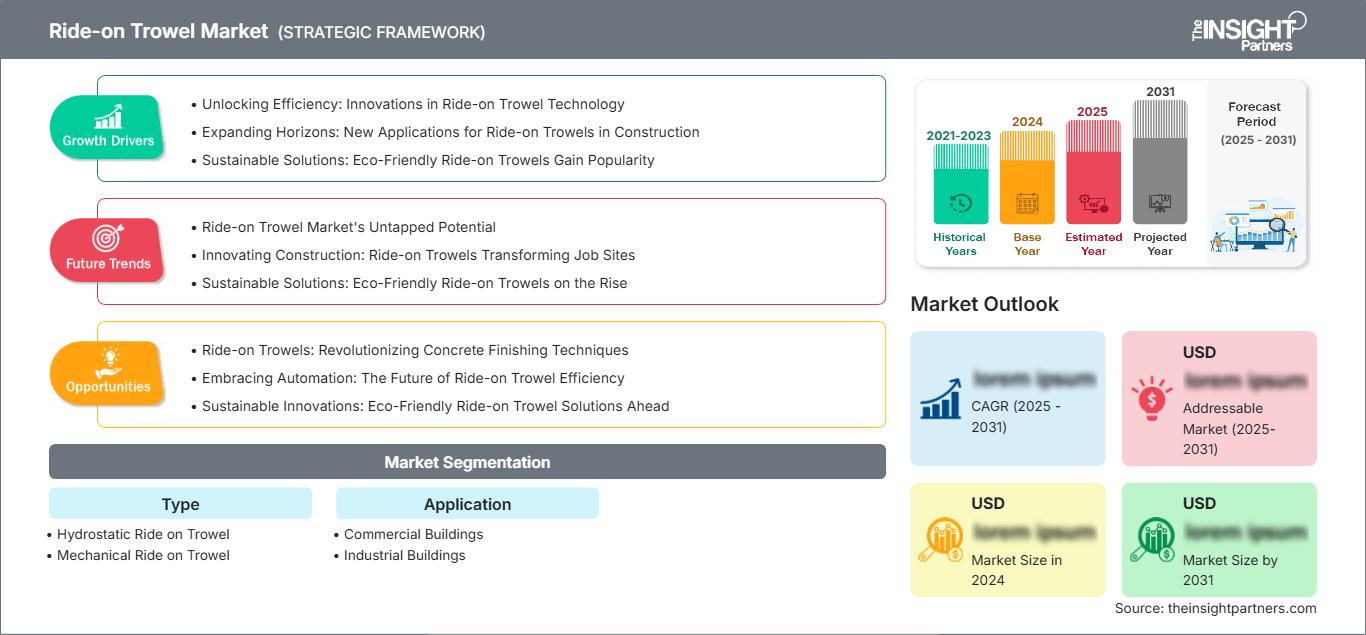
Ride-on Trowel Market: Strategic Insights
Regional Insights
North America ride-on trowel market
North America is estimated to represent 31–35% of global ride-on trowel market revenue in 2025 and is expected to expand at a CAGR of 2.4–2.9% during 2026–2034. The US dominates regional demand, supported by extensive warehouse, manufacturing, logistics, commercial flooring, and infrastructure construction. Mechanized finishing is favored where contractors must complete large slabs within narrow placement windows.
Rental channels further strengthen accessibility for smaller contractors that cannot justify frequent equipment ownership. Canada contributes through industrial, infrastructure, and commercial projects, while replacement demand benefits from established dealer and service networks. Product selection increasingly considers transportability, hydraulic steering, operator ergonomics, and maintenance access. Regional purchasing decisions also reflect fuel availability, emissions requirements, and equipment utilization rates.
U.S. ride-on trowel Market
The US contributes 74–78% of North American revenue in 2025 and is projected to grow at a CAGR of 2.5–3.0% through 2034. Large distribution centers, manufacturing plants, data-center construction, parking facilities, and commercial developments create recurring demand for high-productivity finishing equipment. Rental fleets provide contractors with access to multiple rotor sizes without significant capital commitments.
Multiquip Inc., ALLEN ENGINEERING CORPORATION, MBW Incorporated, and other established suppliers maintain strong market visibility through dealer networks and contractor relationships. Application trends favor hydrostatic machines for larger and technically demanding slabs, while mechanical units remain relevant for cost-sensitive projects. Equipment selection increasingly incorporates reduced maintenance, improved operator control, compact transport dimensions, and compatibility with specialized finishing blades and pans.
Europe ride-on trowel Market
Europe holds an estimated 25–29% of the ride-on trowel market share in 2025 and is forecast to grow at a CAGR of 1.9–2.4% through 2034. Germany leads regional demand, followed by the UK, France, Italy, and Spain. Germany benefits from industrial facilities and logistics construction, while stricter emissions expectations encourage manufacturers to improve machine efficiency and develop cleaner powertrain alternatives.
The UK maintains demand from commercial refurbishment, warehousing, and industrial flooring projects. France, Italy, and Spain contribute through commercial development, manufacturing facilities, infrastructure modernization, and renovation. Regional buyers generally emphasize equipment reliability, occupational ergonomics, transport efficiency, and regulatory compatibility. Wacker Neuson SE and Atlas Copco AB strengthen European competitive presence, while specialist suppliers address contractor-specific concrete-finishing requirements.
APAC ride-on trowel Market
APAC is projected to account for 27–31% of the global ride-on trowel market revenue in 2025 and grow at a CAGR of 2.8–3.4%. China remains the leading market, with Japan, South Korea, India, and Australia contributing through industrial construction and infrastructure programs.
Urbanization, manufacturing expansion, logistics facilities, and public infrastructure support equipment demand. India benefits from construction-equipment modernization, while Japan and South Korea emphasize productivity and quality. China combines domestic equipment production with large construction volumes, making the region strategically important for suppliers seeking scale and cost-efficient manufacturing.
Middle East & Africa ride-on trowel Market
The Middle East and Africa is expected to grow at a CAGR of 2.2–2.8% during 2026–2034, according to the ride-on trowel market report. Saudi Arabia leads regional demand, supported by large-scale urban, tourism, industrial, and infrastructure development, while the UAE remains important for commercial and logistics construction.
South Africa represents a key African market, with demand linked to industrial and commercial projects. The rest of MEA benefits selectively from infrastructure and construction activity. High temperatures, project logistics, equipment durability, and availability of service support influence purchasing decisions, while energy-intensive development and major infrastructure programs create opportunities for productive concrete-finishing equipment.
Segmentation Analysis
Product Type
Product Type is projected to expand at a CAGR of 2.3–2.8% between 2026–2034. Hydrostatic systems command stronger adoption because precise steering, rotor-speed control, and hydraulic actuation support large and technically demanding slabs. Mechanical platforms remain important where simpler architecture, lower acquisition costs, and familiar maintenance practices influence procurement.
- Hydrostatic Ride on Trowel: Hydrostatic equipment holds the leading position because contractors value responsive steering, controlled rotor operation, and reduced mechanical wear for demanding commercial and industrial slab-finishing applications.
- Mechanical Ride on Trowel: Mechanical machines remain strategically important for contractors prioritizing straightforward servicing, established operating practices, and lower equipment complexity, particularly where project requirements do not justify advanced hydraulic controls.
Application
Application is forecast to grow at a CAGR of 2.1–2.6% between 2026–2034. Industrial projects generally require extensive, high-tolerance concrete floors, while commercial construction provides steady demand across warehouses, retail facilities, offices, parking structures, and mixed-use developments. The ride-on trowel market scope therefore, extends across applications with different productivity and finish-quality requirements.
- Commercial Buildings: Commercial projects generate recurring equipment requirements for warehouses, retail facilities, parking structures, offices, and mixed-use developments where contractors need efficient slab finishing across broad floor areas.
- Industrial Buildings: Industrial buildings represent a major demand center because factories, distribution facilities, and manufacturing sites commonly require large, durable concrete floors with consistent flatness and high finishing productivity.
Opportunity Snapshot
| Application | Revenue Contribution (High/Medium/Low) | Trend Tag | Adoption Stage |
| Commercial Buildings | High | Warehouse Floors | Mature |
| Industrial Buildings | High | Flat Slabs | Scaling |
Ride-on Trowel Market Growth Drivers and Impact Analysis
Large-scale warehouse and industrial floor construction
An increase in logistics, manufacturing, distribution, and industrial facility construction will increase the need for equipment that is able to perform finishing of large concrete slabs within specified time frames of placement. Larger floors put more emphasis on productivity, quality, and mobility than small or residential floors. With ride-on equipment, contractors will be able to reduce dependence on manual labor and deploy their skilled workers where they are needed. This is the driver that will also lead to an increased demand for equipment that provides larger rotor diameter and a hydrostatic control system if it will be productive enough for the size of the slab. Due to the fact that industrial buildings are increasingly integrating automation into their design, concrete flatness becomes operationally relevant.
Contractor focus on productivity and labor utilization
More than ever, the factors of labor availability and finishing efficiency become critical in buying machines since concrete placement scheduling might lead to very limited opportunities for floating and finishing. Using a ride-on platform, the operator does not have to stand but works while sitting and controls several rotors, avoiding excessive physical effort compared to operating the machine manually. This factor of higher productivity gains its importance especially in case contractors face strict project schedules or do not have enough experienced finishing crews. Such rental companies make use of that factor since they offer special machines to use without the necessity of buying. Manufacturers compete with each other in terms of ergonomics, sensitivity of control, visibility, accessibility for service, and machine availability.
Expansion of equipment rental and fleet-based procurement
The impact of rental adoption on purchasing economics stems from the ability of contractors to choose the capacity of the equipment based on specific project needs. This matter is especially important when it comes to ride-on equipment due to the difference in utilization of such machines depending on the project and because of the cost of financing, maintenance, and depreciation when the equipment is owned. The rental market in North America is especially important due to the development of fleet management and maintenance practices in equipment rental companies. Contractors consider the availability of equipment, condition, delivery, and ability to replace it in addition to the price, when choosing equipment.
Ride-on Trowel Market Future Trends
Hydraulic intelligence and operator-assistance systems
The ride-on trowel market trends are likely to shift toward greater integration of electronic monitoring, hydraulic optimization, and operator-assistance functions. Futuristic machines could make use of sensors for tracking rotor speed, engine load, hydraulic pressure, temperature, and service intervals, allowing the operator more control of the machine regardless of changes in concrete properties. Machine status and maintenance warnings could be displayed on digital screens, with pitch and steer controls managed electronically in order to reduce repetitive actions performed by the operator. Futuristic machines could even provide fleet management with data on utilization and diagnostics. Such features would come in handy for rental businesses working with mixed fleets at various sites. In the future, manufacturers could compete using measures of productivity and uptime rather than horsepower, weight, and size of the rotor only.
Lower-emission powertrains for enclosed construction environments
Electrification is expected to evolve from small concrete machinery to more sophisticated platforms as advances are made in battery efficiency, infrastructure, and site power management. The change will be more pertinent to applications that are suitable for indoors, such as industrial buildings, parking lots, tunnels, and sites where pollution and ventilation restrictions prevent the use of combustible machinery. Electric machinery in the construction industry is a sign of the move towards the adoption of modular energy sources, thus paving the way for the ride-on platform. Hybrid systems would also prove useful in applications where extended usage periods would not allow complete electrification. There would be a need to weigh the advantages of each system based on battery mass, operational life, recharge time, rotor design, cooling, and cost of acquisition.
Ride-on Trowel Market Opportunities
Rental-ready compact riders for constrained job sites
A significant opportunity exists for compact ride-on platforms designed specifically for rental fleets and projects with restricted access. Smaller machines can address multistory construction, narrow entrances, limited slab access, and sites where large riders create logistical constraints. Manufacturers can strengthen this proposition by combining compact dimensions with durable gearboxes, simple service access, transport-friendly lifting points, and interchangeable tooling. Rental companies could package these machines with blades, pans, maintenance kits, and operator training, creating a complete finishing solution rather than a standalone equipment transaction. The ride-on trowel market forecasts indicate that flexible equipment capable of serving multiple project sizes can improve utilization across rental fleets. Product developers should therefore prioritize transportability, rapid deployment, and low downtime alongside finishing performance.
Integrated tooling and lifecycle service platforms
There is another option to consider in pairing the machines with blades, pans, parts, diagnostics, training, and preventive maintenance services. The finishing process is not only dependent on the machine itself but also on proper tooling, blade condition, pitch configuration, and operator skills. It is possible to generate more income through application-specific tooling solutions for floating, finishing, burnishing, and specialty flooring applications. The digital service history could assist the contractors in establishing the intervals when new components should be replaced and when maintenance is required to prevent any potential problems. Local distributors will be able to stand out with mobile services, operator training, and fast delivery of the parts.
Frequently Asked Questions

- Comprehensive Market Sizing and Forecast Analysis
- Detailed Segmentation Analysis
- In-Depth Market Dynamics Assessment
- Regional and Country-Level Insights
- Competitive Landscape and Company Benchmarking
- Strategic Business Intelligence
Recent Reports
Testimonials

The Insight Partners' SCADA System Market report is comprehensive, with valuable insights on current trends and future forecasts. The team was highly professional, responsive, and supportive throughout. We are very satisfied and highly recommend their services.
RAN KEDEM Partner, Reali Technologies LTDs
I requested a report on a very specific software market and the team produced the report in a few days. The information was very relevant and well presented. I then requested some changes and additions to the report. The team was again very responsive and I got the final report in less than a week.
JEAN-HERVE JENN Chairman, Future Analytica
We worked with The Insight Partners for an important market study and forecast. They gave us clear insights into opportunities and risks, which helped shape our plans. Their research was easy to use and based on solid data. It helped us make smart, confident decisions. We highly recommend them.
PIYUSH NAGPAL Sr. Vice President, High Beam Global
The Insight Partners delivered insightful, well-structured market research with strong domain expertise. Their team was professional and responsive throughout. The user-friendly website made accessing industry reports seamless. We highly recommend them for reliable, high-quality research services
YUKIHIKO ADACHI CEO, Deep Blue, LLC.
This is the first time I have purchased a market report from The Insight Partners.While I was unsure at first, I visited their web site and felt more comfortable to take the risk and purchase a market report.I am completely satisfied with the quality of the report and customer service. I had several questions and comments with the initial report, but after a couple of dialogs over email with their analyst I believe I have a report that I can use as input to our strategic planning process.Thank you so much for taking the extra time and making this a positive experience.I will definitely recommend your service to others and you will be my first call when we need further market data.
JOHN SUZUKI President and Chief Executive Officer, Board Director, BK Technologies
I wish to appreciate your support and the professionalism you displayed in the course of attending to my request for information regarding to infectious disease IVD market in Nigeria. I appreciate your patience, your guidance, and the fact that you were willing to offer a discount, which eventually made it possible for us to close a deal. I look forward to engaging The Insight Partners in the future, all thanks to the impression you have created in me as a result of this first encounter.
DR CHIJIOKE ONYIA MANAGING DIRECTOR, PineCrest Healthcare Ltd.Reason to Buy
- Informed Decision-Making
- Understanding Market Dynamics
- Competitive Analysis
- Identifying Emerging Markets
- Customer Insights
- Market Forecasts
- Risk Mitigation
- Boosting Operational Efficiency
- Strategic Planning
- Investment Justification
- Tracking Industry Innovations
- Aligning with Regulatory Trends





 Get Free Sample for