
Robotics and Automation in Injection Molding Machines Market Trends, Demand & Growth by 2034
Coverage: By Component (Hardware, Software, and Services), Hardware (Robots, Handling Systems, Automation Cells, and Others), Software by Type [Manufacturing Execution Systems (MES), SCADA, Customer Portal, IoT-based Monitoring and Analytics Platform, AI-based Process Optimization, and Others], Software by Deployment Model [Cloud (SaaS) and On-Premises], Services (Consulting, Integration, and Support), Industry (Medical, Electronics, Packaging, Automotive, and Leisure, and Others), Machine Type (Hydraulic, All-Electric, and Hybrid), Clamping Force (0 - 200 kN, 201kN- 5000 kN, and Above 5000 kN), and Geography (North America, Europe, Asia Pacific, South and Central America)
- Status : Published
- Report Code : TIPRE00043161
- Category : Electronics and Semiconductor
- No. of Pages : 439
- Available Report Formats :


- Last update date : June 08, 2026


2025 Market Size
US$ 10,552.52 Mn
Base year value
2034 Forecast
US$ 19,657.14 Mn
Projected by 2034
CAGR 2026-2034
7.2 %
Growth rate
Addressable Market
US$ 136,630.42 Mn
(2026-2034)
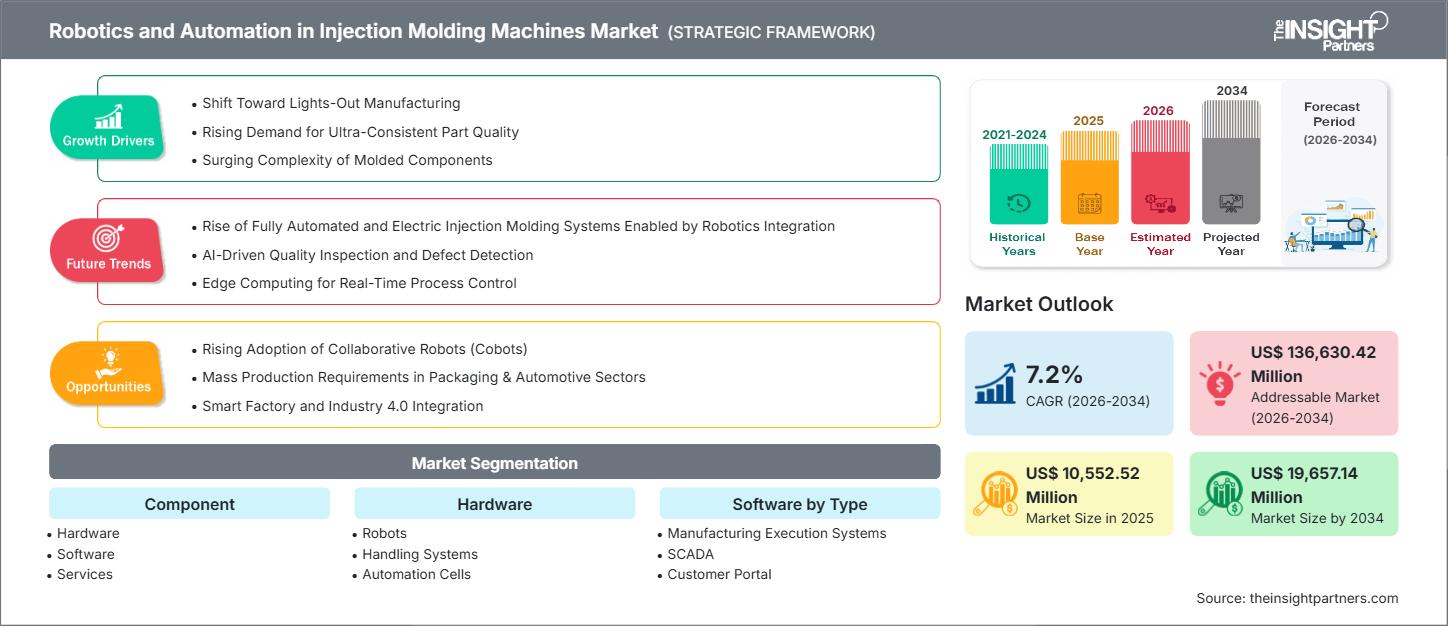
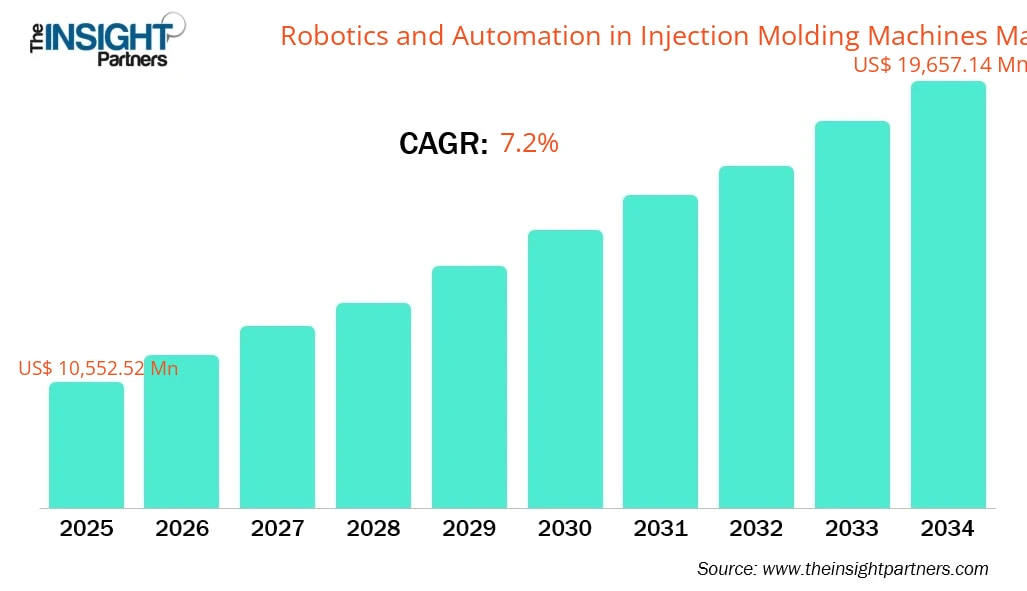
The robotics and automation in injection molding machines market was valued at US$ 10,552.52 million in 2025 and is expected to reach US$ 19,657.14 million by 2034; it is estimated to record a CAGR of 7.2% during 2026–2034.
Robotics and Automation in Injection Molding Machines Market Analysis
The technology used in robotics and automation for injection molding machines is specialized. This technology has been adopted to help improve efficiency, decrease cycles, reduce wastage, and promote safety on the production line in the plastic industry. Among the automation technologies available are linear robots, articulated robots, sprue pickers, conveyors, inspection stations, and fully automated cells. These robots perform tasks such as removal of the molded products from the machine, degating, insertion, stacking, packing, and inspecting of parts.
Robotic and automated solutions have revolutionized manufacturing floors, changing them into fully automated production lines that run in total darkness. Automation has become widespread in automotive parts manufacturing, consumer electronic production, packaging industries, and the manufacture of medical instruments and housewares. The application of concepts such as Industry 4.0 and connectivity through IoT makes these systems more valuable through predictive maintenance.
The adoption of all-electric injection molding machines has strengthened automation capabilities by offering higher precision, faster response times, and improved energy efficiency compared to hydraulic systems. The inclusion of Industry 4.0 technologies, IoT connectivity, and edge computing allows these machines and robots to communicate with factory-wide MES/ERP systems, enabling predictive maintenance, remote monitoring, and data-driven optimization of production lines. As industries such as automotive, electronics, packaging, and medical devices demand higher volumes, tighter tolerances, and faster turnaround times, robotics and automation are becoming essential, transforming injection molding into a smart, scalable, and competitive manufacturing process that supports mass production, customization, and sustainability goals.
Robotics and Automation in Injection Molding Machines Market Overview
The global robotics and automation in injection molding market is expanding due to rising labor costs, increasing demand for precision and consistency in high-volume production, and the need for round-the-clock manufacturing. The shift to electric and hybrid injection molding machines, which work better with automation, is boosting adoption. Robotic systems, sensors, software, and intelligent control technologies are integrated with injection molding equipment to create autonomous manufacturing processes. In modern production environments, robots are used for a range of tasks such as mold loading and unloading, part extraction, insert placement, trimming, assembly, and quality inspection. Automation systems coordinate machine parameters such as temperature, pressure, and cycle timing to ensure consistent output. This integration eliminates the variability associated with manual operations, improving product quality, reducing cycle times, and minimizing material waste. Advanced systems combine robotics with machine vision, AI-based defect detection, and real-time process monitoring, enabling inline quality control and immediate correction of process deviations without stopping production.
Key trends include the use of cobots that work safely near people, AI-based vision technology for quick defect detection, cloud-based production metrics, and automation cells with flexible setups that can handle different parts. In the healthcare and pharmaceutical industries, there is an urgent need for contamination-free and repetitive processes through automation that meet strict standards.
However, heavy investment costs required upfront, the absence of skilled labor to operate and manage robotic and automated technologies, as well as integration complexities with older injection molding machinery, pose substantial hurdles. SMEs find it challenging to adopt expensive machinery.
Market Assessment and Insights
- Asia Pacific dominated the market with 40.1% share in 2025.
- Asia Pacific is poised to grow at a CAGR of 8.3% over the forecast period.
- United States market is projected to grow at a CAGR of 6.1% over the forecast period.
- By Component, the Hardware segment accounted for the largest market share of 58.4% in 2025.
- By Hardware Type, the Automation Cells segment is anticipated to witness the fastest growth, registering a CAGR of 8.1% over the forecast period
- By Robots Segment Industry, the Automotive segment accounted for the largest market share of 32.8% in 2025.
- By Software Type, the AI-based Process Optimization segment is anticipated to witness the fastest growth, registering a CAGR of 10.4% over the forecast period
- By Software Deployment Model, the Cloud (SaaS) segment accounted for the largest market share of 68.5% in 2025.
- By Services Type, the Integration Services segment is anticipated to witness the fastest growth, registering a CAGR of 7.4% over the forecast period
- By Industry, the Automotive segment accounted for the largest market share of 29.1% in 2025.
- By Machine Type, the All-Electric segment is anticipated to witness the fastest growth, registering a CAGR of 8.6% over the forecast period
- By Clamping Force, the 201kN- 5000 kN segment accounted for the largest market share of 41.3% in 2025.
- The report profiles key industry players such as Autodesk Inc, Fanuc Corp, Haitian International Holdings Limited, KraussMaffei Group GmbH, Wittmann Group, ENGEL AUSTRIA GmbH, Sumitomo (SHI) Demag Plastics Machinery GmbH, Sepro Group, Star Automation, Inc., Campetella Robotic Center srl, while also analyzing key developments in novel ideas, disruptive products, and innovative services that could reshape the future market and reveal emerging themes across the industry.
Source: The Insight Partners' analysis based on proprietary research, government publications, company annual reports, investor presentations, industry databases, and expert interviews.
● REPORT CUSTOMIZATION
Tailor This Report To Align With Your Specific Business Requirements
This report can be customized to align precisely with your business objectives, scope, and target markets. Customization options include tailored segmentation, geography, competitive analysis, and strategic insights to support informed decision-making.
Customize This Report →WHAT YOU CAN ADJUST
- ● Segmentations
- ● Geography
- ● Competitive Analysis
- ● Language Preferences
Robotics and Automation in Injection Molding Machines Market: Strategic Insights
-
Get Top Key Market Trends of this report.This FREE sample will include data analysis, ranging from market trends to estimates and forecasts.
Robotics and Automation in Injection Molding Machines Market: Drivers and Opportunities
Market Drivers:
- Labor Shortages and Rising Wage Costs: There are labor shortages across manufacturing fields, particularly when it comes to work related to repetitive activities such as component removing, cutting, and packaging. Automation and robotics allow companies to be less reliant on the labor force, minimize the likelihood of any injuries, and deliver consistent product outputs despite shift shortages.
- Demand for Higher Productivity and Consistency: Automation runs continuously and does not get tired, meaning that there are faster cycle times with reduced amounts of waste. In the field of automotive components and in medical products manufacturing, micron accuracy is important. Automation delivers high consistency in processing parts.
- Growth of Industry 4.0 and Smart Manufacturing: Injection molding plants implement automation systems with sensors that transfer real-time production data to the manufacturing execution system (MES). Sensors in robotic cells help in predicting maintenance needs, calculating OEE, and quickly switching production between orders.
Market Opportunities:
- Collaborative Robots (Cobots) for SME Adoption: Cobots are simpler to program, take up less space, and do not require safety cages, making technology more accessible to small-scale manufacturers. Original equipment manufacturers are creating specialized EOAT for cobots that can automate injection molding processes, offering a huge, untapped market segment.
- AI-Powered Vision and Adaptive Control: The use of artificial intelligence for machine vision applications can help in detecting any surface defect, flash, short shot, and dimensional tolerance errors. When used in collaboration with robotics and automation technology, these errors can be detected and corrected immediately.
- End-of-Arm Tooling (EOAT) Innovation: The advancement of lightweight, multi-functional, and modular end-of-arm tooling (EOAT) enables a robot to carry out various tasks. The robot can pick, degate, insert, and stack parts without the need for multiple machines.
Robotics and Automation in Injection Molding Machines Market Report Segmentation Analysis
The robotics and automation in the injection molding machines market is segmented into distinct categories to provide a clearer understanding of its operation, growth potential, and current trends. Below is the standard segmentation approach used in industry reports:
By Component:
- Hardware: Robots, handling systems, automation cells, and other physical equipment used in injection molding automation.
- Software: Digital solutions for controlling, monitoring, and optimizing automated processes.
- Services: Consulting, integration, and support services for deployment and maintenance.
By Hardware:
- Robots
- Handling Systems
- Automation Cells
- Others
By Software Type:
- Manufacturing Execution Systems (MES)
- SCADA (Supervisory Control and Data Acquisition)
- Customer Portal
- IoT-based Monitoring and Analytics Platform
- AI-based Process Optimization
- Others
By Software Deployment Model:
- Cloud (SaaS)
- On-Premises
By Services:
- Consulting
- Integration
- Support
By Industry:
- Medical
- Electronics
- Packaging
- Automotive
- Leisure
- Others
By Machine Type:
- Hydraulic
- All-Electric
- Hybrid
By Clamping Force:
- 0 – 200 kN
- 201 kN – 5000 kN
- Above 5000 kN
By Geography:
- North America
- Europe
- Asia Pacific
- Latin America
- Middle East & Africa
Robotics and Automation in Injection Molding Machines Market Report Scope
| Report Attribute | Details |
|---|---|
| Market size in 2025 | US$ 10,552.52 Million |
| Market Size by 2034 | US$ 19,657.14 Million |
| Global CAGR (2026 - 2034) | 7.2% |
| Historical Data | 2021-2024 |
| Forecast period | 2026-2034 |
| Segments Covered |
By Component
|
| Regions and Countries Covered |
North America
|
| Market leaders and key company profiles |
|
Robotics and Automation in Injection Molding Machines Market Players Density: Understanding Its Impact on Business Dynamics
The Robotics and Automation in Injection Molding Machines Market is growing rapidly, driven by increasing end-user demand due to factors such as evolving consumer preferences, technological advancements, and greater awareness of the product's benefits. As demand rises, businesses are expanding their offerings, innovating to meet consumer needs, and capitalizing on emerging trends, which further fuels market growth.
Robotics and Automation in Injection Molding Machines Market Share Analysis by Geography
Asia Pacific is witnessing the fastest growth. Emerging markets in Latin America, the Middle East & Africa offer untapped opportunities for companies.
The robotics and automation in the injection molding machines market experience varying growth rates across different regions. Below is a summary of market share and trends by region:
1. North America
- The market is developing at a stable pace, driven by reshoring initiatives in manufacturing, labor shortages, and the necessity for resilient supply chains. Key countries include the US and Mexico. The medical devices and packaging industries are prominent in the implementation of automation in injection molding.
2. Europe
- The market is an advanced one with a lot of innovation, dominated by Germany, Italy, the UK, and Austria. Strong automotive and medical devices manufacturing industry drives the adoption of precise automation systems. European equipment manufacturers such as Engel, Arburg, and KraussMaffei provide fully integrated robotic systems. Workplace safety regulations encourage the implementation of automation technology.
3. Asia Pacific
- The region takes the leading position within the market, holding the largest market share and the highest growth potential. Contributing countries are China, Japan, South Korea, and India. Large plastic manufacturing operations, rising labor rates, and active government initiatives in favor of factory automation are driving factors. China’s strategy called "Made in China 2025" supports robotics and automation within the injection molding domain.
4. South and Central America
- The market growth in this area is fueled by the manufacturing of automotive parts in Brazil and Argentina, as well as the manufacturing of consumer goods. The adoption rate is slower due to financial limitations. However, labor costs are driving automation.
5. Middle East and Africa
- The market is rapidly developing due to the manufacturing of packaging and household goods in the UAE, Saudi Arabia, and South Africa. The demand for robotic and automation systems in injection molding will increase as industrialization progresses in the region.
High Market Density and Competition
Fanuc Corp, ENGEL AUSTRIA GmbH, KraussMaffei Group GmbH, Wittmann Group, ARBURG GmbH + Co KG, and Haitian International Holdings Limited are among the key players dominating the market. Regional and niche manufacturers offer specialized solutions tailored to specific industries or applications.
This high level of competition drives companies to stand out by offering:
- Faster, energy-efficient servo-driven linear robots.
- Integrated machine-robot controls via a single human-machine interface (HMI).
- Predictive maintenance algorithms using edge computing.
- Plug-and-play automation cells for standard injection molding machines.
Opportunities and Strategic Moves
- Strategic partnerships between robotics manufacturers and injection molding machine OEMs for fully integrated solutions.
- Development of low-cost, standardized automation packages for SMEs.
- Expansion of service networks and training programs to address the skills gap.
Major Companies operating in the Robotics and Automation in Injection Molding Machines Market are:
- Sumitomo (SHI) Demag Plastics Machinery GmbH
- Sepro Group
- Star Automation, Inc.
- Campetella Robotic Center srl
- Autodesk Inc
- CoreTech System Co., Ltd. (Moldex3D)
- Fanuc Corp
- ENGEL AUSTRIA GmbH
- KraussMaffei Group GmbH
- Wittmann Group
- ARBURG GmbH + Co KG
- Haitian International Holdings Limited
Other companies analyzed during the course of research:
- Yushin Precision Equipment Co., Ltd.
- Wemo Automation AB
- Harmo Co., Ltd.
- Topstar Technology Co., Ltd.
- Sailor Robot Co., Ltd.
- Hanyang Robotics Co., Ltd.
- Guangdong Switek Technology Co., Ltd.
- Ningbo Weili Robot Technology Co., Ltd.
- Milacron Holdings Corp.
- Husky Injection Molding Systems Ltd.
- Nissei Plastic Industrial Co., Ltd.
- Toshiba Machine Co., Ltd.
- ABB Ltd.
- KUKA AG
- Yaskawa Electric Corporation
- DENSO Robotics
- Kawasaki Robotics
- Nachi-Fujikoshi Corp.
- Epson Robots
- Omron Corporation
Disclaimer: The companies listed above are not ranked in any particular order.
Robotics and Automation in Injection Molding Machines Market News and Recent Developments
- ABB surpasses 10GW milestone in delivering automation solutions : In October 2025, Stäubli Robotics announced the launch of the MTC-900 Machine Tending Cart, a next-generation plug-and-play automation solution engineered to enhance productivity, safety, and flexibility across a wide range of industrial applications. Designed for high-demand environments such as metalworking, plastic injection molding, and precision assembly, the MTC-900 offers manufacturers a fast track to collaborative automation. Its integration with Injection Molding Machines (IMMs) via the Euromap 67 standard enables plug-and-play connectivity, reducing setup time and simplifying deployment in molding operations.
- YIZUMI continued to drive innovation : In February 2025, YIZUMI, a leader in injection molding technology, continued to drive innovation with solutions that enhance efficiency, reduce waste, and improve product quality. The company’s FF Series Electric Injection Molding Machine exemplifies this commitment, offering unmatched precision, flexibility, and automation capabilities.
Robotics and Automation in Injection Molding Machines Market Report Coverage and Deliverables
The "Robotics and Automation in Injection Molding Machines Market Size and Forecast (2021–2034)" report provides a detailed analysis of the market covering below areas:
- Robotics and Automation in Injection Molding Machines Market size and forecast at global, regional, and country levels for all the key segments covered under the scope
- Robotics and Automation in Injection Molding Machines Market trends, as well as dynamics such as drivers, restraints, and key opportunities
- Detailed PEST and SWOT analysis
- Robotics and Automation in Injection Molding Machines Market analysis covering key trends, global and regional framework, major players, regulations, and recent market developments
- Industry landscape and competition analysis covering market concentration, heat map analysis, prominent players, and recent developments for the Robotics and Automation in Injection Molding Machines Market
- Detailed company profiles
Frequently Asked Questions

- Comprehensive Market Sizing and Forecast Analysis
- Detailed Segmentation Analysis
- In-Depth Market Dynamics Assessment
- Regional and Country-Level Insights
- Competitive Landscape and Company Benchmarking
- Strategic Business Intelligence
Recent Reports
Testimonials

The Insight Partners provided valuable market intelligence that supported our global go-to-market strategy. Their team was professional, responsive, and attentive to our feedback, providing thoughtful analysis and helpful methodological clarifications throughout the project.
Junmo Kim Chief Financial Officer (CFO), Enertech Co., Ltd.
The Insight Partners' SCADA System Market report is comprehensive, with valuable insights on current trends and future forecasts. The team was highly professional, responsive, and supportive throughout. We are very satisfied and highly recommend their services.
RAN KEDEM Partner, Reali Technologies LTDs
I requested a report on a very specific software market and the team produced the report in a few days. The information was very relevant and well presented. I then requested some changes and additions to the report. The team was again very responsive and I got the final report in less than a week.
JEAN-HERVE JENN Chairman, Future Analytica
We worked with The Insight Partners for an important market study and forecast. They gave us clear insights into opportunities and risks, which helped shape our plans. Their research was easy to use and based on solid data. It helped us make smart, confident decisions. We highly recommend them.
PIYUSH NAGPAL Sr. Vice President, High Beam Global
The Insight Partners delivered insightful, well-structured market research with strong domain expertise. Their team was professional and responsive throughout. The user-friendly website made accessing industry reports seamless. We highly recommend them for reliable, high-quality research services
YUKIHIKO ADACHI CEO, Deep Blue, LLC.
This is the first time I have purchased a market report from The Insight Partners.While I was unsure at first, I visited their web site and felt more comfortable to take the risk and purchase a market report.I am completely satisfied with the quality of the report and customer service. I had several questions and comments with the initial report, but after a couple of dialogs over email with their analyst I believe I have a report that I can use as input to our strategic planning process.Thank you so much for taking the extra time and making this a positive experience.I will definitely recommend your service to others and you will be my first call when we need further market data.
JOHN SUZUKI President and Chief Executive Officer, Board Director, BK Technologies
I wish to appreciate your support and the professionalism you displayed in the course of attending to my request for information regarding to infectious disease IVD market in Nigeria. I appreciate your patience, your guidance, and the fact that you were willing to offer a discount, which eventually made it possible for us to close a deal. I look forward to engaging The Insight Partners in the future, all thanks to the impression you have created in me as a result of this first encounter.
DR CHIJIOKE ONYIA MANAGING DIRECTOR, PineCrest Healthcare Ltd.Reason to Buy
- Informed Decision-Making
- Understanding Market Dynamics
- Competitive Analysis
- Identifying Emerging Markets
- Customer Insights
- Market Forecasts
- Risk Mitigation
- Boosting Operational Efficiency
- Strategic Planning
- Investment Justification
- Tracking Industry Innovations
- Aligning with Regulatory Trends





 Get Free Sample for