
Rotary Dryers Market Growth, Trends & Forecast by 2034
Coverage: By Type (Direct Dryers, Indirect Dryers); Size (Small, Medium, Large); End-user (Food, Mining, Chemical, Pharmaceutical, Fertilizer, Cement, Paper and Pulp, Others), and Geography (North America, Europe, Asia Pacific, and South and Central America)
- Status : Data Released
- Report Code : TIPRE00013174
- Category : Manufacturing and Construction
- No. of Pages : 150
- Available Report Formats :


- Last update date : September 18, 2026


2025 Market Size
US$ 1.25 Bn
Base year value
2034 Forecast
US$ 2.11 Bn
Projected by 2034
CAGR 2026-2034
5.97 %
Growth rate
Addressable Market
US$ 15.20 Bn
(2026-2034)
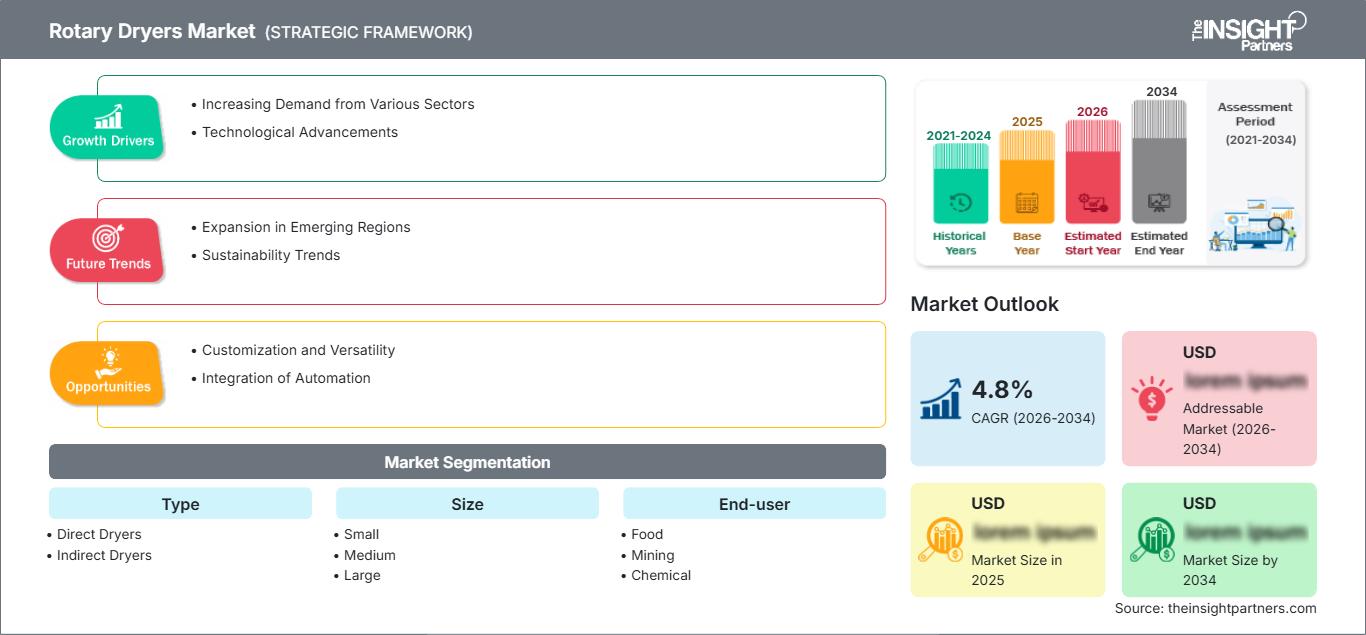
The rotary dryers market is projected to grow from US$ 1.25 Billion in 2025 to US$ 2.11 Billion by 2034, registering a CAGR of 5.97% during 2026–2034. Demand is supported by bulk solids processing, mineral beneficiation, fertilizer granulation, biomass drying, food ingredient stabilization, and process industries that require continuous moisture control under variable feed conditions.
North America's rotary dryers market size is supported by mining, chemicals, food processing, fertilizer, pulp and paper, and cement applications. Regional demand is expected to grow at a CAGR of 5.3–5.8% during 2026–2034 as operators upgrade aging thermal equipment, reduce fuel intensity, and improve product consistency across high-throughput industrial plants.
Rotary Dryers Market Assessment and Insights
- North America accounted for 26–29% share in 2025 and is expected to grow at a CAGR of 5.3–5.8% during 2026–2034, supported by minerals, fertilizer, food, and biomass drying investments.
- US represented 77–81% of North America demand in 2025 and is projected to expand at 5.2–5.7% CAGR, led by mining, chemicals, agriculture, and industrial processing upgrades.
- Europe held 21–24% share in 2025 and is expected to grow at 4.8–5.3% CAGR, with Germany, the UK, France, Italy, and Spain contributing through chemicals, cement, food, and waste-to-energy processing.
- Asia Pacific represented 36–40% share in 2025 and is forecast to grow at 6.4–7.0% CAGR, supported by China, India, Japan, South Korea, and Australia as mining and industrial output expands.
- Largest Segment: Direct Dryers held 61–65% share in 2025 and are projected to grow at 5.8–6.3% CAGR due to high thermal transfer efficiency, broad material compatibility, and lower process complexity.
- High Growth Segment: Large rotary dryers accounted for 34–38% share in 2025 and are expected to grow at 6.3–6.9% CAGR as high-volume minerals, fertilizer, cement, and biomass projects scale capacity.
- Key companies analyzed in detail: ANDRITZ AG, CAD Works Engineering Ltd, Carrier Vibrating Equipment, Inc., FEECO International, Inc., FLSmidth & Co. A/S, GEA Group AG, IDRECO S.r.l., Metso Corporation, thyssenkrupp AG, and Yamato Sanko Co., Ltd.
Source: The Insight Partners' analysis based on proprietary research, government publications, company annual reports, investor presentations, industry databases, and expert interviews.
Equipment evolution has shifted the rotary dryers market from conventional drum systems toward engineered thermal platforms that integrate optimized lifters, burner efficiency, exhaust handling, dust control, and process automation. This is being done to ensure that producers have residence time control, reduced particulate carryover, and flexibility in fuel choices since the cost of drying is directly linked to the margins generated from minerals, fertilizers, chemicals, and biomass plants.
Demand moving forward will be driven by the decarbonization of industry, new mine production, alternative fuels treatment, and recycling applications. New geographies are building new continuous drying capacities, while established geographies will be focused on retrofitting, heat recovery, and monitoring.
Rotary Dryers Market Report Scope
| Report Attribute | Details |
|---|---|
| Market size in 2025 | US$ 1.25 Billion |
| Market Size by 2034 | US$ 2.11 Billion |
| Global CAGR (2026 - 2034) | 5.97% |
| Historical Data | 2021-2024 |
| Forecast period | 2026-2034 |
Rotary Dryers Market Analysis
The rotary dryers market growth is linked to the need for stable moisture reduction in bulk solids before downstream crushing, pelletizing, storage, combustion, packaging, or chemical conversion. Rotary systems remain preferred where materials vary in particle size, stickiness, and inlet moisture. Their ability to handle abrasive minerals, fertilizers, wood fibers, sludge, and food by-products creates resilient demand across long-life industrial assets.
Value-chain decisions increasingly involve burner suppliers, refractory specialists, baghouse providers, control system integrators, and service partners. The rotary dryers market analysis shows that buyers compare throughput, evaporation capacity, fuel flexibility, emissions control, installation footprint, maintenance access, and product temperature control. Custom engineering remains important because feed behavior and target outlet moisture differ sharply across industries.
Positioning is influenced by process expertise and lifecycle services. Custom rotary dryers for bulk solids with direct and indirect arrangements are supplied by FEECO International, Inc. FLSmidth & Co. A/S is an example of suppliers providing FT series rotary dryers for minerals and ores. Support for large drying and cooling is provided by Metso Corporation, while ANDRITZ AG offers drum dryer technologies for biomass, agriculture, and municipal solid wastes.
GEA Group AG boosts the drying industry ecosystem through general particle processing systems, while Carrier Vibrating Equipment, Inc., CAD Works Engineering Ltd, IDRECO S.r.l., thyssenkrupp AG, and Yamato Sanko Co., Ltd. fulfill the engineering needs of the specific applications. Suppliers that provide testing, equipment design, installation, and modernization services after commissioning are more competitive than suppliers that supply just equipment. This integrated approach is expected to support competitive differentiation and long-term growth opportunities, according to the Rotary Dryers Market forecast.
● REPORT CUSTOMIZATION
Tailor This Report To Align With Your Specific Business Requirements
This report can be customized to align precisely with your business objectives, scope, and target markets. Customization options include tailored segmentation, geography, competitive analysis, and strategic insights to support informed decision-making.
Customize This Report →WHAT YOU CAN ADJUST
- ● Segmentations
- ● Geography
- ● Competitive Analysis
- ● Language Preferences
Rotary Dryers Market: Strategic Insights
Regional Insights
North America rotary dryers market
North America accounted for 26–29% share in 2025 and is forecast to advance at 5.3–5.8% CAGR. The rotary dryers market share is reinforced by mineral processing, fertilizer plants, biomass densification, food ingredient drying, and chemical production. Operators are replacing older drums with controlled-airflow systems, better sealing, and improved exhaust handling.
Also, the area has been blessed with good service infrastructure and a solid supply chain of processing machinery. Durability, emission standards, and energy recovery have been critical considerations for American and Canadian customers as drying involves high energy requirements. Improvements can be justified on account of decreased fuel consumption, reduced unscheduled downtimes, and increased moisture uniformity.
U.S. rotary dryers Market
The U.S. represented 77–81% of North America's rotary dryers market demand in 2025 and is projected to grow at 5.2–5.7% CAGR. Demand is centered on minerals, fertilizers, chemicals, pulp and paper, biomass, and food processing. Significant capital investments lead to ongoing opportunities for replacement, upgrades, inspection, and rebuilding.
Company coverage drives market depth through FEECO International, Inc., Carrier Vibrating Equipment, Inc., FLSmidth & Co. A/S, Metso Corporation, and GEA Group AG. Emerging application trends include custom-engineered drums, indirect heat for temperature-sensitive materials, and dust collection and PLC controls.
Europe rotary dryers Market
Europe held 21–24% share of the rotary dryers market in 2025 and is expected to grow at 4.8–5.3% CAGR. Germany leads due to chemical, cement, machinery, food, and environmental technology activity. Demand in UK comes from cement, waste handling, biomass, and special ingredients, where drying efficiency plays an important role for the economic viability of the process.
France, Italy, and Spain participate through food processing, fertilizer mixing, building materials, and pulp industry-related uses. The European customers place emphasis on emissions reduction, fuel switching, heat recovery, and circular economy processing. ANDRITZ AG, GEA Group AG, thyssenkrupp AG, FLSmidth & Co. A/S, and IDRECO S.r.l. Enhance local technological options.
APAC rotary dryers Market
APAC represented 36–40% share in 2025 and is projected to grow at 6.4–7.0% CAGR. China leads demand through minerals, cement, chemicals, fertilizer, and food processing, while India is expanding drying capacity for mining, agriculture, and industrial materials.
Japan, South Korea, and Australia add demand from advanced manufacturing, battery minerals, specialty chemicals, and resource processing. Regional growth is supported by industrial capacity additions, infrastructure programs, and domestic mineral beneficiation. Buyers seek scalable equipment with robust metallurgy, fuel flexibility, and local service access.
Middle East & Africa rotary dryers Market
The Middle East & Africa market is expected to grow at 4.7–5.2% CAGR, supported by mining, cement, fertilizer, phosphate, and infrastructure-linked materials. Saudi Arabia, the UAE, South Africa, and the Rest of MEA are key demand centers.
South Africa leads regional adoption due to its established mining and minerals processing. Saudi Arabia and the UAE are increasing investments in industrial diversification, cement, and phosphate value chains. Equipment durability, dust control, heat resilience, and service availability remain central purchase criteria.
Segmentation Analysis
Type
Type includes Direct Dryers and Indirect Dryers. The rotary dryers market scope under this segment reflects the balance between direct hot-gas contact for high-throughput evaporation and indirect heating where product contamination, oxidation, or heat sensitivity must be controlled. This segment is expected to grow at 5.6–6.2% CAGR during 2026–2034.
- Direct Dryers: Direct systems dominate mineral, fertilizer, biomass, and cement applications because they provide rapid heat transfer, high evaporation rates, and economical operation where direct gas contact does not harm product quality.
- Indirect Dryers: Indirect systems are preferred for chemicals, pharmaceuticals, specialty materials, and sensitive products requiring controlled heating, reduced gas-material contact, cleaner discharge, and tighter process containment.
Size
Size includes Small, Medium, and Large. Size-level demand is expected to grow at 5.7–6.3% CAGR as customers match dryer diameter, length, residence time, and heat input to feed moisture, throughput, and plant layout. Large equipment leads capital value, while small and medium units support modular industrial processing.
- Small: Small dryers serve pilot plants, specialty batches, laboratory-scale process validation, and compact industrial lines where flexibility and controlled output are more important than maximum throughput.
- Medium: Medium dryers support food, chemical, fertilizer, pulp, and regional processing plants that require dependable continuous operation without the capital intensity of very large systems.
- Large: Large dryers are critical for mines, cement plants, fertilizer complexes, biomass facilities, and high-volume materials handling sites where capacity, uptime, and energy efficiency determine project economics.
End-user
End-user includes Food, Mining, Chemical, Pharmaceutical, Fertilizer, Cement, Paper and Pulp, and Others. End-user demand is expected to grow at 5.8–6.4% CAGR. Mining and fertilizer generate high-volume demand, while food and pharmaceuticals require cleaner, more controlled drying environments.
- Food: Food processors use rotary drying for grains, ingredients, by-products, and feed materials where uniform moisture helps preserve shelf life, handling properties, and downstream formulation quality.
- Mining: Mining applications require rugged drums for ores, concentrates, coal, clays, salts, and industrial minerals where high throughput and abrasive feed handling are essential.
- Chemical: Chemical producers use direct or indirect systems to stabilize powders, granules, crystals, and intermediates while managing temperature sensitivity, solvent control, or downstream reaction requirements.
- Pharmaceutical: Pharmaceutical applications are smaller but technically demanding, requiring controlled thermal exposure, material traceability, cleanability, and process containment for active or excipient handling.
- Fertilizer: Fertilizer manufacturers rely on rotary dryers for granules, phosphates, potash blends, and compound fertilizers, where moisture consistency affects storage, transport, and spreading performance.
- Cement: Cement and construction material producers use rotary drying to condition limestone, clay, slag, sand, and alternative fuels before grinding, calcination, or blending.
- Paper and Pulp: Paper and pulp operators use drying systems for sludge, biomass residues, and fiber-derived materials, supporting waste reduction, fuel recovery, and process by-product valorization.
Opportunity Snapshot
| End-User | Revenue Contribution | Trend Tag | Adoption Stage |
| Food | Medium | Ingredient Drying | Scaling |
| Mining | High | Ore Processing | Mature |
| Chemical | High | Powder Control | Mature |
| Pharmaceutical | Low | Clean Drying | Emerging |
| Fertilizer | High | Granule Stability | Mature |
| Cement | Medium | Fuel Prep | Scaling |
| Paper and Pulp | Medium | Sludge Valorization | Scaling |
Rotary Dryers Market Growth Drivers and Impact Analysis
Expansion of Minerals and Fertilizer Processing Capacity
Continuous drying is essential for mining and fertilizer plants to condition ores, concentrates, phosphates, potash, and fertilizers prior to transportation, storage, grinding, or distribution. Moisture changes result in caking, dusting, handling problems, and reduce the quality of the material, making thermal drying an important component of the process flow. Large drums are popular since they can handle abrasive feed material, higher levels of moisture, and changes in particle size. Growth in critical minerals, construction aggregates, and fertilizer material results in increased equipment purchases.
Energy Efficiency and Emissions Compliance Pressure
Drying processes require considerable amounts of energy, and as a consequence, the reconsideration of fuel consumption, burner efficiency, energy recovery, and exhaust gas handling comes up. State-of-the-art rotary dryers have the potential to be equipped with advanced sealing, internal design, heat recovery via the recycling of exhaust gases, modern burner technology, and process controls that help to achieve consistent moisture at the dryer discharge and lower fuel consumption. Rising environmental requirements make the need for baghouse facilities, scrubbers, and particulate removal in mineral, cement, biomass, and chemical plants inevitable.
Industrial Waste Recovery and Biomass Utilization
From waste-to-energy, biomass pellets, and sludge treatment, to circular material recovery, there are a lot of applications emerging for rotary drying. Drying removes moisture, which leads to an increase in caloric value, better storage stability, and more controlled processes of combustion, gasification, and reusing of materials. Companies such as ANDRITZ AG and Metso Corporation point out various uses of drying in relation to biomass, municipal solid waste, wood pulp, and sludge. It broadens the scope of applicability from typical ore and fertilizer drying to environmental management. The equipment should be corrosion-resistant and capable of managing odorous exhaust gases.
Rotary Dryers Market Future Trends
Digitally Monitored Thermal Performance
The rotary dryers market trends point toward digitally monitored systems that track inlet moisture, outlet temperature, shell condition, burner performance, bearing health, and exhaust quality. Predictive maintenance is preferred over reactive shutdowns as a dryer shutdown leads to the shutdown of an entire production line. Future platforms will link the sensor networks, the control systems, and service analytics for optimization of fuel usage and maintenance plans. These factors are likely to influence future buying decisions towards greater automation capabilities, data transparency, and remote access capabilities.
Low-Carbon Fuel Flexibility and Heat Recovery
Futures dryer design requirements will focus more on the use of alternate fuels, waste heat usage, hydrogen readiness, and electrical or hybrid heaters when possible. FLSmidth & Co. A/S already makes references to fuel flexibility and alternative energy systems in rotary dryers. The future is expected to see a trend towards exhaust heat recovery and preheated combustion air due to fuel costs and emission requirements impacting economic decisions on projects. This will create an advantage for those suppliers able to verify the performance using testing and modeling.
Rotary Dryers Market Opportunities
Retrofit Programs for Installed Dryer Fleets
Rotary Dryer Predictions show promising potential for the upgrading of installed dryers. There are a lot of dryers that have good shells and drive but old internal components, seals, burners, instrumentation, or exhaust. Manufacturers can create value through the retrofitting of the lifters, optimization of air flow, adding moisture detection, dust collection and control system modifications. It requires less investment compared to the complete replacement of the dryer. The mature markets, such as North America and Europe, are particularly promising due to the long life of industrial installations there.
Custom Drying Systems for Critical Materials
Critical minerals, battery materials, specialty chemicals, and advanced fertilizers require tailored drying profiles, contamination control, and stable product moisture. This creates an opportunity for suppliers with pilot testing, thermal modeling, metallurgy expertise, and integrated system design. Customers increasingly need complete packages that include feeding, heating, exhaust treatment, discharge handling, and automation rather than only a drum. The opportunity is strongest in APAC and resource-rich regions where beneficiation capacity is expanding. Engineering-led vendors can differentiate through process guarantees and localized service support.
Frequently Asked Questions

- Comprehensive Market Sizing and Forecast Analysis
- Detailed Segmentation Analysis
- In-Depth Market Dynamics Assessment
- Regional and Country-Level Insights
- Competitive Landscape and Company Benchmarking
- Strategic Business Intelligence
Recent Reports
Testimonials

The Insight Partners' SCADA System Market report is comprehensive, with valuable insights on current trends and future forecasts. The team was highly professional, responsive, and supportive throughout. We are very satisfied and highly recommend their services.
RAN KEDEM Partner, Reali Technologies LTDs
I requested a report on a very specific software market and the team produced the report in a few days. The information was very relevant and well presented. I then requested some changes and additions to the report. The team was again very responsive and I got the final report in less than a week.
JEAN-HERVE JENN Chairman, Future Analytica
We worked with The Insight Partners for an important market study and forecast. They gave us clear insights into opportunities and risks, which helped shape our plans. Their research was easy to use and based on solid data. It helped us make smart, confident decisions. We highly recommend them.
PIYUSH NAGPAL Sr. Vice President, High Beam Global
The Insight Partners delivered insightful, well-structured market research with strong domain expertise. Their team was professional and responsive throughout. The user-friendly website made accessing industry reports seamless. We highly recommend them for reliable, high-quality research services
YUKIHIKO ADACHI CEO, Deep Blue, LLC.
This is the first time I have purchased a market report from The Insight Partners.While I was unsure at first, I visited their web site and felt more comfortable to take the risk and purchase a market report.I am completely satisfied with the quality of the report and customer service. I had several questions and comments with the initial report, but after a couple of dialogs over email with their analyst I believe I have a report that I can use as input to our strategic planning process.Thank you so much for taking the extra time and making this a positive experience.I will definitely recommend your service to others and you will be my first call when we need further market data.
JOHN SUZUKI President and Chief Executive Officer, Board Director, BK Technologies
I wish to appreciate your support and the professionalism you displayed in the course of attending to my request for information regarding to infectious disease IVD market in Nigeria. I appreciate your patience, your guidance, and the fact that you were willing to offer a discount, which eventually made it possible for us to close a deal. I look forward to engaging The Insight Partners in the future, all thanks to the impression you have created in me as a result of this first encounter.
DR CHIJIOKE ONYIA MANAGING DIRECTOR, PineCrest Healthcare Ltd.Reason to Buy
- Informed Decision-Making
- Understanding Market Dynamics
- Competitive Analysis
- Identifying Emerging Markets
- Customer Insights
- Market Forecasts
- Risk Mitigation
- Boosting Operational Efficiency
- Strategic Planning
- Investment Justification
- Tracking Industry Innovations
- Aligning with Regulatory Trends





 Get Free Sample for