
Rotary Hammer Drill Market Growth, Trends & Demand by 2034
Coverage: By Type (Wired, Wireless); Application (Residential, Commercial, Industrial) , and Geography (North America, Europe, Asia Pacific, and South and Central America)
- Status : Data Released
- Report Code : TIPRE00027295
- Category : Manufacturing and Construction
- No. of Pages : 150
- Available Report Formats :


- Last update date : September 18, 2026


2025 Market Size
US$ 1.64 Bn
Base year value
2034 Forecast
US$ 2.21 Bn
Projected by 2034
CAGR 2026-2034
3.37 %
Growth rate
Addressable Market
US$ 17.48 Bn
(2026-2034)
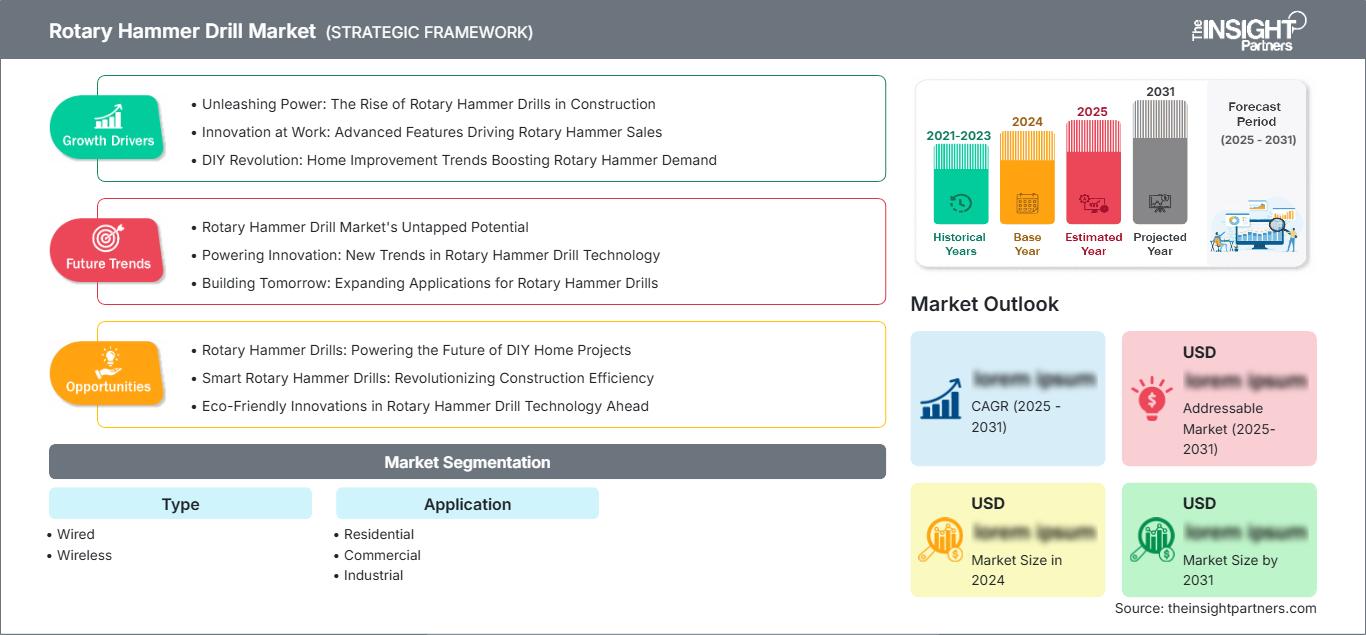
The Rotary Hammer Drill market was valued at US$ 1.64 billion in 2025 and is expected to reach US$ 2.21 billion by 2034; it is estimated to record a CAGR of 3.37% during 2026-2034.
Rotary Hammer Drill Market Assessment and Insights
- North America accounted for 31–35% share in 2025 and is expected to grow at a CAGR of 3.4–3.9% during 2026–2034, supported by professional contractor replacement demand and infrastructure refurbishment.
- US represented 78–82% of North America demand in 2025 and is projected to expand at 3.3–3.8% CAGR, led by commercial construction, tool rental, and repair work.
- Europe held 23–26% share in 2025 and is expected to grow at 3.0–3.5% CAGR, with Germany, the UK, France, Italy, and Spain contributing through renovation, energy retrofits, and professional trades.
- Asia Pacific represented 32–36% share in 2025 and is forecast to grow at 4.2–4.8% CAGR, supported by China, India, Japan, South Korea, and Australia as urban construction and infrastructure projects advance.
- Largest Segment: Wired rotary hammer drills held 55–59% share in 2025 and are projected to grow at 3.1–3.6% CAGR because corded tools remain preferred for continuous heavy-duty drilling.
- High Growth Segment: Wireless rotary hammer drills accounted for 41–45% share in 2025 and are expected to grow at 4.5–5.1% CAGR as battery platforms improve runtime, impact energy, and dust extraction compatibility.
- Key companies analyzed in detail: Robert Bosch Tool Corporation, Hilti Corporation, Stanley Black & Decker, Inc., PORTER-CABLE, Würth Group, TOYA S.A., Makita Corporation, Techtronic Industries Co. Ltd., DEWALT, and Koki Holdings Co., Ltd.
Source: The Insight Partners' analysis based on proprietary research, government publications, company annual reports, investor presentations, industry databases, and expert interviews.
Tool design has evolved from heavy corded hammering tools toward lighter, brushless, vibration-controlled, and dust-compatible platforms. The rotary hammer drill market now reflects a split between durable wired units for continuous drilling and cordless systems that reduce site preparation time. SDS Plus tools dominate medium-duty fastening work, while SDS Max products address demolition, coring, and larger anchor applications.
Future demand will be shaped by construction labor efficiency, safety compliance, and regional infrastructure investment. Emerging geographies are expanding building stock, while mature markets are renovating commercial facilities, utilities, bridges, and housing. Replacement cycles are also becoming shorter because contractors standardize on battery ecosystems, brushless motors, and tool connectivity to reduce downtime and manage fleet performance.
Rotary Hammer Drill Market Report Scope
| Report Attribute | Details |
|---|---|
| Market size in 2025 | US$ 1.64 Billion |
| Market Size by 2034 | US$ 2.21 Billion |
| Global CAGR (2026 - 2034) | 3.37% |
| Historical Data | 2021-2024 |
| Forecast period | 2026-2034 |
Rotary Hammer Drill Market Analysis
The rotary hammer drill market growth is tied to concrete-intensive construction workflows that require anchor holes, rebar fastening, pipe routing, channel cleaning, and light chiseling. Compared with standard hammer drills, rotary hammers deliver higher impact energy through pneumatic hammering, helping professionals drill reinforced masonry and concrete with less effort. Demand also rises when rental fleets refresh tools for contractors needing reliable equipment across job-site environments.
Supply dynamics are shaped by professional power tool brands, battery platform owners, distributors, rental networks, and dust-control accessory suppliers. The rotary hammer drill market analysis indicates that buyers assess impact energy, tool weight, chuck type, vibration control, runtime, dust extraction compatibility, warranty, and platform compatibility. Cordless adoption is rising, but wired models retain a strong place where all-day concrete drilling requires uninterrupted power.
The main areas of competition include brand trust, battery technology, ergonomics, and safety equipment on the construction site. Robert Bosch Tool Corporation provides cordless and corded, vibration, and dust-management SDS Plus and SDS Max rotary hammer drills. Hilti Corporation markets Nuron cordless rotary hammers using Active Torque Control, Active Vibration Reduction, and dust extraction systems technologies. Makita Corporation, DEWALT, Techtronic Industries Co. Ltd., and Stanley Black & Decker, Inc. use contractor eco-systems for their competitive advantage.
Strategic positioning requires suppliers to offer tools, bits, dust collectors, batteries, chargers, fleet management, and services. Porter-Cable Corporation, Würth Group, TOYA S.A., and Koki Holdings Co., Ltd. still play significant roles in the value chain, distribution and trade markets. Manufacturers are investing in brushless motors, anti-kickback systems, compact housings, and battery packs that make cordless performance closer to corded output, strengthening product competitiveness and end-user adoption, according to the Rotary Hammer Drill Market report.
● REPORT CUSTOMIZATION
Tailor This Report To Align With Your Specific Business Requirements
This report can be customized to align precisely with your business objectives, scope, and target markets. Customization options include tailored segmentation, geography, competitive analysis, and strategic insights to support informed decision-making.
Customize This Report →WHAT YOU CAN ADJUST
- ● Segmentations
- ● Geography
- ● Competitive Analysis
- ● Language Preferences
Rotary Hammer Drill Market: Strategic Insights
Regional Insights
North America rotary hammer drill market
North America accounted for 31–35% share in 2025 and is expected to grow at 3.4–3.9% CAGR. The rotary hammer drill market share is supported by commercial renovation, infrastructure repair, concrete fastening, and mature contractor tool replacement. Rental channels also create demand for durable models with reliable serviceability.
Regional buyers prioritize OSHA-aligned dust solutions, vibration control, and cordless platforms that reduce extension-cord dependency. Bosch, DEWALT, Hilti, Makita, and Milwaukee-branded Techtronic Industries Co. Ltd. products are visible across trade retail, distribution, and rental outlets. Battery standardization is strengthening repeat purchases among professional contractors.
U.S. rotary hammer drill Market
The U.S. represented 78–82% of North America demand in 2025 and is projected to expand at 3.3–3.8% CAGR. Demand comes from commercial buildings, MEP installation, residential remodeling, concrete repair, road infrastructure, and industrial maintenance. Tool replacement is frequent because contractors value lower vibration, uptime, and accessory availability.
Company presence is strong through national retailers, specialist distributors, and fleet programs. Robert Bosch Tool Corporation, Hilti Corporation, DEWALT, Makita Corporation, Techtronic Industries Co. Ltd., and Stanley Black & Decker, Inc. compete across SDS Plus and SDS Max categories. Application trends favor cordless drilling, onboard dust extraction, and compact tools for overhead fastening.
Europe rotary hammer drill Market
Europe held 23–26% share in 2025 and is expected to grow at 3.0–3.5% CAGR. Renovation, industrial maintenance, and trades professionals form the core strength of Germany, whereas the UK makes a contribution through infrastructure repair, housing improvements, and commercial fit-out activities. France, Italy, and Spain make contributions through heavy masonry construction and renovations for energy efficiency.
European market adoption is driven by vibration regulations, dust control requirements, and preference for durable professional tools. Bosch, Hilti, Würth Group, Makita, DEWALT, and Koki Holdings Co., Ltd. are benefiting from distributors and trade loyalties. Cordless tool platforms are emerging, but wired tools are prevalent for prolonged drilling and chiseling operations.
APAC rotary hammer drill Market
APAC represented 32–36% share in 2025 and is forecast to grow at 4.2–4.8% CAGR. China is the leading country due to construction scale, while India, Japan, South Korea, and Australia add demand from infrastructure, housing, and industrial maintenance.
Regional growth is supported by urbanization, contractor mechanization, and the expansion of professional tool retail. Price-sensitive users still purchase wired units, but wireless models are gaining adoption among contractors that value mobility, faster setup, and battery sharing across tool fleets.
Middle East & Africa rotary hammer drill Market
The Middle East & Africa market is expected to grow at 3.2–3.7% CAGR, driven by construction, hospitality, utilities, and industrial maintenance. Saudi Arabia, the UAE, South Africa, and the Rest of MEA form the main demand base.
The UAE leads premium tool adoption through commercial projects and distributor availability, while Saudi Arabia supports demand through infrastructure and industrial diversification. Buyers prioritize durability, heat tolerance, service support, and tools that withstand concrete, blockwork, and renovation use.
Segmentation Analysis
Type
Type includes Wired and Wireless. The rotary hammer drill market scope under this segment reflects the balance between corded continuity and cordless mobility. Type-level demand is expected to grow at 3.6–4.1% CAGR during 2026–2034 as users select tools based on runtime, drilling intensity, jobsite access, and power availability.
- Wired: Wired tools remain important for sustained concrete drilling, demolition support, and lower acquisition cost. They are favored where reliable mains power allows continuous operation without battery rotation.
- Wireless: Wireless tools are gaining share because brushless motors, high-output batteries, and dust extractor compatibility improve productivity. Contractors value faster setup, reduced cord hazards, and shared battery platforms.
Application
The application includes Residential, Commercial, and Industrial. Application-level demand is expected to grow at 3.7–4.3% CAGR as rotary hammers support concrete anchoring, renovation, facility maintenance, and installation work. Commercial use leads due to frequent fastening, utility routing, and remodeling activity. The continued growth of construction upgrades and building maintenance projects is expected to sustain demand, according to the Rotary Hammer Drill Market forecast.
- Residential: Residential demand reflects renovation, remodeling, tile removal, masonry drilling, and home improvement projects where compact SDS Plus tools help professionals and advanced DIY users work efficiently.
- Commercial: Commercial applications include MEP installation, tenant fit-outs, anchor drilling, signage, façade repair, and concrete maintenance. Contractors prefer tools with lower vibration, dust control, and dependable accessories.
- Industrial: Industrial users need rugged rotary hammers for plant maintenance, equipment anchoring, machinery installation, shutdown work, and concrete repair in factories, utilities, and process facilities.
Opportunity Snapshot
| Application | Revenue Contribution | Trend Tag | Adoption Stage |
| Residential | Medium | Home Retrofit | Scaling |
| Commercial | High | Anchor Work | Mature |
| Industrial | Medium | Plant Maintenance | Mature |
Rotary Hammer Drill Market Growth Drivers and Impact Analysis
Construction Renovation and Concrete Fastening Demand
Maintenance, retrofit, and renovation provide consistent demand for power drills as old buildings have concrete, bricks, stones, and masonry that must be drilled into. Fit-out operations need holes to be made for mounting cable trays, HVAC mounting frames, partitions, railings, and facade systems. Residential remodeling also involves rotary hammers being used for the removal of tiles, drilling walls, and small chiseling operations. The effect on the market is wide-scale replacement demand from contractors, equipment rental, and maintenance teams. With tighter schedules becoming the norm, consumers increasingly seek equipment that drills faster and minimizes operator fatigue, along with accessories.
Cordless Battery Platform Expansion
This driver is affecting buying decisions through the introduction of efficient battery-powered rotary hammer drills, which can be used professionally in drilling. There are now powerful lithium-ion batteries coupled with brushless motors and electronics that enable cordless rotary hammer drills to provide excellent impact energy. The advantage that contractors get through this change is fewer cables, minimal tripping dangers, quick installation of equipment, and battery interchangeability with other tools such as drills, saws, grinders, and dust extractors. The benefit is enhanced by the fact that most customers tend to buy only tools from the same manufacturer after investing in batteries and chargers.
Health, Safety, and Dust Management Requirements
Drilling of concrete leads to silica dust generation and vibration exposure. These two factors determine the choice of the drilling device. Modern contractors prefer rotary hammer drills equipped with onboard or portable dust collection systems, anti-vibration handles, torque control, and a safe jammed-bit reaction. All these characteristics shorten the clean-up process, satisfy the requirements for job site safety, and increase user comfort during overhead and wall drilling operations. The driver exerts considerable effect on the sale of accessories since dust collection covers, high-efficiency particulate air extractors, hollow drill bits, and matching hoses become part of the tool purchase decision.
Rotary Hammer Drill Market Future Trends
Connected Tool Fleets and Usage Analytics
Rotary hammer drill market trends point toward connected tools that help contractors track assets, monitor usage, and reduce loss across fleets. Tool connectivity will support service alerts, battery diagnostics, utilization visibility, and safer deployment of higher-energy rotary hammers. Large contractors and rental companies will benefit most because they manage many tools across sites. As software links tools, batteries, chargers, and service records, procurement decisions will increasingly consider fleet productivity rather than only unit price. This will favor brands that offer reliable connected ecosystems without making field operations more complex.
Cordless Performance Moving Closer to Corded Output
The development of future products will reduce the performance difference between wired and wireless machines. The new platforms based on higher voltage, enhanced cell chemistry, increased motor efficiency, and improved thermal management will enable the wireless machines to manage bigger anchors, drilling, and chiseling. The wired machines will continue to be useful in situations where continuous operation is needed; however, the wireless machines will take the lead in commercial and industrial applications due to their mobility.
Rotary Hammer Drill Market Opportunities
Dust Extraction Accessories and Compliance Kits
The Rotary Hammer Drills Market forecasts reveal strong potential in dust extraction attachments, HEPA vacuum cleaners, hollow drill bits, and compliance kit bundles. Most contractors view dust management not only as an important safety aspect but as a mandatory one. By offering their products in kits along with corresponding accessories such as dust extractors, batteries, and chargers, manufacturers could improve the average revenue generated per user. It is especially true for North America and Europe, where safety expectations are high.
Rental and Fleet Standardization Programs
Standardization of power tool fleets to fewer battery types, shared charging, and servicing schedules is becoming the norm amongst rental companies and contractors. This provides an opportunity to brands providing rotary hammers that are robust, serviceable, trackable, and have fast replacement policies. Fleet buyers are interested in performance and cost of ownership rather than just the acquisition cost. Brands and distributors can build ties through service agreements, training, accessories, and platform conversions.
Frequently Asked Questions

- Comprehensive Market Sizing and Forecast Analysis
- Detailed Segmentation Analysis
- In-Depth Market Dynamics Assessment
- Regional and Country-Level Insights
- Competitive Landscape and Company Benchmarking
- Strategic Business Intelligence
Recent Reports
Testimonials

The Insight Partners provided valuable market intelligence that supported our global go-to-market strategy. Their team was professional, responsive, and attentive to our feedback, providing thoughtful analysis and helpful methodological clarifications throughout the project.
Junmo Kim Chief Financial Officer (CFO), Enertech Co., Ltd.
The Insight Partners' SCADA System Market report is comprehensive, with valuable insights on current trends and future forecasts. The team was highly professional, responsive, and supportive throughout. We are very satisfied and highly recommend their services.
RAN KEDEM Partner, Reali Technologies LTDs
I requested a report on a very specific software market and the team produced the report in a few days. The information was very relevant and well presented. I then requested some changes and additions to the report. The team was again very responsive and I got the final report in less than a week.
JEAN-HERVE JENN Chairman, Future Analytica
We worked with The Insight Partners for an important market study and forecast. They gave us clear insights into opportunities and risks, which helped shape our plans. Their research was easy to use and based on solid data. It helped us make smart, confident decisions. We highly recommend them.
PIYUSH NAGPAL Sr. Vice President, High Beam Global
The Insight Partners delivered insightful, well-structured market research with strong domain expertise. Their team was professional and responsive throughout. The user-friendly website made accessing industry reports seamless. We highly recommend them for reliable, high-quality research services
YUKIHIKO ADACHI CEO, Deep Blue, LLC.
This is the first time I have purchased a market report from The Insight Partners.While I was unsure at first, I visited their web site and felt more comfortable to take the risk and purchase a market report.I am completely satisfied with the quality of the report and customer service. I had several questions and comments with the initial report, but after a couple of dialogs over email with their analyst I believe I have a report that I can use as input to our strategic planning process.Thank you so much for taking the extra time and making this a positive experience.I will definitely recommend your service to others and you will be my first call when we need further market data.
JOHN SUZUKI President and Chief Executive Officer, Board Director, BK Technologies
I wish to appreciate your support and the professionalism you displayed in the course of attending to my request for information regarding to infectious disease IVD market in Nigeria. I appreciate your patience, your guidance, and the fact that you were willing to offer a discount, which eventually made it possible for us to close a deal. I look forward to engaging The Insight Partners in the future, all thanks to the impression you have created in me as a result of this first encounter.
DR CHIJIOKE ONYIA MANAGING DIRECTOR, PineCrest Healthcare Ltd.Reason to Buy
- Informed Decision-Making
- Understanding Market Dynamics
- Competitive Analysis
- Identifying Emerging Markets
- Customer Insights
- Market Forecasts
- Risk Mitigation
- Boosting Operational Efficiency
- Strategic Planning
- Investment Justification
- Tracking Industry Innovations
- Aligning with Regulatory Trends





 Get Free Sample for