
Rough Terrain Crane Market Trends, Share & Demand by 2034
Coverage: By Lifting Capacity (Below 35 Tonnes, 35-50 Tonnes, 50-100 Tonnes, Above 100 Tonnes); End-Use (Construction Industry, Oil and Gas Industry, Shipping and Port Building, Wind Farms, Others) , and Geography (North America, Europe, Asia Pacific, and South and Central America)
- Status : Data Released
- Report Code : TIPRE00022379
- Category : Manufacturing and Construction
- No. of Pages : 150
- Available Report Formats :


- Last update date : September 21, 2026


2025 Market Size
US$ 524.77 Mn
Base year value
2034 Forecast
US$ 734.43 Mn
Projected by 2034
CAGR 2026-2034
3.81 %
Growth rate
Addressable Market
US$ 5,720.44 Mn
(2026-2034)
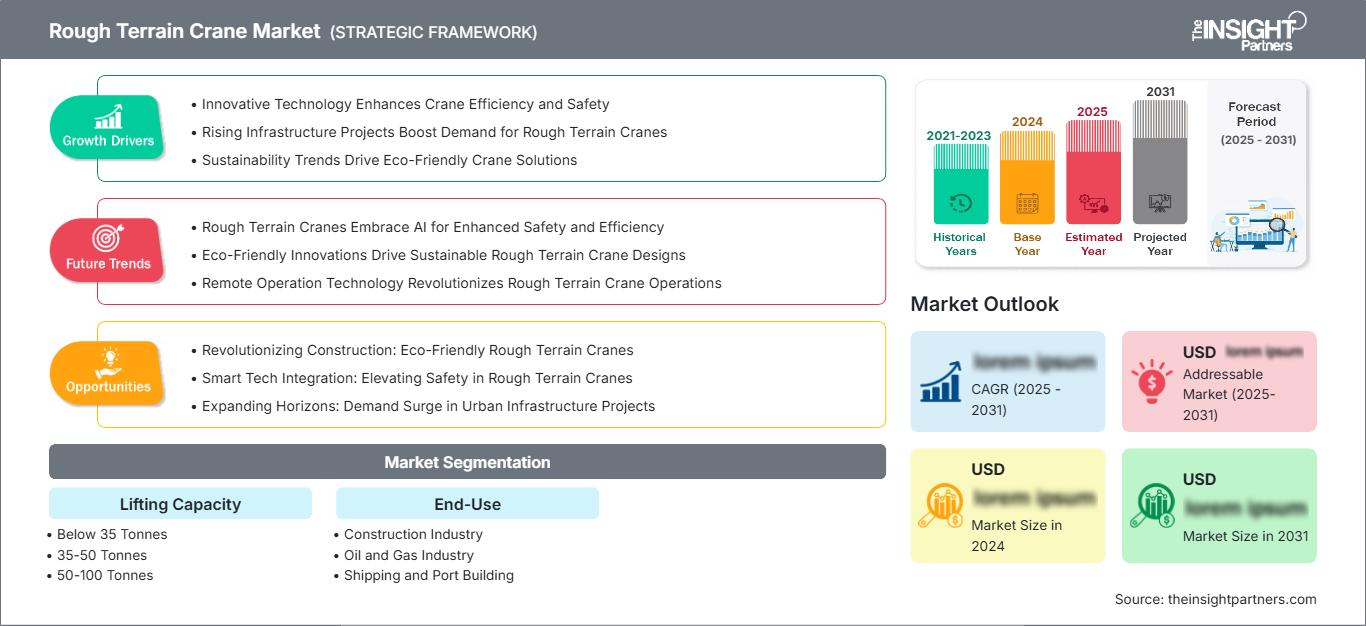
The rough terrain crane market is valued at US$ 524.77 Million in 2025 and is projected to reach US$ 734.43 Million by 2034, registering a CAGR of 3.81% during 2026–2034. Demand is supported by mobile lifting requirements across construction, energy, industrial maintenance, ports, and wind projects. Buyers increasingly prioritize maneuverability, lifting radius, setup time, transportability, operator safety, fuel efficiency, and compatibility with constrained or uneven jobsites.
North America is expected to expand at a 2.9–3.5% CAGR between 2026–2034, supported by infrastructure investment, industrial maintenance, energy projects, and the replacement of aging lifting fleets. The rough terrain crane market size is also influenced by rental penetration, contractor fleet modernization, and demand for compact cranes capable of operating where larger mobile cranes face access or ground-condition limitations.
Rough Terrain Crane Market Assessment and Insights
- North America: North America is estimated to hold a 24–28% share in 2025, growing at a 2.9–3.5% CAGR between 2026–2034, supported by infrastructure construction, industrial maintenance, energy projects, and established crane rental networks.
- US: The US is estimated to represent 84–88% of North American demand in 2025, expanding at a 3.0–3.6% CAGR between 2026–2034, supported by infrastructure replacement, construction activity, and rental fleets.
- Europe: Europe is estimated to account for a 20–24% share in 2025, expanding at a 2.7–3.3% CAGR between 2026–2034, with Germany, France, Italy, the UK, and Spain supported by industrial investment and renewable-energy construction.
- Asia Pacific: Asia Pacific is estimated to represent a 34–38% share in 2025, growing at a 4.1–4.7% CAGR between 2026–2034, led by China, Japan, India, South Korea, and Southeast Asian infrastructure programs.
- Largest Segment: 35-50 Tonnes is estimated to hold a 29–33% market share in 2025, expanding at a 3.6–4.2% CAGR between 2026–2034, reflecting broad construction and maintenance applicability.
- High Growth Segment: Wind Farms is estimated to hold a 12–16% market share in 2025, growing at a 4.5–5.1% CAGR between 2026–2034, supported by renewable-energy construction and component handling.
- Key companies analyzed in detail: KATO WORKS CO., LTD., Liebherr-International Deutschland GmbH, Link-Belt Cranes, Sany Heavy Industry Co., Ltd., Tadano Ltd., Terex Corporation, The Manitowoc Company, Inc., TIL Limited, XCMG Europe GmbH, and Zoomlion Heavy Industry Science and Technology Co., Ltd.
Source: The Insight Partners' analysis based on proprietary research, government publications, company annual reports, investor presentations, industry databases, and expert interviews.
The equipment profile is evolving toward higher capacity-to-weight ratios, improved hydraulic control, variable outrigger systems, electronic load monitoring, and operator-assistance functions. Manufacturers are balancing compact dimensions with longer telescopic booms and improved load charts. The rough terrain crane market is consequently shifting from basic mobility and lifting capability toward integrated productivity, safety, transport efficiency, and lower operating costs across demanding worksites.
Investment through 2034 is likely to concentrate on replacement fleets, rental equipment, renewable-energy construction, petrochemical maintenance, and infrastructure projects. Emerging Asian economies should provide incremental demand, while developed markets remain replacement-driven. Regulatory emphasis on lifting safety, emissions, operator visibility, and machine inspection can accelerate modernization where older fleets cannot economically meet increasingly demanding operational requirements.
Rough Terrain Crane Market Report Scope
| Report Attribute | Details |
|---|---|
| Market size in 2025 | US$ 524.77 Million |
| Market Size by 2034 | US$ 734.43 Million |
| Global CAGR (2026 - 2034) | 3.81% |
| Historical Data | 2021-2024 |
| Forecast period | 2026-2034 |
Rough Terrain Crane Market Analysis
The rough terrain crane market growth is closely connected with projects requiring lifting equipment that can travel and position itself on uneven surfaces without extensive site preparation. Contractors for construction works, operators in the oil and gas industries, developers for wind farms, industrial service providers, ports, and crane rental firms constitute the main demand ecosystem. Equipment producers obtain their engines, hydraulic systems, transmissions, structural steel, electronic systems, tires, and control components from dedicated suppliers.
Equipment rental companies impact buying behavior because the economic performance of assets depends on how often they are used, on the value of second-hand units, on the maintenance needed, and on the flexibility of the equipment. As such, manufacturers are increasingly designing platforms that cater to several size categories and employ many common parts. The supply chains will always be vulnerable to the costs of steel, hydraulic components, semiconductors, and logistics.
The rough terrain crane market analysis indicates a competitive structure combining established global crane manufacturers with regional specialists. Tadano Ltd., The Manitowoc Company, Inc., Liebherr-International Deutschland GmbH, Terex Corporation, and Link-Belt Cranes differentiate themselves on technology, capacity range, dealer network, and service offerings. Sany Heavy Industry Co., Ltd., XCMG Europe GmbH, and Zoomlion Heavy Industry Science and Technology Co., Ltd. bring to the table strong manufacturing prowess from Asia and increasingly international distribution.
Increasingly strategic positioning of companies is driven by the economics of the machinery life cycle rather than the price of acquisition alone. Compact lifting solutions characterize the strategy of KATO WORKS CO., LTD. and regional requirements for TIL Limited through its presence in India. Investment is also being made in telematics, predictive maintenance, operator aids, and low-emissions engines.
● REPORT CUSTOMIZATION
Tailor This Report To Align With Your Specific Business Requirements
This report can be customized to align precisely with your business objectives, scope, and target markets. Customization options include tailored segmentation, geography, competitive analysis, and strategic insights to support informed decision-making.
Customize This Report →WHAT YOU CAN ADJUST
- ● Segmentations
- ● Geography
- ● Competitive Analysis
- ● Language Preferences
Rough Terrain Crane Market: Strategic Insights
Regional Insights
North America rough terrain crane market
North America is estimated to hold a 24–28% of the rough terrain crane market share in 2025 and is projected to expand at a 2.9–3.5% CAGR between 2026–2034. While the US leads in regional demand, Canada’s role in providing services comes through energy, infrastructure, mining, and industrial maintenance. Modern contractors need crane solutions that are easily deployed at partly ready sites, especially in cases when mobile cranes suffer from logistical challenges of access and preparation.
This market enjoys well-developed rental and used equipment channels, allowing for the renewal of the fleet in a regular manner. Construction, petrochemical maintenance, power generation, and wind projects present different types of lifting needs. Purchasers pay attention to the load chart, boom reach, transportation dimensions, ground clearance, visibility, and availability of services. Well-established suppliers profit from a wide distribution network coverage, while rentals take into account machine utilization and life-cycle cost.
U.S. rough terrain crane Market
The US represents approximately 84–88% of North American rough terrain crane market demand in 2025 and is projected to grow at a 3.0–3.6% CAGR between 2026–2034. Infrastructure modernization, commercial construction, industrial projects, energy maintenance, and renewable systems require the use of equipment. The influence of rental companies persists since contractors have the option to acquire specialized equipment without incurring the total cost of ownership due to project pipelines that vary over time.
The Terex Corporation, The Manitowoc Company, Inc., Link-Belt Cranes, and Tadano Ltd. have a competitive significance; other international manufacturers contribute through distributors and specialized fleets. Equipment must be small in size, all-wheel steerage, easy to erect, and electronically controlled loads. High-capacity equipment is used for industrial and energy uses, but 35-50 tonne equipment finds a wide range of applications.
Europe rough terrain crane Market
Europe is estimated to account for a 20–24% share of the rough terrain crane market in 2025 and is projected to expand at a 2.7–3.3% CAGR between 2026–2034. Germany remains a leading market because of industrial machinery production and specialized contracting. France and Italy provide demand from construction and industrial maintenance, while the UK and Spain contribute through infrastructure, energy, ports, and renewable projects.
Germany has a strong demand for technologically advanced cranes, emphasizing safety, compact transport, and high utilization. The UK market is influenced by construction, energy infrastructure, and rental fleets, where rapid deployment and service coverage remain important. France, Italy, and Spain provide additional opportunities in civil engineering, industrial facilities, ports, and renewable-energy construction. European buyers increasingly assess emissions, machine efficiency, digital monitoring, and compliance alongside lifting performance.
APAC rough terrain crane Market
APAC is estimated to represent a 34–38% share of the rough terrain crane market in 2025 and is projected to grow at a 4.1–4.7% CAGR between 2026–2034. China is the leading market, followed by Japan, India, South Korea, and Australia. Infrastructure construction, industrial expansion, energy projects, and port development provide diverse applications. India and Southeast Asia offer particularly strong opportunities as contractors modernize lifting fleets.
Regional demand is supported by local manufacturing and expanding equipment distribution. Sany Heavy Industry Co., Ltd., XCMG Europe GmbH, Zoomlion Heavy Industry Science and Technology Co., Ltd., and Tadano Ltd. participate across regional capacity requirements. Government infrastructure programs and renewable-energy investment can improve utilization, while fragmented jobsite conditions favor compact machines with strong mobility, rapid setup, and flexible lifting configurations.
Middle East & Africa rough terrain crane Market
Middle East and Africa rough terrain crane market demand is projected to expand at a 3.1–3.7% CAGR between 2026–2034. Saudi Arabia and the UAE lead regional activity through large infrastructure, industrial, energy, and urban-development projects. South Africa provides a developed equipment base linked to mining, construction, and industrial maintenance, while other African markets remain dependent on project financing and imported machinery.
The region's energy and infrastructure investment creates requirements for mobile lifting equipment capable of operating across constrained or undeveloped sites. Oil and gas maintenance supports recurring demand, while ports and renewable projects add applications. Suppliers with strong regional service networks, robust machines, and accessible spare parts are positioned to benefit as contractors increasingly evaluate equipment availability and downtime alongside purchase price.
Segmentation Analysis
Lifting Capacity
Lifting Capacity determines the addressable project range, machine dimensions, transport requirements, and operating economics. The segment is projected to grow at a 3.5–4.1% CAGR between 2026–2034. Mid-capacity cranes remain versatile for general construction, while higher-capacity units gain relevance in energy, industrial, and major infrastructure projects requiring greater reach and lifting margins.
- Below 35 Tonnes: Below 35-tonne cranes serve compact construction, maintenance, utility, and industrial applications. Their smaller footprints support maneuverability and lower transport requirements, making them relevant where site access and operating space are constrained.
- 35-50 Tonnes: 35-50 tonne machines provide a balanced combination of capacity, mobility, and operating cost. They are suitable for general construction, industrial maintenance, and contractor fleets requiring broad application flexibility.
- 50-100 Tonnes: 50-100 tonne cranes address heavier construction, energy, industrial, and infrastructure requirements. Their greater capacity and boom reach support projects where conventional mid-capacity equipment cannot provide adequate lifting margins.
- Above 100 Tonnes: Above 100-tonne cranes target specialized heavy lifting, energy, industrial, and infrastructure projects. Their strategic value comes from handling large loads while retaining rough-terrain mobility compared with larger specialized equipment.
End-Use
End-Use requirements vary according to load characteristics, site conditions, project duration, and lifting frequency. The segment is expected to expand at a 3.8–4.4% CAGR between 2026–2034, with construction providing broad utilization while wind and energy applications support specialized, higher-value demand. Fleet specifications increasingly reflect application-specific load charts and access requirements.
- Construction Industry: Construction remains a core application because cranes support structural assembly, material placement, equipment handling, and site logistics. Demand is strongest where projects require mobile lifting across changing terrain and partially prepared surfaces.
- Oil and Gas Industry: Oil and gas applications require robust equipment for plant construction, maintenance, turnaround activity, and equipment replacement. Reliability, lifting capacity, corrosion resistance, and service responsiveness are particularly important for minimizing costly downtime.
- Shipping and Port Building: Port construction and marine infrastructure require cranes capable of handling equipment and structural components around changing ground conditions. Compact mobility can improve deployment where fixed lifting infrastructure is unavailable or impractical.
- Wind Farms: Wind projects require cranes for component installation, maintenance, and balance-of-plant activities. Increasing turbine dimensions and remote project locations create demand for higher capacity, strong mobility, efficient transport, and dependable site deployment.
Opportunity Snapshot
| End-Use | Revenue Contribution | Trend Tag | Adoption Stage |
| Construction Industry | High | Site Lifting | Mature |
| Oil and Gas Industry | High | Turnaround Lifting | Mature |
| Shipping and Port Building | Medium | Port Expansion | Scaling |
| Wind Farms | Medium | Turbine Lifting | Scaling |
Rough Terrain Crane Market Growth Drivers and Impact Analysis
Infrastructure and Industrial Construction Expansion
The spending on infrastructure development will directly contribute to an increased demand for lifting machinery due to frequent handling of materials necessary for building bridges, power plants, industrial buildings, infrastructure, and commercial buildings. Rough terrain variants are especially useful at the initial stage of construction, where no roads are yet built, and there is no need for fixed lifting equipment. The business implications do not only consist of the sale of new machinery but also of increased demand for renting services since renting companies often increase their fleets before obtaining construction orders. Higher utilization rates are beneficial for the economics of assets and sometimes even result in reduced asset lifetime. Contractors are more interested in machinery that can relocate from one lifting place to another without a complicated disassembly process.
Expansion of Renewable Energy Construction
The development of wind energy leads to a certain niche demand for cranes due to the need to lift turbines, towers, electrical infrastructure, and balance of plant facilities in remote areas with different soil properties. Rough terrain cranes will be able to assist other lifting equipment in component transportation, construction operations, and maintenance. Such an effect will especially be visible where road access, geography, and logistics do not allow the use of standard equipment. Contractors and developers will increasingly pay attention to transportability, setup, load radius, and availability of cranes instead of their capacity only. Machines with higher capacity will be able to cope with more weight, while mid-capacity cranes will be able to handle additional construction work. Companies producing equipment appropriate for renewable projects will be able to diversify from cyclically fluctuating building construction.
Increasing Preference for Rental and Flexible Fleet Models
Rental penetration is another critical structural factor since the contractors can gain access to specific lifting capacity without needing to make significant investments in machines with low usage. This is particularly ideal for projects involving construction, industrial turnaround projects, port development, and renewable energy installations. The rental companies will have a lot of impact on what manufacturers should include in the machine design since they will need machines that can be used by different clients and in diverse applications. With high usage, it will become more important for the machine to be reliable, easy to maintain, durable, and have good parts availability. The rental company can also want standard control and telematics for several crane types because this makes training easier.
Rough Terrain Crane Market Future Trends
Digital Load Management and Predictive Fleet Monitoring
The rough terrain crane market trends are expected to increasingly incorporate connected load-management and predictive-maintenance capabilities. Modern crane controls can capture operating hours, load cycles, fault conditions, maintenance requirements, and machine location, allowing fleet managers to identify utilization patterns and service needs. Future systems may combine these data streams with terrain information, weather conditions, and jobsite planning tools to improve lift preparation. Predictive diagnostics can reduce unscheduled downtime by identifying hydraulic, engine, transmission, or structural issues before failures occur. Fleet operators can also compare machine productivity across projects and use performance information when purchasing replacement equipment. As connectivity becomes more standardized, digital functionality is likely to move from a premium differentiator to an expected feature, particularly among large rental companies and contractors managing geographically dispersed fleets.
Lower-Emission Powertrains and Efficient Hydraulic Systems
Future design of new products will focus on low fuel consumption, less idle time, and adherence to higher standards of emission. This can be achieved through electronic control of the engine, hydraulic circuits optimization, variable speed control, automatic shut off of the engine, as well as hybrid or alternative energy systems, where the working conditions allow. Rough-terrain cranes are exposed to some difficulties due to the nature of their lifting operation, which requires high hydraulic power but not necessarily continuous travel. Energy saving without reduction of the capacity for lifting will still be among the engineering challenges. Fuel consumption will be evaluated by the cost of the total project and not simply by machine parameters.
Rough Terrain Crane Market Opportunities
Regional Rental Fleet Expansion
The rough terrain crane market forecasts indicate a meaningful opportunity for rental companies to expand specialized fleets in emerging construction and energy centers. Regional rental operators can address contractor demand where purchasing equipment outright remains difficult because projects are intermittent or financing costs are elevated. The strongest opportunities are likely to emerge around infrastructure corridors, industrial clusters, ports, petrochemical complexes, and renewable-energy zones. Manufacturers can support this expansion through standardized machine platforms, dealer financing, spare-parts hubs, and service agreements designed for intensive utilization. Rental businesses can further differentiate through operator training, mobilization services, digital fleet tracking, and emergency maintenance. Establishing regional partnerships rather than relying solely on direct sales can improve equipment penetration while reducing customer acquisition costs. Such models also create pathways for manufacturers to develop recurring service relationships.
High-Capacity Equipment for Energy and Industrial Projects
Industrial facilities, energy infrastructure, and renewable projects create opportunities for suppliers capable of delivering higher-capacity rough-terrain machines without excessive transport complexity. Projects increasingly involve heavier equipment, larger modules, and more demanding lift radii, creating requirements beyond conventional construction capacities. Manufacturers can target this opportunity through optimized boom structures, compact chassis configurations, improved load charts, advanced outrigger systems, and transport-friendly counterweight arrangements. The commercial proposition should focus on project productivity rather than rated capacity alone. A crane that reduces setup time, mobilization requirements, or the number of supporting machines can generate measurable savings for contractors. Suppliers can also develop application packages for wind, oil and gas, ports, and industrial maintenance, combining machine specifications with training, inspection support, spare parts, and lifecycle service to improve customer confidence.
Frequently Asked Questions

- Comprehensive Market Sizing and Forecast Analysis
- Detailed Segmentation Analysis
- In-Depth Market Dynamics Assessment
- Regional and Country-Level Insights
- Competitive Landscape and Company Benchmarking
- Strategic Business Intelligence
Recent Reports
Testimonials

The Insight Partners' SCADA System Market report is comprehensive, with valuable insights on current trends and future forecasts. The team was highly professional, responsive, and supportive throughout. We are very satisfied and highly recommend their services.
RAN KEDEM Partner, Reali Technologies LTDs
I requested a report on a very specific software market and the team produced the report in a few days. The information was very relevant and well presented. I then requested some changes and additions to the report. The team was again very responsive and I got the final report in less than a week.
JEAN-HERVE JENN Chairman, Future Analytica
We worked with The Insight Partners for an important market study and forecast. They gave us clear insights into opportunities and risks, which helped shape our plans. Their research was easy to use and based on solid data. It helped us make smart, confident decisions. We highly recommend them.
PIYUSH NAGPAL Sr. Vice President, High Beam Global
The Insight Partners delivered insightful, well-structured market research with strong domain expertise. Their team was professional and responsive throughout. The user-friendly website made accessing industry reports seamless. We highly recommend them for reliable, high-quality research services
YUKIHIKO ADACHI CEO, Deep Blue, LLC.
This is the first time I have purchased a market report from The Insight Partners.While I was unsure at first, I visited their web site and felt more comfortable to take the risk and purchase a market report.I am completely satisfied with the quality of the report and customer service. I had several questions and comments with the initial report, but after a couple of dialogs over email with their analyst I believe I have a report that I can use as input to our strategic planning process.Thank you so much for taking the extra time and making this a positive experience.I will definitely recommend your service to others and you will be my first call when we need further market data.
JOHN SUZUKI President and Chief Executive Officer, Board Director, BK Technologies
I wish to appreciate your support and the professionalism you displayed in the course of attending to my request for information regarding to infectious disease IVD market in Nigeria. I appreciate your patience, your guidance, and the fact that you were willing to offer a discount, which eventually made it possible for us to close a deal. I look forward to engaging The Insight Partners in the future, all thanks to the impression you have created in me as a result of this first encounter.
DR CHIJIOKE ONYIA MANAGING DIRECTOR, PineCrest Healthcare Ltd.Reason to Buy
- Informed Decision-Making
- Understanding Market Dynamics
- Competitive Analysis
- Identifying Emerging Markets
- Customer Insights
- Market Forecasts
- Risk Mitigation
- Boosting Operational Efficiency
- Strategic Planning
- Investment Justification
- Tracking Industry Innovations
- Aligning with Regulatory Trends





 Get Free Sample for