
Rubber Internal Mixer Machine Market Demand, Trends & Forecast by 2034
Coverage: by Mixer Type (Tangential Rotor Type, Intermeshing Rotor Type); Capacity (Below 100 Liters, 100-200 Liters, Above 200 Liters) , and Geography (North America, Europe, Asia Pacific, and South and Central America)
- Status : Data Released
- Report Code : TIPRE00010631
- Category : Manufacturing and Construction
- No. of Pages : 150
- Available Report Formats :


- Last update date : September 18, 2026


2025 Market Size
US$ 505.17 Mn
Base year value
2034 Forecast
US$ 638. Mn
Projected by 2034
CAGR 2026-2034
2.63 %
Growth rate
Addressable Market
US$ 5,188.32 Mn
(2026-2034)
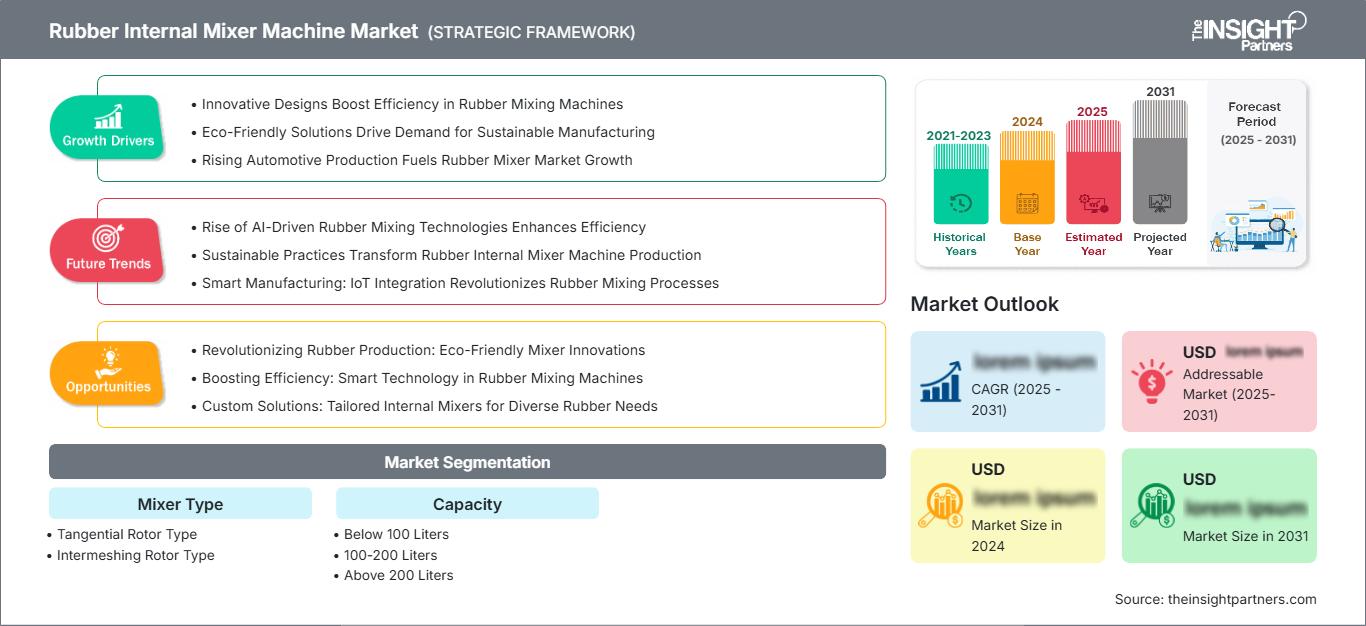
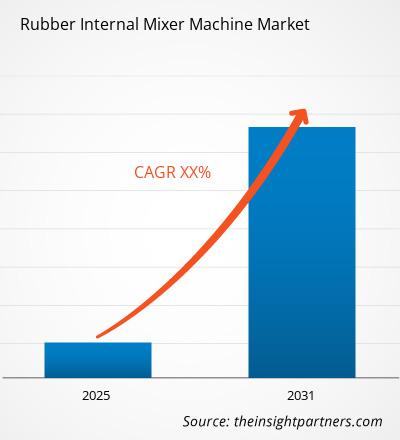
The rubber internal mixer machine market was valued at US$ 505.17 Million in 2025 and is projected to reach US$ 638.00 Million by 2034, expanding at a CAGR of 2.63% during 2026–2034. The market covers equipment used to disperse and homogenize rubber, fillers, oils, and curing ingredients before downstream forming and vulcanization, with investment increasingly linked to productivity, energy management, process consistency, and equipment modernization.
North America remains an established equipment market, supported by tire replacement demand, specialty rubber production, and modernization of aging compounding lines. The Rubber Internal Mixer Machine Market size outlook is supported by investments in automated feeding, process monitoring, energy-efficient drives, and refurbishment programs, with regional growth estimated at a CAGR of 2.8–3.4% during 2026–2034.
Rubber Internal Mixer Machine Market Assessment and Insights
- North America: North America is expected to hold a 23–27% share in 2025 and expand at a CAGR of 2.8–3.4% between 2026–2034, supported by tire manufacturing, industrial rubber demand, modernization, and automation of established mixing facilities.
- US: The US is estimated to account for 72–76% of North America's 2025 market and grow at a CAGR of 2.7–3.3%, reflecting replacement investment and specialty-compound production.
- Europe: Europe is projected to represent a 27–31% share in 2025 and grow at a CAGR of 2.4–3.0%, led by Germany, Italy, France, and the UK, where equipment efficiency and process control remain important investment criteria.
- Asia Pacific: Asia Pacific is estimated at a 34–38% share in 2025 and is expected to grow at a CAGR of 3.0–3.7%, led by China, Japan, India, and South Korea, supported by tire capacity additions and industrial manufacturing.
- Largest Segment: Tangential Rotor Type is estimated to hold a 60–64% market share in 2025, with a CAGR of 2.4–3.0%, reflecting broad installed-base compatibility and high-volume compounding use.
- High Growth Segment: Intermeshing Rotor Type is estimated at a 34–38% market share in 2025 and is expected to expand at a CAGR of 3.2–3.8%, supported by efficient dispersion and temperature control.
- Key companies analyzed in detail: Bosch Rexroth AG, Comerio Ercole S.p.A., Dalian Second Rubber and Plastic Machinery Co., Ltd., French Oil Mill Machinery Co., HF Mixing Group, Kobe Steel, Ltd., Mitsubishi Heavy Industries Machinery Systems, Ltd., Pelmar Group Ltd., Qingdao Qshengyuan Rubber Machinery Co., Ltd., and Yiyang Rubber and Plastics Machinery Group Co., Ltd.
Source: The Insight Partners' analysis based on proprietary research, government publications, company annual reports, investor presentations, industry databases, and expert interviews.
The industry has evolved from mechanically controlled batch mixing toward integrated systems combining variable-speed drives, hydraulic controls, automated weighing, temperature management, and programmable logic control. Intermeshing rotor designs are increasingly relevant for demanding formulations because their geometry can improve intake, dispersion, and cooling. Manufacturers are also emphasizing rotor configuration, chamber design, sealing performance, and drive efficiency to reduce cycle variability and maintenance requirements.
Future investment is likely to concentrate on modernization rather than indiscriminate capacity expansion in mature markets. Emerging Asian production centers are expected to provide comparatively stronger equipment demand as tire and technical rubber capacity expands. The Rubber Internal Mixer Machine Market report highlights that regulatory attention to energy use, workplace safety, emissions, and material efficiency should encourage buyers to evaluate the total cost of ownership, automated process control, and measurable reductions in power consumption.
Rubber Internal Mixer Machine Market Report Scope
| Report Attribute | Details |
|---|---|
| Market size in 2025 | US$ 505.17 Million |
| Market Size by 2034 | US$ 638. Million |
| Global CAGR (2026 - 2034) | 2.63% |
| Historical Data | 2021-2024 |
| Forecast period | 2026-2034 |
Rubber Internal Mixer Machine Market Analysis
Demand is closely connected with tire manufacturing, automotive components, conveyor belts, hoses, seals, footwear, and other molded rubber products. The Rubber Internal Mixer Machine Market growth trajectory, therefore, depends on compound production volumes as well as replacement cycles for installed equipment. Value chain includes machinery engineering, rotor & chamber construction, drive packages, control, handling systems, installation, commissioning, and after-sales services.
Economic production favors machinery that provides consistency of batch quality with low energy density and human interference. Systems that automatically weigh and feed carbon blacks, silicas, oils, polymers, and curatives will increase the repeatability of the formulations, while closed temperature control will help keep the formula within specifications. Engineering, refurbishing, spare parts, and remote diagnostics have become more important for competition than just machinery.
Competition is fragmented across established engineering groups and specialist machinery manufacturers. The Rubber Internal Mixer Machine Market forecast suggests that technology differentiation will remain centered on rotor geometry, cooling efficiency, drive architecture, automation, and service capability. Kobe Steel has extensive experience in internal mixers, while HF Mixing Group retains its strength in machinery for tires and technical rubbers. Mitsubishi Heavy Industries Machinery Systems and Bosch Rexroth provide additional machinery and drive systems technologies.
Comerio Ercole, Pelmar Group Ltd., French Oil Mill Machinery Co., Dalian Second Rubber and Plastic Machinery Co., Ltd., Qingdao Qshengyuan Rubber Machinery Co., Ltd., and Yiyang Rubber and Plastics Machinery Group Co., Ltd. cover additional regional and application needs. Modern positioning involves combining sales of new machines with machine updating, upgrading control systems, engineering services, and life cycle services. Investment decisions will therefore be affected by such factors as productivity, energy consumption, maintenance cycles, and ability to integrate into existing manufacturing lines.
● REPORT CUSTOMIZATION
Tailor This Report To Align With Your Specific Business Requirements
This report can be customized to align precisely with your business objectives, scope, and target markets. Customization options include tailored segmentation, geography, competitive analysis, and strategic insights to support informed decision-making.
Customize This Report →WHAT YOU CAN ADJUST
- ● Segmentations
- ● Geography
- ● Competitive Analysis
- ● Language Preferences
Rubber Internal Mixer Machine Market: Strategic Insights
Regional Insights
North America Rubber internal mixer machine market
North America is estimated to hold a 23–27% of the Rubber Internal Mixer Machine Market share in 2025 and expand at a CAGR of 2.8–3.4% through 2034. The region boasts an established installed base, hence replacing and modernizing machines becomes vital. Manufacturing of tires, automotive sealing systems, hoses and belts, and specialty compounds creates consistent needs for controlled batching. Automation, energy savings, safety, and compatibility with existing materials handling are becoming more important to consumers.
The US dominates the regional demand, whereas Canada and Mexico add to the demand through the manufacture of automotive, industrial, and tire products. Modernization becomes an attractive alternative in lieu of replacement, where the latter does not make economic sense. North American companies require more stringent process tracking and safety practices, hence the need for programmable controls, automated ingredient handling, and condition monitoring.
U.S. Rubber internal mixer machine Market
The US is estimated to represent 72–76% of North America's 2025 Rubber Internal Mixer Machine Market demand and is projected to grow at a CAGR of 2.7–3.3%. Its applicability ranges from tires for passenger and commercial use, automobile parts, industrial rubber products, medical devices, and elastomers. The demand for elastomers depends more on modernization and replacement than greenfield capacity addition, especially among established elastomer compounding companies.
Bosch Rexroth AG, French Oil Mill Machinery Co., along with many foreign and local suppliers, take part in this industry through equipment, drive technology, repurposing and process engineering. Applications demanding good dispersion and temperature control may allow the use of an intermeshing system. Tangential systems continue to be favored for high-volume compounding applications. Automation in terms of weighing, batch identification, variable speed drives and predictive maintenance is among the investment considerations of today’s manufacturers.
Europe Rubber internal mixer machine Market
Europe is estimated to command a 27–31% share of the Rubber Internal Mixer Machine Market in 2025 and grow at a CAGR of 2.4–3.0%, with Germany leading regional demand. The UK and Germany maintain significant technical rubber and automotive ecosystems, while France, Italy, and Spain support tire, component, and industrial rubber manufacturing. European buyers place strong emphasis on energy efficiency, machine safety, process traceability, and lifecycle performance.
Germany benefits from sophisticated automotive and industrial manufacturing, while Italy has a strong machinery engineering base and extensive rubber-processing expertise. France and Spain provide demand from automotive and industrial applications, with Italy particularly important for machinery supply and engineering services. European investment increasingly favors digitally controlled retrofits, efficient drive systems, advanced cooling, and automation capable of integrating mixers with upstream weighing and downstream batch-off equipment.
APAC Rubber internal mixer machine Market
Asia Pacific is estimated to represent a 34–38% share of the Rubber Internal Mixer Machine Market in 2025 and grow at a CAGR of 3.0–3.7%, making it the leading regional market. China remains the largest demand center, followed by Japan, India, South Korea, and Australia. Tire capacity, automotive manufacturing, and industrial rubber production support equipment utilization.
China and India provide the strongest expansion opportunities, while Japan and South Korea emphasize advanced process control and high-quality compounds. Australia represents a smaller specialist market. Industrial policy, automotive localization, infrastructure investment, and export-oriented tire production support equipment demand. Suppliers with local manufacturing, engineering support, and spare-parts networks can improve competitiveness where buyers prioritize shorter installation cycles and responsive service.
Middle East & Africa Rubber internal mixer machine Market
The Middle East and Africa Rubber Internal Mixer Machine Market demand is comparatively smaller but is projected to expand at a CAGR of 2.2–2.8%. Saudi Arabia and the UAE benefit from industrial diversification and manufacturing investment, while South Africa maintains an established automotive and industrial rubber base. The rest of the region presents selective opportunities around infrastructure and processing.
Saudi Arabia is positioned as a leading regional opportunity as industrial diversification encourages downstream manufacturing. The UAE benefits from logistics and industrial investment, while South Africa supports established tire and component production. Energy availability, infrastructure development, localization initiatives, and investment in manufacturing ecosystems can influence future machinery procurement. Buyers typically assess equipment flexibility and service availability closely because installed bases and specialized technical support are less extensive than in mature markets.
Segmentation Analysis
Mixer Type
The Mixer Type segment of the Rubber internal mixer machine market is characterized by differing rotor geometries that influence shear, dispersion, energy input, cooling, and cycle characteristics. Tangential machines remain widely used because of established production practices and broad application compatibility, while intermeshing configurations gain attention for demanding formulations. The segment is expected to expand at a CAGR of 2.4–3.8% across its principal configurations during 2026–2034, with equipment selection increasingly tied to compound formulation and throughput requirements.
- Tangential Rotor Type: Tangential Rotor Type machines remain widely deployed for conventional masterbatch and final-batch production, offering familiar operating practices, broad process flexibility, and compatibility with established rubber-compounding lines.
- Intermeshing Rotor Type: Intermeshing Rotor Type equipment supports demanding dispersion applications through rotor interaction, controlled material flow, and efficient heat management, making it strategically relevant for advanced tire and technical rubber compounds.
Capacity
The Capacity segment reflects production scale, batch requirements, plant configuration, and investment strategy. Larger machines can improve throughput where compound volumes justify higher capital expenditure, whereas smaller systems remain relevant for specialty compounds and flexible production. The Rubber Internal Mixer Machine Market trends indicate that capacity selection is increasingly linked to utilization rates and batch economics. Across the principal capacity categories, the segment is expected to expand at a CAGR of 2.2–3.9% during 2026–2034.
- Below 100 Liters: Below 100 Liters machines serve laboratory, development, specialty, and lower-volume applications where formulation flexibility, compact installation, and frequent product changes are more important than maximum throughput.
- 100-200 Liters: 100-200 Liters equipment provides a balanced configuration for medium-scale compound production, supporting manufacturers seeking scalable capacity without the footprint and capital requirements associated with very large mixers.
- Above 200 Liters: Above 200 Liters machines are strategically important for high-volume operations because larger working volumes can support continuous production programs, subject to appropriate cooling, drive capacity, and material feeding systems.
Opportunity Snapshot
| Capacity | Revenue Contribution (High/Medium/Low) | Trend Tag (MAX 2 words) | Adoption Stage |
| Below 100 Liters | Low | Lab Compounding | Mature |
| 100-200 Liters | Medium | Flexible Batches | Scaling |
| Above 200 Liters | High | High Throughput | Mature |
Rubber Internal Mixer Machine Market Growth Drivers and Impact Analysis
Compound Quality and Process Consistency
The need for tighter compound specifications is prompting manufacturers to procure machinery that will allow them to control the speed of the rotor, ram pressure, temperature of the chamber, and the mixing time more precisely. Proper dispersion of carbon black, silica, oils, polymers, and curatives is a critical determinant of subsequent manufacturing processes and of performance in the final products. In such a situation, modern internal mixers are being used not as mechanical devices, but as controlled process platforms. The trend is most significant in tire and technical rubber manufacturers who deal with complicated formulas, since batch inconsistency may lead to waste and downstream problems. Suppliers that offer weighing, feeding, temperature control, and programmable controls are able to benefit from higher value of equipment purchases.
Energy Efficiency and Total Cost of Ownership
Consumption of energy is another criterion for procurement due to the amount of work that is done internally during mixing and heating and cooling processes. Procurement of machines is being considered on the basis of power requirement along with production rate, maintenance cost, lifespan of components, and overall output. Efficient motors and drive systems, rotor design, cooling circuitry, and automatic operation will help cut down the unnecessary energy loss while keeping the same quality in the compound. The importance of this commercially lies in the fact that with the reduction in cycle times, more production capacity can be achieved without necessarily adding to the equipment. The equipment manufacturers must now be able to prove their economic worth on the basis of the whole life cycle of the machinery.
Automation, Traceability, and Safer Production
The impact of automation on machinery procurement comes from less manual interaction and greater repeatability between batches. Automation of weighing, feeding, recipe management, process alarms, and electronic documentation enables compounders to create their formulations more reliably and spot problems sooner. In addition, safety considerations necessitate quicker response times from hydraulic and electric systems, along with better guarding and interlocking of equipment and monitoring of operators. Such capabilities can affect capital investments even if production remains constant since manufacturers will be able to use equipment more effectively and be less reliant on manual process adjustments. Linkage with manufacturing execution systems at the plant level adds further value, linking batch data with quality and maintenance information. With increased automation in the newer machines, vendors with good integration of automation will stand out through software features and support services.
Rubber Internal Mixer Machine Market Future Trends
Recipe Intelligence and Predictive Process Control
Future rubber mixing machines will make use of batch historical records, sensor data, and process models to achieve dynamic recipe optimization. Instead of being dependent on predetermined time and temperature control, intelligent systems will be capable of making decisions based on factors like torque, energy input, material temperature, rotor speed, and batch behavior to define when processes should end. In addition to minimizing variations between batches, the system will be able to alert operators to any abnormalities in the performance of machinery. Cloud-based dashboard solutions will allow operators to compare the performance of multiple lines, although the aspects of cybersecurity and data rights will need to be considered in implementing such a solution. The most promising prospects for the technology adoption lie in compounders having multiple production lines with predefined formulations.
Low-Energy Mixing and Circular Compound Processing
There should be a possibility of incorporating considerations such as sustainability in rotor design, cooling system design, drive systems choice, and materials handling. Manufacturers have started considering the effect of recycling rubber, recovery of carbon black, recyclable polymers and alternative fillers during mixing. Therefore, there is a need for new mixing systems that will enable the use of wider varieties of formulations. In the future, energy input accuracy, better temperature control, and rotor configuration flexibility should be considered in new mixers to ensure good dispersion even when the material properties change. There is a need to have energy tracking at a detailed level, whereby the energy used will be benchmarked per formula or batch, as opposed to just the mixer alone.
Rubber Internal Mixer Machine Market Opportunities
Retrofit Programs for Installed Mixing Lines
A substantial opportunity exists in upgrading existing mixers rather than replacing complete production systems. Retrofit packages can include variable-speed drives, hydraulic upgrades, new sensors, automated weighing, programmable controls, temperature-management systems, safety interlocks, and remote diagnostics. Such projects can address operational weaknesses while reducing capital expenditure and minimizing production disruption. Suppliers can develop standardized retrofit modules for commonly installed machine families, creating scalable service offerings across mature manufacturing regions. The opportunity is particularly relevant where equipment chambers and rotors remain mechanically serviceable, but control systems are outdated. Commercial models can combine engineering, installation, commissioning, spare parts, and performance monitoring, increasing recurring service revenue. Manufacturers evaluating investment under constrained capital budgets may favor modernization projects that produce measurable productivity or energy benefits within shorter payback periods.
Localized Manufacturing and Aftermarket Service Networks
Expansion of tire and technical rubber production in emerging manufacturing centers creates opportunities for suppliers to establish localized engineering, assembly, spare parts, and maintenance capabilities. Regional service hubs can shorten response times, reduce logistics exposure, and improve customer confidence when purchasing complex machinery from international suppliers. India, Southeast Asia, China, and selected Middle Eastern manufacturing clusters offer opportunities for localized support as production capacity expands. Suppliers can strengthen market access through partnerships with automation integrators, component manufacturers, and industrial service providers. The most attractive models may combine new-machine supply with commissioning, operator training, preventive maintenance, rotor refurbishment, and digital monitoring. Localized capabilities also enable suppliers to adapt equipment specifications to regional power infrastructure, production practices, material availability, and regulatory requirements.
Frequently Asked Questions

- Comprehensive Market Sizing and Forecast Analysis
- Detailed Segmentation Analysis
- In-Depth Market Dynamics Assessment
- Regional and Country-Level Insights
- Competitive Landscape and Company Benchmarking
- Strategic Business Intelligence
Recent Reports
Testimonials

The Insight Partners provided valuable market intelligence that supported our global go-to-market strategy. Their team was professional, responsive, and attentive to our feedback, providing thoughtful analysis and helpful methodological clarifications throughout the project.
Junmo Kim Chief Financial Officer (CFO), Enertech Co., Ltd.
The Insight Partners' SCADA System Market report is comprehensive, with valuable insights on current trends and future forecasts. The team was highly professional, responsive, and supportive throughout. We are very satisfied and highly recommend their services.
RAN KEDEM Partner, Reali Technologies LTDs
I requested a report on a very specific software market and the team produced the report in a few days. The information was very relevant and well presented. I then requested some changes and additions to the report. The team was again very responsive and I got the final report in less than a week.
JEAN-HERVE JENN Chairman, Future Analytica
We worked with The Insight Partners for an important market study and forecast. They gave us clear insights into opportunities and risks, which helped shape our plans. Their research was easy to use and based on solid data. It helped us make smart, confident decisions. We highly recommend them.
PIYUSH NAGPAL Sr. Vice President, High Beam Global
The Insight Partners delivered insightful, well-structured market research with strong domain expertise. Their team was professional and responsive throughout. The user-friendly website made accessing industry reports seamless. We highly recommend them for reliable, high-quality research services
YUKIHIKO ADACHI CEO, Deep Blue, LLC.
This is the first time I have purchased a market report from The Insight Partners.While I was unsure at first, I visited their web site and felt more comfortable to take the risk and purchase a market report.I am completely satisfied with the quality of the report and customer service. I had several questions and comments with the initial report, but after a couple of dialogs over email with their analyst I believe I have a report that I can use as input to our strategic planning process.Thank you so much for taking the extra time and making this a positive experience.I will definitely recommend your service to others and you will be my first call when we need further market data.
JOHN SUZUKI President and Chief Executive Officer, Board Director, BK Technologies
I wish to appreciate your support and the professionalism you displayed in the course of attending to my request for information regarding to infectious disease IVD market in Nigeria. I appreciate your patience, your guidance, and the fact that you were willing to offer a discount, which eventually made it possible for us to close a deal. I look forward to engaging The Insight Partners in the future, all thanks to the impression you have created in me as a result of this first encounter.
DR CHIJIOKE ONYIA MANAGING DIRECTOR, PineCrest Healthcare Ltd.Reason to Buy
- Informed Decision-Making
- Understanding Market Dynamics
- Competitive Analysis
- Identifying Emerging Markets
- Customer Insights
- Market Forecasts
- Risk Mitigation
- Boosting Operational Efficiency
- Strategic Planning
- Investment Justification
- Tracking Industry Innovations
- Aligning with Regulatory Trends





 Get Free Sample for