
Saw Blades Market Size, Share & Growth by 2034
Coverage: By Product Type (Circular Saw, Band Saw, Chain Saw, Hand Saw, Others); Application (Wood Cutting, Metal Cutting, Stone Cutting, Others) , and Geography (North America, Europe, Asia Pacific, and South and Central America)
- Status : Data Released
- Report Code : TIPRE00027346
- Category : Manufacturing and Construction
- No. of Pages : 150
- Available Report Formats :


- Last update date : September 21, 2026


2025 Market Size
US$ 16.73 Bn
Base year value
2034 Forecast
US$ 23.64 Bn
Projected by 2034
CAGR 2026-2034
4.42 %
Growth rate
Addressable Market
US$ 188.09 Bn
(2026-2034)
The saw blades market was valued at US$ 16.73 Billion in 2025 and is projected to reach US$ 23.64 Billion by 2034, registering a CAGR of 4.42% during 2026–2034. Demand is supported by recurring blade replacement across woodworking, metal fabrication, construction, furniture production, and industrial processing. Product development increasingly emphasizes cutting accuracy, durability, lower vibration, reduced kerf, and compatibility with automated equipment.
Across North America, established construction and manufacturing activity supports sustained procurement of professional and industrial cutting tools, contributing significantly to the Saw Blades Market size. The regional outlook is reinforced by replacement demand, remodeling activity, metal fabrication, and adoption of higher-performance carbide and coated products. Increasing automation in production environments is also encouraging buyers to prioritize blade life, cutting consistency, and total operating cost rather than purchase price alone.
Saw Blades Market Assessment and Insights
- North America represented an estimated 32–36% share in 2025 and is expected to grow at a CAGR of 3.6–4.2% between 2026 – 2034, supported by mature construction, woodworking, manufacturing, and industrial replacement demand.
- US accounted for approximately 22–25% of global demand in 2025 and is projected to expand at a CAGR of 3.7–4.3% during 2026–2034, supported by construction and industrial cutting requirements.
- Europe held an estimated 22–26% share in 2025 and is expected to record a CAGR of 3.5–4.1% through 2034, with Germany, Italy, France, and the UK supporting demand through advanced manufacturing and woodworking.
- Asia Pacific captured approximately 30–34% share in 2025 and is forecast to register a CAGR of 5.0–5.8% during 2026–2034, led by China, Japan, India, and South Korea amid manufacturing and infrastructure expansion.
- Largest Segment: Circular Saw accounted for an estimated 25–29% market share in 2025 and is projected to grow at a CAGR of 3.9–4.5% during 2026–2034.
- High Growth Segment: Metal Cutting held an estimated 28–32% market share in 2025 and is projected to expand at a CAGR of 4.8–5.5% through 2034.
- Key companies analyzed in detail: AKE Knebel GmbH & Co. KG, DoALL Company, Freud America, Inc., Kinkelder B.V., Ledermann GmbH & Co. KG, Leuco Tool Corporation, The M. K. Morse Company, Pilana Knives a.s., Simonds International L.L.C. (BGR Saws Inc.), Stanley Black & Decker, Inc.
Source: The Insight Partners' analysis based on proprietary research, government publications, company annual reports, investor presentations, industry databases, and expert interviews.
In production, the economics of tool manufacturing have evolved from simple consumable tooling to specific application-cutting systems. The development of carbide tip, coated, thin kerf, vibration-resistant, and ground-tooth designs has become more common in order to meet the need for increased edge durability and consistent cutting. Tooth form, body design, and coating are also being customized for use on automated machinery and challenging materials.
Looking forward, growth in the Saw Blades Market report is likely to broaden beyond established woodworking markets toward industrializing economies with expanding fabrication, furniture, construction, and infrastructure capacity. Investment in automated cutting lines will encourage demand for application-matched blades and digital selection tools. Environmental considerations may also support thinner kerfs, longer service intervals, and improved re-sharpening economics, while regional manufacturing strategies can encourage localized production and distribution of industrial cutting consumables.
Saw Blades Market Report Scope
| Report Attribute | Details |
|---|---|
| Market size in 2025 | US$ 16.73 Billion |
| Market Size by 2034 | US$ 23.64 Billion |
| Global CAGR (2026 - 2034) | 4.42% |
| Historical Data | 2021-2024 |
| Forecast period | 2026-2034 |
Saw Blades Market Analysis
Demand in the saw blades market is primarily supported by the recurring replacement cycle associated with cutting tools. In all industries including woodworking, furniture production, building, metal cutting, car production, and in general industrial processes, saw blades wear out gradually, thus lowering their cutting accuracy, speed, and efficiency. In order to compensate for this process, users need to change or sharpen their blades from time to time, which forms a steady market that does not depend so much on buying machines as on the level of industry activity, production volumes, and servicing.
A saw blade value chain is quite wide and strongly interrelated, including raw materials suppliers, components suppliers, manufacturers, and service providers. The steel, carbide, and alloy suppliers make up the upstream, while the coating, grinding, and heat treatment providers contribute to the blade durability and efficiency. Blade manufacturers cooperate with machine producers, distributors, and blade sharpeners to offer application-oriented solutions. Users become interested in an efficient cutting performance, not in products only, thus giving more chances to suppliers who can give consultations and recommendations regarding different applications.
A key trend shaping the market is the growing focus on application engineering and performance optimization. Blade effectiveness is influenced by factors such as machine speed, feed rate, material hardness, cutting environment, tooth geometry, and coating technology. Consequently, manufacturers are investing in research and development to design products that improve cutting precision, reduce material waste, extend blade life, and lower overall operating costs. Customers are increasingly evaluating suppliers based on measurable productivity gains, including reduced downtime, higher throughput, and improved surface finish quality, rather than simply comparing product portfolios.
Consequently, the competitive positioning of players in the saw blades market has shifted from a wide product range to expertise in particular products and differentiation based on performance. For instance, AKE Knebel GmbH & Co. KG, Ledermann GmbH & Co. KG, Leuco Tool Corporation, and Freud America, Inc. compete via the use of highly engineered blade shapes and superior quality materials in order to provide application-oriented cutting solutions. Kinkelder B.V. has been able to earn a good reputation in terms of industrial steel-cutting applications. On the other hand, DoALL Company, The M. K. Morse Company, Pilana Knives a.s., and Simonds International L.L.C. specialize in specific requirements of professional and industrial end users. Finally, Stanley Black & Decker, Inc. enjoys competitive positioning due to its large-scale distribution network, well-known brands, and sales channels for professional and consumer tools. Thus, innovations are oriented at efficiency, precision, durability, and total cost of ownership.
● REPORT CUSTOMIZATION
Tailor This Report To Align With Your Specific Business Requirements
This report can be customized to align precisely with your business objectives, scope, and target markets. Customization options include tailored segmentation, geography, competitive analysis, and strategic insights to support informed decision-making.
Customize This Report →WHAT YOU CAN ADJUST
- ● Segmentations
- ● Geography
- ● Competitive Analysis
- ● Language Preferences
Saw Blades Market: Strategic Insights
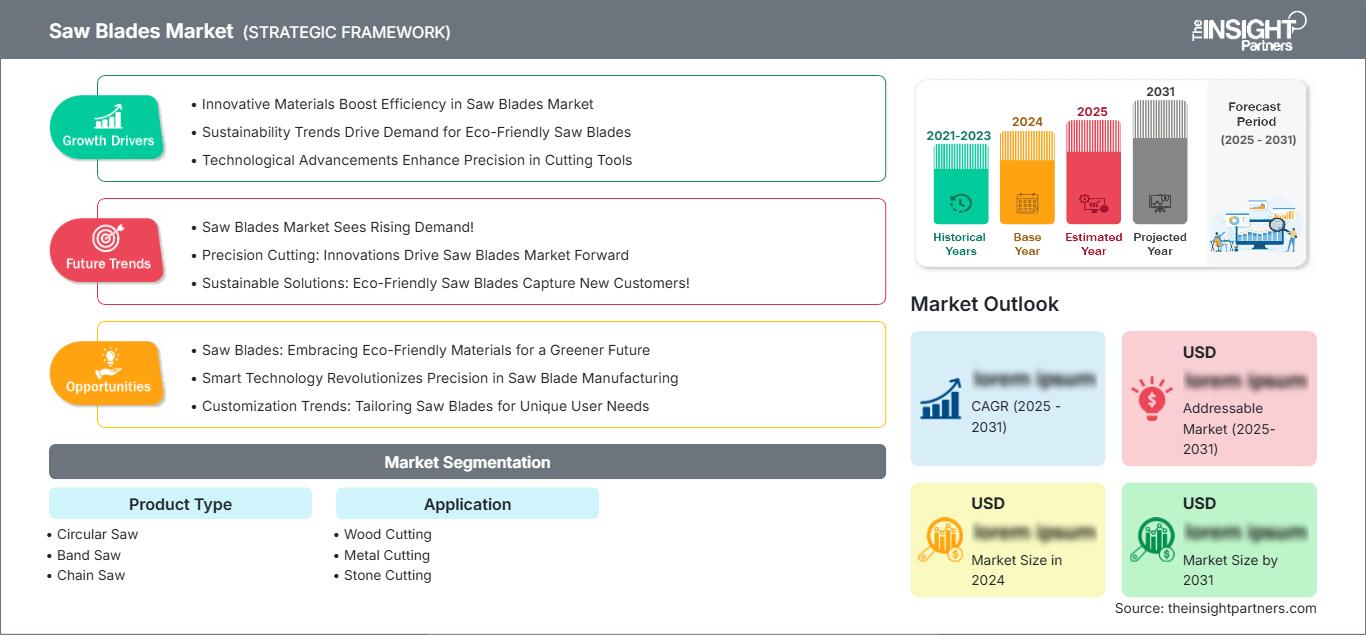
Regional Insights
North America Saw Blades Market
North America accounted for an estimated 32–36% of the global saw blades market share in 2025 and is expected to register a CAGR of 3.6–4.2% through 2034. There exist wood-working, construction, metal working, furniture-making and industrial maintenance operations in the area. The United States is the primary market, while Canada and Mexico provide additional prospects through construction, manufacturing and industrial supply chains.
Buying decisions are driven by productivity and total cost of ownership considerations. Industrial buyers want carbide, coated and specialty blades that can hold dimension but minimize the need for blade changes. The professional construction/renovation activity drives demand for portable blades, while the automated production process drives demand for precision blades with uniform cutting capabilities.
U.S. Saw Blades Market
The U.S. accounted for approximately 64–70% of North American Saw Blades Market demand in 2025 and is projected to grow at a CAGR of 3.7–4.3% during 2026–2034. Demand spans construction, cabinetmaking, furniture production, metal fabrication, utilities, and general manufacturing. Stanley Black & Decker, Inc., Freud America, Inc., The M. K. Morse Company, DoALL Company, and Simonds International L.L.C. have established market presence across professional and industrial applications.
Wood cutting remains important across construction and woodworking, while metal cutting benefits from manufacturing, structural fabrication, automotive supply chains, and industrial maintenance. Buyers increasingly specify blades according to machine compatibility, material grade, tooth configuration, and required finish. Portable cordless equipment is also encouraging thinner kerfs and efficient cutting geometries because reduced cutting resistance can improve operating time and productivity on battery-powered tools.
Europe Saw Blades Market
Europe represented an estimated 22–26% of the Saw Blades Market share in 2025 and is expected to expand at a CAGR of 3.5–4.1% through 2034. Germany leads regional demand through advanced machinery, woodworking, furniture manufacturing, and metalworking. The UK maintains significant professional and construction demand, while France, Italy, and Spain provide additional opportunities through furniture, renovation, industrial fabrication, and infrastructure activity.
Germany remains a technology-intensive market where users place substantial emphasis on cutting precision, tool life, automation compatibility, and process efficiency. Italy combines furniture, woodworking machinery, and industrial manufacturing demand, supporting premium blade adoption. France and the UK benefit from construction and renovation activity, while Spain presents opportunities from manufacturing, woodworking, and infrastructure investment. Across the region, sustainability considerations favor longer blade life, re-sharpening, reduced kerf, and lower material waste.
APAC Saw Blades Market
APAC accounted for approximately 30–34% share of the Saw Blades Market in 2025 and is projected to record a CAGR of 5.0–5.8% through 2034. China remains the leading country, supported by manufacturing, construction, furniture, and metal processing. Japan and South Korea contribute through precision manufacturing, while India and Australia provide opportunities across construction, infrastructure, woodworking, mining-related fabrication, and industrial applications.
Regional demand is increasingly differentiated between high-volume price-sensitive products and premium blades used in automated production. China combines a large manufacturing base with domestic tool production, while India is supported by industrialization and construction expansion. Japan and South Korea emphasize precision and productivity, whereas Australia has stronger links with construction, fabrication, and resource-related activities. Investment in modern production equipment should continue to support higher-performance blade adoption.
Middle East & Africa Saw Blades Market
The Middle East & Africa Saw Blades Market represented a smaller share of global demand in 2025 but is expected to expand at a CAGR of 3.8–4.6% through 2034. Saudi Arabia and the UAE provide significant opportunities through construction, infrastructure, industrial diversification, and large-scale development programs. South Africa remains an important manufacturing and construction center, while the rest of MEA is influenced by project-led demand.
Energy, infrastructure, commercial construction, and industrial development determine regional purchasing patterns. Saudi Arabia benefits from major construction and diversification investments, while the UAE supports demand through commercial, residential, and infrastructure development. South Africa has broader industrial and woodworking requirements. Buyers in developing markets often prioritize product availability, durability, and distributor support, creating opportunities for suppliers that can combine competitive pricing with application guidance and dependable replacement availability.
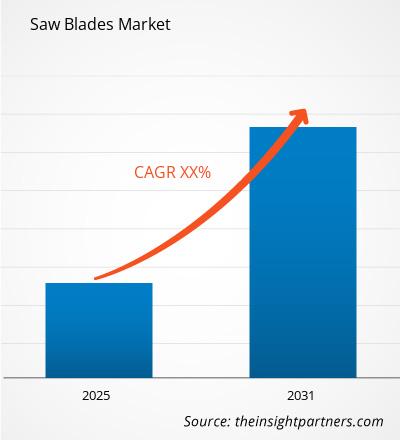
Segmentation Analysis
Product Type
The Product Type segment is expected to grow at a CAGR of 3.9–4.5% during 2026–2034. Demand is shaped by application-specific cutting requirements, machine compatibility, material characteristics, and replacement frequency. Circular and band saw products remain central to industrial and professional operations, while chain and hand saws serve specialized construction, forestry, maintenance, and portable cutting requirements, reflecting key Saw Blades Market trends.
- Circular Saw: Circular saw products occupy the largest position because they support portable, stationary, panel-sizing, woodworking, and industrial cutting operations. Demand increasingly favors carbide, thin-kerf, coated, and vibration-reducing designs.
- Band Saw: Band saw blades remain important for continuous cutting of metals, wood, and other materials. Industrial users prioritize tooth durability, dimensional stability, cutting speed, and compatibility with automated sawing equipment.
- Chain Saw: Chain saw blades serve forestry, landscaping, construction, and specialized cutting applications. Product selection emphasizes chain configuration, cutting efficiency, durability, safety, and compatibility with powered equipment.
- Hand Saw: Hand saw products retain relevance in construction, woodworking, maintenance, and professional trades where portability and low equipment complexity are important. Ergonomic designs and material-specific teeth support differentiated demand.
Application
The Application segment is projected to expand at a CAGR of 4.0–4.7% during 2026–2034. Application requirements determine blade geometry, tooth material, coating, thickness, and operating parameters. Industrial buyers increasingly select products around productivity and total cost per cut, while professional users continue to value versatility and predictable performance.
- Wood Cutting: Wood cutting remains a major application across construction, furniture, cabinetry, sawmills, and remodeling. Buyers increasingly favor blades that deliver clean finishes, long edge life, reduced vibration, and efficient material removal.
- Metal Cutting: Metal cutting is strategically important for fabrication, automotive, machinery, construction, and steel processing. Demand favors carbide, high-speed steel, coated, and precision-ground products capable of maintaining performance under demanding thermal and mechanical conditions.
- Stone Cutting: Stone cutting serves construction, masonry, countertop fabrication, tile processing, and infrastructure work. Diamond-equipped solutions are valued for cutting durability, dimensional control, reduced chipping, and productivity across hard mineral-based materials.
Opportunity Snapshot
| Application | Revenue Contribution (High/Medium/Low) | Trend Tag | Adoption Stage |
|---|---|---|---|
| Wood Cutting | High | Clean Cutting | Mature |
| Metal Cutting | High | Precision Cutting | Scaling |
| Stone Cutting | Medium | Diamond Cutting | Scaling |
Saw Blades Market Growth Drivers and Impact Analysis
Expansion of Automated Cutting and Precision Manufacturing
The trend towards manufacturing automation makes consistent cutting performance all the more important as the assembly lines work with set feed rates, machine speed and dimensional tolerances. The automation of cutting machines necessitates that blades provide the capability of maintaining consistent geometry and cutting stability during extended periods of operation. It leads to the use of coated, thin kerf, carbide-tipped, and application-specific blades. The economic consequences are much wider than just sales of blades as the manufacturers can distinguish themselves through optimized process, selection of appropriate blades, sharpening and engineering support. Blade manufacturers and equipment makers have more reasons to work together to develop application-specific geometries.
Industrial Fabrication and Infrastructure Development
Increases in production of industrial fabrication, construction, infrastructure, and manufacturing of industrial machinery result in increased demand for cutting in steel, wood, composites, and stone materials. New facilities will need primary cutting tools and also replacement components. Metal fabrication will be of particular importance because of the requirement for high efficiency and dimensional accuracy in steel processing. For developing countries, growth in manufacturing capacity may increase the installation of sawing equipment, leading to a recurring stream of replacement purchases after the initial purchases of equipment. For developed countries, there will be an opportunity for replacement, upgrading, and maintenance of existing facilities. Thus, there will be opportunities for expansion and premiumization of product lines for blade manufacturers.
Demand for Longer Tool Life and Lower Operating Cost
Consumers of blades now evaluate consumables based on factors such as cost per cut, output quality, frequency of changing blades, and use of equipment. Factors like durability of carbides, protective coatings, improved design of teeth, and anti-vibration bodies could lead to fewer replacements and smoother operations. It therefore means that there exists potential for suppliers to convince consumers to buy high-end products based on the benefits of their operation. Remeasuring blades still holds significant meaning within industrial settings since prolonging the life of blades can lead to savings in terms of consumables. Suppliers with the ability to do engineering on the part of consumers can retain consumers through advice on how to run their machines.
Saw Blades Market Future Trends
Thin-Kerf and Material-Efficient Blade Design
The development of thin-kerf blades may grow in significance as producers and users try to maximize material utilization, minimize resistance to cutting, and increase energy savings. Minimizing kerf can help to reduce the amount of material being cut, especially for panels and in wood and mass production processes. The task of engineering here is to preserve blade stiffness, thermal performance, and dimensions while decreasing body thickness. It means that manufacturers will have to use modern carbide alloys, tooth design, balancing, and vibration reduction characteristics. These trends may prove especially useful when raw materials take up a considerable share of production costs. With increasing emphasis on sustainability and efficiency in manufacturing, products that reduce waste and provide efficient output deserve consideration by both consumers and manufacturers.
Digital Blade Selection and Application Optimization
There will be greater usage of digital technologies in blade selection as the users have to deal with an increasingly complicated combination of equipment types, materials, cutting speed, teeth geometry, and production objectives. Digital blade selectors, cutting calculators, an application database, and a support portal will help minimize mistakes in the blade selection process and enhance equipment productivity. At the same time, there will be an opportunity for blade manufacturers to collect data on applications and performance requirements. Such digital assistance will be especially useful for distributors that serve small workshops without process engineers. In the long term, suppliers that combine physical product and application intelligence will be able to develop strong customer relations and promote premium solutions.
Saw Blades Market Opportunities
Premium Industrial Blades for High-Throughput Metal Processing
High-throughput metal processing offers an attractive opportunity for suppliers capable of delivering measurable improvements in cutting speed, blade life, dimensional consistency, and machine utilization. Steel service centers, tube manufacturers, automotive suppliers, machinery producers, and fabrication companies operate under pressure to increase throughput while controlling downtime. Application-specific carbide, coated, and high-performance blades can address these requirements more effectively than general-purpose products. Suppliers can strengthen this opportunity through technical partnerships with machine manufacturers, on-site application engineering, and performance monitoring. Recurring replacement cycles provide a foundation for long-term customer relationships, while premium products create opportunities for value-based pricing. Regional manufacturing expansion in Asia and industrial modernization in developed markets provide complementary demand channels for specialized metal-cutting solutions.
Integrated Blade Reconditioning and Lifecycle Services
Lifecycle services represent an opportunity to expand revenue beyond initial blade sales by combining sharpening, inspection, repair, replacement planning, and technical recommendations. Industrial users can benefit from predictable blade availability and improved utilization when suppliers manage the complete consumable lifecycle. Reconditioning can also reduce waste and support sustainability objectives where blade bodies remain suitable for further use. The opportunity is particularly relevant to large woodworking, metalworking, and manufacturing facilities that consume blades continuously and can standardize maintenance schedules. Suppliers can differentiate through digital tracking, collection logistics, condition assessment, and performance reporting. Such services may also increase customer retention because switching suppliers becomes less attractive when product supply and technical support are integrated into a broader operating model.
Frequently Asked Questions

- Comprehensive Market Sizing and Forecast Analysis
- Detailed Segmentation Analysis
- In-Depth Market Dynamics Assessment
- Regional and Country-Level Insights
- Competitive Landscape and Company Benchmarking
- Strategic Business Intelligence
Recent Reports
Testimonials

The Insight Partners' SCADA System Market report is comprehensive, with valuable insights on current trends and future forecasts. The team was highly professional, responsive, and supportive throughout. We are very satisfied and highly recommend their services.
RAN KEDEM Partner, Reali Technologies LTDs
I requested a report on a very specific software market and the team produced the report in a few days. The information was very relevant and well presented. I then requested some changes and additions to the report. The team was again very responsive and I got the final report in less than a week.
JEAN-HERVE JENN Chairman, Future Analytica
We worked with The Insight Partners for an important market study and forecast. They gave us clear insights into opportunities and risks, which helped shape our plans. Their research was easy to use and based on solid data. It helped us make smart, confident decisions. We highly recommend them.
PIYUSH NAGPAL Sr. Vice President, High Beam Global
The Insight Partners delivered insightful, well-structured market research with strong domain expertise. Their team was professional and responsive throughout. The user-friendly website made accessing industry reports seamless. We highly recommend them for reliable, high-quality research services
YUKIHIKO ADACHI CEO, Deep Blue, LLC.
This is the first time I have purchased a market report from The Insight Partners.While I was unsure at first, I visited their web site and felt more comfortable to take the risk and purchase a market report.I am completely satisfied with the quality of the report and customer service. I had several questions and comments with the initial report, but after a couple of dialogs over email with their analyst I believe I have a report that I can use as input to our strategic planning process.Thank you so much for taking the extra time and making this a positive experience.I will definitely recommend your service to others and you will be my first call when we need further market data.
JOHN SUZUKI President and Chief Executive Officer, Board Director, BK Technologies
I wish to appreciate your support and the professionalism you displayed in the course of attending to my request for information regarding to infectious disease IVD market in Nigeria. I appreciate your patience, your guidance, and the fact that you were willing to offer a discount, which eventually made it possible for us to close a deal. I look forward to engaging The Insight Partners in the future, all thanks to the impression you have created in me as a result of this first encounter.
DR CHIJIOKE ONYIA MANAGING DIRECTOR, PineCrest Healthcare Ltd.Reason to Buy
- Informed Decision-Making
- Understanding Market Dynamics
- Competitive Analysis
- Identifying Emerging Markets
- Customer Insights
- Market Forecasts
- Risk Mitigation
- Boosting Operational Efficiency
- Strategic Planning
- Investment Justification
- Tracking Industry Innovations
- Aligning with Regulatory Trends





 Get Free Sample for