
Scraper Conveyors Market Size, Share & Forecast by 2034
Coverage: By Type (Vertical, Horizontal); End-user Industry (Mining, Power Generation, Wood, Metals and Minerals, Others) , and Geography (North America, Europe, Asia Pacific, and South and Central America)
- Status : Data Released
- Report Code : TIPRE00017530
- Category : Manufacturing and Construction
- No. of Pages : 150
- Available Report Formats :


- Last update date : September 22, 2026


2025 Market Size
US$ 777.83 Mn
Base year value
2034 Forecast
US$ 1,318.16 Mn
Projected by 2034
CAGR 2026-2034
6.04 %
Growth rate
Addressable Market
US$ 9,493.87 Mn
(2026-2034)
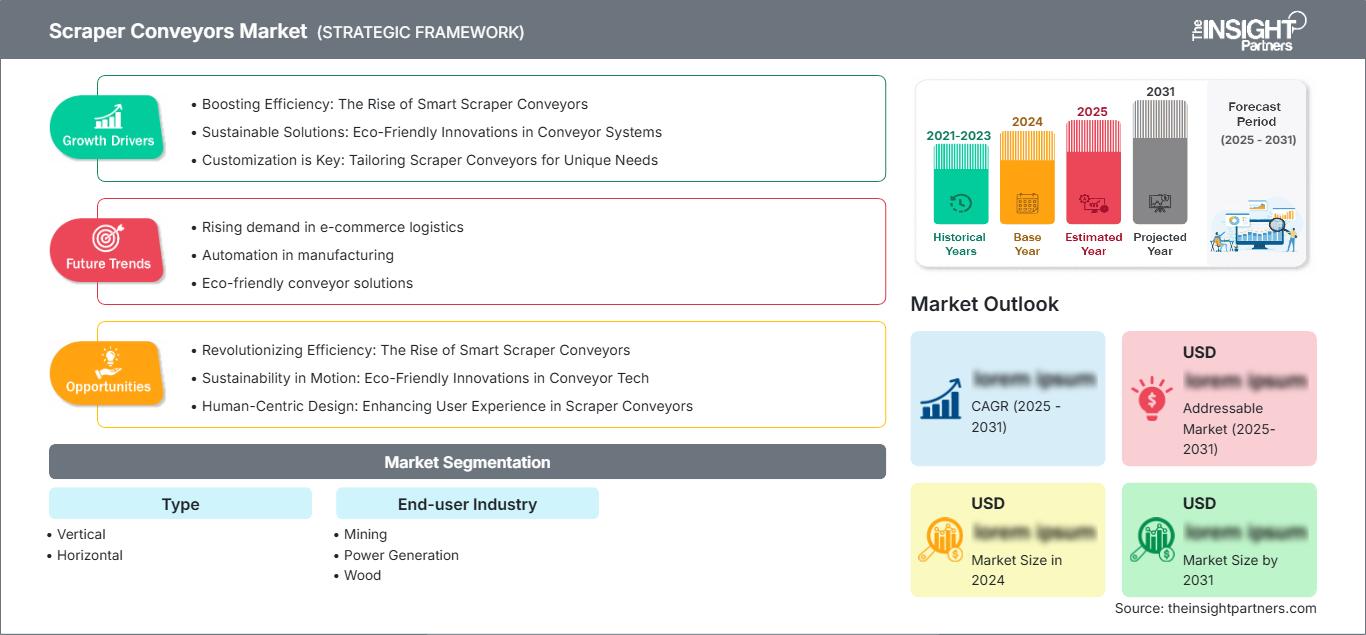
The scraper conveyors market was valued at US$ 777.83 Million in 2025 and is projected to reach US$ 1318.16 Million by 2034, expanding at a CAGR of 6.04% during 2026–2034. Demand is supported by continuous material movement requirements in mining, power generation, wood processing, and metals and minerals handling. Equipment modernization, higher throughput requirements, and greater emphasis on enclosed conveying are also shaping procurement decisions across heavy industrial applications.
North America is expected to record a moderate-to-strong expansion trajectory, supported by mine modernization, replacement of aging conveying equipment, and investments in automated bulk-material handling. The region is also benefiting from demand for reliable systems capable of operating under abrasive, high-load conditions, while industrial facilities increasingly prioritize equipment availability, maintenance efficiency, and controlled material transfer. These factors continue to support the growth and development of the Scraper Conveyors Market size across the region.
Scraper Conveyors Market Assessment and Insights
- North America: The region is estimated to hold a 24–28% share in 2025 and is projected to grow at a 5.6–6.1% CAGR between 2026–2034, supported by mining modernization, industrial replacement cycles, and automated material handling.
- US: The US is estimated to represent 62–66% of North America's 2025 market and expand at a 5.4–5.9% CAGR between 2026–2034, led by mining and industrial handling applications.
- Europe: Europe is estimated to account for a 22–26% share in 2025 and grow at a 5.5–6.0% CAGR between 2026–2034, with Germany, the UK, France, Italy, and Spain supporting replacement and automation demand.
- Asia Pacific: Asia Pacific is estimated to command a 34–38% share in 2025 and expand at a 6.8–7.4% CAGR between 2026–2034, led by China, India, Japan, and South Korea.
- Largest Segment: Horizontal conveyors are estimated to hold a 58–62% market share in 2025 and grow at a 5.7–6.1% CAGR during 2026–2034, reflecting broad industrial applicability.
- High Growth Segment: Vertical conveyors are estimated to hold a 38–42% market share in 2025 and expand at a 6.7–7.2% CAGR during 2026–2034, supported by constrained-space installations.
- Key companies analyzed in detail: CICSA S.r.l.; Don Valley Engineering; Entecom Systems NV; FLSmidth A/S; HEKO Group; Komatsu Ltd.; SANY Group; TOSO S.r.l.; TSUBAKI KABELSCHLEPP GmbH; Vacat Sp.
Source: The Insight Partners' analysis based on proprietary research, government publications, company annual reports, investor presentations, industry databases, and expert interviews.
The trend in scraper conveyor technology has shifted from mechanical systems to application-oriented models that provide high capacity, high abrasive resistance, compact design, and maintenance ease. Scraper shapes, chains, trough design, driveline, and wear-resistant surfaces have been fine-tuned by manufacturers to increase system efficiency. The enclosure technology enables the transportation of coal, ashes, chips, biomass, and mineral substances in a cleaner manner.
In future years, modular design, monitoring, energy efficiency, and longer service life would be the focus areas of equipment manufacturers. Future mining projects in Asia Pacific, Africa, and the Middle East would contribute towards the increased demand for conveying systems, while decarbonization in industries would favor the conveyance of biomass and other recycled products. Procurement is also shifting toward lifecycle economics, making maintainability and spare-parts availability increasingly important selection criteria, as highlighted in the Scraper Conveyors Market report.
Scraper Conveyors Market Report Scope
| Report Attribute | Details |
|---|---|
| Market size in 2025 | US$ 777.83 Million |
| Market Size by 2034 | US$ 1,318.16 Million |
| Global CAGR (2026 - 2034) | 6.04% |
| Historical Data | 2021-2024 |
| Forecast period | 2026-2034 |
Scraper Conveyors Market Analysis
The scraper conveyors market growth is closely linked to material-handling intensity rather than consumer demand. Coal, ores, and overburden-associated materials need to be continuously transported during mining processes. Power plants utilize scrapers for transporting ashes and other residues. Chain, drive and conveyor system manufacturing companies; engineering companies; component makers; system integrators and maintenance service providers are some of the supply sources. Specifications for the equipment are dependent upon the material being handled, distance to be conveyed, inclination of the route, volume, temperature and abrasion.
Suppliers with an ability to design the whole system will have an advantage over those who supply only the mechanical parts. Chain design, scraper design, drive size, wear resistance and trough alignment affect the operating life of the system. Installation, commissioning support, spare parts and maintenance service capability are now considered important for heavy industry purchasers of such equipment.
Competition in the scraper conveyor industry is characterized by fragmentation, including conveyor makers, mining equipment makers, chain makers, and engineering companies. While CICSA S.r.l. Focuses on the production of chains, scrapers, and conveyors for power generation and mining applications, Don Valley Engineering and Entecom Systems NV offer solutions in application engineering. Companies like FLSmidth A/S and Komatsu Ltd. have their strengths in mining equipment and are thus able to integrate the conveying process with material handling equipment.
Strategic positioning will become more about application engineering, durability, and after-market services. Companies such as HEKO Group, SANY Group, TOSO S.r.l., TSUBAKI KABELSCHLEPP GmbH, and Vacat Sp. are becoming competitors because of their expertise in specific areas of conveying, chain and engineering equipment. Capital expenditure is likely to focus on high-strength components, monitoring technologies, modularization and low-maintenance equipment.
● REPORT CUSTOMIZATION
Tailor This Report To Align With Your Specific Business Requirements
This report can be customized to align precisely with your business objectives, scope, and target markets. Customization options include tailored segmentation, geography, competitive analysis, and strategic insights to support informed decision-making.
Customize This Report →WHAT YOU CAN ADJUST
- ● Segmentations
- ● Geography
- ● Competitive Analysis
- ● Language Preferences
Scraper Conveyors Market: Strategic Insights
Regional Insights
North America scraper conveyors market
North America is estimated to represent 24–28% of the global scraper conveyors market in 2025, with growth of 5.6–6.1% during 2026–2034. Demand is concentrated in mining, metals processing, power generation, and industrial material handling. Replacement of aging conveyor infrastructure remains important because equipment downtime can interrupt upstream extraction, processing, or plant operations. Heavy-duty designs with abrasion-resistant components are therefore favored in demanding applications.
The US accounts for 62–66% of North America's 2025 market, supported by established mining operations, industrial facilities, and engineering capabilities. Canada contributes through mining projects involving coal, potash, base metals, and other mineral resources, while Mexico supports regional demand through mining and metals processing. Procurement increasingly considers automation compatibility, predictive maintenance, and lifecycle cost. Suppliers with local service networks can strengthen competitiveness because rapid access to chains, drives, scrapers, and wear components reduces maintenance-related production interruptions.
U.S. scraper conveyors Market
The U.S. represents an estimated 62–66% share of North America's 2025 scraper conveyors market and is projected to expand at a 5.4–5.9% CAGR through 2034. Mining, metals processing, power generation, and industrial manufacturing form the principal application base. Demand is increasingly influenced by replacement requirements, plant modernization, and the need to improve material-handling reliability without extensive facility reconstruction. Compact configurations are attractive where existing layouts constrain installation options.
Application trends favor equipment designed for abrasive and high-temperature materials, including coal, ash, mineral products, metal residues, and industrial waste. Major international suppliers such as FLSmidth A/S and Komatsu Ltd. have broader mining relationships that support equipment integration, while specialized manufacturers address conveyor components and engineered systems. Buyers increasingly evaluate maintenance intervals, component interchangeability, energy consumption, and service availability alongside initial equipment cost.
Europe scraper conveyors Market
Europe is estimated to hold a 22–26% of the scraper conveyors market share in 2025 and expand at a 5.5–6.0% CAGR through 2034. Germany is the leading country, supported by advanced manufacturing, metalworking, industrial automation, and engineered equipment production. The UK maintains demand through quarrying, waste handling, energy infrastructure, and industrial processing. France contributes through metals, manufacturing, and energy-related applications, while Italy and Spain support demand through industrial production, mining-related activities, and material-processing facilities. Equipment buyers increasingly emphasize safety, energy efficiency, maintainability, and environmental performance. Regulatory attention to industrial efficiency and workplace conditions encourages replacement of inefficient systems and favors enclosed conveying configurations.
APAC scraper conveyors Market
Asia Pacific is estimated to account for 34–38% of the 2025 market and grow at a 6.8–7.4% CAGR, making it the leading regional market. China is the largest country, followed by India, Japan, South Korea, and Australia. Mining expansion, metals processing, power infrastructure, and industrial automation support demand. Investment in efficient material handling and modernization of heavy industrial facilities is encouraging the adoption of higher-capacity systems. China and India provide particularly strong volume opportunities, while Japan and South Korea emphasize precision, reliability, and automated production environments.
Middle East & Africa scraper conveyors Market
The Middle East and Africa scraper conveyors market demand is projected to expand at a 5.8–6.4% CAGR, supported by mining development, power infrastructure, mineral processing, and industrial diversification. Saudi Arabia and the UAE are important markets as infrastructure and industrial investment expand, while South Africa remains significant because of its mining base. The Rest of MEA provides additional opportunities through mineral extraction, energy projects, and industrial facilities. Heavy-duty equipment designed for abrasive materials and high operating temperatures is particularly relevant. Supplier service capability is important because remote sites require dependable spare parts and maintenance support.
Segmentation Analysis
Type
Type segmentation comprises Vertical and Horizontal configurations. The segment is expected to expand at a 5.9–6.3% CAGR during 2026–2034. Horizontal systems maintain broad adoption because they provide efficient continuous movement across processing areas, while vertical configurations address elevation changes and constrained plant layouts. Selection depends on material properties, available floor space, discharge requirements, conveying distance, and installation geometry, according to the Scraper Conveyors Market forecast.
- Vertical: Vertical systems support material elevation where plant footprints are constrained or where transfer between different processing levels is required. Their strategic importance increases in compact facilities and multi-level industrial layouts requiring controlled vertical material movement.
- Horizontal: Horizontal systems serve extensive bulk-material handling requirements across mining, power generation, wood, and metals and minerals facilities. Their established design, scalable capacity, and straightforward maintenance support widespread industrial deployment.
End-user Industry
End-user Industry segmentation covers Mining, Power Generation, Wood, and Metals and Minerals and is projected to expand at a 6.1–6.6% CAGR during 2026–2034. Mining remains the largest application base because continuous material extraction requires dependable conveying. Power generation and metals processing provide stable replacement demand, while wood applications benefit from biomass and residue handling requirements, reflecting key Scraper Conveyors Market trends.
- Mining: Mining operations require rugged conveying systems capable of handling abrasive, heavy, and continuous material flows. Reliability, chain durability, high load capacity, and access to replacement components are central purchasing considerations.
- Power Generation: Power facilities use scraper systems for coal, ash, and related material handling. Equipment selection emphasizes enclosed movement, dependable operation, wear resistance, and compatibility with plant maintenance schedules.
- Wood: Wood-processing facilities use conveyors for chips, residues, biomass, and related materials. Demand is influenced by biomass utilization, plant automation, space efficiency, and the need for dependable continuous feed systems.
- Metals and Minerals: Metals and minerals facilities handle abrasive feedstock, residues, and processed materials. Robust scraper construction, wear resistance, controlled discharge, and integration with crushing or processing equipment support adoption.
Opportunity Snapshot
| End-user Industry | Revenue Contribution (High/Medium/Low) | Trend Tag (MAX 2 words) | Adoption Stage (Emerging/Scaling/Mature) |
| Mining | High | Heavy Duty | Mature |
| Power Generation | Medium | Ash Handling | Mature |
| Wood | Medium | Biomass Feed | Scaling |
| Metals and Minerals | High | Ore Transfer | Scaling |
Scraper Conveyors Market Growth Drivers and Impact Analysis
Mining automation and higher throughput requirements
Continuous and reliable material handling is now seen by mining corporations as an increasingly significant criterion for their operation as production systems become automated and equipment efficiency goals increase. Scrapers provide a solution to achieve controlled material transfer within extractive and processing environments with less dependency on sporadic material movement. Greater production levels mean that there is higher economic significance for failures in chains, scrapers, and drive mechanisms, which will drive investments in stronger systems. Consequently, the increased demand for such products will create a need for equipment providers with the ability to supply robust systems along with maintenance solutions. This is made more important by the fact that automation raises the economic significance of predictable conveyor behavior because of other machinery that requires a stable material flow.
Expansion of biomass and residue handling applications
Increased reliance on biomass, wood wastes, and other industrial byproducts presents possibilities beyond traditional mining and energy applications. Scrape conveyors can deal with fairly coarse materials, and their designs allow for fully enclosed or inclined conveyance, thus being well-suited for use at facilities working with wood chips, biomass fuels, ash, and associated byproducts. The economic effect touches upon equipment manufacturers, system installers, and maintenance companies, since all new facilities require the installation of entire conveyance systems rather than single machines. The demand for these products is additionally driven by the necessity to maintain a stable material flow to feeding equipment. The search of industrial operators to utilize resources more effectively and decrease waste generation may lead to the incorporation of scrapers into process improvement projects.
Replacement of aging industrial conveying infrastructure
There exists an important opportunity with regard to replacement projects with regard to established mines, power generation plants, metal processing plants, and manufacturing operations. Old conveyors might have higher maintenance requirements, lower mechanical efficiencies, and a high chance of becoming subject to unplanned downtimes. Increasingly, replacement decisions have been based on total cost of ownership considerations rather than just equipment costs. There would be a preference for conveyor systems that have long part lives, standard wear parts, better serviceability, and engineering capabilities. The vendors would also derive more business opportunities due to design considerations that would require minimal changes in structure, as well as minimal installation times. Additionally, there is lower reliance on greenfield project cycles since established operations have to maintain continuity of production.
Scraper Conveyors Market Future Trends
Intelligent condition monitoring
Digital condition monitoring is expected to become more relevant as operators seek earlier identification of chain elongation, abnormal vibration, drive overload, and component wear. Sensor-enabled equipment can provide operating information that supports maintenance planning and reduces dependence on fixed service intervals. Integration with plant monitoring platforms may allow maintenance teams to compare operating conditions across conveyor assets and prioritize interventions according to actual equipment behavior. For remote mining and processing facilities, this capability can reduce unnecessary site visits and improve spare-parts planning. Over time, intelligent monitoring may become increasingly integrated into conveyor packages rather than offered solely as an optional accessory. The strongest commercial opportunity will involve practical systems that convert equipment data into actionable maintenance decisions without adding excessive operational complexity.
Lightweight and wear-resistant construction
Engineering research is increasingly examining ways to reduce conveyor component mass while preserving strength, durability, and resistance to abrasion. Lightweight chains, scrapers, trough components, and composite materials can reduce mechanical loading and potentially lower energy requirements, particularly in long conveying systems. Material innovation is especially relevant to mining applications where conveyor structures can become extremely heavy as conveying distances and capacities increase. Future designs may combine conventional steel components with advanced non-metallic materials in selected locations where corrosion, wear, or weight reduction provides measurable advantages. Commercial adoption will depend on lifecycle validation, field reliability, repairability, and compatibility with existing drive systems. Suppliers that demonstrate lower operating costs without compromising ruggedness could gain an advantage in technically demanding projects.
Scraper Conveyors Market Opportunities
Localized manufacturing and service networks
Regional manufacturing and service capabilities offer suppliers an opportunity to reduce lead times and improve customer responsiveness in mining and industrial markets. Large conveying projects often require customized dimensions, material specifications, drive arrangements, and discharge configurations, making local engineering support valuable. Establishing regional inventories for chains, scrapers, bearings, drives, and wear components can further improve maintenance responsiveness. Asia Pacific, Africa, and the Middle East provide particularly relevant opportunities because expanding industrial facilities may operate far from established equipment manufacturing centers. Partnerships with engineering contractors and mining service companies can help suppliers access projects without creating extensive direct infrastructure. A localized model can also improve adaptation to regional operating conditions, procurement practices, installation requirements, and customer expectations.
Retrofit packages for energy and maintenance efficiency
Retrofit solutions represent an attractive opportunity because many existing facilities can improve conveying performance without replacing entire material-handling systems. Suppliers can develop packages combining upgraded chains, scraper assemblies, drives, wear liners, monitoring equipment, and control components. Such projects can address specific bottlenecks while reducing capital requirements compared with complete conveyor replacement. Power generation, mining, metals processing, and wood facilities can use retrofit programs to extend equipment life and improve reliability during planned shutdowns. Commercial models based on inspections, component replacement schedules, and performance assessments can create recurring service relationships. The strongest opportunities are likely to involve equipment where structural components remain serviceable but mechanical assemblies have reached the end of their effective operating life.
Frequently Asked Questions

- Comprehensive Market Sizing and Forecast Analysis
- Detailed Segmentation Analysis
- In-Depth Market Dynamics Assessment
- Regional and Country-Level Insights
- Competitive Landscape and Company Benchmarking
- Strategic Business Intelligence
Recent Reports
Testimonials

The Insight Partners provided valuable market intelligence that supported our global go-to-market strategy. Their team was professional, responsive, and attentive to our feedback, providing thoughtful analysis and helpful methodological clarifications throughout the project.
Junmo Kim Chief Financial Officer (CFO), Enertech Co., Ltd.
The Insight Partners' SCADA System Market report is comprehensive, with valuable insights on current trends and future forecasts. The team was highly professional, responsive, and supportive throughout. We are very satisfied and highly recommend their services.
RAN KEDEM Partner, Reali Technologies LTDs
I requested a report on a very specific software market and the team produced the report in a few days. The information was very relevant and well presented. I then requested some changes and additions to the report. The team was again very responsive and I got the final report in less than a week.
JEAN-HERVE JENN Chairman, Future Analytica
We worked with The Insight Partners for an important market study and forecast. They gave us clear insights into opportunities and risks, which helped shape our plans. Their research was easy to use and based on solid data. It helped us make smart, confident decisions. We highly recommend them.
PIYUSH NAGPAL Sr. Vice President, High Beam Global
The Insight Partners delivered insightful, well-structured market research with strong domain expertise. Their team was professional and responsive throughout. The user-friendly website made accessing industry reports seamless. We highly recommend them for reliable, high-quality research services
YUKIHIKO ADACHI CEO, Deep Blue, LLC.
This is the first time I have purchased a market report from The Insight Partners.While I was unsure at first, I visited their web site and felt more comfortable to take the risk and purchase a market report.I am completely satisfied with the quality of the report and customer service. I had several questions and comments with the initial report, but after a couple of dialogs over email with their analyst I believe I have a report that I can use as input to our strategic planning process.Thank you so much for taking the extra time and making this a positive experience.I will definitely recommend your service to others and you will be my first call when we need further market data.
JOHN SUZUKI President and Chief Executive Officer, Board Director, BK Technologies
I wish to appreciate your support and the professionalism you displayed in the course of attending to my request for information regarding to infectious disease IVD market in Nigeria. I appreciate your patience, your guidance, and the fact that you were willing to offer a discount, which eventually made it possible for us to close a deal. I look forward to engaging The Insight Partners in the future, all thanks to the impression you have created in me as a result of this first encounter.
DR CHIJIOKE ONYIA MANAGING DIRECTOR, PineCrest Healthcare Ltd.Reason to Buy
- Informed Decision-Making
- Understanding Market Dynamics
- Competitive Analysis
- Identifying Emerging Markets
- Customer Insights
- Market Forecasts
- Risk Mitigation
- Boosting Operational Efficiency
- Strategic Planning
- Investment Justification
- Tracking Industry Innovations
- Aligning with Regulatory Trends





 Get Free Sample for